In the landscape of software development, complexity is the enemy of maintainability. As systems grow, the cognitive load required to understand and modify them increases exponentially. This is where abstraction techniques become essential. By hiding implementation details and exposing only necessary interfaces, developers can manage complexity effectively. This guide explores how abstraction functions within Object-Oriented Analysis and Design (OOAD) to create robust, scalable architectures.
🧠 Understanding the Core Challenge
Complex systems often suffer from tight coupling and high visibility. When every component knows too much about every other component, changes in one area ripple unpredictably through the entire structure. This fragility leads to increased bug rates and slower development cycles. The goal is not to eliminate complexity, which is inherent in problem-solving, but to contain it.
- Visibility: How much internal state can a module access?
- Coupling: How dependent are modules on each other?
- Cohesion: How closely related are the responsibilities within a module?
Abstraction addresses these metrics directly. It acts as a filter, allowing developers to interact with a system at a higher level of logic without needing to understand the underlying mechanics. This separation of concerns is fundamental to long-term project health.
📚 What is Abstraction?
Abstraction is the process of identifying the essential features of an object while ignoring the non-essential details. In a practical sense, it means defining a contract or interface that describes what an object does, rather than how it does it. This allows for flexibility. If the implementation changes, the contract remains stable, and dependent code does not break.
There are two primary forms of abstraction in design:
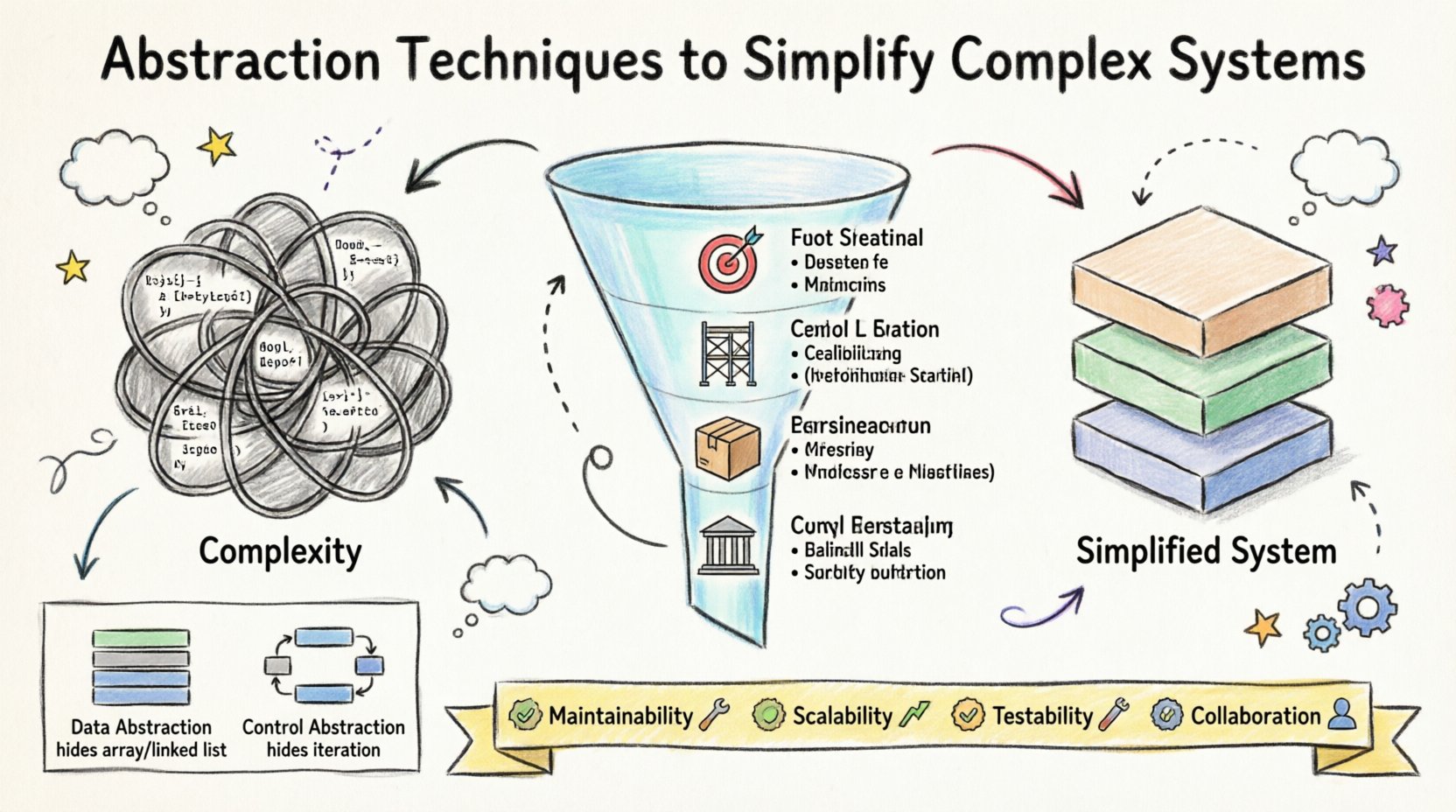
- Data Abstraction: Hides the representation of data. The user interacts with operations on the data without seeing how it is stored or managed.
- Control Abstraction: Hides the flow of control. The user specifies the desired outcome, and the system manages the steps to achieve it.
🔑 Key Techniques for System Simplification
To apply abstraction effectively, specific patterns and techniques must be employed. These methods provide the structure necessary to enforce boundaries and reduce interdependency.
1. Interface-Based Design 🎯
Interfaces define a set of methods that a class must implement. They serve as a contract between the consumer and the producer. By programming to an interface rather than a concrete class, you ensure that the system remains flexible.
- Decoupling: Consumers depend on the interface, not the implementation.
- Swappability: Implementations can be swapped without affecting the client code.
- Testing: Mock implementations can be created easily for unit testing.
2. Abstract Classes 🏗️
Abstract classes provide a way to share code among closely related classes. They can contain both abstract methods (no implementation) and concrete methods (full implementation). This is useful when multiple classes share a common behavior but require specific overrides for unique logic.
- Code Reuse: Common logic is written once in the base class.
- Enforcement: Subclasses are forced to implement specific behaviors.
- State Management: Abstract classes can maintain state, which interfaces typically cannot.
3. Module and Package Boundaries 📦
Organizing code into logical modules or packages creates a physical boundary for abstraction. Internal details of a module are hidden from the outside world. Only public APIs are exposed.
- Encapsulation: Prevents external code from modifying internal state directly.
- Namespace Management: Prevents naming conflicts and clarifies ownership.
- Dependency Control: Limits which other modules a package can depend on.
4. Layered Architecture 🏛️
Layering separates concerns by organizing components into distinct levels, such as presentation, business logic, and data access. Each layer communicates only with its immediate neighbor.
- Separation of Concerns: UI logic does not mix with database logic.
- Scalability: Each layer can be scaled or modified independently.
- Security: Sensitive operations are hidden behind layers.
📊 Comparison of Abstraction Techniques
Understanding the differences between these techniques helps in selecting the right tool for the job. The table below outlines the primary distinctions.
| Technique | Primary Use Case | Enforces Contract? | Supports State? |
|---|---|---|---|
| Interface | Defining capabilities across unrelated classes | Yes | No |
| Abstract Class | Sharing code among related classes | Yes (for abstract methods) | Yes |
| Module | Physical code organization | Yes (via public API) | Yes |
| Layering | System-wide architectural separation | Yes (via interfaces) | Yes |
🔄 Data vs Control Abstraction
Distinguishing between data and control abstraction is vital for clear design. Confusing the two often leads to bloated classes that try to do everything.
Data Abstraction
Focuses on hiding the internal representation of data. For example, a stack data structure exposes push and pop methods. The user does not need to know if the stack is implemented using an array or a linked list. This allows the implementation to change without breaking user code.
Control Abstraction
Focuses on hiding the flow of execution. Loops, conditionals, and function calls are forms of control abstraction. Higher-level abstractions might hide these details entirely. For instance, a forEach operation hides the iteration logic. The developer specifies the action to perform on each element, and the system handles the traversal.
- Benefit: Reduces boilerplate code.
- Benefit: Makes code more declarative and readable.
- Benefit: Allows the system to optimize execution paths automatically.
⚖️ Evaluating Trade-offs
While abstraction simplifies interaction, it introduces overhead. Designers must balance simplicity with performance and complexity.
- Performance: Indirection (e.g., virtual method calls) can introduce slight latency. In high-frequency scenarios, this must be measured.
- Complexity: Too many layers of abstraction can make the codebase harder to navigate. Debugging may become difficult as the call stack grows.
- Over-Engineering: Creating abstractions for hypothetical future needs often leads to unnecessary complexity. Build abstractions only when the pattern is clear.
🚫 Common Pitfalls to Avoid
Even experienced designers can fall into traps that undermine the benefits of abstraction. Awareness of these pitfalls helps maintain system integrity.
- Leaky Abstractions: When implementation details become visible to the user. For example, if a method requires a database connection string, the storage layer is not truly abstracted.
- God Objects: Classes that handle too many responsibilities. This violates the principle of cohesion and makes the object a bottleneck.
- Interface Bloat: Interfaces that require implementing methods not needed by the client. This forces clients to write dummy code.
- Deep Inheritance: Relying too heavily on deep inheritance hierarchies. This makes the system fragile when changes are required in base classes.
🛡️ Maintaining Simplicity Over Time
Abstraction is not a one-time setup; it is a continuous discipline. As the system evolves, abstractions can become outdated or misaligned with requirements.
Regular Refactoring
Code needs periodic cleaning. Refactoring ensures that abstractions remain relevant. If a concrete class implements an interface but only uses one method, the interface might be too broad. Splitting the interface can restore clarity.
Documentation
Clear documentation explains the intent behind an abstraction. When a new developer joins the project, they need to understand why a certain boundary exists. Comments should explain the why, not just the how.
Code Reviews
Peer reviews are essential for catching abstraction violations. A reviewer should check if a new module is introducing hidden dependencies or breaking existing boundaries. This ensures that the architectural intent is preserved.
🧩 Implementation Strategies
To put these concepts into practice, follow a structured approach. This ensures that abstraction is applied consistently across the project.
- Identify Boundaries: Define what constitutes a distinct unit of functionality. Group related responsibilities together.
- Define Contracts: Write the interface first. This forces the team to agree on how components interact before writing implementation details.
- Implement Logic: Fill in the classes to satisfy the contracts. Focus on the specific business logic here.
- Inject Dependencies: Use dependency injection to provide implementations. This makes the system testable and decoupled.
- Verify Behavior: Run tests against the interface. Ensure that swapping implementations does not break functionality.
🚀 Benefits of Effective Abstraction
When done correctly, the return on investment is significant. The system becomes easier to work with over time.
- Maintainability: Changes are localized. Fixing a bug in one module does not require changing code in unrelated modules.
- Scalability: New features can be added by implementing new interfaces or extending layers without rewriting existing logic.
- Testability: Mocking dependencies allows for isolated testing. You can test logic without needing a live database or external service.
- Collaboration: Teams can work on different modules simultaneously, provided they adhere to the defined interfaces.
🔍 Real-World Application
Consider a system that manages user authentication. Without abstraction, the authentication logic might be mixed with the login UI logic and the database logic. With abstraction:
- Auth Interface: Defines
loginandlogoutmethods. - Database Service: Implements the interface to store user data.
- UI Controller: Calls the interface to handle user requests.
If the database provider changes, only the implementation class needs modification. The UI controller remains untouched. This isolation is the power of abstraction.
📝 Final Thoughts
Complexity is inevitable in software engineering, but it does not have to be unmanageable. Abstraction techniques provide the tools to tame this complexity. By focusing on interfaces, boundaries, and separation of concerns, developers can build systems that are robust and adaptable.
The key is discipline. It requires resisting the urge to shortcut implementation details and adhering to the defined contracts. While this approach may slow down initial development, it pays dividends in the long run. Systems built with strong abstractions withstand change better. They allow teams to evolve the product without being held back by technical debt.
Start small. Apply these principles to new modules. Refactor existing code where possible. Over time, the system will become more coherent. The result is a codebase that is easier to understand, easier to test, and easier to extend. This is the foundation of sustainable software development.