Polymorphism is a cornerstone of robust object-oriented design. It allows systems to handle objects of different types through a common interface. This flexibility reduces complexity and enhances maintainability. When applied correctly, it leads to code that is easier to extend and modify. This guide explores how to leverage polymorphism effectively to achieve clean code principles.
🔍 Understanding the Core Concept
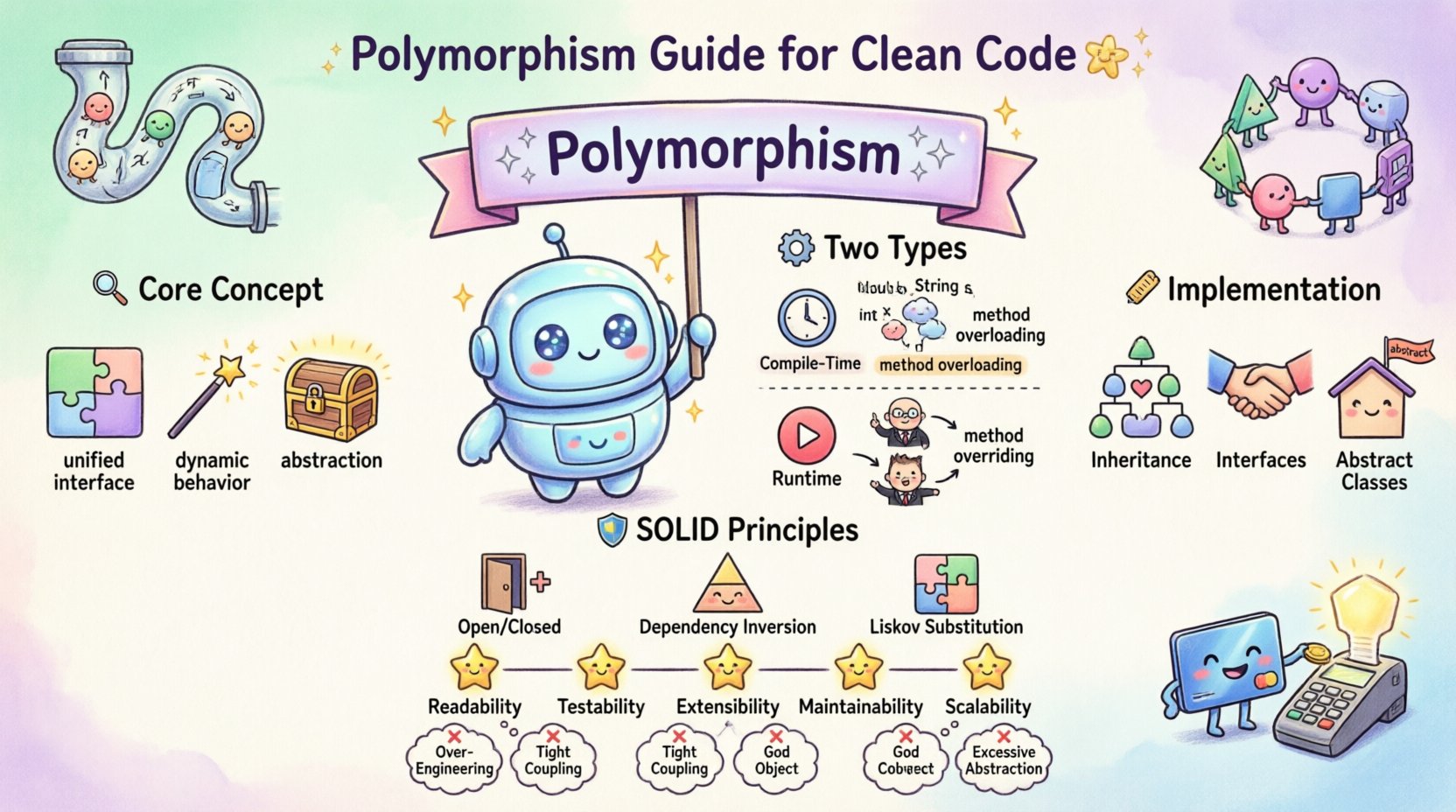
The term polymorphism comes from Greek roots meaning “many forms.” In software architecture, it refers to the ability of a variable, function, or object to take on multiple forms. This capability enables generic programming patterns where specific behaviors are determined at runtime or compile time.
- Unified Interface: Different classes can implement the same method signature.
- Dynamic Behavior: The system decides which method to call based on the object type.
- Abstraction: Internal implementation details are hidden from the client code.
Consider a scenario where you have multiple payment processors. Without polymorphism, you would need separate logic for each type. With polymorphism, you treat them as a single entity, simplifying the workflow significantly.
⚙️ Types of Polymorphism
Understanding the distinction between compile-time and runtime polymorphism is essential for making informed design decisions. Each type serves different purposes within the architecture.
1️⃣ Compile-Time Polymorphism
This occurs when the compiler resolves the method call before the program runs. It is often achieved through method overloading.
- Method Overloading: Multiple methods share the same name but have different parameter lists.
- Static Binding: The method to be executed is determined at the time of compilation.
- Use Case: Useful when behavior varies based on input types or counts, not object hierarchy.
2️⃣ Runtime Polymorphism
This occurs when the decision is deferred until the program executes. It relies on dynamic method dispatch.
- Method Overriding: A subclass provides a specific implementation of a method already defined in its parent.
- Dynamic Binding: The system identifies the actual object type at runtime.
- Use Case: Essential for plugin architectures and extensible systems.
🛠️ Implementation Mechanisms
There are specific structural patterns used to enable polymorphism. Choosing the right mechanism affects coupling and flexibility.
🔹 Inheritance
Inheritance allows a new class to derive properties and methods from an existing class. It creates an “is-a” relationship.
- Benefits: Promotes code reuse and establishes a clear hierarchy.
- Risks: Deep inheritance trees can become fragile and hard to modify.
- Best Practice: Limit inheritance depth to two or three levels to maintain clarity.
🔹 Interfaces
Interfaces define a contract without providing implementation. They focus on behavior rather than state.
- Flexibility: A class can implement multiple interfaces simultaneously.
- Decoupling: Clients depend on the interface, not the concrete class.
- Standardization: Ensures all implementing classes adhere to specific method signatures.
🔹 Abstract Classes
Abstract classes can provide partial implementation and shared state. They sit between concrete classes and interfaces.
- Shared Code: Common logic can be written once in the parent class.
- State Management: Can maintain variables that subclasses inherit.
- Restriction: A class can typically extend only one abstract class.
📊 Comparison of Implementation Strategies
The following table highlights the differences between common approaches.
| Feature | Interface | Abstract Class | Concrete Class |
|---|---|---|---|
| Multiple Inheritance | Yes | No | Yes (via composition) |
| State Management | No (fields not allowed) | Yes | Yes |
| Implementation | None (abstract) | Partial | Full |
| Flexibility | High | Medium | Low |
| Binding Type | Runtime | Runtime | Compile-Time |
🧱 Connection to SOLID Principles
Polymorphism is not an isolated concept; it works in tandem with established design principles.
🟢 Open/Closed Principle
This principle states that entities should be open for extension but closed for modification. Polymorphism supports this by allowing new behaviors to be added via new classes without altering existing code.
- Example: Add a new report type without changing the reporting engine logic.
- Outcome: Reduced risk of introducing bugs in stable code.
🟢 Dependency Inversion Principle
High-level modules should not depend on low-level modules. Both should depend on abstractions. Polymorphism facilitates this by allowing high-level logic to rely on abstract interfaces.
- Benefit: Reduces coupling between components.
- Result: Easier to swap out implementations during testing or maintenance.
🟢 Liskov Substitution Principle
Objects of a superclass should be replaceable with objects of its subclasses without breaking the application. This ensures that polymorphism does not introduce unexpected behavior.
- Constraint: Subclasses must honor the contract of the parent.
- Warning: Changing preconditions or postconditions can violate this rule.
✅ Benefits for Clean Code
Implementing polymorphism brings tangible improvements to the quality of the codebase.
- Readability: Code becomes more declarative. You call methods without worrying about specific types.
- Testability: Interfaces allow for easy mocking of dependencies in unit tests.
- Extensibility: New features can be added as new implementations rather than modifying existing logic.
- Maintainability: Changes in one area do not cascade through the entire system.
- Scalability: Systems can grow in complexity without becoming unmanageable spaghetti code.
⚠️ Common Pitfalls and Anti-Patterns
While powerful, polymorphism can be misused. Understanding what to avoid is just as important as knowing how to apply it.
🔴 Over-Engineering
Creating complex hierarchies for simple tasks adds unnecessary overhead. Not every problem requires polymorphism.
- Sign: Deep inheritance trees with little shared logic.
- Fix: Use simple conditional logic or composition where appropriate.
🔴 Tight Coupling
Even with interfaces, classes can become tightly coupled if they depend on specific implementation details.
- Sign: Methods return concrete types instead of interfaces.
- Fix: Ensure signatures use abstraction layers.
🔴 The “God Object”
A single class that handles too many polymorphic behaviors violates the Single Responsibility Principle.
- Sign: A class with hundreds of methods implementing various interfaces.
- Fix: Split responsibilities into smaller, focused classes.
🔴 Excessive Abstraction
Creating an interface for every class can make the code harder to navigate.
- Sign: Too many interfaces with only one implementation.
- Fix: Introduce interfaces only when multiple implementations are expected.
🚀 Step-by-Step Implementation Strategy
Follow this workflow to introduce polymorphism into your project effectively.
- Identify Variations: Look for code that repeats with minor differences. These are candidates for abstraction.
- Define the Contract: Create an interface that describes the required behavior.
- Implement Variants: Build concrete classes that fulfill the contract.
- Inject Dependencies: Use constructors or setters to pass the correct implementation.
- Refactor Usage: Update client code to use the interface type instead of concrete types.
- Verify: Run tests to ensure behavior remains consistent across implementations.
🧪 Impact on Testing
Polymorphism significantly changes how software is tested. It enables isolation of components.
- Mocking: Create fake implementations of interfaces to test logic without external dependencies.
- Integration Testing: Verify that different implementations work correctly with the same consumer.
- Regression Testing: New implementations can be tested independently of old ones.
Without polymorphism, testing often requires setting up complex real-world environments. With it, tests remain fast and reliable.
🔄 Refactoring for Polymorphism
Refactoring an existing codebase to use polymorphism requires care. Sudden changes can break functionality.
- Extract Method: Move common logic into a base class or shared interface.
- Replace Type Code: Remove conditional logic that checks types and replace it with polymorphic dispatch.
- Introduce Parameter Object: Group related parameters into a single object to reduce method signature complexity.
- Validate Continuously: Maintain a test suite that runs after every refactoring step.
🌐 Real-World Scenarios
Here are conceptual examples of how polymorphism applies to general software architecture.
📦 Data Processing Pipelines
Imagine a system that processes data from various sources. Each source requires different parsing logic.
- Interface:
DataSourcewith a methodfetchData(). - Implementations:
FileSource,NetworkSource,DatabaseSource. - Benefit: The pipeline code calls
fetchData()without knowing the source type.
🎨 Rendering Engines
A graphics system needs to draw shapes on different displays.
- Interface:
Rendererwith a methoddraw(shape). - Implementations:
VectorRenderer,RasterRenderer. - Benefit: Switch rendering strategies without altering the application logic.
💳 Payment Systems
A checkout process needs to handle various payment methods.
- Interface:
PaymentProcessorwith a methodcharge(amount). - Implementations:
CreditCardProcessor,PayPalProcessor. - Benefit: Add new payment methods without modifying the checkout flow.
📝 Decision Matrix
Use this checklist when deciding whether to implement polymorphism.
- Are there multiple behaviors for the same action? Yes ➝ Polymorphism.
- Will the behavior change frequently? Yes ➝ Interface or Abstract Class.
- Is the behavior shared by all classes? Yes ➝ Abstract Class.
- Is the behavior optional? Yes ➝ Interface.
- Is the system simple and static? Yes ➝ Avoid Polymorphism.
🛡️ Security Considerations
Polymorphism introduces layers of indirection that can affect security.
- Validation: Ensure all implementations of an interface handle inputs securely.
- Access Control: Be careful with protected members in inheritance hierarchies.
- Injection: Polymorphic dependencies should be configured securely to prevent malicious implementations.
🏁 Summary
Polymorphism is a vital tool for creating flexible, maintainable software systems. It allows developers to write code that is adaptable to change without rewriting core logic. By following SOLID principles and avoiding common pitfalls, teams can build architectures that stand the test of time. The key is balance: use abstraction where it adds value, but avoid unnecessary complexity. With careful planning and disciplined implementation, polymorphism leads to cleaner, more robust code.
Focus on clear interfaces and well-defined contracts. Prioritize readability and testability. These practices ensure that your code remains manageable as it grows. Embrace the power of polymorphism to build systems that are resilient and easy to evolve.