Designing robust software systems requires careful consideration of how objects relate to one another. Two primary mechanisms define these relationships in object-oriented analysis and design: inheritance and composition. Understanding the nuances between these approaches is critical for building scalable, maintainable, and flexible applications. This guide explores the distinctions, benefits, and trade-offs of each strategy to help you make informed architectural decisions.
🏗️ Understanding Inheritance 🧬
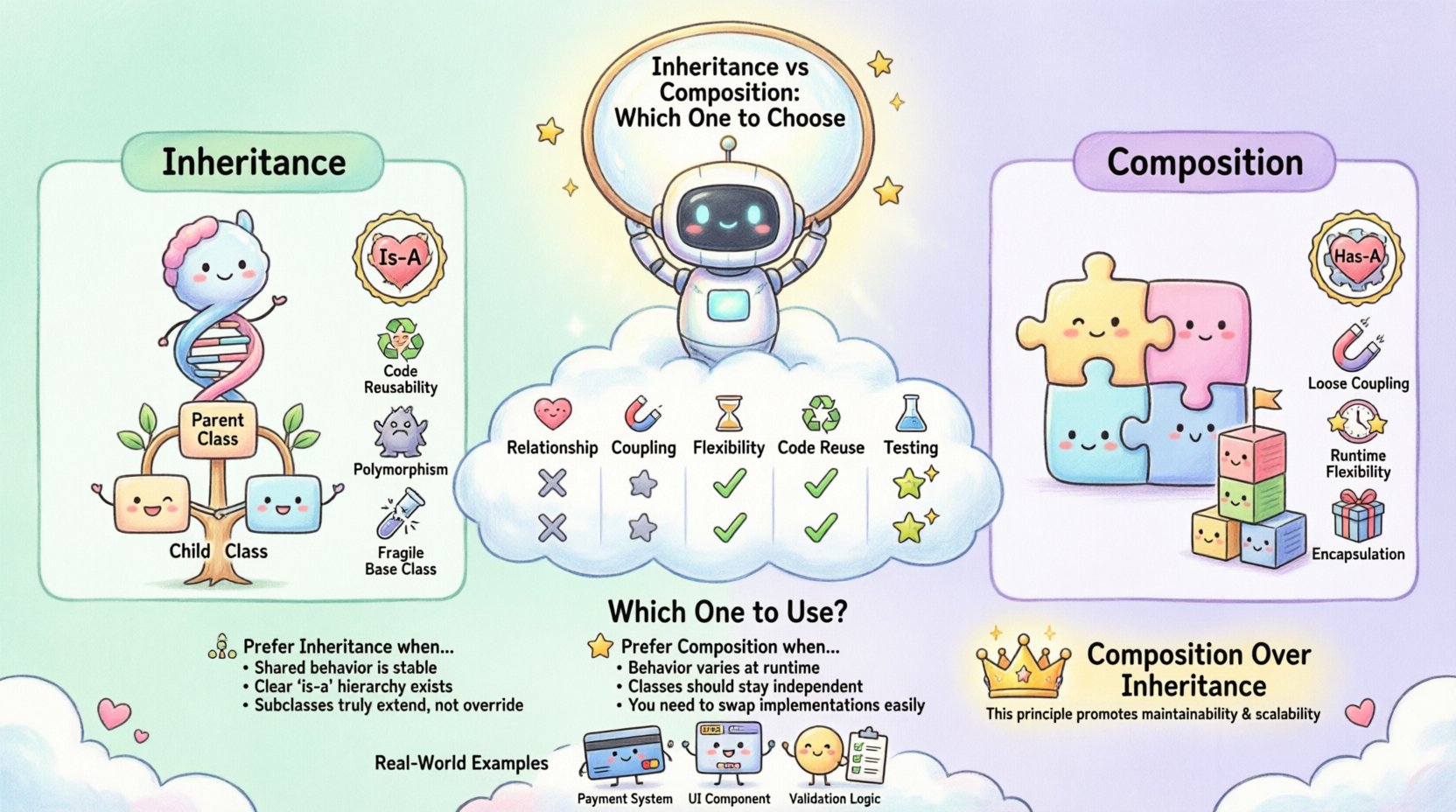
Inheritance establishes a hierarchical relationship between classes. It allows a new class, known as a child or subclass, to acquire the properties and behaviors of an existing class, known as the parent or superclass. This mechanism embodies the “Is-A” relationship. For example, a Car class might inherit from a Vehicle class because a car is a vehicle.
Core Principles of Inheritance
- Code Reusability: Common logic is defined once in the parent class, reducing redundancy.
- Polymorphism: Allows objects of different subclasses to be treated as objects of a common superclass.
- Hierarchical Structure: Creates a clear taxonomy of related concepts.
The Fragile Base Class Problem
While inheritance promotes reuse, it introduces coupling. Changes in the parent class can inadvertently break child classes. This is often referred to as the fragile base class problem. If a parent method changes its behavior, all subclasses relying on that method may fail. This tight coupling makes refactoring difficult and testing complex.
🧱 Understanding Composition 🧩
Composition involves building complex objects by combining instances of other objects. Instead of inheriting behavior, a class contains instances of other classes as fields. This embodies the “Has-A” relationship. Using the previous example, a Car might contain an Engine object. The car has an engine, rather than being an engine.
Core Principles of Composition
- Loose Coupling: Objects depend on interfaces or abstractions rather than concrete implementations.
- Runtime Flexibility: Relationships can be changed dynamically during execution.
- Encapsulation: Internal state is hidden, and interaction happens through defined methods.
The Power of Flexibility
Composition allows for greater modularity. You can swap out components without altering the core structure of the class. For instance, a ReportGenerator class might have a strategy object for formatting. You can change the formatting strategy without touching the generator code. This aligns with the Open/Closed Principle, where software entities should be open for extension but closed for modification.
📊 Comparison: Inheritance vs Composition
The following table highlights the key differences to aid in decision-making.
| Feature | Inheritance | Composition |
|---|---|---|
| Relationship | “Is-A” | “Has-A” |
| Coupling | Tight | Loose |
| Flexibility | Low (Compile-time) | High (Runtime) |
| Code Reuse | High | Medium (via delegation) |
| Testing | Complex (Mocking parents) | Simple (Mocking dependencies) |
| Overriding | Polymorphism supported | Delegation required |
🛠️ When to Use Inheritance
Inheritance remains a valuable tool when the relationship is strictly hierarchical and the base class behavior is universally applicable to all subclasses. It is most appropriate when you have a clear taxonomic hierarchy.
- Clear Taxonomy: When the subclass is undeniably a type of the superclass. A
Squareis aRectangle(mathematically), but be careful with geometric assumptions. - Common Behavior: When all subclasses require the exact same implementation of a method, and the implementation is unlikely to change independently.
- Polymorphic Needs: When you need to treat different types uniformly through a common interface or base class.
- Stable Hierarchy: When the hierarchy is unlikely to change significantly over the lifecycle of the software.
🛠️ When to Use Composition
Composition is generally preferred in modern software design. It offers greater control and reduces the risk of breaking changes propagating through the system.
- Behavioral Variation: When a class needs different behaviors at different times. You can inject different strategies or components.
- Complex Logic: When the logic is better suited for a dedicated class rather than a superclass.
- Multiple Capabilities: When a class needs to combine features from multiple sources. A
Vehiclemight need bothSteeringandBrakingcapabilities from different modules. - Testing Requirements: When isolation is critical for unit testing. Mocking dependencies is easier than mocking parent class state.
- Avoiding Fragility: When you want to prevent changes in a base class from affecting dependent code.
🧪 The Testing Implications
Testing is a major factor in choosing between these patterns. Inheritance can make testing cumbersome because the test environment must often replicate the state of the parent class. If the parent class has complex initialization logic, tests for the child class become heavy.
Composition simplifies testing. You can replace dependencies with test doubles (mocks or stubs) without affecting the core logic. This leads to faster test execution and more reliable results. When a class relies on interfaces for its dependencies, you can swap implementations easily during verification.
🔄 Refactoring and Evolution
Software evolves. Requirements change. Architecture must support this evolution. Inheritance locks you into a structure defined at compile time. If you need to change the relationship between classes, you often must refactor the entire hierarchy.
Composition supports evolution better. You can introduce new capabilities by creating new classes and injecting them into existing ones. You do not need to alter the class definition itself. This supports the idea of building systems that grow organically rather than being forced into a rigid box.
🚫 Common Pitfalls to Avoid
Even experienced developers can stumble when applying these patterns. Here are common mistakes to watch out for.
- Overusing Inheritance: Creating deep hierarchies where a class is too many levels down from the root. This makes the code hard to navigate and understand.
- Forcing Is-A Relationships: Creating a subclass just to reuse code, even if the relationship doesn’t make logical sense. This leads to the “Fragile Base Class” problem.
- Ignoring Composition: Assuming inheritance is the only way to share code. This limits flexibility and increases coupling.
- Over-Engineering: Using complex composition patterns where simple inheritance would suffice. Keep it simple until complexity is required.
- Violating Liskov Substitution: Creating subclasses that break the expectations of the parent class. If a child class cannot be used where the parent is expected, the hierarchy is flawed.
🌍 Real-World Scenarios
Let us look at how these patterns apply in generic scenarios without referencing specific platforms.
Scenario 1: Payment Processing
Imagine a system handling transactions. You could create a PaymentProcessor class. If you use inheritance, you might have CreditCardProcessor, PayPalProcessor, and BitcoinProcessor inheriting from PaymentProcessor. If a new payment method is added, you add a new class. However, if the base class logic changes, all processors are affected. Using composition, you might have a TransactionManager that holds a PaymentStrategy. You inject the specific strategy needed. This allows adding new methods without touching the manager code.
Scenario 2: User Interfaces
Consider a graphical interface. A Button class might inherit from a Widget class. This is often acceptable because the visual properties are shared. However, if you need to add a ClickListener, Draggable, or Resizable capability, inheritance becomes messy. Instead, you compose these behaviors. The Button class contains instances of these capability interfaces. This keeps the core widget logic clean.
Scenario 3: Data Validation
When validating data, you might have rules for email, phone number, and age. Instead of inheriting validation logic, you can compose a set of Validator objects. The main validator iterates through this list. Adding a new rule is as simple as adding a new object to the list. This is far more flexible than creating a hierarchy of validator classes.
🏆 The Golden Rule of Design
There is a guiding principle in software architecture that suggests composition over inheritance. While inheritance is not inherently bad, it should be used sparingly. It is best reserved for cases where the relationship is truly hierarchical and the behavior is stable. For most business logic and application structures, composition provides the necessary agility.
Focus on building small, focused classes that do one thing well. Combine them to create larger systems. This approach reduces the surface area for bugs and makes the codebase easier to reason about. It also aligns with the Single Responsibility Principle, where a class should have only one reason to change.
🧭 Final Thoughts
Choosing between inheritance and composition is not a binary decision but a spectrum of design choices. It depends on the specific needs of your project, the stability of your requirements, and the complexity of your domain. By understanding the strengths and weaknesses of each, you can build systems that are resilient to change.
Start by analyzing the relationship between your classes. Is it an “Is-A” relationship or a “Has-A” relationship? If it is the latter, lean towards composition. If it is the former, consider inheritance, but remain vigilant about potential coupling. Always prioritize maintainability and flexibility over immediate code reuse. Your future self, and the team that maintains the code, will thank you for these deliberate choices.
Continue to refine your design skills. Study design patterns to see how these concepts are applied in practice. Remember that code is read more often than it is written. Write code that communicates intent clearly and adapts easily to new requirements.