In the landscape of software development, the gap between a user’s need and a working system is often bridged by a specific discipline known as Object-Oriented Analysis and Design (OOAD). At the heart of this discipline lies a fundamental concept: mapping abstract real-world problems into concrete structures of classes and objects. This process is not merely about writing code; it is about modeling reality in a way that a machine can process while remaining understandable to humans. When done correctly, the resulting software feels intuitive, robust, and maintainable. When done poorly, it becomes a tangled web of dependencies that resists change.
This guide explores the mechanics of translating tangible entities, behaviors, and relationships from the physical world into the digital constructs of object-oriented programming. We will examine the principles that govern this translation, analyze specific scenarios, and identify common pitfalls to avoid. By understanding how to map the world to code, developers can build systems that stand the test of time and complexity.
🧩 Core Concepts: Class vs. Object
To understand the mapping process, one must first distinguish between the blueprint and the building. In object-oriented terminology, these are the Class and the Object.
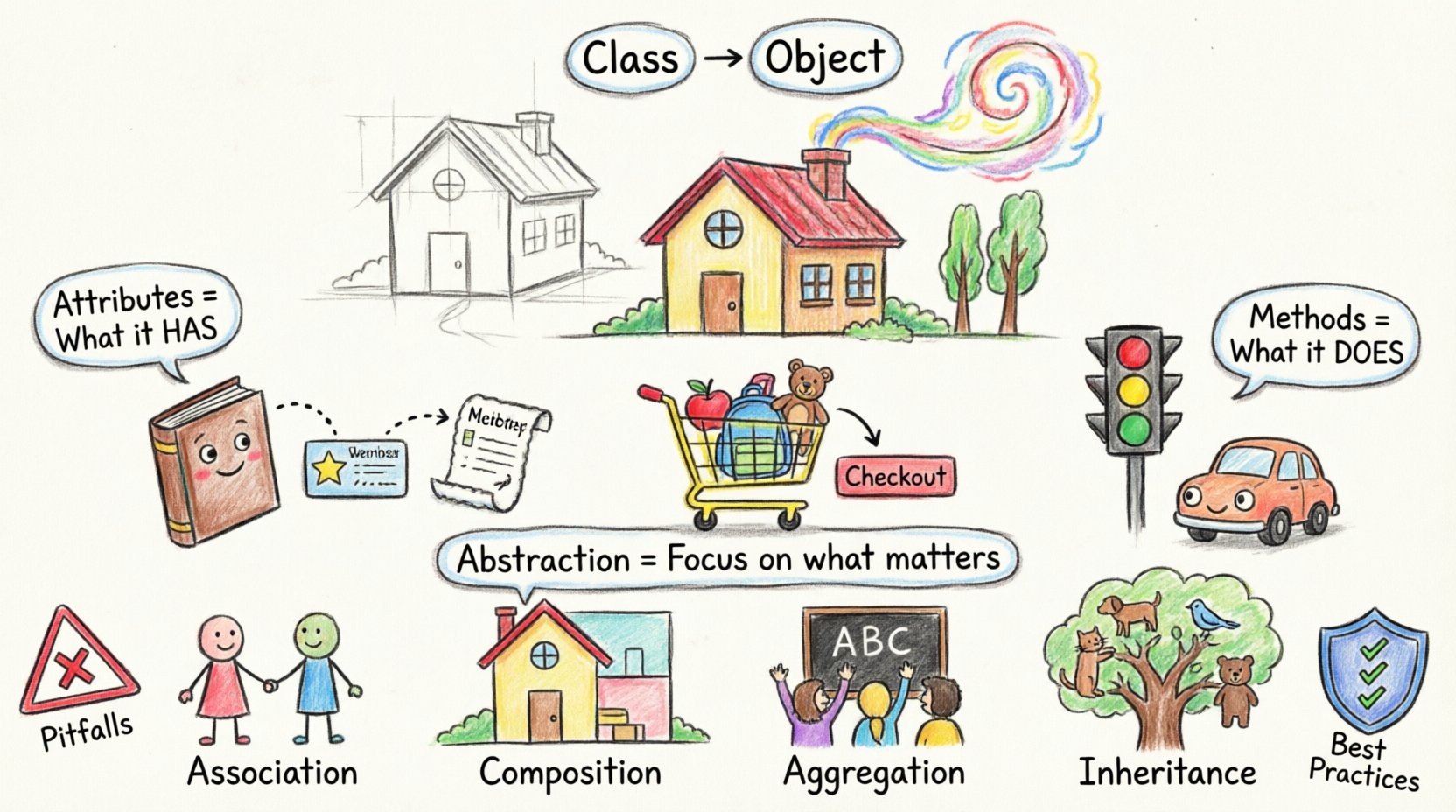
- Class: A class is a template or a blueprint. It defines the structure and behavior that specific items will share. Think of it as the architectural drawing for a house. It specifies how many rooms there are, where the doors go, and the electrical wiring logic, but it is not a house itself.
- Object: An object is an instance of a class. It is the actual realization of that blueprint. If the class is the drawing, the object is the physical house built from it. Each house (object) might have a different color, different furniture, and a different family living inside, but they all follow the same structural plan.
When mapping to real-world problems, the Class represents the category of things we are dealing with, while the Object represents the specific individual instances occurring within the system.
Attributes and Behavior
A complete mapping requires identifying two main components within a class:
- Attributes (State): These are the data points that describe the object. In a real-world scenario, these are properties like name, age, color, or location. In code, they are variables stored within the object.
- Methods (Behavior): These are the actions an object can perform. In the real world, a car can accelerate, brake, or turn. In code, these are functions or methods defined within the class that manipulate the attributes or interact with other objects.
🔍 The Mapping Philosophy: Abstraction
The bridge between the physical world and code is built on the principle of abstraction. Abstraction involves identifying the essential characteristics of a real-world entity while ignoring irrelevant details. Not every detail of a human being is necessary to model them in a banking system. We do not need to know their eye color or shoe size to process a loan. We only need their identity, credit history, and account balance.
Effective abstraction answers the question: What does this entity do in the context of our problem?
- Identify the Nouns: Scan the problem description for nouns. These are likely to become classes. (e.g., “Customer”, “Order”, “Product”, “Invoice”).
- Identify the Verbs: Scan for actions. These often become methods. (e.g., “Place Order”, “Calculate Interest”, “Ship Item”).
- Filter Irrelevance: Decide what data is necessary for the system’s scope. If a feature does not serve the core requirement, exclude it from the model to keep it clean.
🛠️ Step-by-Step Mapping Process
Translating a problem into code is a systematic activity. It moves from understanding the requirements to defining the structure.
- Requirement Analysis: Gather the user stories and functional requirements. Understand the business rules that govern the problem.
- Domain Modeling: Create a visual representation of the entities. Draw boxes for classes and lines for relationships. This is often called a Domain Model.
- Defining Attributes: For each class, list the data that must be persisted or tracked.
- Defining Methods: Determine what actions these entities can take. What changes their state?
- Establishing Relationships: Define how entities interact. Does one class depend on another? Is it a one-to-one or one-to-many relationship?
- Refinement: Review the model for cohesion and coupling. Ensure that classes have a single, clear responsibility.
🌍 Real-World Examples of Mapping
To visualize this process, let us look at how different domains are mapped into class structures. These examples demonstrate how specific business needs dictate the design of the code.
1. Library Management System
In a library, the core entities revolve around books, members, and loans. The mapping focuses on ownership and time limits.
- Book Class: Attributes include ISBN, Title, Author, and Location (Shelf Number). Method includes
isAvailable(). - Member Class: Attributes include MemberID, Name, and ContactInfo. Method includes
borrowBook(). - Loan Class: This connects the two. Attributes include LoanDate, DueDate, and Status. Method includes
calculateFine().
2. E-Commerce Platform
An online store requires a more complex relationship between products and inventory. The mapping must handle transactions and stock levels.
- Product Class: Attributes include SKU, Price, Description, and StockCount. Method includes
decrementStock(). - Cart Class: Attributes include a list of Items. Method includes
addItem()andcheckout(). - Order Class: Attributes include OrderID, TotalAmount, and ShippingAddress. This object is immutable once created to preserve history.
3. Traffic Control System
IoT systems mapping real-world physical constraints require precise timing and state management.
- TrafficLight Class: Attributes include CurrentColor (Red, Yellow, Green) and Timer. Method includes
cycleColors(). - Car Class: Attributes include Speed, Position, and Destination. Method includes
accelerate()andbrake(). - Intersection Class: Manages the lights. Attributes include List of Lights. Method includes
coordinateLights()to prevent collisions.
🔗 Modeling Relationships
Objects rarely exist in isolation. The power of object-oriented design lies in how objects connect. These connections are known as relationships.
Types of Relationships
| Relationship Type | Description | Real-World Analogy |
|---|---|---|
| Association | A general link between objects. One object can reference another. | A Student is associated with a Teacher. |
| Composition | A strong relationship where the part cannot exist without the whole. Lifecycle is tied. | A House has Rooms. If the House is demolished, the Rooms cease to exist. |
| Aggregation | A weak relationship where the part can exist independently of the whole. | A Department has Employees. If the Department closes, the Employees still exist. |
| Inheritance | A “Is-A” relationship. A subclass inherits properties from a superclass. | A Square is a Rectangle. A Dog is an Animal. |
One-to-Many vs. Many-to-Many
Mapping complex scenarios often involves cardinality.
- One-to-Many: One Customer places Many Orders. The
Customerclass will hold a list ofOrderobjects. - Many-to-Many: Many Students enroll in Many Courses. This often requires a linking class (e.g.,
Enrollment) to manage the relationship data, such as grades or dates.
🔄 Inheritance and Polymorphism in Mapping
When mapping real-world hierarchies, inheritance allows us to reuse code. If we have a generic Vehicle class, we can create Car and Truck classes that inherit common attributes like engineType and fuelLevel.
However, inheritance should not be overused. It should only be used when there is a clear “Is-A” relationship. If a relationship is merely “Has-A”, composition is preferred.
Polymorphism allows different objects to respond to the same message in different ways. For example, a print() method on a Document object might print text, while on an Image object, it might render pixels. This flexibility is crucial when the real-world problem involves diverse items that share a common interface.
⚠️ Common Pitfalls and Anti-Patterns
Even with a solid understanding of the mapping process, developers can make mistakes that degrade the quality of the software.
- Anemic Domain Model: This occurs when classes contain only getters and setters, with no business logic. This violates encapsulation and pushes logic into service layers, making the code harder to understand. The object should own its behavior.
- God Objects: Creating a class that tries to do everything. This class becomes too large, difficult to test, and hard to maintain. Break complex classes into smaller, focused ones.
- Over-Engineering: Creating layers of abstraction before they are needed. It is better to start simple and refactor later as requirements evolve. Premature optimization leads to rigid code.
- Ignoring Business Rules: Focusing too much on technical implementation and forgetting the actual business constraints. The model must reflect the domain rules, not just the database schema.
- Tight Coupling: When one class knows too much about the internal details of another. This makes changes in one class break the other. Use interfaces or abstract classes to define contracts.
🛡️ Ensuring Maintainability
The ultimate goal of mapping classes to real-world problems is maintainability. A well-structured object model allows the software to evolve as the business changes.
Encapsulation
Encapsulation protects the internal state of an object. By restricting access to attributes, you ensure that data is only modified in valid ways. This prevents external code from putting the object into an invalid state.
Single Responsibility Principle
Each class should have one reason to change. If a ReportGenerator class also handles EmailSending, it violates this principle. Split them. If the reporting requirement changes, the email logic should not be affected.
Dependency Injection
Instead of creating dependencies directly inside a class, pass them in from the outside. This makes the class easier to test because you can mock the dependencies. It also reduces coupling between components.
📝 Summary of Best Practices
To summarize the effective mapping of real-world problems to code:
- Focus on the domain logic, not just the technical implementation.
- Use clear, meaningful names for classes and methods that reflect business terminology.
- Keep objects small and focused on a single responsibility.
- Model relationships accurately using composition or aggregation where appropriate.
- Regularly refactor the model as the understanding of the problem deepens.
- Write code that documents itself through its structure and naming.
- Validate that the object state remains consistent after any method call.
The transition from a problem statement to a class diagram is a cognitive leap. It requires the developer to think like the system they are building. By treating the code as a model of reality, rather than just a set of instructions, the resulting software becomes more resilient. It aligns with how users perceive the world, reducing the friction between the business need and the digital solution.
When you design a system, you are not just writing functions; you are defining the rules of a new world. The classes are the laws of physics in that world. If the laws are sound, the world functions smoothly. If the laws are contradictory, the system crashes. Therefore, the mapping process is the most critical phase of software creation, determining the longevity and adaptability of the entire application.