In the modern landscape of project management, the distinction between strategic oversight and tactical execution is blurring. Governance structures were traditionally designed to monitor compliance and financial health, but they often lack the depth required to assess business value. Integrating business analysis into these frameworks bridges the gap between high-level strategy and project delivery. This integration ensures that decisions are not just compliant, but also viable and valuable for the organization. Without this connection, projects often deliver outputs that fail to meet actual market or operational needs.
This article explores the mechanics of embedding business analysis functions within governance bodies. It covers the necessary shifts in authority, the specific roles involved, and the practical steps to ensure a cohesive operational environment. By aligning these disciplines, organizations can achieve higher success rates and more resilient project outcomes.
The Strategic Imperative 🚀
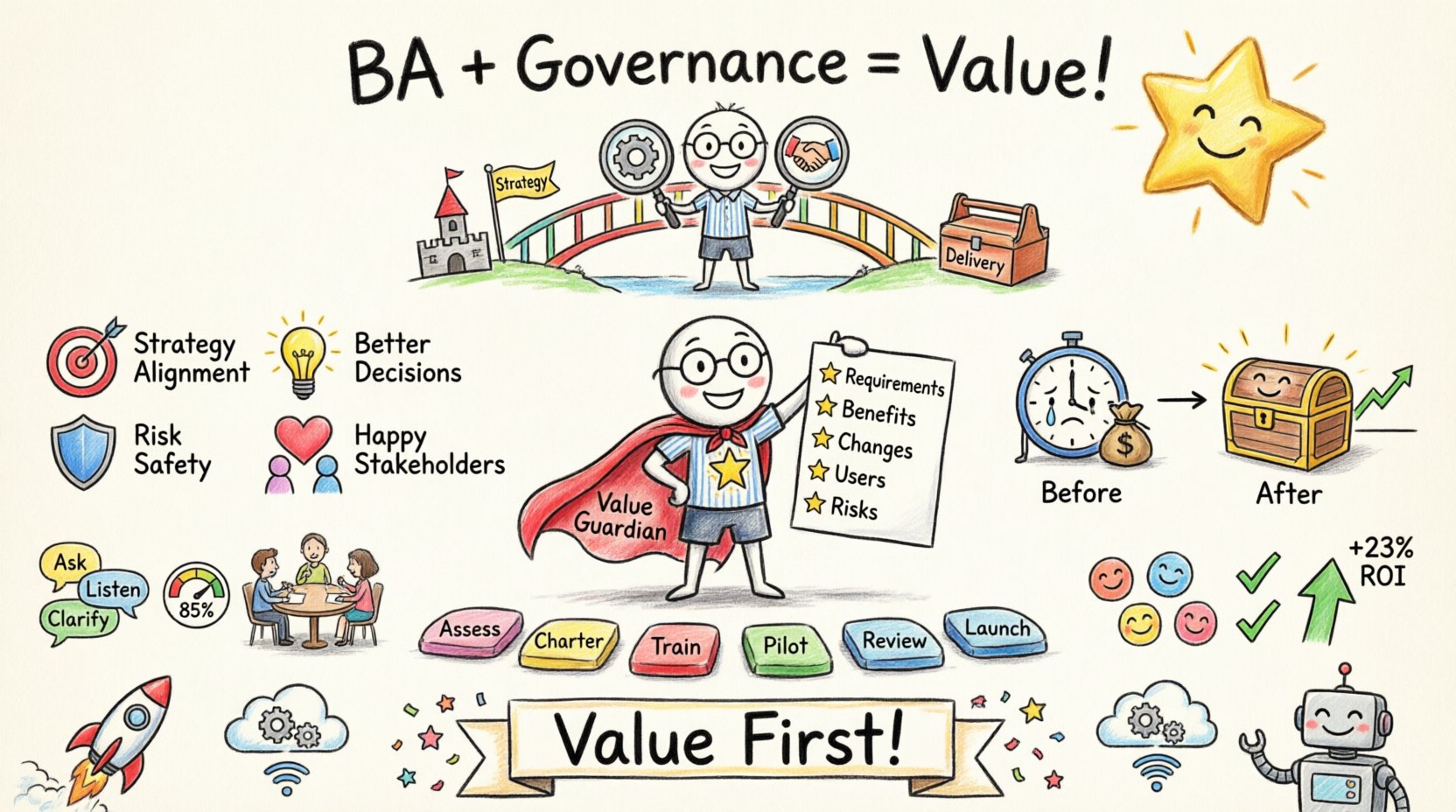
Governance is often viewed as a control mechanism. However, when business analysis is woven into the fabric of governance, it transforms into a value assurance engine. The primary goal is to ensure that the work being performed delivers the intended benefits. Without business analysis input, governance committees may focus solely on timelines and budgets, ignoring whether the solution actually solves the problem it was intended to address.
- Alignment with Strategy: Ensures every project contributes to the broader organizational goals.
- Improved Decision Making: Provides data-driven insights rather than assumptions.
- Risk Mitigation: Identifies scope creep and value erosion early in the lifecycle.
- Stakeholder Confidence: Demonstrates a commitment to delivering tangible business outcomes.
When governance bodies lack business analysis expertise, they risk approving initiatives that are technically feasible but commercially unviable. Integrating these functions ensures that the “why” is as scrutinized as the “how”.
Core Governance Pillars 🧱
To successfully integrate business analysis, one must understand the existing pillars of governance. These typically include the Steering Committee, the Project Management Office (PMO), and specific Risk or Quality Boards. Each pillar requires a specific input from the business analysis function to function correctly.
Below is a comparison of how traditional governance differs from integrated governance:
| Feature | Traditional Governance | Integrated Governance |
|---|---|---|
| Focus Area | Compliance, Budget, Schedule | Value, Benefits, Requirements, Compliance |
| Decision Basis | Historical Performance Data | Current Needs + Future Value Analysis |
| BA Involvement | Ad Hoc or Minimal | Continuous and Strategic |
| Outcome | Project Completion | Business Value Realization |
This shift requires a cultural change within the organization. It moves the conversation from “Did we finish the work?” to “Did the work achieve the desired result?”. The table above highlights that the integrated model is more holistic, encompassing the entire value stream rather than just the delivery pipeline.
Defining the BA Authority 🎓
One of the most significant hurdles in this integration is defining the authority of the business analyst within the governance structure. They cannot simply be observers; they must be active participants with voting rights or at least a veto power on value-related decisions. This authority must be codified in the governance charter.
Key responsibilities for this role within the governance framework include:
- Requirement Validation: Confirming that requirements align with strategic objectives before approval.
- Benefit Realization Planning: Defining how success will be measured and tracked post-delivery.
- Change Control: Assessing the impact of changes on business value, not just cost.
- Stakeholder Representation: Acting as the voice of the end-user or customer in high-level meetings.
- Risk Identification: Highlighting operational risks that technical teams might overlook.
By granting this level of authority, the organization ensures that business viability is never sacrificed for speed or budget constraints alone. The business analyst becomes the guardian of value within the governance structure.
Communication Channels 💬
Effective integration relies heavily on clear communication pathways. Governance bodies operate on specific cycles, such as monthly steering meetings or quarterly reviews. Business analysis findings must be tailored to fit these schedules without losing critical detail.
- Executive Summaries: High-level briefs for steering committees focusing on value and risks.
- Detailed Reports: Comprehensive documentation for the PMO and technical leads.
- Visual Dashboards: Real-time tracking of requirements status and benefit metrics.
- Workshops: Collaborative sessions for resolving complex requirements conflicts.
The format of communication must be consistent. If the governance structure expects weekly updates, the business analysis function must be prepared to deliver consistent, high-quality inputs on that timeline. Inconsistency here can lead to governance fatigue, where critical insights are ignored due to noise.
Risk and Compliance 🛡️
Governance is inherently linked to risk management. Business analysis adds a layer of risk assessment that is often missing in technical reviews. This includes understanding the risk of not delivering the solution versus the risk of delivering it incorrectly.
Key areas of focus include:
- Regulatory Compliance: Ensuring the solution meets legal and industry standards.
- Operational Feasibility: Assessing if the organization can actually support the new solution.
- Market Dynamics: Monitoring external changes that might render the solution obsolete.
- Resource Constraints: Evaluating if the necessary skills exist to maintain the solution.
By integrating these risks into the governance decision-making process, the organization avoids costly rework and ensures long-term sustainability. The business analyst acts as the bridge between technical feasibility and operational reality.
Implementation Roadmap 🗺️
Implementing this integration does not happen overnight. It requires a phased approach to ensure buy-in and stability. A structured roadmap helps manage the transition from the old model to the new one.
- Assessment Phase: Evaluate current governance maturity and identify gaps in business analysis support.
- Charter Revision: Update governance charters to explicitly include business analysis roles and responsibilities.
- Training: Educate governance members on how to interpret business analysis outputs.
- Pilot Program: Run a pilot with one project to test the new integration model.
- Review and Adjust: Gather feedback and refine the processes before full rollout.
- Full Deployment: Apply the model across all active projects and programs.
This step-by-step approach minimizes disruption while building the necessary competency within the organization. It allows the governance body to adapt to the new flow of information without becoming overwhelmed.
Measuring Integration Success 📊
How do you know if the integration is working? You need specific metrics that reflect the health of the governance structure itself. These metrics go beyond standard project performance indicators.
- Decision Latency: The time taken to make decisions after business analysis input is provided.
- Value Realization Rate: The percentage of projected benefits that are actually achieved.
- Requirement Stability: The rate of change in requirements after initial sign-off.
- Stakeholder Satisfaction: Feedback from those affected by the project outcomes.
- Issue Resolution Time: How quickly governance resolves blockers related to scope or value.
Tracking these metrics provides a clear picture of whether the business analysis function is adding value to the governance process. If decision latency increases without a corresponding increase in decision quality, the process may be too bureaucratic.
Future Trends in Governance 🔮
The landscape of project management is evolving. Agile and hybrid methodologies are becoming the norm, which changes how governance operates. Traditional stage-gate models are shifting towards continuous value delivery.
Future governance structures will likely see:
- Data-Driven Insights: Greater reliance on analytics to drive governance decisions.
- Decentralized Authority: More decision-making power pushed to delivery teams.
- Automated Compliance: Using technology to handle routine compliance checks.
- Continuous Feedback Loops: Real-time input from users rather than periodic reviews.
Business analysts will need to adapt to these changes by becoming more proficient with data and automation tools. The core function of ensuring value remains the same, even if the methods of governance evolve.
Final Thoughts on Value Assurance 📝
Integrating business analysis into governance structures is not merely an administrative task; it is a strategic necessity. It ensures that the organization invests in the right things and delivers them effectively. By embedding this function, companies create a robust framework that supports sustainable growth and adaptability.
The journey requires commitment from leadership and a willingness to redefine roles. When done correctly, it creates a culture where value is the primary currency of decision-making. This alignment between strategy and execution is the hallmark of mature project management practices. Organizations that prioritize this integration position themselves to navigate complexity with confidence and deliver results that truly matter.