Project management often sits at the intersection of complex technical execution and clear business strategy. One of the most critical skills a project manager can possess is the ability to translate technical roadmaps into language that resonates with non-technical stakeholders. When business leaders, executives, or clients cannot grasp the progress of a project, alignment breaks down. This disconnect can lead to unrealistic expectations, budget overruns, and diminished trust.
Effective communication is not about simplifying the work; it is about framing the work in terms of value. This article explores practical strategies to bridge the gap between engineering teams and business objectives. We will look at audience analysis, narrative construction, and visual presentation to ensure your roadmap serves as a tool for alignment rather than a source of confusion.
Understanding the Audience 👥
Before drafting a single slide or outlining a timeline, you must understand who you are speaking to. Non-technical stakeholders operate with a different set of priorities than the development team. Their primary concern is often return on investment, market timing, and customer satisfaction. They are less interested in the architecture, the codebase, or the specific technical debt being addressed.
To communicate effectively, you need to shift the perspective from “how” to “why” and “what”. Consider the following distinctions:
- Business Leaders: Focus on revenue impact, competitive advantage, and strategic milestones. They need to know when features will be available to support sales cycles.
- Marketing Teams: Focus on launch dates and feature capabilities that can be promoted. They need to know what is ready for public announcement.
- Operations Teams: Focus on stability, maintenance, and support readiness. They need to know when the system will be stable enough for high traffic.
- Executive Sponsors: Focus on overall progress against the strategic vision. They need to know if the project is on track to deliver the promised value.
When you tailor your message to these specific groups, you increase engagement and reduce friction. A roadmap presented to an engineering lead will look vastly different from one presented to a chief financial officer. Recognizing these nuances is the first step in successful communication.
Principles of Effective Translation 🔄
Translating technical work into business value requires discipline. It involves stripping away jargon and focusing on the outcome. Here are core principles to guide your communication strategy.
Focus on Outcomes, Not Outputs
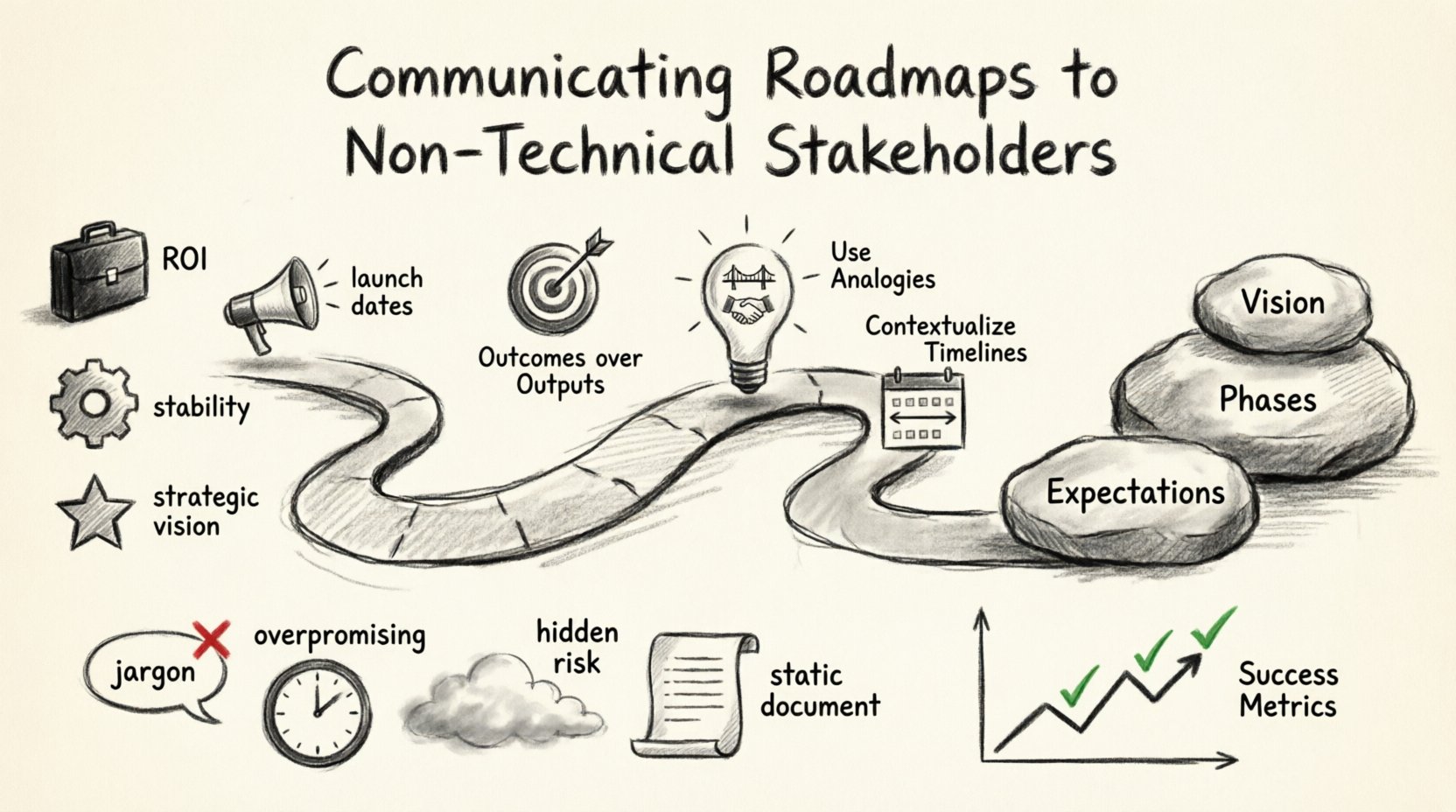
A common mistake is listing deliverables as tasks. For example, saying “We are building a new API” tells a stakeholder nothing about the benefit. Instead, frame it as “We are enabling third-party integrations to increase partner revenue.” The outcome is the value; the output is the mechanism. Stakeholders care about the value.
Use Metaphors and Analogies
Complex systems can be explained through familiar concepts. If you are explaining a database migration, compare it to moving a library to a new building. You are keeping the books (data) safe, organizing them better (structure), but the readers (users) should not notice the move. Analogies help stakeholders visualize the process without needing technical knowledge.
Contextualize Timelines
Estimates in software development are rarely exact. Providing a single date can create a false sense of security. Instead, provide ranges or phases. Use terms like “Early Q3” or “Targeting November” rather than a hard “November 15th”. Explain the factors that influence the timeline, such as dependencies, testing cycles, or external market changes.
Structuring Your Narrative 📖
A roadmap is more than a timeline; it is a story. It tells the journey from the current state to the desired future state. Structuring this narrative helps stakeholders understand the progression and the logic behind the plan.
The Vision and Strategy
Start with the destination. Before discussing specific features, reiterate the overarching goal. This anchors the conversation. If the goal is to improve customer retention, every feature mentioned should tie back to that metric. This reinforces the purpose of the work.
The Phases of Delivery
Break the roadmap into logical phases. This allows stakeholders to see progress incrementally. Instead of a single massive release, show a sequence of value deliveries. This reduces anxiety about waiting for a final result and allows for feedback loops.
- Phase 1: Foundation. Core infrastructure and stability.
- Phase 2: Core Features. Essential capabilities for early adopters.
- Phase 3: Expansion. Additional features and optimizations.
Managing Expectations
Be transparent about risks. If a timeline is tentative, state it clearly. If a feature depends on external factors, highlight that. Honesty builds trust. When you deliver on promises made about risks, stakeholders are more likely to trust your delivery estimates in the future.
Common Pitfalls to Avoid ⚠️
Even with the best intentions, communication can go awry. Being aware of common traps helps you avoid them.
- Jargon Overload: Avoid acronyms and technical terms unless they are defined. Terms like “latency,” “refactoring,” or “CI/CD” mean little to a business audience.
- Overpromising: Do not commit to dates you cannot guarantee. It is better to under-promise and over-deliver than to miss a deadline.
- Ignoring Risks: Hiding potential blockers creates surprises later. Surface risks early so they can be mitigated.
- Static Documents: A roadmap is a living document. If it does not change when priorities shift, it becomes obsolete and loses credibility.
Templates for Different Scenarios 📝
Different situations require different approaches. Use the following table to select the right format and language for your audience.
| Scenario | Focus Area | Recommended Language |
|---|---|---|
| Quarterly Planning | Strategic Alignment | Goals, OKRs, Business Impact |
| Stakeholder Review | Progress & Value | Completed Features, Metrics, ROI |
| Risk Assessment | Threats & Mitigation | Dependencies, Blockers, Contingency Plans |
| Feature Launch | Adoption & Support | User Benefits, Training, Availability |
Handling Questions and Pushback 💬
When presenting a roadmap, you will face questions. Some will be about timing, others about priority. The goal is to answer confidently without becoming defensive.
Active Listening
Listen to the concern behind the question. If a stakeholder asks, “Why is this taking so long?”, they might actually be worried about the budget or the market window. Address the underlying concern, not just the surface question.
Data-Backed Responses
Use data to support your decisions. If a delay occurred, explain the data that led to the new estimate. If a feature was deprioritized, reference the impact analysis. Decisions based on data are harder to argue against than decisions based on opinion.
Offer Options
When facing constraints, offer choices. If a feature cannot be delivered by the requested date, suggest alternatives. “We can deliver Feature A by Q3, or Feature B by Q2. Which provides more value right now?” This shifts the conversation from a barrier to a strategic choice.
Measuring Success 📊
How do you know if your communication is working? Look for indicators of alignment and engagement.
- Reduced Churn: Fewer last-minute requests or scope changes.
- Clearer Questions: Stakeholders ask better, more informed questions.
- Faster Decisions: Decisions on priorities happen quicker because the trade-offs are clear.
- Positive Feedback: Stakeholders express confidence in the team’s ability to deliver.
Regularly solicit feedback on the communication itself. Ask stakeholders if the format is clear and if the information is sufficient. This continuous improvement loop ensures your strategy evolves with the needs of the organization.
Ultimately, the goal is to foster a partnership between technical and business teams. When everyone understands the path forward, the organization moves faster and with greater confidence. By focusing on value, clarity, and transparency, you turn the roadmap into a powerful tool for collaboration.