Project success relies heavily on how well needs are understood and defined at the outset. Whether working within a rigid framework or an iterative environment, the core objective remains the same: deliver value that meets stakeholder expectations. However, the path to achieving this varies significantly depending on the methodology employed. This guide explores the nuances of handling requirements in both Agile and traditional project management contexts.
Understanding Requirements Management ⚙️
Requirements management involves identifying, documenting, and maintaining the needs of a project. It is not merely about writing down what users want; it is about ensuring those needs are feasible, testable, and aligned with business goals. Effective management prevents scope creep, reduces rework, and ensures that the final product solves the intended problem.
When teams fail to manage these inputs properly, projects often suffer from budget overruns, missed deadlines, or products that do not fit user needs. A structured approach to gathering and tracking requirements is essential for any project manager or business analyst.
Traditional Requirements Management 🏗️
In traditional settings, often associated with the Waterfall methodology, requirements are defined extensively before development begins. This approach assumes that needs are stable and can be fully understood at the start of the project.
Key Characteristics
- Upfront Planning: A comprehensive requirements document is created early in the lifecycle.
- Sequential Phases: Once requirements are signed off, the project moves to design, then development, and finally testing.
- Change Control: Modifying requirements after the initial phase is difficult and often requires formal change requests.
- Detailed Documentation: Extensive text-based specifications are standard to avoid ambiguity.
The Process Flow
The traditional process typically follows a linear path:
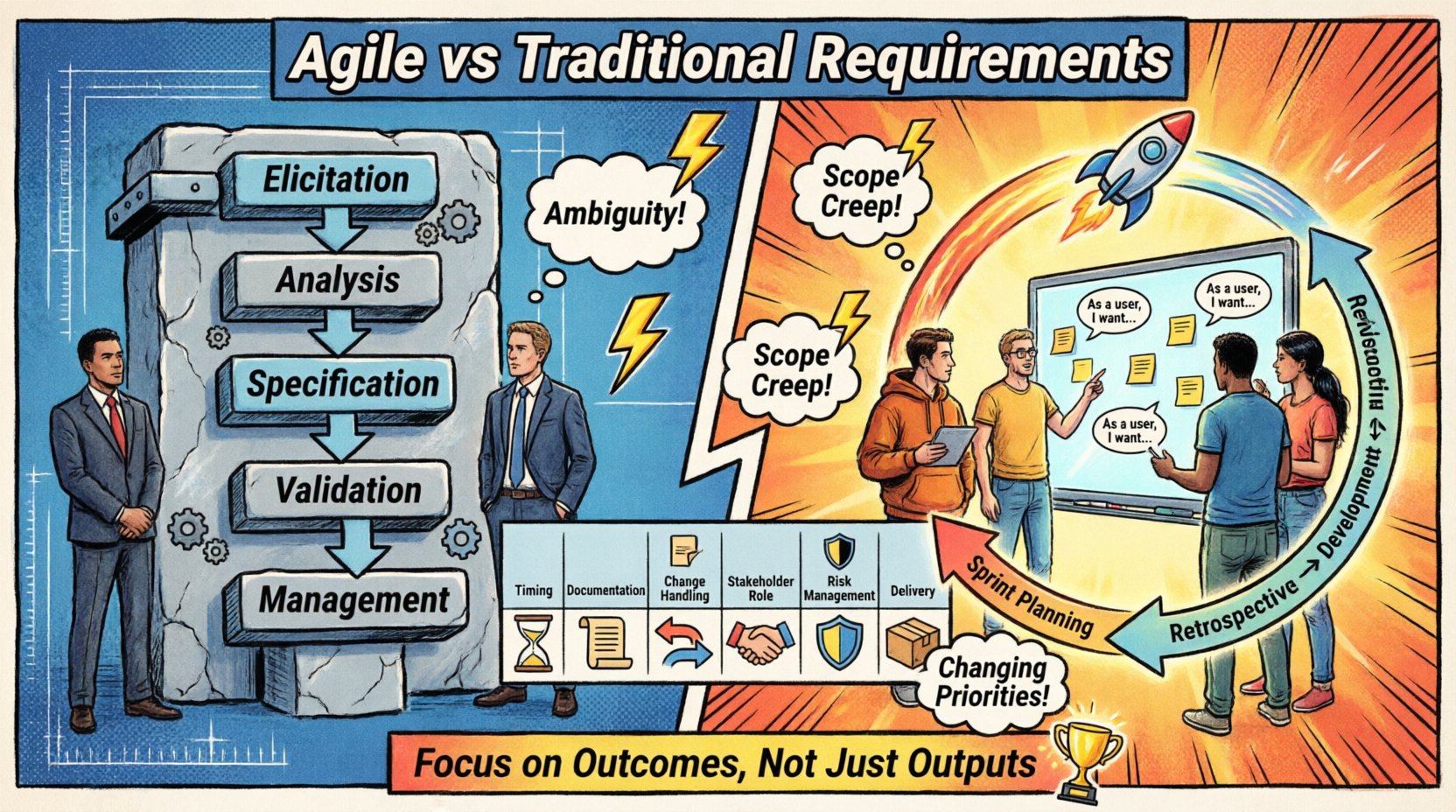
- Elicitation: Gathering information from stakeholders through interviews and workshops.
- Analysis: Reviewing gathered data to identify conflicts or gaps.
- Specification: Writing the formal requirements document (often called an SRS).
- Validation: Confirming the document accurately reflects stakeholder needs.
- Management: Tracking changes and ensuring alignment throughout the project.
This method works well for projects where the scope is fixed, regulations are strict, or technology is well-understood. However, it can struggle when market conditions change rapidly or when user needs are unclear initially.
Agile Requirements Management 🚀
Agile methodologies prioritize flexibility and customer collaboration. Requirements are not static; they evolve as the team learns more about the product and the market. Instead of a massive document, requirements are broken down into smaller, manageable units.
Key Characteristics
- Iterative Definition: Requirements are refined continuously throughout the project.
- User Stories: Needs are expressed from the user’s perspective (e.g., “As a user, I want…”).
- Backlog Management: A prioritized list of items drives the work for upcoming cycles.
- Adaptability: Feedback from previous iterations informs future requirements.
The Process Flow
In an Agile setting, the flow is cyclical rather than linear:
- Product Vision: Establishing the high-level goal and value proposition.
- Backlog Creation: Generating initial user stories and features.
- Prioritization: Ordering items based on value and risk.
- Sprint Planning: Selecting items for the next iteration.
- Refinement: Clarifying details before and during development.
- Review: Demonstrating the work to stakeholders for feedback.
Comparing Methodologies 🆚
Understanding the differences helps teams choose the right approach or blend them effectively. The table below highlights the core distinctions between managing requirements in traditional versus Agile environments.
| Feature | Traditional (Waterfall) | Agile |
|---|---|---|
| Timing | Defined at the beginning | Defined continuously |
| Documentation | Comprehensive upfront | Just enough, often digital |
| Change Handling | Formal change control | Embraced via backlog |
| Stakeholder Role | Early consultation, limited later | Active throughout |
| Risk Management | Identified early | Identified iteratively |
| Delivery | Single release at end | Frequent releases |
Common Challenges and Solutions 💡
Regardless of the methodology, teams face hurdles when managing requirements. Below are common issues and practical strategies to address them.
1. Ambiguity and Miscommunication
Unclear requirements lead to rework. In traditional settings, this often stems from vague text. In Agile, it can happen if user stories lack acceptance criteria.
- Solution: Use clear language. Define acceptance criteria for every item. Conduct reviews with stakeholders to ensure shared understanding.
2. Scope Creep
Uncontrolled expansion of project scope is a major risk. Stakeholders may add features mid-project without assessing the impact.
- Solution: Implement a clear prioritization framework, such as MoSCoW (Must have, Should have, Could have, Won’t have). Ensure all new requests go through a review process to weigh value against cost.
3. Changing Priorities
Business needs shift. A feature that was critical last month might be irrelevant today.
- Solution: Regularly review the backlog. In traditional projects, this might mean a formal scope change. In Agile, it is a standard part of sprint planning.
4. Traceability Issues
It becomes difficult to track which requirement leads to which feature or test case.
- Solution: Maintain a traceability matrix or link requirements directly to test cases. Ensure every piece of work can be traced back to a business need.
Best Practices for Success 🌟
To manage requirements effectively, teams should adopt specific habits that reinforce clarity and alignment.
Engage Stakeholders Early and Often
Stakeholders hold the key to understanding business value. In traditional projects, this happens during the planning phase. In Agile, they should be available for reviews at the end of every cycle. Regular communication prevents surprises.
Prioritize Ruthlessly
Resources are finite. Teams cannot build everything. Use data-driven prioritization techniques. Focus on high-value items first. This ensures that if the project must stop, the most critical requirements are already delivered.
Maintain a Single Source of Truth
Avoid scattered information across emails and spreadsheets. Use a central system where all requirements are stored. This ensures everyone works from the latest version of the truth.
Focus on Outcomes, Not Just Outputs
Don’t just check off a list of features. Ask if the feature solves the problem. In Agile, this is done through user feedback. In traditional projects, this is done through rigorous validation testing.
Navigating Hybrid Environments 🔄
Many organizations operate in a hybrid model, combining elements of both traditional and Agile approaches. This might mean using a structured document for compliance while running development in sprints.
When managing requirements in hybrid settings:
- Define the Boundary: Clearly state which requirements are fixed (e.g., regulatory compliance) and which are flexible (e.g., user interface design).
- Adapt Documentation: Create lightweight documentation that satisfies compliance needs without slowing down development.
- Standardize Communication: Ensure that stakeholders understand how changes will be handled across different parts of the organization.
The Role of Tools and Technology 🛠️
While specific software names are not necessary, the function of tools is critical. Teams need platforms that support the chosen methodology.
- For Traditional: Systems that support version control, baselining, and complex change request workflows are essential.
- For Agile: Systems that support backlog management, sprint tracking, and real-time collaboration are preferred.
The tool should facilitate the process, not dictate it. If a tool hinders the team’s ability to communicate, it is not serving its purpose. The goal is to reduce administrative burden so the team can focus on building value.
Final Thoughts on Requirement Strategy 🎯
There is no one-size-fits-all approach to managing requirements. The best strategy depends on the project context, team maturity, and organizational culture. Traditional methods offer stability and predictability, while Agile methods offer speed and adaptability.
Successful project managers understand the strengths and weaknesses of each approach. They select the right mix of documentation, communication, and control to fit the situation. By focusing on clear communication, prioritization, and continuous feedback, teams can navigate the complexities of requirements management and deliver successful outcomes.
Remember that requirements are not just a list of tasks; they are a promise of value. Keeping that promise requires discipline, flexibility, and a commitment to understanding the needs of the people who will use the final product.