Organizations often begin their project journey with a flexible, reactive approach. Tasks arise, team members pick them up, and deadlines are met through sheer effort. This ad-hoc project management style works for small startups or short-term initiatives, but it eventually hits a ceiling. As teams grow and complexity increases, the lack of a defined framework creates friction, delays, and burnout.
Moving toward structured project management is not about adding bureaucracy; it is about creating clarity. This guide outlines how to shift from chaotic workflows to a disciplined environment without stifling creativity. We will explore the signals that indicate a need for change, the steps to build a sustainable system, and how to measure the impact of your new processes.
Recognizing the Signs of Ad-Hoc Operations 🤷♂️
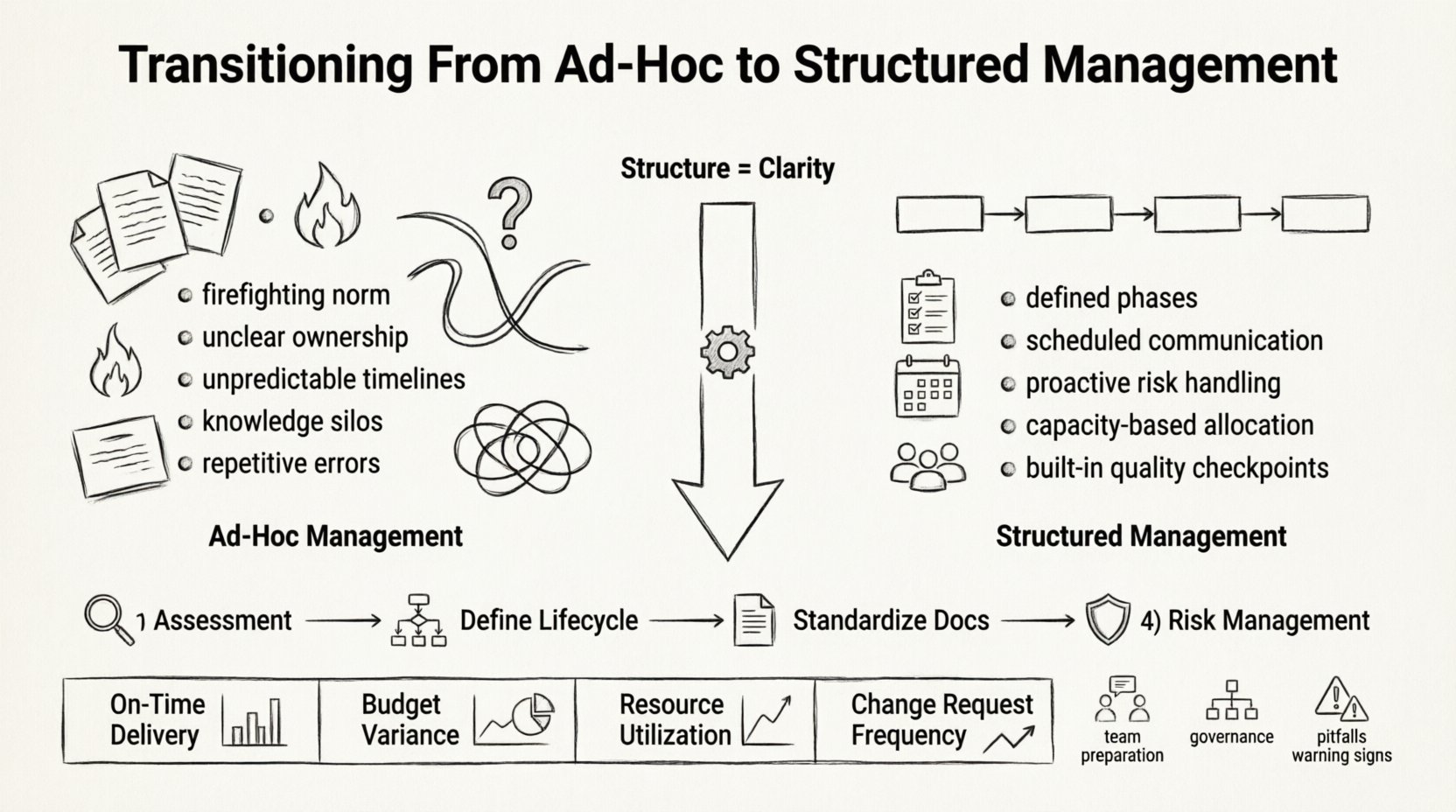
Before implementing change, you must acknowledge the current state. Ad-hoc management is characterized by a lack of standardization. Work is assigned based on availability rather than capacity. Decisions are made on the fly without historical data. If your team experiences the following symptoms, a transition is likely overdue:
- Firefighting is the norm: The team spends more time resolving unexpected issues than planning for them.
- Unclear ownership: Multiple people work on the same task, or critical tasks fall through the cracks because everyone assumed someone else was handling it.
- Unpredictable timelines: Estimates are guesses, and delivery dates slip frequently without warning.
- Knowledge silos: Only one person knows how to complete a specific function, creating a single point of failure.
- Repetitive errors: The same mistakes occur in different projects because there is no lessons-learned repository.
These indicators suggest that the organization is relying on heroics rather than systems. While heroics might save a project temporarily, they are not a scalable strategy for long-term growth.
The Value of Structure 🏗️
Adopting a structured approach brings predictability. It allows stakeholders to understand what is happening and when. It empowers the team to focus on execution rather than navigating administrative ambiguity. The goal is not to rigidly control every action, but to provide a reliable backbone for work.
Consider the differences between the two operational models:
| Feature | Ad-Hoc Management | Structured Management |
|---|---|---|
| Planning | Minimal or non-existent | Defined phases and milestones |
| Communication | Informal, ad-hoc channels | Scheduled updates and clear reporting lines |
| Risk Handling | Reactive (fix after it breaks) | Proactive (identify and mitigate) |
| Resource Allocation | Based on immediate availability | Based on capacity and skills |
| Quality Control | Review at the end | Built-in checkpoints throughout the lifecycle |
Preparing Your Team for Change 🛠️
Transitioning workflows is as much about people as it is about process. Introducing structure can feel like adding constraints to a group that values freedom. To mitigate resistance, leadership must communicate the why behind the shift.
- Explain the benefits: Focus on how structure reduces overtime and stress. Highlight that clear processes mean less ambiguity during execution.
- Involve the team: Ask team members what barriers they face. If they help design the solution, they are more likely to adopt it.
- Start small: Do not overhaul every project at once. Pick one pilot team or project to test the new framework.
- Provide training: Ensure everyone understands the new definitions of roles and the required documentation.
Establishing Governance Frameworks 📜
Governance is the set of policies and procedures that guide decision-making. In project management, this means defining who approves what and when.
Roles and Responsibilities
Clarity on roles prevents the “who is doing this?” question. You should define:
- Project Sponsor: The individual accountable for business value and budget.
- Project Manager: The person responsible for execution, timeline, and delivery.
- Team Members: The individuals completing the work.
- Stakeholders: Anyone with an interest in the outcome who requires updates.
Communication Protocols
Ad-hoc environments often rely on chat messages for critical decisions. This leads to lost information. A structured approach requires:
- Status Meetings: Regular, timed sessions to review progress against the plan.
- Documentation Standards: Decisions must be recorded. Meeting notes should be distributed within 24 hours.
- Escalation Paths: A clear hierarchy for when a blocker cannot be resolved at the team level.
Implementation Roadmap 🚀
Building a structured system requires a phased approach. Rushing the process often leads to abandonment. Follow these steps to integrate structure into your daily operations.
Phase 1: Assessment and Baseline
Document how work is currently done. Map out the flow from request to delivery. Identify the bottlenecks. Do not judge the process yet; simply understand it. This baseline helps you measure improvement later.
Phase 2: Define the Lifecycle
Establish standard stages for every project. A common structure includes:
- Initiation: Defining the goal and securing approval.
- Planning: Breaking down work into tasks and estimating resources.
- Execution: Performing the work according to the plan.
- Monitoring: Tracking progress and managing variances.
- Closing: Finalizing deliverables and archiving records.
Phase 3: Standardize Documentation
Create templates for common artifacts. Every project should have a charter, a plan, and a status report. Templates ensure consistency. They do not dictate the content, but they dictate the format.
Phase 4: Integrate Risk Management
In an ad-hoc environment, risks are often ignored until they become issues. Structured management requires identifying risks early. Create a risk register where potential threats are logged, assigned an owner, and tracked.
- Identify: What could go wrong?
- Assess: How likely is it? How severe would the impact be?
- Mitigate: What steps can we take to reduce the likelihood or impact?
Overcoming Common Pitfalls ⚠️
Even with a solid plan, organizations face hurdles during the transition. Being aware of these common traps can help you navigate them.
- Over-Engineering: Creating processes that are too complex for the project size. Keep the framework lightweight for small tasks and robust for large initiatives.
- Bureaucratic Bloat: Adding too many approval layers slows down momentum. Ensure approvals are necessary for value, not just for control.
- Tool Dependency: Buying a system does not fix broken processes. Focus on the workflow first; the tool is secondary.
- Lack of Leadership Support: If leadership does not follow the new rules, the team will revert to old habits. Leaders must model the behavior.
Measuring Performance and Success 📊
How do you know the transition worked? You need metrics that reflect efficiency and quality, not just activity. Track the following key performance indicators over time:
| Metric | Definition | Target |
|---|---|---|
| On-Time Delivery Rate | Percentage of projects completed by the agreed deadline | Increase quarter over quarter |
| Budget Variance | Difference between estimated and actual cost | Within ±10% |
| Resource Utilization | Percentage of time spent on billable or productive work | Balance between 70% and 85% |
| Change Request Frequency | Number of scope changes after planning | Reduce over time |
These metrics provide objective data. If you see improvement in these areas, the structure is working. If not, it is time to refine the approach.
Sustaining the New Workflow 🔄
Maintaining structure requires continuous effort. Processes drift back to chaos if not monitored. Schedule regular reviews of your project management practices. Ask the team what is working and what is hindering them. Be willing to adjust the framework as the organization matures.
Ultimately, the goal is to create an environment where work flows smoothly without constant intervention. By moving away from ad-hoc reactions and toward structured management, you build a foundation for resilience. This allows the organization to scale without collapsing under its own weight.
Start today by auditing one project. Apply the principles of planning and governance. Observe the difference in clarity. Over time, these small steps will compound into a robust operational system.