Managing a portfolio of projects introduces significant complexity. Without a unified approach, data becomes fragmented, stakeholders lose visibility, and decision-making slows down. Consistent reporting standards serve as the backbone of effective portfolio governance. They ensure that every project manager speaks the same language, providing leadership with a clear, accurate picture of organizational health. This guide outlines how to establish and maintain rigorous reporting frameworks that drive value across the enterprise.
Why Consistency Matters in Portfolio Management 🎯
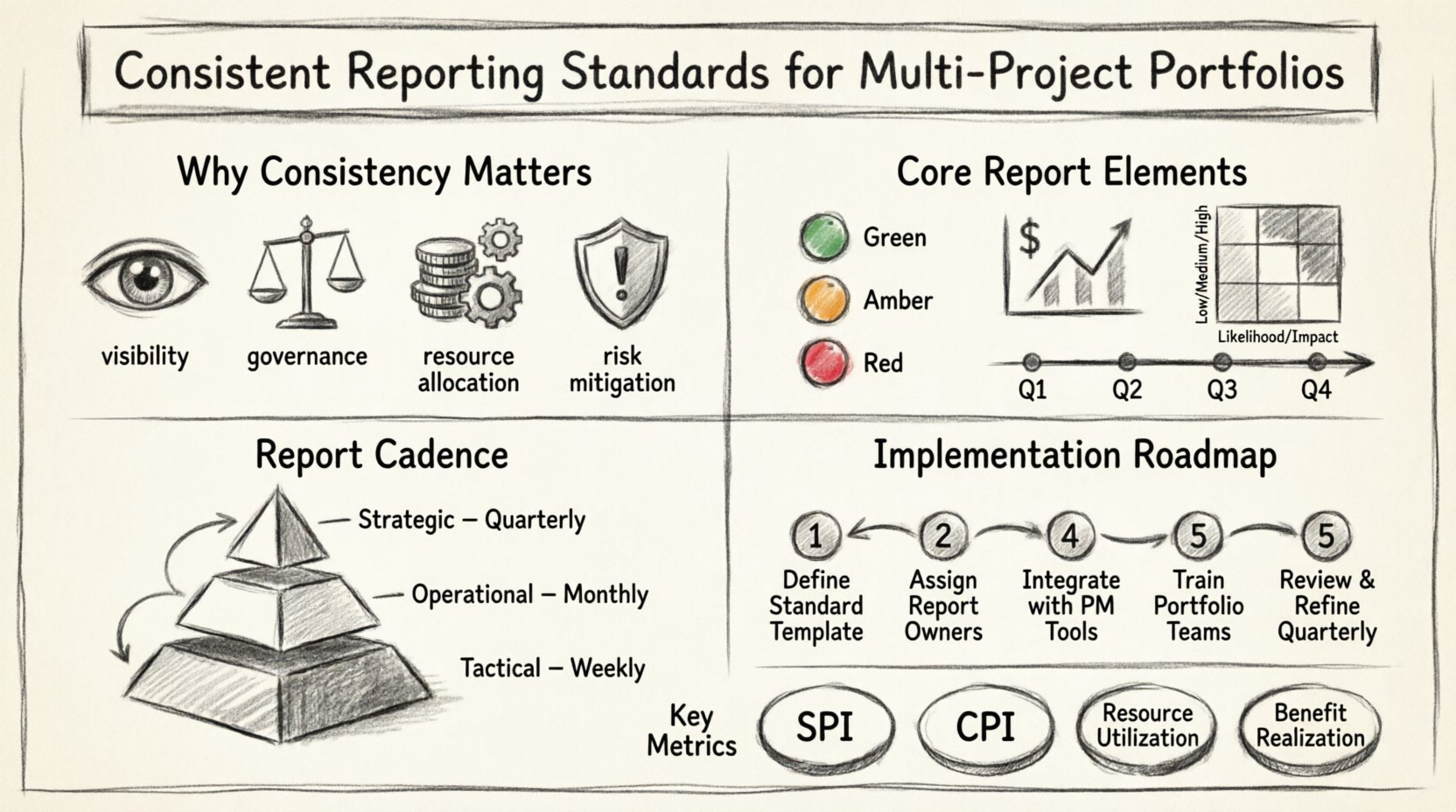
When multiple teams operate in silos, each may define success differently. One team might define “complete” as 90% of tasks finished, while another requires 100%. This inconsistency creates noise in executive dashboards. Standardization removes ambiguity. It aligns expectations and ensures that metrics are comparable across different initiatives.
- Visibility: Leadership gains a single source of truth regarding progress.
- Governance: Compliance and audit trails become easier to manage.
- Resource Allocation: Accurate data allows for better distribution of budget and personnel.
- Risk Mitigation: Early warning signs are detected faster when thresholds are uniform.
Core Elements of a Standardized Report 📋
A robust reporting structure goes beyond simple status updates. It requires a defined data dictionary and clear protocols for information flow. Every report should contain specific components that reflect the strategic goals of the organization.
1. Project Health Status
Define clear criteria for color codes. Avoid subjective terms like “good” or “bad”. Use objective thresholds.
- Green: On track, no significant risks, budget variance within 5%.
- Amber: Potential issues identified, variance between 5-10%, mitigation plan in place.
- Red: Critical risks, budget over 10% variance, timeline impacted significantly.
2. Financial Metrics
Financial tracking must be consistent to allow for portfolio-level aggregation.
- Planned Value (PV)
- Actual Cost (AC)
- Estimate at Completion (EAC)
- Budget Variance
3. Risk and Issue Registers
Risks must be categorized by probability and impact using a standard matrix. This ensures that a “High” risk in one project carries the same weight as a “High” risk in another.
- Open Risks Count
- Closed Risks Count
- Top 3 Risks Requiring Attention
- Issue Resolution Time
4. Milestone Tracking
Use a unified definition of “completed” for milestones. Does this mean the task is done, or has it been accepted by the client?
- Milestones Due This Period
- Milestones Achieved This Period
- Milestones at Risk
Defining Report Cadence and Audience 👥
Frequency and audience dictate the depth of information required. A weekly team sync requires different data than a monthly steering committee presentation. Standardizing the cadence prevents meeting fatigue and ensures information arrives when it is needed.
| Report Type | Frequency | Primary Audience | Focus Area |
|---|---|---|---|
| Tactical | Weekly | Project Team, PM | Task completion, immediate blockers |
| Operational | Bi-Weekly | Program Manager, Department Head | Resource usage, milestone progress |
| Strategic | Monthly/Quarterly | Executive Leadership, Portfolio Board | ROI, portfolio alignment, high-level risks |
Essential Portfolio Metrics 📈
To make data actionable, you must measure the right indicators. These metrics should align with the organization’s strategic objectives. Relying on vanity metrics can mask underlying issues.
- Portfolio Schedule Performance Index (SPI): Measures efficiency of time usage across all projects.
- Cost Performance Index (CPI): Indicates how well budget is being utilized.
- Resource Utilization Rate: Ensures no team is overallocated or underutilized.
- Benefit Realization: Tracks the actual value delivered compared to the business case.
Implementation Roadmap 🚀
Establishing standards is a process, not a one-time event. It requires planning, communication, and enforcement.
Step 1: Audit Current State
Review existing reports. Identify inconsistencies in terminology, formatting, and data points. Determine where the gaps are most critical.
Step 2: Define Templates
Create master templates that include all required fields. Use dropdowns for status to reduce manual entry errors. Ensure the layout is clean and logical.
Step 3: Train Project Managers
Conduct workshops to explain the new standards. Provide examples of compliant vs. non-compliant reports. Emphasize the “why” behind the changes.
Step 4: Enforce Compliance
Review submissions during the initial phase. Provide feedback on non-compliant reports. Gradually reduce intervention as adoption improves.
Step 5: Automate Where Possible
Utilize generic tooling to pull data from project schedules and financial systems. Manual entry increases the risk of error. Automation ensures data integrity.
Common Challenges and Mitigation 🛡️
Resistance to change is natural. Teams may feel that standardized reporting adds administrative burden. Address these concerns directly.
- Challenge: Perceived bureaucracy.
- Mitigation: Show how the report saves time by reducing follow-up meetings.
- Challenge: Data accuracy.
- Mitigation: Implement validation rules and require manager sign-off.
- Challenge: Tool fragmentation.
- Mitigation: Centralize data collection points even if the source tools differ.
Sustaining Standards Over Time 🏛️
Standards degrade without maintenance. Regular reviews ensure the framework evolves with the organization.
- Quarterly Reviews: Assess if the metrics still align with business goals.
- Feedback Loops: Allow stakeholders to suggest improvements to the reporting format.
- Version Control: Keep track of template updates to ensure everyone uses the latest version.
- Success Stories: Share examples where consistent reporting prevented a major issue.
Final Thoughts on Governance
Consistency in reporting is not about control; it is about clarity. When every project contributes to a coherent dataset, leadership can make decisions based on facts rather than anecdotes. This approach builds trust and ensures that the portfolio delivers the intended value. Commit to the framework, maintain the discipline, and watch the organization operate with greater agility and confidence.