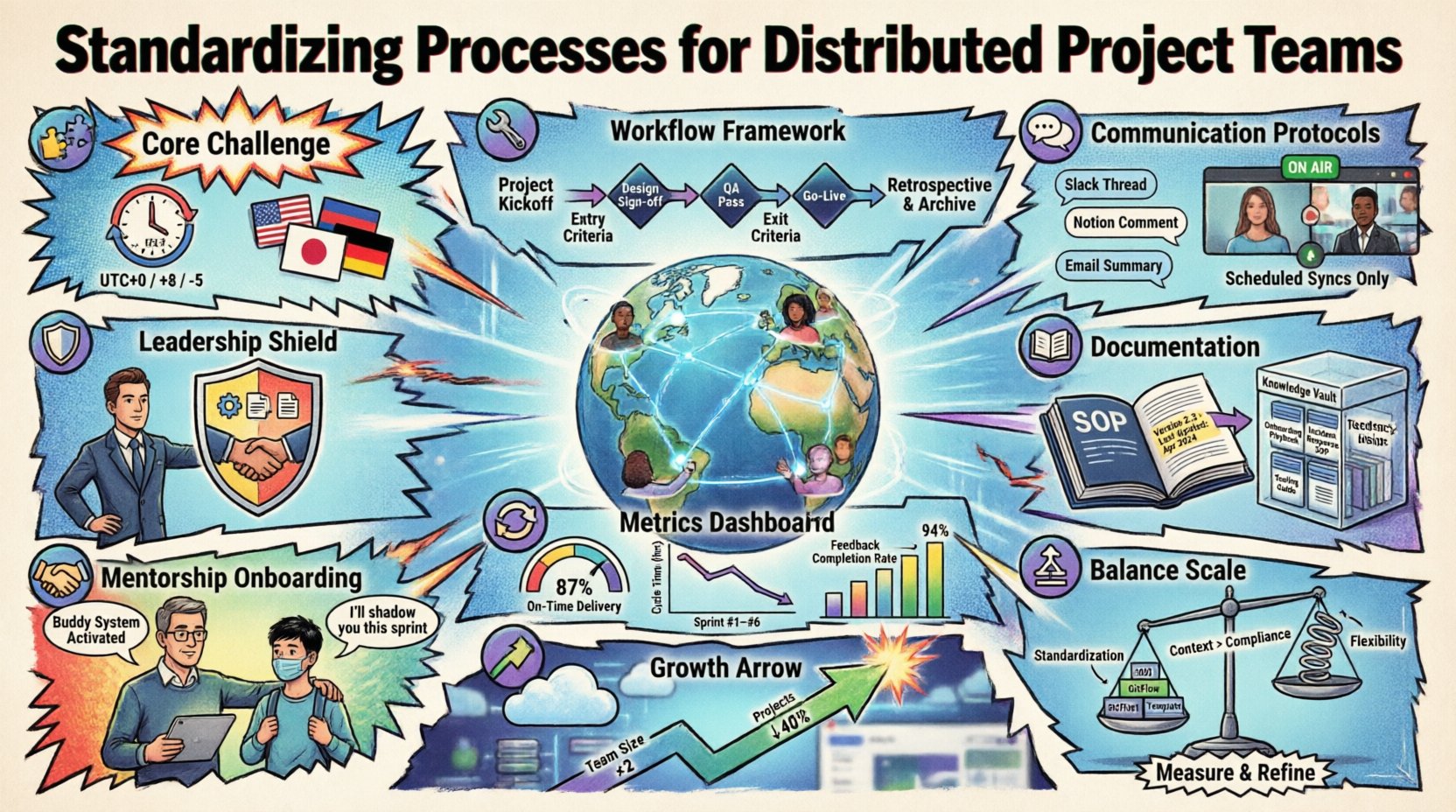
Remote work has fundamentally shifted how organizations operate. The ability to hire talent from anywhere is a powerful asset, but it introduces complexity regarding coordination and consistency. Without a structured approach, distributed teams often drift into silos, leading to duplicated efforts, missed deadlines, and communication breakdowns. Standardizing processes is not about restricting creativity; it is about creating a reliable foundation that allows autonomy to function safely.
When teams are co-located, information often flows through hallway conversations or quick desk visits. In a distributed environment, these informal channels disappear. To maintain productivity, teams must intentionally design systems that replace physical proximity with digital clarity. This article outlines the essential steps to build robust workflows for remote groups without relying on specific vendor tools or proprietary software.
🧩 The Core Challenge of Remote Coordination
Geographic dispersion creates friction points that do not exist in traditional offices. Time zone differences mean that real-time collaboration is often impossible. Cultural nuances can lead to misunderstandings regarding tone and urgency. Without standardization, every team member creates their own method of working, which leads to chaos as the team scales.
Standardization addresses these issues by establishing a single source of truth. It ensures that whether a project lead is in London or a developer is in Tokyo, they are operating from the same playbook. This consistency reduces cognitive load, allowing individuals to focus on their specific tasks rather than figuring out how the team operates.
🛠️ Building a Unified Workflow Framework
Creating a workflow framework requires clarity on inputs, outputs, and handoffs. Every project should follow a defined lifecycle. This lifecycle acts as a roadmap for the duration of the engagement. It dictates when documentation is required, when approvals are needed, and when deliverables are considered complete.
- Define Entry Criteria: What conditions must be met before a project starts? This prevents work from beginning before requirements are clear.
- Establish Milestones: Break large initiatives into manageable checkpoints. This allows for regular progress verification without micromanagement.
- Set Exit Criteria: Define what “done” looks like for every task. Ambiguity here is a primary cause of scope creep.
- Identify Stakeholders: Clearly map who needs to be informed at each stage of the process.
By codifying these steps, teams eliminate guesswork. New members can onboard faster because the path is already paved. Senior members spend less time correcting procedural errors and more time solving complex problems.
💬 Communication Protocols and Expectations
Communication is the lifeblood of a distributed team. However, too much communication causes fatigue, while too little causes isolation. A standardized protocol defines the appropriate channel for specific types of information.
For instance, urgent matters requiring immediate attention should be routed through direct messaging or phone calls. Strategic discussions that do not require instant feedback should occur in scheduled video meetings. General updates and announcements belong in a dedicated channel visible to all. This segregation ensures that important signals are not lost in the noise.
Async-First Principles
Given time zone differences, asynchronous communication should be the default mode. This means recording status updates in writing so colleagues can review them at their own pace. It reduces the need for meetings and allows deep work to happen uninterrupted.
- Document Decisions: Every decision made in a meeting must be written down immediately. This creates a permanent record for reference.
- Response Time Expectations: Set clear guidelines on how quickly team members are expected to respond to messages. This manages expectations regarding availability.
- Meeting Hygiene: Limit synchronous meetings to those where interaction is essential. Always provide an agenda beforehand.
📚 Documentation and Knowledge Sharing
In a remote setting, documentation is the institutional memory of the organization. If it is not written down, it effectively does not exist. Standardizing documentation practices ensures that knowledge is retained even when employees leave.
Every process should have a corresponding Standard Operating Procedure (SOP). These documents should be versioned, dated, and easily searchable. They should answer the following questions for any task:
- What is the goal of this task?
- What resources are required?
- Who is responsible for execution?
- Who is responsible for approval?
- What does the final output look like?
A centralized repository is essential for storing these documents. It should be organized logically, perhaps by department or function, allowing users to find information quickly without needing to ask a colleague. This self-service model empowers team members to solve problems independently.
⚖️ Balancing Standardization with Flexibility
While consistency is vital, rigid adherence to processes can stifle innovation. The goal is to standardize the framework, not the execution of every single detail. Teams should be encouraged to propose improvements to the workflow as they identify inefficiencies.
Feedback loops are critical here. Regularly scheduled retrospectives allow the team to discuss what is working and what is not. If a process step is consistently skipped because it adds no value, it should be removed. This keeps the system lean and relevant.
| Area of Focus | Standardized Approach | Flexibility Allowed |
|---|---|---|
| Project Reporting | Weekly status reports due Friday | Team chooses format (text, slide, spreadsheet) |
| Code Quality | All code must pass automated tests | Developers choose testing methodology |
| Clients Meetings | Recorded and documented | Team chooses specific agenda items |
| Onboarding | Mandatory training modules | Self-paced completion within timeline |
🔄 Measuring and Refining Standards
Implementing a process is not a one-time event. It requires ongoing monitoring to ensure it remains effective. Key performance indicators (KPIs) should be established to measure the health of the workflow itself.
Metrics might include the time it takes to onboard a new hire, the frequency of missed deadlines, or the volume of clarification questions asked during handoffs. If these numbers trend negatively, it indicates a breakdown in the standardized process.
- Track Cycle Time: How long does a task take from start to finish?
- Monitor Rework Rates: High rework rates suggest unclear initial instructions.
- Gather Sentiment: Use surveys to understand if the team feels the processes are helpful or burdensome.
👥 Training and Onboarding Integration
Standards are useless if the team does not know how to follow them. Onboarding must include a comprehensive overview of the workflows. New hires should be paired with a mentor who can guide them through the processes during their first few weeks.
This mentorship ensures that theoretical knowledge is applied correctly in practice. It also provides a safety net for new employees to ask questions without feeling they are exposing their ignorance. Over time, these new members will become the mentors themselves, perpetuating the culture of standardization.
🤝 Leadership Roles in Process Adoption
Leadership plays a pivotal role in the success of process standardization. Leaders must model the behavior they expect to see. If management skips documentation or ignores communication protocols, the team will follow suit.
Leaders should also protect the team from external pressures that might force them to bypass standard procedures. This might involve pushing back on clients who demand rush work that violates safety or quality checks. By defending the process, leaders reinforce its importance.
📈 The Long-Term Impact on Organizational Health
Investing time in standardizing processes yields significant returns over time. It reduces operational risk by minimizing human error. It scales the organization by making it easier to add new resources without diluting quality. It improves employee satisfaction by removing ambiguity from their daily work.
Ultimately, a distributed team with strong processes functions like a well-oiled machine. It can adapt to changes in the market without losing its internal structure. This resilience is the competitive advantage that separates successful remote organizations from those that struggle to maintain cohesion.
Building this infrastructure takes effort and patience. It requires discipline to document what seems obvious and consistency to follow rules even when it is inconvenient. However, the payoff is a workspace where clarity reigns, and productivity thrives regardless of location.