Project Management Offices (PMOs) serve as the backbone of organizational strategy, ensuring alignment between execution and business goals. However, a common failure mode occurs when governance structures become rigid, creating friction that slows down delivery. The objective is not to eliminate control, but to design a framework that enables speed without sacrificing compliance. Effective governance acts as a steering mechanism rather than a roadblock. This article explores how to structure a PMO environment that maintains oversight while keeping momentum intact.
🔍 Understanding the Core Tension
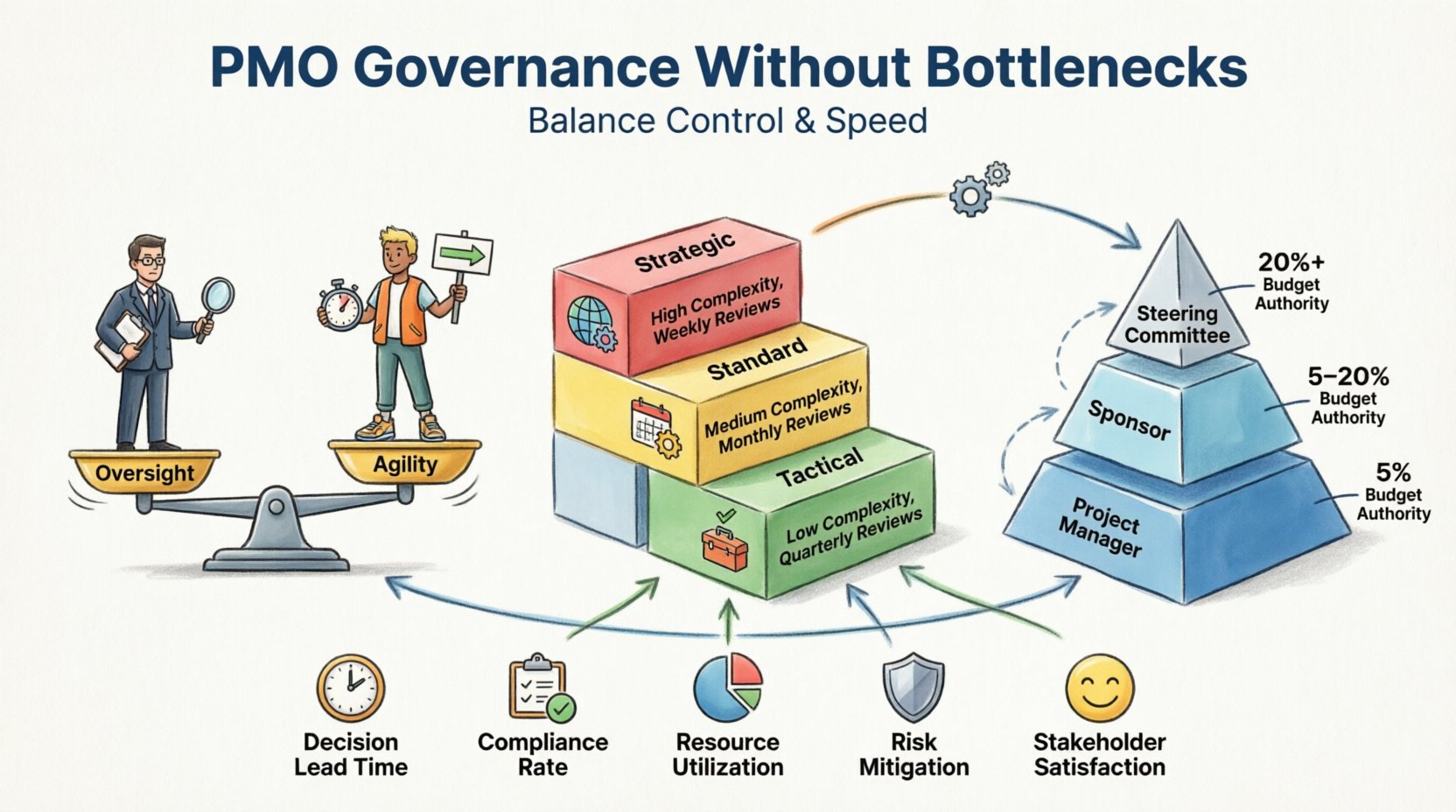
There is an inherent tension between the need for oversight and the need for agility. Governance defines the rules of engagement, risk tolerance, and approval hierarchies. When these rules are too complex, they create bottlenecks. When they are too loose, risks accumulate unchecked. The goal is to find the equilibrium where control supports rather than hinders progress.
Many organizations mistake governance for bureaucracy. True governance is about clarity and accountability. It answers the questions of who decides what, when decisions must be made, and how risks are escalated. A well-designed framework reduces ambiguity, which is often the root cause of delays. Teams spend less time seeking clarification and more time executing tasks.
⚠️ Identifying Common Bottlenecks
Before redesigning a governance model, it is necessary to audit current processes. Bottlenecks rarely appear as obvious errors; they manifest as delays in approval cycles, repeated status updates, or confusion over authority levels. Below are frequent areas where friction typically arises:
- Approval Fatigue: Too many layers of sign-off for routine decisions. Every minor change requires executive review.
- Unclear Roles: Stakeholders are unsure who has the final say on budget or scope changes. This leads to parallel conversations and conflicting directives.
- Static Requirements: Governance frameworks that do not adapt to project size or complexity treat a small internal tool update the same as a multi-year infrastructure rollout.
- Information Silos: Critical data is trapped in specific departments, preventing cross-functional visibility needed for timely decision-making.
- Reporting Overload: Teams spend more time compiling status reports than working on deliverables. Data is collected but rarely utilized for action.
Addressing these issues requires a shift from process-centric thinking to value-centric thinking. The question should always be: Does this step add value to the project outcome? If the answer is no, the step should be reconsidered.
🛠️ Designing a Flexible Governance Framework
Creating a robust yet agile framework involves establishing clear tiers of authority. Not all projects require the same level of scrutiny. A one-size-fits-all approach is inefficient. Instead, organizations should implement a tiered governance model based on project characteristics.
Tiered Governance Models
Segmenting projects allows for tailored oversight. High-risk, high-budget initiatives receive deep scrutiny, while smaller initiatives operate with lighter touchpoints. This ensures resources are focused where they matter most.
| Project Tier | Complexity | Governance Level | Approval Frequency |
|---|---|---|---|
| Strategic | High | Full PMO Oversight | Weekly Steering Committee |
| Standard | Medium | PMO Support | Monthly Review |
| Tactical | Low | Self-Managed | Quarterly Check-in |
By adopting this structure, the PMO reduces the administrative burden on low-risk teams while maintaining strict control over high-stakes initiatives.
Delegation of Authority
Clarity is paramount. Every team member should know the limits of their authority. A Delegation of Authority (DoA) matrix defines specific thresholds for budget, scope, and schedule changes.
- Project Manager: Can approve changes up to 5% of the budget without external approval.
- Sponsor: Approves changes between 5% and 20%.
- Steering Committee: Approves changes exceeding 20% or affecting strategic alignment.
This approach empowers leaders to make decisions quickly without waiting for consensus on every minor adjustment. It accelerates the decision-making loop significantly.
🤝 Cultivating the Right Culture
Processes and tools are only as effective as the people using them. A governance model that is technically sound can still fail if the culture resists it. The goal is to foster a culture of accountability rather than blame.
Communication Channels
Establishing clear communication pathways prevents information from getting stuck. Regular cadences should be set for status updates, but these must be efficient. Instead of long meetings, use concise dashboards that highlight risks and blockers. This allows stakeholders to scan information quickly and intervene only when necessary.
Continuous Improvement
Governance is not static. It must evolve as the organization matures. Implement a feedback loop where project teams can report on the friction they experience with the governance process. Ask specific questions during retrospectives:
- Did we waste time on unnecessary documentation?
- Were decisions made too slowly?
- Was the right information available when needed?
Use this feedback to refine the framework. If a specific approval gate is consistently bypassed, it may be redundant and should be removed. If a risk is frequently missed, a new checkpoint may be required.
📊 Measuring Success and Efficiency
How do you know if the governance model is working? You need metrics that reflect both control and speed. Relying solely on delivery dates can be misleading. A combination of efficiency and compliance metrics provides a holistic view.
- Decision Lead Time: How long does it take to get approval on key milestones?
- Compliance Rate: Percentage of projects adhering to defined governance standards without audit findings.
- Resource Utilization: How much time do project teams spend on administrative tasks versus delivery?
- Risk Mitigation: Number of identified risks that were successfully resolved before becoming issues.
- Stakeholder Satisfaction: Feedback from sponsors regarding the effectiveness of oversight.
Tracking these metrics allows the PMO to demonstrate value beyond simple reporting. It shows that the governance structure is actively contributing to project success.
🔒 Balancing Risk and Agility
The ultimate challenge in PMO governance is balancing the need for risk management with the need for agility. In fast-moving environments, excessive control can stifle innovation. However, ignoring risk can lead to catastrophic failures.
The solution lies in risk-based governance. Instead of checking every box for every project, focus governance efforts on areas with high uncertainty. If a project involves new technology or external vendors, increase the oversight. If the technology is well-understood and the team is experienced, reduce the oversight.
This dynamic approach ensures that control measures are applied where they provide the most value. It prevents the “check-the-box” mentality where compliance is treated as a hurdle rather than a safeguard.
🚀 Moving Forward
Building a governance model that avoids bottlenecks requires constant attention and adjustment. It is a continuous process of refinement rather than a one-time setup. By focusing on clarity, delegation, and feedback, organizations can create an environment where projects thrive without unnecessary friction. The PMO becomes a partner in delivery, not just a gatekeeper of processes. This shift in perspective is essential for modern project management success.
Start by auditing your current processes. Identify the specific points of delay. Implement tiered governance to match risk levels. Empower your teams with clear authority limits. Measure the impact of these changes. With patience and precision, the balance between control and speed is achievable.