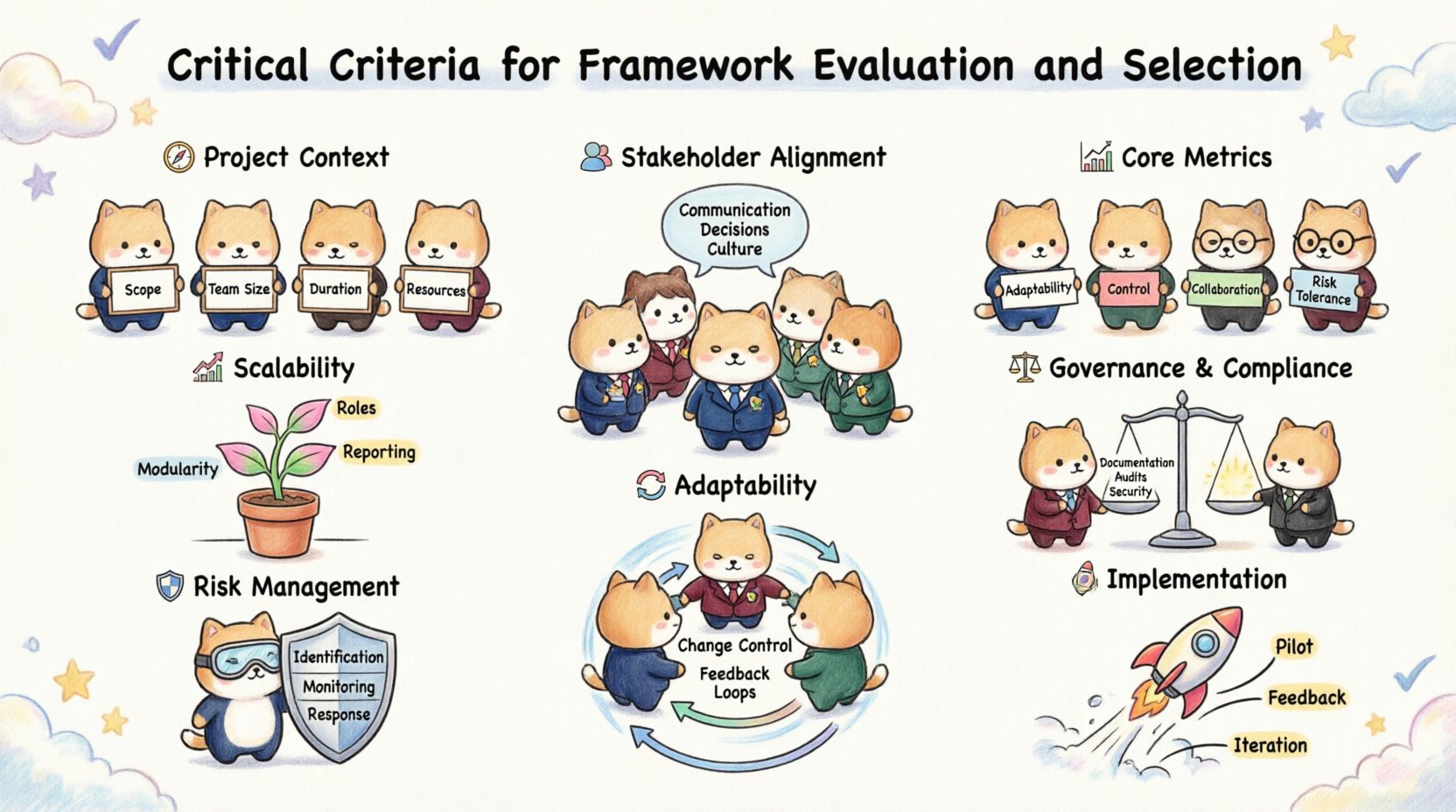
Selecting the right project management framework determines the trajectory of delivery and organizational efficiency. A mismatch between methodology and project needs often leads to friction, budget overruns, and team burnout. This guide outlines the essential factors to consider when assessing methodologies, ensuring alignment with strategic goals without relying on external tools.
🧭 Understanding Project Context and Complexity
Before committing to a structure, leaders must assess the environment in which work occurs. Not every initiative requires the same level of rigor or flexibility. Projects differ significantly in scope, duration, and the nature of the deliverables.
Scope Definition: Is the end goal clear from the start, or does it evolve as work progresses?
Team Size: How many individuals contribute to the effort? Small teams often need lightweight coordination, while large groups require defined roles.
Duration: Short-term bursts differ from multi-year strategic initiatives in terms of governance needs.
Resource Availability: Are resources fixed, or can they be scaled dynamically based on demand?
Understanding these dimensions provides the baseline for evaluation. A framework that works for a rapid software deployment may fail when applied to a construction project with rigid regulatory milestones. The goal is to match the structure to the work, not force the work into a pre-set mold.
📊 Core Evaluation Metrics
Several key metrics help determine suitability. These criteria should be weighted based on organizational priorities. Use the table below to compare how different factors influence the decision-making process.
Criteria | High Priority Impact | Low Priority Impact |
|---|---|---|
Adaptability | Fast-changing markets, innovation-driven goals | Static environments, highly regulated industries |
Control & Visibility | High-risk projects, compliance-heavy sectors | Exploratory research, creative tasks |
Collaboration Style | Distributed teams, cross-functional groups | Single-location teams, specialized silos |
Risk Tolerance | High-stakes financial or safety outcomes | Low-cost experiments, internal prototypes |
When analyzing these metrics, avoid generic assumptions. For instance, high control does not always mean bureaucracy. It can mean clear audit trails and defined approval chains. Similarly, adaptability does not imply chaos; it implies structured flexibility.
👥 Stakeholder Alignment and Culture
Frameworks are not just processes; they are cultural artifacts. The chosen methodology must resonate with the people executing the work. If the team resists the structure, adoption will fail regardless of how logical the framework appears on paper.
Communication Habits: Does the team prefer daily check-ins or weekly status reports?
Decision-Making Authority: Are decisions centralized or decentralized? The framework must reflect this reality.
Conflict Resolution: How are disputes handled? Some structures prioritize consensus, while others empower individual leads.
Training Requirements: Can the team learn the necessary skills within a reasonable timeframe?
Ignoring cultural fit leads to shadow processes where teams work around the official system. Engagement is higher when the workflow supports natural behaviors rather than fighting against them. Assessing the human element is just as critical as the procedural element.
📈 Scalability and Future Growth
A framework selected today must remain viable tomorrow. Organizations grow, and project portfolios expand. The chosen structure should accommodate increased complexity without requiring a complete overhaul.
Consider the following scalability indicators:
Modularity: Can components be added or removed without breaking the system?
Role Definition: Are roles flexible enough to expand as the team grows?
Reporting Layers: Does the structure support multi-level reporting without becoming unwieldy?
Integration Points: How easily does the framework connect with other organizational systems?
Scalability is often overlooked until a bottleneck occurs. Early planning prevents the need for disruptive changes later. A rigid framework might work for a pilot program but collapse under the weight of enterprise-level operations.
⚖️ Governance and Compliance Requirements
Certain industries operate under strict regulatory frameworks. Healthcare, finance, and public sector projects often require specific documentation and audit trails. The evaluation must account for these mandatory constraints.
Documentation Standards: What records must be retained and for how long?
Audit Trails: Is there a clear history of changes and approvals?
Security Protocols: Does the workflow ensure data protection at every stage?
Lifecycle Management: Are there specific gates or phases required for compliance approval?
Compliance is non-negotiable. A framework that offers speed but sacrifices auditability is a liability. Conversely, a framework that is too heavy for the risk level creates unnecessary drag. Balance is key.
🔄 Adaptability to Change
Scope creep and pivots are inevitable in complex environments. The framework should provide mechanisms to manage change without derailing the entire project. Rigid structures break under pressure; flexible ones absorb shocks.
Key aspects of adaptability include:
Change Control Processes: How quickly can scope adjustments be approved?
Feedback Loops: Are there regular intervals to assess progress and direction?
Resource Reallocation: Can effort be shifted to high-priority areas without breaking the workflow?
Iterative Planning: Does the approach allow for short-term planning with long-term vision?
Change management is not just about reacting; it is about anticipating the need to react. The selected methodology should facilitate smooth transitions rather than requiring a restart.
📉 Risk Management Capabilities
Every project carries risk. The framework must support the identification, assessment, and mitigation of these risks. Ignoring risk leads to surprises, while managing it leads to resilience.
Identification Tools: Are there standard methods for spotting potential issues early?
Monitoring Mechanisms: How are risks tracked throughout the lifecycle?
Response Strategies: Does the structure allow for predefined responses to common threats?
Transparency: Are risk statuses visible to all relevant stakeholders?
A robust framework integrates risk management into daily operations rather than treating it as a separate phase. This ensures that risk awareness is constant, not just a periodic review item.
🔄 Implementation Considerations
Once a framework is selected, the path to adoption matters. Implementation should be phased to allow for adjustment and feedback. Rushing the process often leads to confusion.
Steps for successful integration include:
Pilot Programs: Test the framework on a small, low-risk project first.
Feedback Collection: Gather input from users on what works and what hinders progress.
Iteration: Refine the process based on real-world usage before full rollout.
Support Structures: Ensure help is available for teams encountering difficulties.
Patience during implementation yields better long-term results. The goal is sustainable adoption, not immediate compliance. Allow time for the team to internalize the new ways of working.