In the modern business landscape, the gap between high-level strategy and day-to-day execution often determines organizational success. When project management approaches are not synchronized with corporate goals, resources dissipate, timelines slip, and value creation stalls. Aligning project methodologies with corporate strategy ensures that every initiative contributes directly to the broader vision of the enterprise. This process requires deliberate planning, clear communication, and a flexible framework that adapts to changing market conditions.
Strategic alignment is not a one-time event but a continuous discipline. It demands that leaders look beyond the immediate deliverables of a project and evaluate how those outputs feed into long-term objectives. By integrating strategy into the project lifecycle, organizations can optimize resource allocation, mitigate risk, and enhance stakeholder confidence. The following sections detail the mechanics of this alignment, offering a structured approach for implementation.
Understanding the Strategic Foundation 🏢
Before selecting a project management approach, one must fully comprehend the corporate strategy. This strategy defines the organization’s mission, vision, and core objectives. It dictates where the company intends to go and how it intends to get there. Without this context, project managers risk building solutions that are technically sound but strategically irrelevant.
- Business Vision: The long-term aspiration of the organization.
- Strategic Goals: Specific, measurable targets derived from the vision.
- Core Competencies: The unique strengths the organization leverages.
- Market Position: How the organization compares to competitors.
Project managers must engage with executive leadership to understand these elements. A deep dive into the strategic plan reveals priorities such as cost reduction, market expansion, innovation, or customer retention. These priorities directly influence the choice of methodology.
Evaluating Common Project Methodologies 🛠️
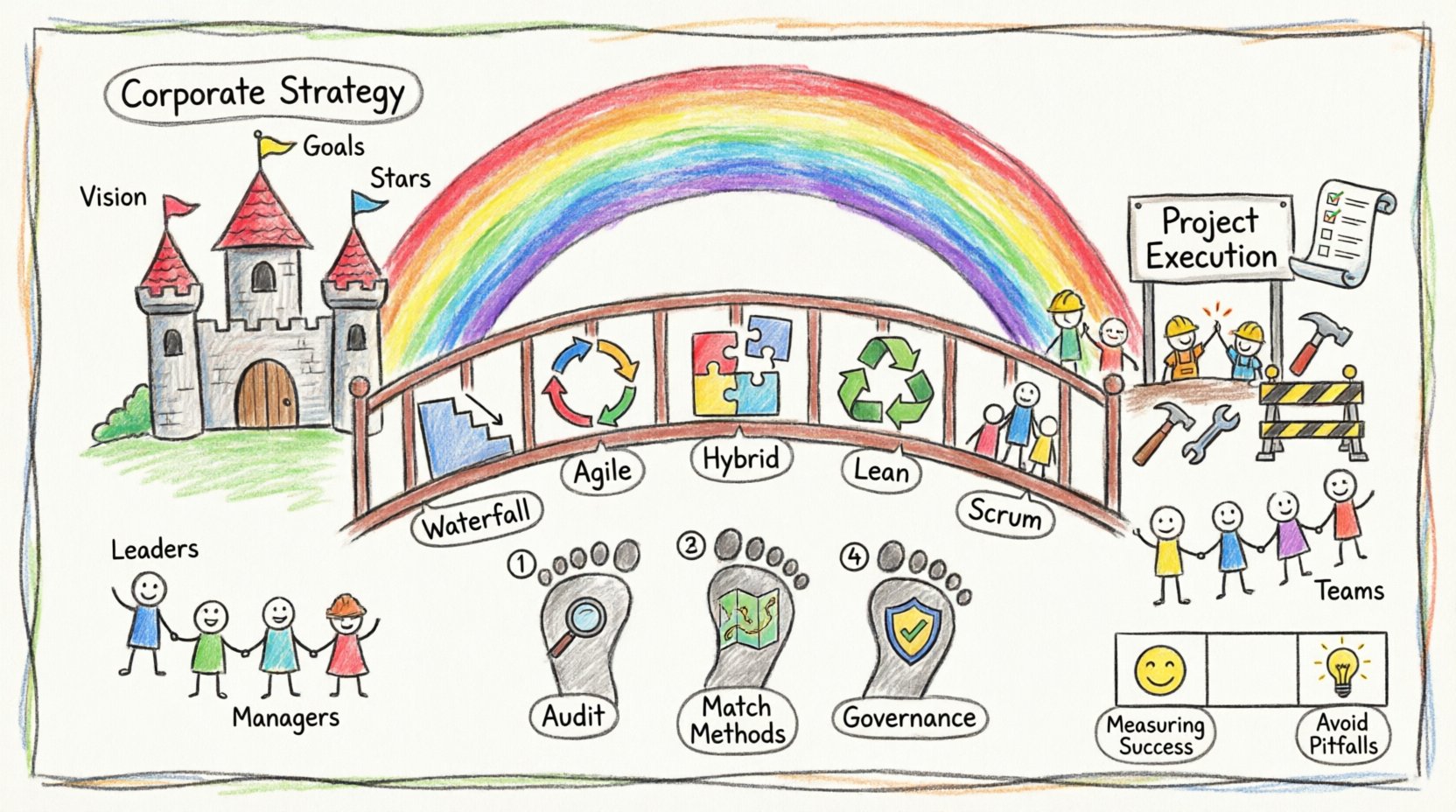
Different strategies require different execution vehicles. The methodology chosen acts as the bridge between the strategic intent and the final product. Selecting the wrong approach can lead to friction, wasted effort, and misaligned outcomes. Below is an analysis of common methodologies and their strategic fit.
| Methodology | Best Strategic Fit | Key Characteristics |
|---|---|---|
| Waterfall | Stable markets, regulatory compliance, fixed scope | Linear, sequential, heavy documentation |
| Agile | Fast-paced innovation, uncertain requirements | Iterative, collaborative, adaptive |
| Hybrid | Complex projects with fixed and variable elements | Combines structure with flexibility |
| Lean | Efficiency-focused, waste reduction goals | Value stream mapping, continuous improvement |
| Scrum | Product development, frequent releases | Sprints, roles, ceremonies, backlog |
Steps to Ensure Strategic Fit 🧩
Aligning methodology with strategy is a systematic process. It involves assessment, selection, implementation, and review. The following steps provide a roadmap for achieving this integration without disrupting existing operations.
1. Conduct a Strategic Audit
Begin by reviewing current projects against strategic goals. Identify which initiatives are driving value and which are drifting. This audit highlights gaps in execution. It answers critical questions regarding resource utilization and outcome delivery.
- Review project charters for strategic linkage.
- Analyze past performance data.
- Interview stakeholders for qualitative insights.
2. Map Methodologies to Objectives
Once the strategy is clear, map it to potential methodologies. If the goal is rapid time-to-market, an iterative approach like Agile is often superior. If the goal is strict adherence to budget and timeline in a regulated industry, a predictive approach may be necessary.
Consider the following alignment criteria:
- Flexibility: Does the strategy require pivoting based on feedback?
- Risk Tolerance: Is the organization willing to take calculated risks?
- Team Structure: Does the current team support collaborative or hierarchical workflows?
- Stakeholder Engagement: How often do decision-makers need visibility?
3. Define Governance Structures
Governance provides the rules and boundaries within which projects operate. It ensures accountability and compliance with strategic directives. A governance framework should define decision-making authority, reporting lines, and escalation paths. It prevents scope creep and keeps the project focused on strategic outcomes.
Key governance elements include:
- Steering committees for high-level oversight.
- Defined roles and responsibilities matrices.
- Standardized reporting templates.
- Quality assurance checkpoints.
Roles and Responsibilities 👥
Successful alignment requires participation from all levels of the organization. It is not solely the responsibility of the project manager or the executive team. Each role plays a specific part in maintaining the strategic connection.
Executive Leadership
Executives set the tone and provide the necessary resources. They must communicate the strategic vision clearly and consistently. They also need to support the project manager when difficult trade-offs arise between scope, time, and cost.
Project Managers
Project managers translate strategy into action. They must understand the business context, not just the technical requirements. They are responsible for monitoring progress against strategic milestones and escalating issues that threaten alignment.
Functional Managers
Functional managers control the resources. They ensure that team members have the time and skills required to meet project goals. They act as a bridge between operational demands and project requirements.
Team Members
Team members execute the work. They provide feedback on feasibility and efficiency. Their engagement is crucial for identifying risks early and suggesting improvements.
Measuring Alignment Success 📊
Without measurement, alignment is merely an assumption. Organizations must track specific metrics to verify that projects are delivering on strategic promises. These metrics should go beyond traditional project management indicators like schedule variance.
Effective metrics include:
- Strategic Value Realization: Does the output achieve the intended business impact?
- Resource Efficiency: Are resources allocated to high-priority initiatives?
- Stakeholder Satisfaction: Do key decision-makers feel the project supports their goals?
- Adaptability: How quickly can the project pivot when strategy shifts?
Regular reviews should be scheduled to assess these metrics. Quarterly business reviews are common for high-level initiatives, while sprint reviews work for Agile environments. The frequency depends on the volatility of the market and the strategic horizon.
Navigating Change and Resistance 🔄
Aligning methodologies often requires cultural change. Teams accustomed to one way of working may resist shifting to another. For example, moving from Waterfall to Agile requires a mindset shift towards collaboration and self-organization. Resistance is natural and must be managed proactively.
Strategies for managing resistance include:
- Training and Development: Equip teams with the skills needed for the new methodology.
- Communication: Explain the “why” behind the change clearly.
- Champions: Identify influential team members to advocate for the new approach.
- Phased Implementation: Roll out changes gradually to allow for adjustment.
Leaders must remain patient and supportive during this transition. Change management is as critical as project management in this context.
Common Pitfalls to Avoid ⚠️
Even with the best intentions, organizations can stumble during the alignment process. Being aware of common pitfalls helps in steering clear of them.
- Ignoring Context: Applying a methodology because it is trendy rather than because it fits the strategy.
- Over-Engineering: Creating complex governance structures that slow down delivery.
- Disconnect: Allowing project teams to operate in silos without strategic oversight.
- Static Planning: Treating strategy as a fixed document rather than a dynamic guide.
- Lack of Feedback: Failing to incorporate lessons learned into future planning.
Long-Term Sustainability 🌱
The ultimate goal of alignment is sustainability. A project might finish on time and within budget, but if it does not contribute to the corporate strategy, it has failed to deliver value. Organizations must build a culture where strategic alignment is embedded in the DNA of project management.
This involves continuous learning and adaptation. As the market evolves, so too must the strategies and the methodologies used to execute them. Regularly revisiting the alignment framework ensures that the organization remains responsive and resilient.
By treating project management as a strategic function rather than an administrative task, companies can achieve higher levels of performance. The connection between the project office and the boardroom becomes stronger, driving growth and stability. This disciplined approach to execution is what separates industry leaders from the rest.
Start by auditing your current projects. Identify the gaps. Select the right methodologies. Implement with care. Measure the results. And repeat. This cycle ensures that every project undertaken is a step forward toward the corporate vision.