


Introduction to AI-Enabled Visual Modeling
Visual Paradigm has reimagined its core platform by integrating advanced Generative AI into its comprehensive suite for visual modeling, software development, and enterprise architecture. Moving beyond traditional drag-and-drop interfaces, the platform now employs an AI engine capable of understanding natural language requirements to build complex systems instantly. This guide explores the extensive capabilities of Visual Paradigm’s AI ecosystem, from intelligent chatbots to specialized agile tools.
The AI Chatbot: Conversational Diagramming
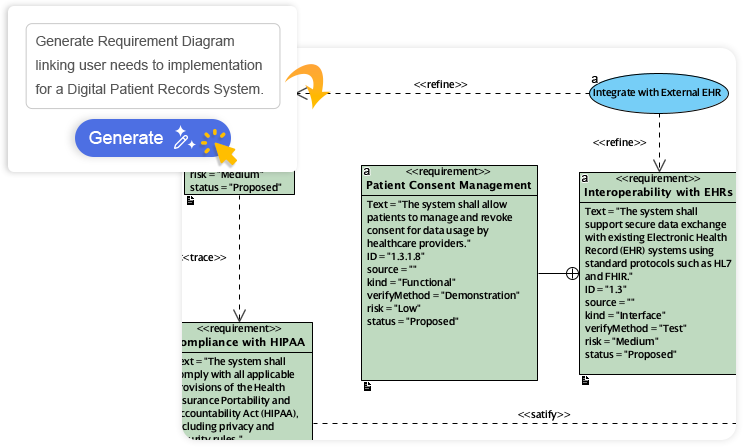
At the heart of the new ecosystem is the AI Chatbot for Visual Modeling. This feature leverages natural language processing to transform plain English text into industry-standard diagrams. It eliminates the steep learning curve associated with complex modeling languages like UML or SysML, allowing users to focus on logic rather than syntax.
How the AI Chatbot Works
The process of generating diagrams is broken down into a streamlined, four-step workflow:
- Describe Your Idea: Users simply type a request, such as “Create a use case diagram for an online shopping system.” The AI interprets the intent and context of the prompt.
- Generate Instantly: Within seconds, the text is converted into a fully formed, presentation-ready diagram with optimized layout and spacing.
- Refine with Commands: Users can edit the diagram conversationally. Commands like “Add a payment gateway” or “Rename Customer to Buyer” update the model immediately without manual redrawing.
- Explore and Document: The AI can answer questions about the model, such as identifying main use cases, and generate project summaries or documentation based on the visual data.
Supported Diagram Types
The AI diagram generation engine supports a vast array of visual standards, ensuring utility across various organizational roles:
- Software Architecture: C4 Models (Component, Container, Deployment, System Context), UML (Class, Activity, Sequence, State Machine, Deployment), and ArchiMate.
- Systems Engineering: SysML Block Definition, Internal Block, and Requirement diagrams.
- Business Strategy: SWOT Analysis, PEST/PESTLE Analysis, Porter’s Five Forces, Ansoff Matrix, and McKinsey 7S Model.
- Project Management: PERT Charts, Work Breakdown Structures (WBS), and Eisenhower Matrices.
The Suite of Intelligent Tools
Beyond the core chatbot, Visual Paradigm offers a curated “Innovation Hub” containing purpose-built AI applications designed to automate specific domains of work.

Software Development and Database Design
DBModeler AI allows developers to transform ideas into production-ready databases in minutes. By providing a plain English description, the tool guides users through the modeling process to generate SQL code. Additionally, Agilien serves as an AI-powered Jira Backlog Planner. It translates high-level concepts into detailed user stories and backlog items, ensuring consistency and saving significant time during sprint planning.
Content and Visualization
For researchers and content creators, the Markmap Studio turns scattered thoughts into structured mind maps instantly, while the AI Flipbook Maker Lite designs and publishes e-books. The AI Image Translator provides utility for global teams by translating text within images across languages.
Strategic and Process Analysis
The platform automates business analysis through specialized generators. The Intelligent BPM and Analysis Suite documents and visualizes business workflows from simple descriptions. It can identify bottlenecks and generate Six Sigma reports to optimize operational efficiency.
Desktop and Cloud Integration
Visual Paradigm has designed its AI features to bridge the gap between cloud flexibility and desktop power. While the AI Chatbot is a cloud-native feature powered by VP Online, it is seamlessly accessible within the Visual Paradigm Desktop environment.
Seamless Synchronization
Work is synchronized to a single Visual Paradigm account. This allows users to generate a diagram via the web interface and immediately access it within the desktop application. For users with Professional Edition licenses or higher, AI-generated diagrams can be imported directly into desktop projects for advanced modeling and code engineering.
Use Cases by Industry
| Role | Application | Key AI Tools |
|---|---|---|
| Software Architects | Generating standard architecture diagrams from specs and documenting system context. | C4 PlantUML Studio, UML Generators, Code Engineering |
| Product Managers | Translating requirements into user stories and prioritizing backlogs. | Agilien (Jira Integration), User Story Mapping |
| Business Analysts | Visualizing workflows and conducting market strategy assessments. | BPMN Suite, SWOT/PESTLE Generators |
| Researchers | Organizing data and synthesizing web research. | Annotator, Markmap Studio |
Pricing and Access Models
Visual Paradigm offers a flexible model to accommodate different user needs, ranging from casual usage to enterprise deployment.
Free vs. Paid Solutions
The platform provides a “Forever Free” tier for several core AI applications, offering fundamental functionality for workflow and content generation. This is distinct from short-term trials.
Paid subscriptions unlock the full potential of the AI suite. Benefits of the paid tier include:
- Advanced Features: Access to real-time processing and deep third-party integrations.
- Enterprise Security: Enhanced data protection suitable for corporate environments.
- Priority Access: Unrestricted access to specialized tools like advanced Strategic Analysis and higher usage limits.
- Support: Paid tiers function on monthly or annual subscriptions that grant premium access across the suite.

Conclusion
Visual Paradigm’s integration of Generative AI transforms it from a traditional modeling tool into an intelligent assistant that builds, refines, and analyzes complex systems. By automating the manual labor of drawing and documenting, tools like the AI Chatbot and Agilien allow professionals to focus on innovation and strategy. Whether for software engineering, agile management, or business process analysis, the platform provides a cohesive ecosystem where ideas are instantly converted into structured, actionable visuals.
Related posts:
 Q&A: Real Questions Tech Startups Ask About the Business Model Canvas (And Answers)
 The “No-Code” Approach to Building a Robust Business Model Canvas for MVPs
 Beyond Revenue Streams: Using the Business Model Canvas to Secure Series A Funding
 The Silent Killer: Ignoring Key Partnerships on Your Business Model Canvas