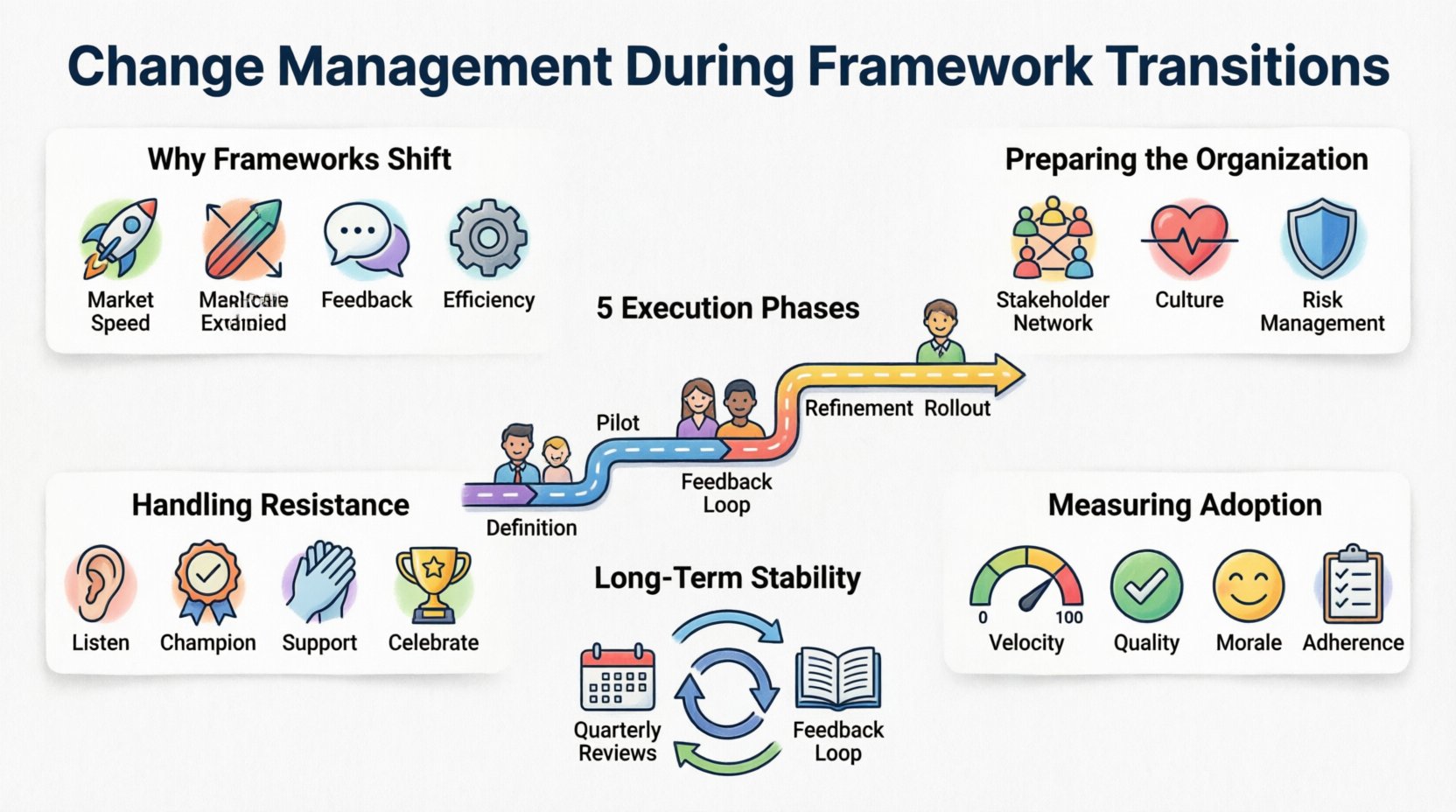
Transitioning between project management frameworks is a significant undertaking for any organization. It is not merely a change in tools or documentation, but a shift in the underlying operating model. When a team moves from a predictive approach to an adaptive one, or vice versa, the impact ripples through governance, communication, and delivery. Success requires a structured approach to change management. This guide outlines the strategic steps necessary to navigate these shifts effectively.
Why Frameworks Shift 🏗️
Organizations do not change frameworks arbitrarily. There is usually a driver necessitating the transition. Understanding the root cause is the first step in managing the change. Common drivers include:
- Market Dynamics: Speed to market becomes critical, requiring more agile iterations.
- Scalability Issues: Current methods may not support growth or increased team size.
- Stakeholder Feedback: Clients or internal users may demand more transparency or flexibility.
- Operational Efficiency: Reducing waste and improving flow often necessitates a new process.
Without a clear understanding of the “why,” the team may view the change as unnecessary noise. Leadership must articulate the value proposition clearly. This aligns expectations and reduces the friction associated with the new workflow.
Preparing the Organization 🛡️
Before implementing any new structure, the organization must assess its readiness. A framework is only as strong as the culture supporting it. Preparation involves several critical layers.
Stakeholder Mapping
Identify everyone who will be impacted by the transition. This includes sponsors, team members, and external partners. Map their influence and interest levels. High-influence stakeholders need active engagement. Low-influence but high-interest groups require regular updates. Ignoring specific groups often leads to pockets of resistance later.
Cultural Readiness
Assess the current mindset of the team. Are they comfortable with ambiguity and change? A shift to a framework that requires more autonomy may fail if the culture is strictly hierarchical. Conversely, a move toward rigid planning may stall a creative team. Tailor the transition to fit the existing cultural fabric while gently nudging it toward the desired state.
Risk Identification
Every transition introduces risk. Document potential points of failure. What happens if a key person leaves during the pilot? What if the new metrics are unclear? Create mitigation plans for these scenarios. Having a contingency plan reduces panic when issues arise.
Execution Phases 🚀
Implementation should not happen overnight. A phased approach allows for learning and adjustment. The following phases provide a logical progression for the transition.
- Phase 1: Definition: Define the new framework rules, roles, and artifacts.
- Phase 2: Pilot: Run the new framework in a single project or team.
- Phase 3: Feedback Loop: Gather data and testimonials from the pilot.
- Phase 4: Refinement: Adjust the framework based on pilot learnings.
- Phase 5: Rollout: Expand the adoption to the wider organization.
During the pilot phase, treat it as a learning experiment rather than a mandate. This lowers the stakes and encourages honest feedback. Document everything. The lessons learned here will prevent costly mistakes during the full rollout.
Transition Phase Checklist
| Phase | Key Action | Primary Owner | Success Indicator |
|---|---|---|---|
| Assessment | Gap Analysis | Lead PM | Report signed off |
| Planning | Communication Plan | Change Manager | Stakeholders briefed |
| Pilot | Team Training | Trainer | 100% team certified |
| Review | Post-Implementation Audit | Audit Team | Risk register updated |
Handling Resistance 👥
Resistance is a natural response to change. It is not inherently negative; it often signals a lack of understanding or fear of the unknown. Addressing resistance requires empathy and patience.
- Listen Actively: Hold town halls or open forums where team members can voice concerns without fear of repercussion. Validate their feelings.
- Identify Champions: Find influential team members who are open to the change. Empower them to advocate for the new framework.
- Provide Support: Ensure adequate resources are available. Training, time, and mentorship reduce the anxiety of learning new methods.
- Celebrate Wins: Highlight early successes. When people see the new way works, resistance often turns to support.
Do not force compliance. Focus on education and demonstration. When the value becomes apparent through practice, adoption tends to follow naturally.
Measuring Adoption 📊
How do you know the transition is successful? Rely on data rather than intuition. Define key performance indicators (KPIs) that reflect the goals of the new framework.
- Delivery Velocity: Are teams delivering value at a consistent rate?
- Quality Metrics: Has the defect rate decreased or improved stability?
- Team Morale: Use surveys to measure satisfaction and engagement levels.
- Adherence: Are the defined processes being followed consistently?
Review these metrics regularly. If a metric is not improving, investigate why. It may be a training issue, a process flaw, or a cultural mismatch. Adjust the strategy based on the data.
Long-Term Stability ⚖️
The transition does not end with the rollout. Sustainability requires ongoing maintenance. Frameworks drift over time if not governed. Establish a governance body to oversee the framework’s evolution.
- Regular Reviews: Schedule quarterly reviews to assess the framework’s relevance.
- Continuous Training: Onboard new hires with the current standard. Avoid knowledge silos.
- Feedback Loops: Maintain channels for continuous improvement suggestions.
By institutionalizing the learning process, the organization ensures that the framework evolves with its needs. This prevents the stagnation that often leads to future transitions. The goal is a living system that supports the business, not a rigid set of rules that hinders it.
Final Thoughts on Governance
Successful change management during framework transitions relies on clarity, communication, and consistent execution. It is a human challenge as much as a technical one. By focusing on the people and the process, organizations can navigate shifts with minimal disruption. The result is a resilient project management environment capable of adapting to future demands.