


Imagine having a strategic planning tool that can instantly generate a comprehensive growth roadmap for your business. The AI-Powered Ansoff Matrix Strategy Builder from Visual Paradigm makes this a reality. This feature deep dive explores how this powerful tool helps business leaders, like those at UrbanBrew, a local coffee shop chain, to map out their future with clarity and speed. Using a step-by-step wizard, the tool guides users through the four core strategies of the Ansoff Matrix—Market Penetration, Market Development, Product Development, and Diversification—turning complex strategic thinking into a structured, actionable process. The best part? You can leverage AI to generate a full set of growth initiatives in seconds, or build your own plan from scratch. Let’s see how it works in practice.
Key Takeaways
-
The AI-Powered Ansoff Matrix Strategy Builder is a powerful tool for creating a structured growth plan.
-
It guides users through a 5-step wizard, covering all four quadrants of the Ansoff Matrix.
-
Users can either use AI to generate strategies or build them manually with detailed implementation plans.
-
Each strategy includes a description, implementation plan, expected outcome, and risk level.
-
The final output is a professional, printable report that consolidates all the strategies.
How the AI-Powered Ansoff Matrix Strategy Builder Works
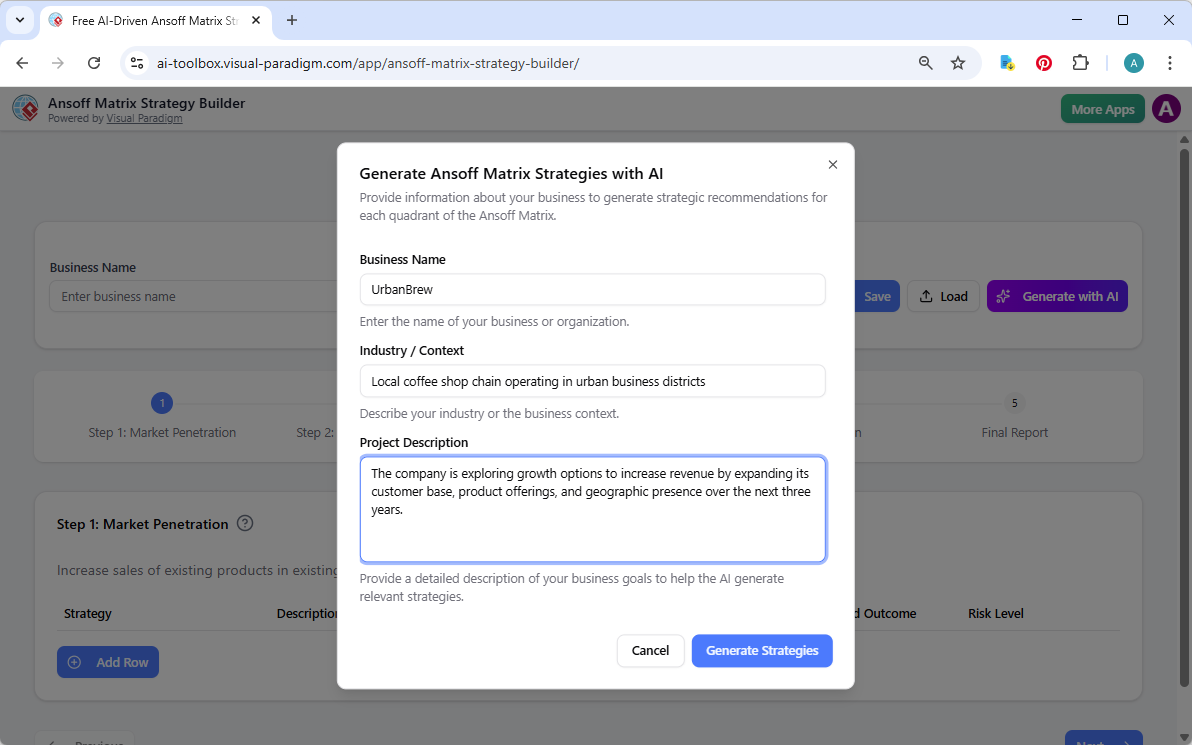
The process begins with a simple input. As shown in Image 1, the user starts by providing basic business context. For UrbanBrew, this includes the business name, its industry (a local coffee shop chain in urban districts), and a project description outlining their goal to increase revenue through customer base expansion, new product offerings, and geographic growth. This information serves as the foundation for the AI to generate relevant and context-specific strategies. Once the details are entered, the user clicks “Generate with AI,” and the tool begins its work, populating the matrix with potential growth initiatives.
Step 1: Market Penetration – Boosting Sales in Existing Markets
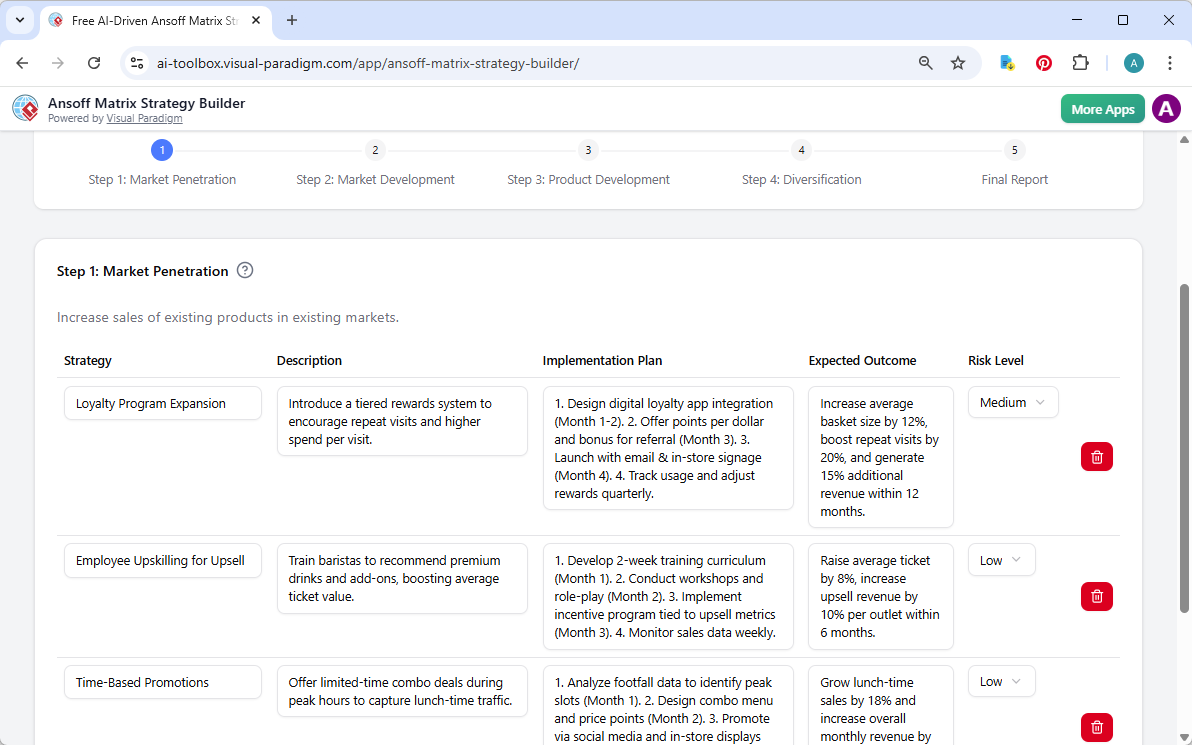
After the AI generates the initial ideas, the user moves to Step 1: Market Penetration. This quadrant focuses on increasing sales of existing products in current markets. As seen in Image 2, the tool presents a detailed table with strategies like a “Loyalty Program Expansion” and “Employee Upskilling for Upsell.” Each strategy has a description, a clear implementation plan with monthly milestones, a projected outcome, and an assessed risk level. This level of detail transforms a simple idea into a concrete action plan, ensuring that every initiative is thoughtfully considered.
Step 2: Market Development – Selling Existing Products to New Markets
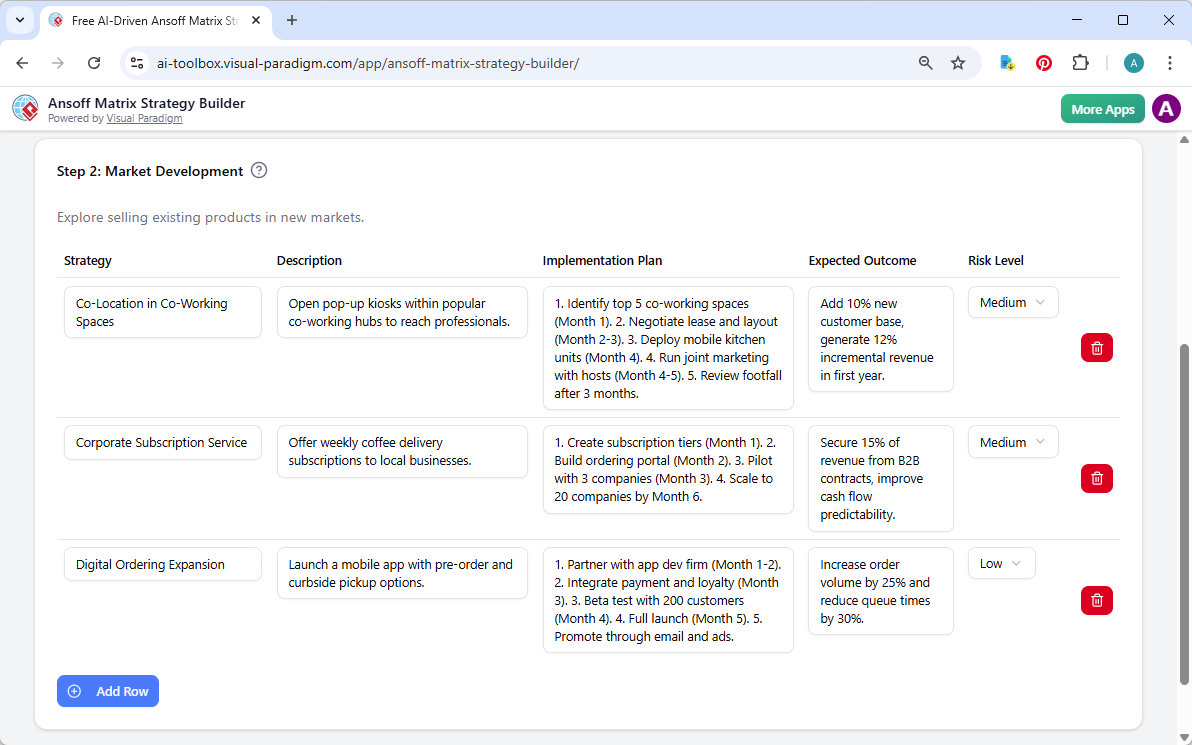
Next, the user proceeds to Step 2: Market Development, which is about selling existing products to new markets. Image 3 shows the strategies generated for this quadrant, such as “Co-Location in Co-Working Spaces” and a “Corporate Subscription Service.” These ideas are designed to reach new customer segments, like professionals in co-working hubs or local businesses needing coffee deliveries. The implementation plans are again detailed, outlining specific actions and timelines to achieve the expected outcomes, such as adding new customers or generating incremental revenue.
Step 3: Product Development – Creating New Products for Existing Markets
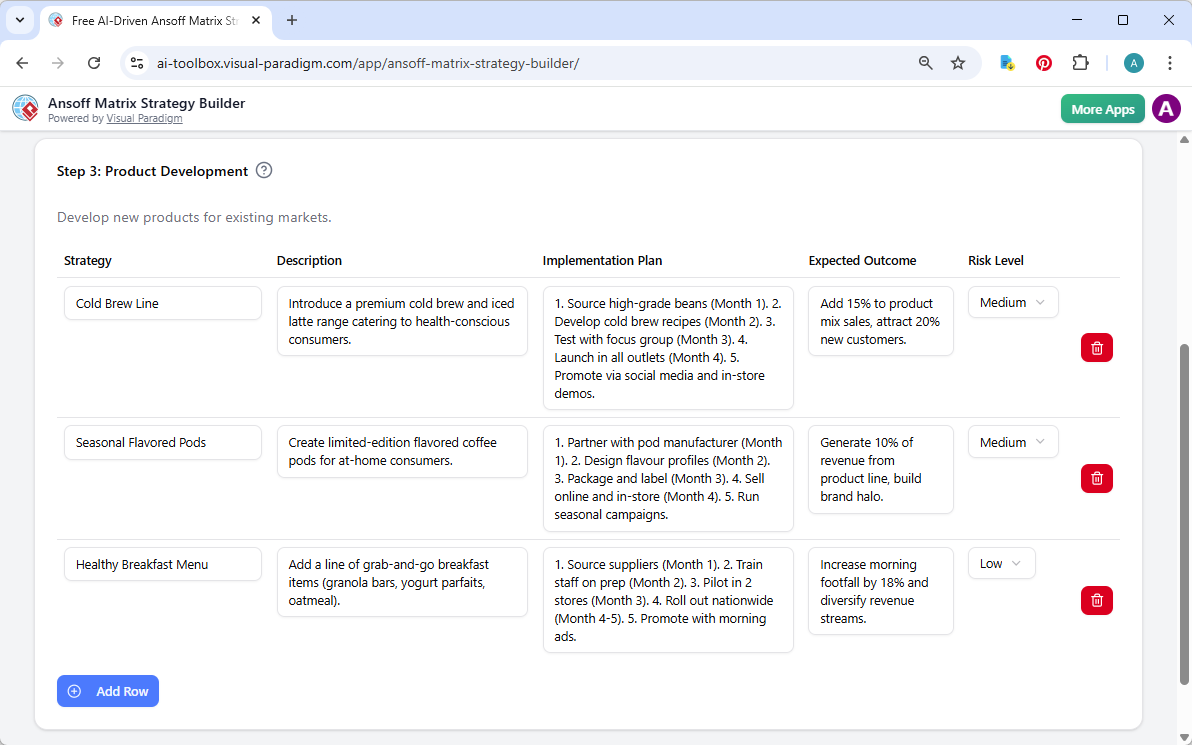
For Step 3: Product Development, the focus shifts to developing new products for existing markets. Image 4 displays strategies like launching a “Cold Brew Line” and a “Seasonal Flavored Pods.” These initiatives aim to attract new customer segments, such as health-conscious consumers or at-home coffee enthusiasts. The AI provides a comprehensive implementation plan for each, including sourcing ingredients, testing, and promotion, along with a clear expected outcome and risk assessment. This step ensures that new product ideas are not just conceptual but are backed by a solid plan for execution.
Step 4: Diversification – Introducing New Products to New Markets
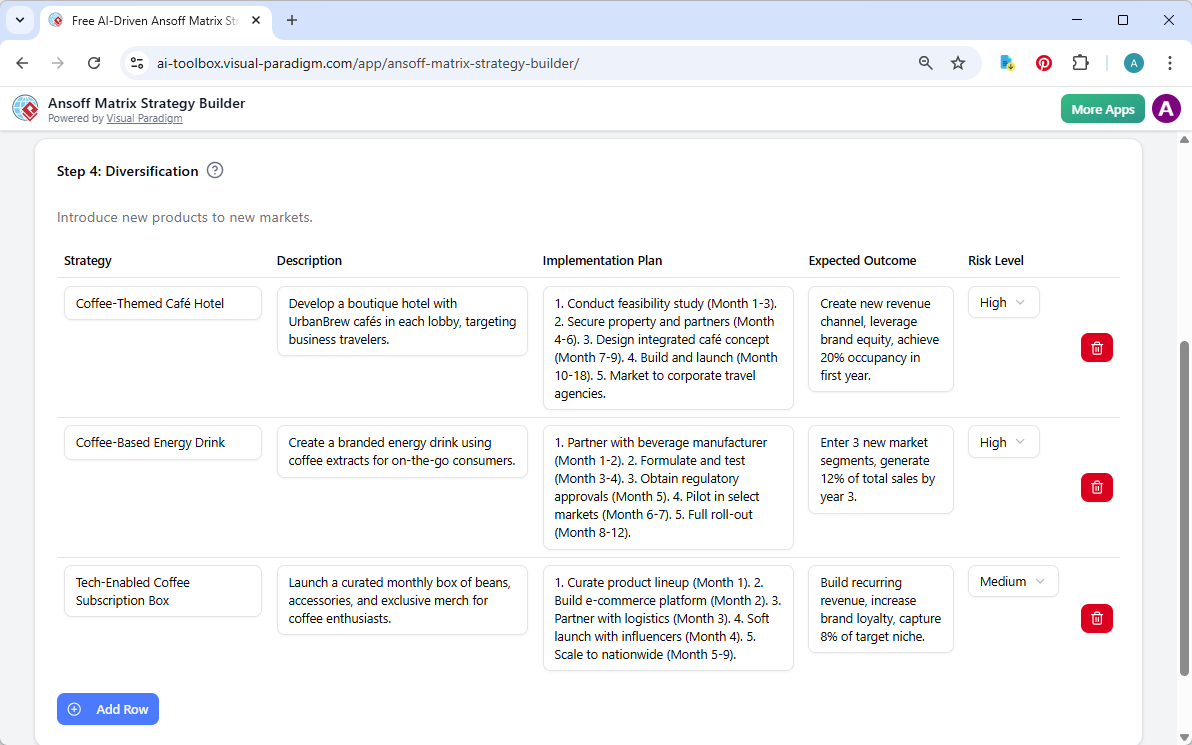
Step 4: Diversification is the most ambitious quadrant, focusing on introducing new products to new markets. As shown in Image 5, the AI generates ideas like a “Coffee-Themed Café Hotel” and a “Coffee-Based Energy Drink.” These strategies represent significant growth opportunities, but also carry higher risk, as indicated by the “High” risk level assigned to them. The implementation plans are detailed, outlining the necessary steps for feasibility studies, securing partners, and launching the new ventures. This step encourages bold thinking while still providing a structured framework for planning.
Final Report: A Professional, Actionable Growth Plan
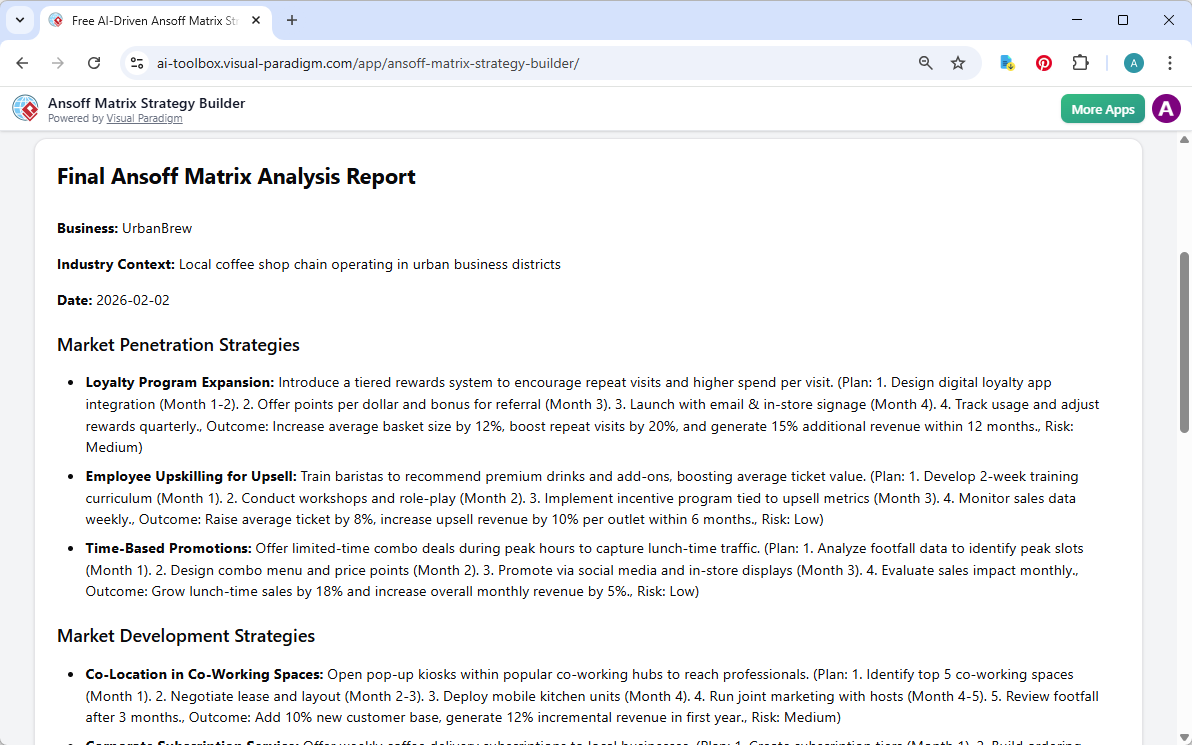
The journey culminates in the Final Report, as displayed in Image 6. This comprehensive document consolidates all the strategies from the four quadrants into a single, professional report. It includes the business name, industry context, and date, followed by a clear breakdown of the strategies under each category. The report is designed for easy review, presentation, and sharing. Users can print it directly or save it as a PDF, making it a powerful tool for strategic alignment meetings and decision-making. The entire process, from initial input to final report, is streamlined and efficient, allowing users to focus on the strategic content rather than the administrative work.
Conclusion
The AI-Powered Ansoff Matrix Strategy Builder from Visual Paradigm is a game-changer for business strategy. It simplifies the complex process of strategic planning by providing a structured, guided approach to exploring growth opportunities. Whether you’re a business owner, product manager, or strategist, this tool empowers you to generate and refine growth strategies quickly and effectively. The ability to use AI to create a first draft, combined with the flexibility to build a plan manually, makes it a versatile solution for any business. The final report is not just a document; it’s a strategic roadmap ready to be shared with your team and stakeholders.
Ready to build your own growth strategy? Try the AI-Powered Ansoff Matrix Strategy Builder today and see how it can transform your strategic planning process.
Related Links
The Ansoff Matrix is a strategic planning framework used by organizations to evaluate and plan for growth through four distinct strategies: market penetration, market development, product development, and diversification. Visual Paradigm provides specialized tools and AI-powered assistants that allow teams to apply this framework effectively, identifying growth opportunities while conducting risk assessments to support data-driven decisions. These tools are part of an integrated strategic analysis suite that enables practitioners to transition between frameworks like SWOT, PESTLE, and Ansoff to gain a comprehensive view of their business environment.
-
Using the Ansoff Matrix with Visual Paradigm Smart Board – Strategic Growth Planning: A specialized guide for assessing market and product growth strategies using collaborative visual tools.
-
Using AI to Assess Risk in the Ansoff Matrix for Strategic Growth: Details how to apply AI to evaluate risks within the Ansoff quadrants, enabling more informed decisions for market expansion.
-
Visual Paradigm AI Suite: A Comprehensive Guide to Intelligent Modeling Tools: An exploration of AI-driven tools that support the Ansoff Matrix alongside other strategic frameworks like SWOT and PESTLE.
-
PESTLE Analysis Explained: The Ultimate AI Guide: Highlights how the Ansoff Matrix serves as a core component of an integrated strategic analysis toolkit enhanced by AI.
-
What Makes Visual Paradigm’s AI Chatbot Different from Other AI Diagram Tools?: Explains how the AI chatbot specifically supports business frameworks like Ansoff to bridge the gap between strategic planning and technical modeling.
-
Strategic Analysis Tool for Business Planning: An online platform designed to support informed decision-making through various strategic modeling frameworks.
-
Comprehensive Suite of Strategic Analysis Tools: A central resource detailing integrated tools designed to support data-driven business decisions and structured organizational planning.
-
AI-Powered Visual Modeling and Design Solutions: The primary hub for AI-driven strategic tools that accelerate growth planning and automated visual modeling workflows.