


Introduction
In the world of Business Process Management (BPM), we are often obsessed with what happens inside an organization. We map internal workflows, database updates, and employee tasks. But what about the space between organizations?
When a patient books an appointment, a customer places an order on Amazon, or two banks settle a transaction, there is a complex dance of messages occurring between independent entities. Standard BPMN “Collaboration” diagrams try to show this by placing multiple pools side-by-side, but they often become cluttered messes of crossing message lines that reveal too much internal logic.
Enter the BPMN Choreography Diagram. Think of it as the “neutral ground” of process modeling. It ignores internal private processes entirely and focuses exclusively on the contract of interaction—who sends what to whom, and in what order. For beginners, mastering choreography is the key to designing clean system integrations, microservices, and B2B agreements without getting bogged down in implementation details.
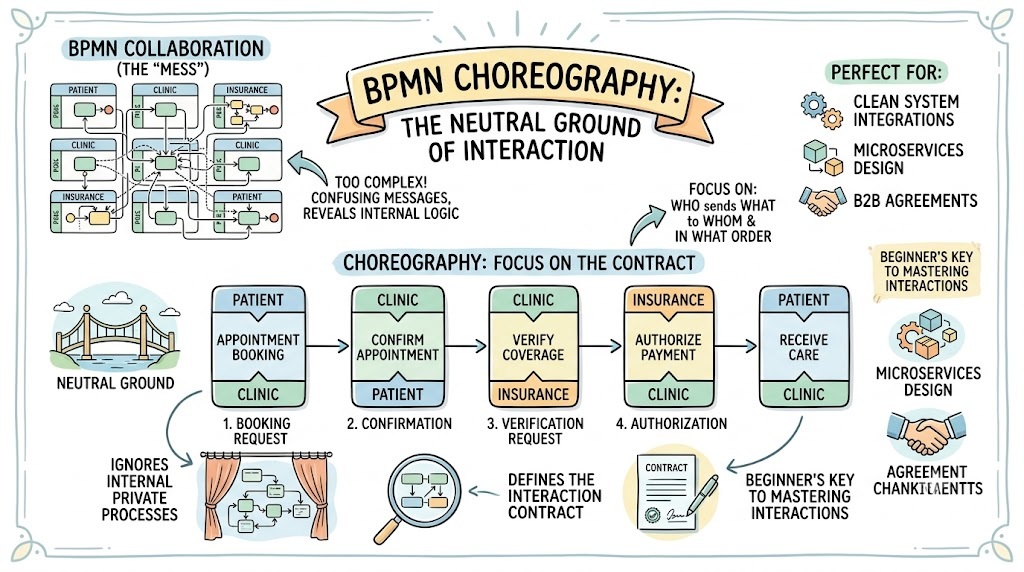
This tutorial will walk you through the core concepts, analyze a real-world medical clinic scenario, and demonstrate how modern AI tools like Visual Paradigm can accelerate your modeling journey.
Part 1: What is a Choreography Diagram?
A Choreography diagram is a formal blueprint of message exchanges. Unlike Orchestration (which shows one participant’s internal steps), Choreography describes behavior from a neutral, third-party perspective.
| Feature | Orchestration (Standard BPMN) | Choreography |
|---|---|---|
| Focus | Internal tasks & logic of ONE participant | Message exchanges BETWEEN participants |
| Perspective | Subjective (My view) | Objective (Neutral contract) |
| Internal Steps | Visible (e.g., “Update DB”) | Hidden / Abstracted |
| Best For | Internal workflow optimization | B2B integration, API contracts, SLAs |
The Core Building Block: The Choreography Task
The fundamental unit of a choreography is the Choreography Task. Visually, it is a rounded rectangle divided into three horizontal bands:
-
Initiating Participant (White Band): The party who triggers the interaction.
-
Activity Name (Middle Band): Describes the interaction (e.g., “Request Appointment”).
-
Receiving Participant (Gray Band): The party receiving the initial message.
💡 Pro Tip: The color coding is mandatory in BPMN 2.0. White always equals “Initiator,” and Gray always equals “Receiver.” This visual cue allows stakeholders to instantly understand the direction of communication without reading every label.
Essential Notation Elements
-
Multi-Instance Marker (|||): Three vertical lines inside a participant band indicate that multiple instances of that entity are involved simultaneously (e.g., “Multiple Patients” or “Several Suppliers”).
-
Message Links (Envelopes): Dotted lines connecting envelopes to tasks represent the actual data payload (e.g., a JSON request or a PDF confirmation).
-
Gateways (X): Exclusive gateways control the flow based on conditions (e.g., “Is the slot available?”). Note that in choreography, gateways represent decisions made about the interaction, not internal business rules.
Part 2: Real-World Case Study – Medical Clinic Appointment Booking
Let’s deconstruct a realistic healthcare scenario to see these concepts in action. This workflow models how a Patient and a Medical Clinic interact to book a visit, handling both success paths and rescheduling loops.
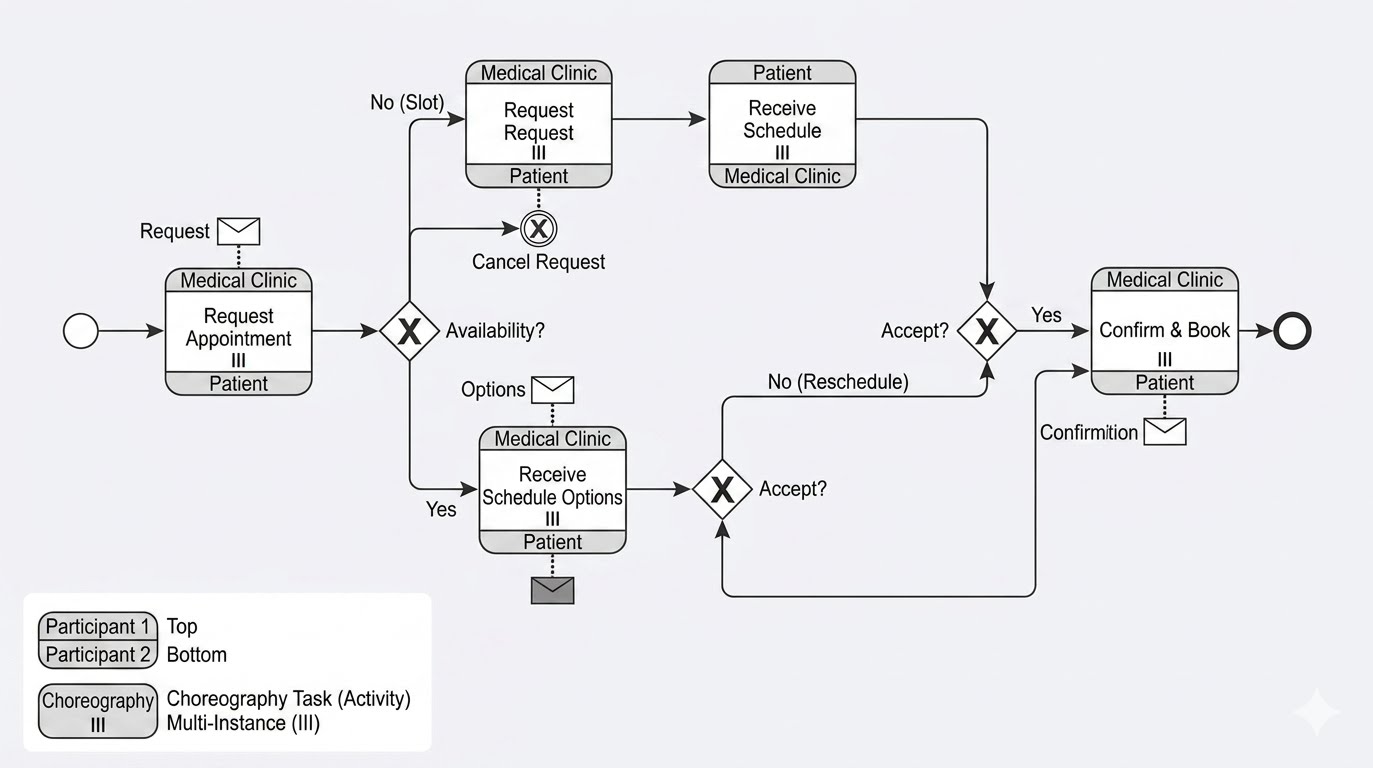
Phase 1: The Handshake
The process begins when the Patient (Initiator/White) sends a Request message to the Medical Clinic (Receiver/Gray) via the “Request Appointment” task.
-
Why Choreography? We don’t care if the patient uses a mobile app or calls a receptionist. We only care that a request was transmitted.
Phase 2: The Availability Fork
An Exclusive Gateway (Availability?) evaluates the clinic’s capacity.
-
Path A (No Slot): If no immediate slot exists, the flow moves to a Multi-Instance task: “Request Request.” Here, the Clinic iterates through alternative queues or subsystems. If all fail, a
Cancel Requestevent terminates the thread. -
Path B (Yes): If slots exist, the Clinic initiates the “Receive Schedule Options” task, sending an
Optionspayload back to the Patient.
Phase 3: Negotiation and Finalization
The Patient reviews the options at an “Accept?” gateway.
-
Reschedule Loop: If the patient rejects the times, the flow loops back to generate new options. This demonstrates how choreographies elegantly model negotiation cycles without showing the clinic’s internal calendar algorithm.
-
Confirmation: Upon acceptance, the final “Confirm & Book” task executes. The Clinic sends a
Confirmationmessage, and the process ends with a dark End Event ring.
Part 3: Why Standalone Choreographies Matter
For beginners, it might seem easier to just draw two pools and connect them with arrows. However, standalone choreographies offer distinct advantages:
-
System Interoperability: Perfect for SOA and Microservices architectures where you cannot see inside the partner’s system. You define the API contract visually.
-
Legal & SLA Compliance: Serves as a binding visual agreement. It proves exactly who is responsible for sending specific data at specific milestones, reducing liability disputes.
-
Cognitive Clarity: Eliminates the “spaghetti” of cross-pool message flows. Stakeholders focus purely on the interface, not the implementation.
Part 4: Accelerating Modeling with Visual Paradigm & AI
While understanding the theory is crucial, drawing these diagrams manually can be tedious. Visual Paradigm is a leading tool for BPMN, and its integrated AI features significantly lower the barrier to entry for beginners.
Recommended Workflow with Visual Paradigm AI
1. Text-to-Diagram Generation
Instead of dragging shapes manually, use Visual Paradigm’s AI Modeler.
-
Action: Describe your process in natural language: “Create a choreography diagram where a patient requests an appointment, the clinic checks availability, and if unavailable, offers alternative slots until accepted.”
-
Result: The AI generates a syntactically correct BPMN 2.0 choreography draft, including proper initiator/receiver band coloring and gateway placement.
2. Intelligent Validation
Choreography diagrams have strict rules (e.g., every task must have exactly two participants).
-
Feature: Use the Model Checker with AI assistance. It doesn’t just flag errors; it suggests fixes. If you accidentally make both bands white, the AI explains why this violates the spec and offers a one-click correction.
3. Documentation & Code Generation
-
Auto-Documentation: Generate stakeholder-ready PDFs that explain the “contract” in plain English, derived directly from the diagram metadata.
-
API Skeleton Generation: For technical teams, Visual Paradigm can export choreography tasks as OpenAPI/Swagger specifications, bridging the gap between business analysts and developers.
⚠️ Beginner Warning: AI is a powerful assistant, not a replacement for understanding. Always verify that the AI-generated initiator/receiver roles match your actual business intent. The AI understands syntax; you understand semantics.
Conclusion
BPMN Choreography Diagrams are the missing link in modern business process management. They provide a clean, neutral language for describing how independent systems and organizations collaborate. By focusing on the interaction rather than the implementation, you create models that are more durable, legally defensible, and technically actionable.
For beginners, the learning curve involves shifting your mindset from “what do I do?” to “what do we exchange?” Once you master the three-band task structure and the logic of message flows, you unlock the ability to design robust B2B integrations. Leveraging tools like Visual Paradigm with AI capabilities transforms this from a theoretical exercise into a rapid, practical skill—allowing you to turn complex contractual relationships into clear, executable blueprints in minutes rather than days.
Start small: pick a simple two-party interaction in your organization, model it as a choreography, and experience the clarity that comes from focusing purely on the contract.
Related posts:
 Q&A: Real Questions Tech Startups Ask About the Business Model Canvas (And Answers)
 The “No-Code” Approach to Building a Robust Business Model Canvas for MVPs
 Beyond Revenue Streams: Using the Business Model Canvas to Secure Series A Funding
 The Silent Killer: Ignoring Key Partnerships on Your Business Model Canvas