


Introduction
In the rapidly evolving landscape of modern software architecture, the bridge between an object-oriented domain model and a relational database remains one of the most complex layers to maintain. For decades, developers have grappled with the impedance mismatch between Java objects and SQL tables, often spending significant time writing, debugging, and optimizing raw SQL queries. As business logic grows in complexity, so does the difficulty of managing these database interactions manually.
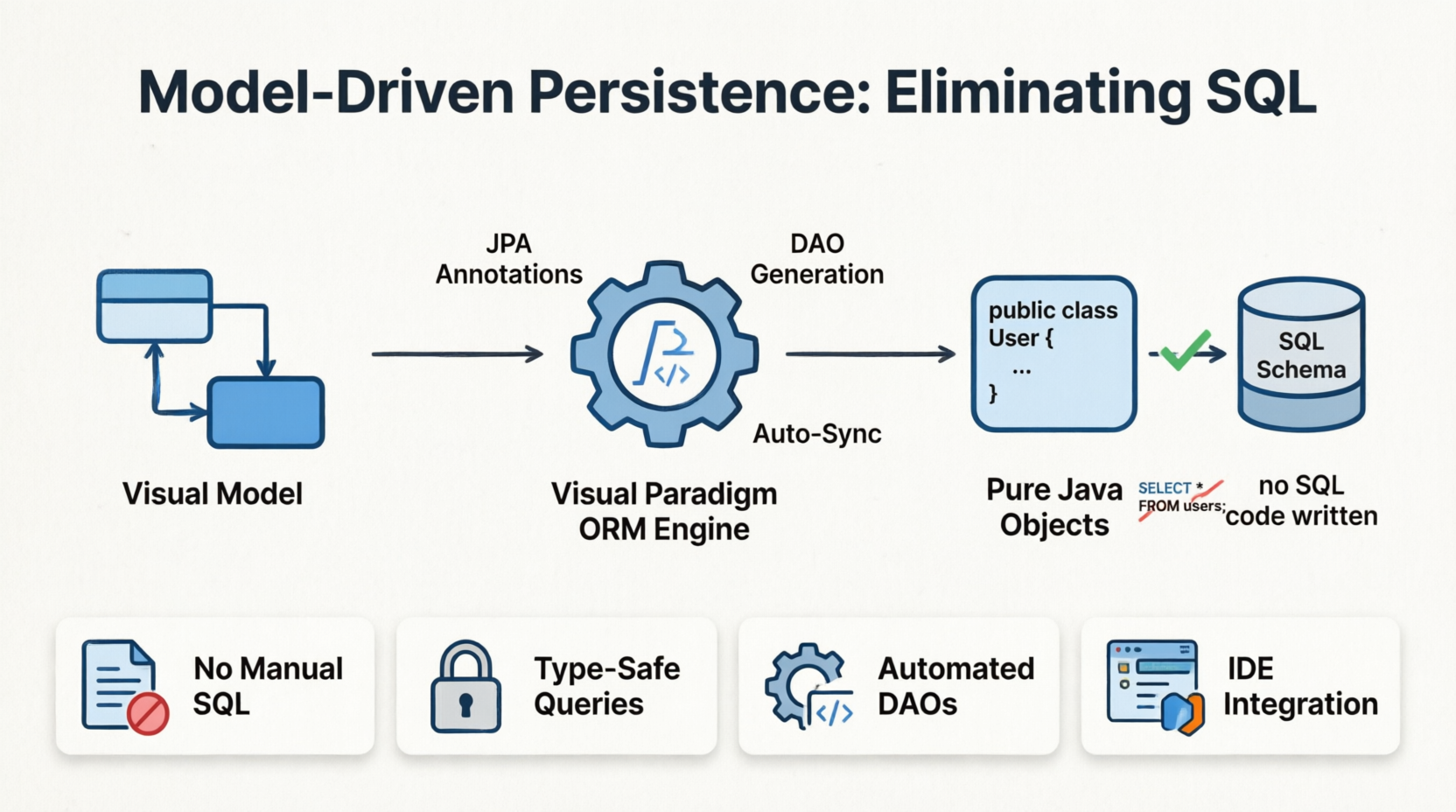
This case study explores a transformative approach to data persistence: SQL-less Database Programming. By leveraging Object-Relational Mapping (ORM) tools within Visual Paradigm, development teams can shift their focus from low-level database syntax to high-level domain modeling. This guide demonstrates how to design, generate, and manage a robust persistence tier using Hibernate and NHibernate, allowing developers to manipulate database records entirely through pure Java or .NET objects. The result is a cleaner codebase, reduced development time, and a seamless integration between visual modeling and executable code.
Java Object Persistence with Hibernate
SQL can be difficult to code and debug, and will only become more difficult as your schema and business logic become more complicated. Ever thought of manipulating database without writing a line of SQL? Our Object Relational Mapping (ORM) tool lets you achieve this.
Simply design database with our ERD tool (or to reverse engineer an ERD from the existing database). Then, generate Hibernate ORM mapping tier from the ERD, and that’s it! The generated object library allows you to access and manipulate database records entirely with pure Java objects. Bye SQL!

.NET Object Persistence with NHibernate
Forget the time and effort it takes to write and debug SQL. From now on, you can access database via persistable objects generated from ERDs and the NHibernate framework. Enjoy elegant coding – no more SQL, no more pain!

IDE Integration
Perform visual modeling and programming within a unified environment – your favorite IDE. Design system and database with class diagram and ERD, generate the persistable classes and program in the IDE. No switch between windows, no SQL, no hassle!

Popular IDEs supported (Eclipse/NetBeans/IntelliJ IDEA/Visual Studio/Android Studio)
Elevate your software development experience to a new level through its seamless integration with Eclipse, Visual Studio, NetBeans, IntelliJ IDEA and Android Studio.
Synchronize between ERD and UML class diagram
Generate class diagram from ERD and synchronizing changes between them, and vice versa.
Relate class model and data model with ORM diagram
Object-relational mapping diagram (ORM diagram) presents the mapping between classes and entities visually.
Hibernate code generation from existing database
Generate Hibernate ORM code from an existing database.
Support of Hibernate XML and JPA
Allow specifying how mapping information is to be stored.
Error handling
Allow specifying how error is being handled when occur.
Exception handling
Allow specifying how exception is being handled when occur.
Lazy collection initialization
Reduce database loading. Avoid objects from being loaded when the main object is loaded with the ‘lazy’ option.
Different association handling
Allow specifying the behavior of update when updating a bi-directional association.
Static methods, Factory, DAO and POJO support
Allow specifying the way objects can be retrieved with generated code.
Cache options
Improve performance by configuring second level cache.
Optional jar selection
Include optional libraries and JDBC drivers in generated orm.jar.
Generate code and servlet sample
Generate sample files that teaches you how to work with the generated code.
Generate JSP
Generate Java Server Page (JSP) sample.
Generate filter and Web App Descriptor
Generate the file web.xml essential in Web application development
Reverse engineer ORM model from Hibernate mapping files
Automatically form the ORM persistence model from generated Hibernate mapping files.
Mastering ORM Generation: A Guide to Visual Paradigm & Hibernate
In modern software architecture, the bridge between an object-oriented domain model and a relational database is often the most complex layer to maintain. Visual Paradigm (VP) provides a robust ORM (Object-Relational Mapping) generation engine that automates the creation of Java/Persistence classes, mapping files, and database schemas directly from your UML models.
1. Preparation: The Modeling Foundation
Before triggering the wizard, ensure your project is “Persistence Ready”:
-
Model Consistency: Ensure your UML Class Diagram or ERD is finalized.
-
The Persistable Mark: Only classes marked as “Persistable” (via the Class Specification or Stereotype) will be processed.
-
Synchronization: If you started with an ERD, use VP’s synchronization tool to map it to a Class Diagram first.
2. Configuring the Generation Wizard
Navigate to Tools > Hibernate > Generate Code… to open the Database Code Generation dialog.
Core Execution Settings
| Setting | Purpose | Recommended Choice |
|---|---|---|
| Generate | Defines the output (Code, DB, or both). | Code and Database |
| Language | The target programming language. | Java (standard) |
| Code To | The environment context. | Standalone (for most) |
| Framework | Mapping style. | JPA Annotations (Modern) |
3. Designing the Persistence Layer
The power of VP lies in its ability to dictate the architecture of your data access layer through a few toggle switches.
Architecture & API Patterns
Select a Persistent API that fits your project’s complexity:
-
DAO (with Interface): The “Gold Standard.” It generates interfaces and implementations, making your code unit-testable and easy to swap.
-
Static Methods: Best for rapid prototyping; CRUD operations are called directly on the entity (e.g.,
User.save()). -
Criteria API: Always enable Generate Criteria. This allows you to write type-safe queries in Java rather than raw HQL or SQL strings.
Error and Exception Handling
Don’t let your app fail silently.
-
Error Handling: Set this to Throw RuntimeException to avoid “Checked Exception” clutter while ensuring database failures are still caught.
-
Logging: Use Print to log4j for production environments to ensure database traces are captured in your standard logs.
4. Performance Tuning: Fetching & Associations
How your application handles data relationships determines its speed.
-
Lazy Collection Initialization: Set to Extra. This provides a middle ground where collections are lazy-loaded, but the framework handles the synchronization of bidirectional associations automatically.
-
Smart Association Handling: This is a “must-have” feature. It ensures that if you add an Item to a Category, the Category is automatically updated on the Item side, maintaining referential integrity in memory.
5. Advanced Refinements
Click the Advanced Settings button for granular control over the generated code’s “flavor”:
-
Collection Types: Choose
Setfor unique constraints orListfor ordered data. -
Date Mapping: Map temporal data precisely as
Date,Time, orTimestamp. -
ToString() Generation: Use Business Key or ID Only to avoid circular reference loops in your logs.
6. From Model to Database (DDL)
Under the Database Tab, you can bridge the gap to the physical world:
-
Export to Database: VP will generate the DDL and execute it against your target DB.
-
DB Mode: Use Update to evolve an existing schema or Drop & Create for a fresh development environment.
-
Sample Data: Check this to have VP insert test rows automatically based on your model attributes.
Summary Checklist for 2026 Standards
Framework: JPA (Annotations)
API: DAO with Interface
Fetching: Lazy (Extra)
Querying: Enable Criteria API
Validation: Enable Validator Annotations (Advanced Settings)
Conclusion
The transition from manual SQL scripting to model-driven ORM generation represents a significant leap forward in software engineering efficiency. By utilizing Visual Paradigm’s integrated tools, developers can eliminate the tedious and error-prone process of writing raw SQL, replacing it with intuitive visual modeling and automated code generation.
Whether working with Java/Hibernate or .NET/NHibernate, the ability to synchronize ERDs with UML class diagrams and generate robust DAOs ensures that the persistence layer remains consistent, maintainable, and performant. As demonstrated in this case study, adopting best practices such as using JPA annotations, implementing DAO interfaces, and leveraging lazy loading not only streamlines development but also future-proofs applications against the increasing complexity of modern data architectures. For teams looking to accelerate delivery without sacrificing quality, SQL-less database programming is no longer just a possibility—it is a strategic imperative.
References
- Visual Paradigm’s Hibernate ORM Tools Overview: This resource provides an overview of built-in tools designed for generating Hibernate ORM code, including entity classes, DAOs, and database schemas directly from UML models.
- How to Generate Hibernate ORM Code and Database Schema in Visual Paradigm: A technical guide offering step-by-step instructions for producing Hibernate-compatible code and schemas from visual models.
- Defining Custom Implementations for ORM in Visual Paradigm: This tutorial demonstrates how to customize ORM code generation by defining specific templates and implementations for Java entity and DAO classes.
- Streamlining Hibernate Implementation with Visual Paradigm: A comprehensive guide on using model-driven development to simplify Hibernate implementation and maintain synchronization with databases.
- How to Generate ORM Code from Class Diagram in Visual Paradigm: This resource explains the process of using UML class diagrams to generate Hibernate or JPA-compliant ORM code for efficient software development.
- Hibernate Criteria Tutorial for Java Developers: A practical tutorial focused on using the Hibernate Criteria API to build type-safe and dynamic database queries within Java applications.
- Generating ORM Models in Visual Paradigm: Detailed documentation explaining how to generate ORM models from existing databases to facilitate model-driven engineering.
- Generating ORM from Database in Visual Paradigm: Instructions on reverse-engineering a database to produce ORM models using integrated automation tools.
- Unlock the Power of Data Modeling with ERD Tool for ORM & Hibernate: This article highlights how the ERD tool supports ORM and Hibernate frameworks for seamless mapping and code generation.
- Hibernate Integration and Usage Guide: A specialized knowledge base resource covering Hibernate integration, configuration, and advanced features within the modeling environment.