

Now Reading: Visual Paradigm vs. Generic LLMs: A Guide to AI-Generated PlantUML Diagrams
-
01
Visual Paradigm vs. Generic LLMs: A Guide to AI-Generated PlantUML Diagrams



Visual Paradigm vs. Generic LLMs: A Guide to AI-Generated PlantUML Diagrams
In the evolving landscape of software architecture and system design, the integration of Artificial Intelligence has promised to streamline the creation of complex diagrams. However, relying on generic Large Language Models (LLMs) often introduces significant limitations, ranging from hallucinated syntax to static, uneditable outputs. Visual Paradigm (VP) addresses these specific challenges by providing a specialized ecosystem designed to enhance AI-generated PlantUML diagrams. This guide explores how Visual Paradigm combines architectural enforcement, a diverse range of diagram types, and seamless integration with professional modeling tools to solve the common hardships associated with generic AI tools.

Expanding Beyond Limited Diagram Types
One of the primary frustrations with basic PlantUML tools and generic LLMs is the restriction to a narrow set of formats. Visual Paradigm’s AI suite significantly expands this horizon, supporting a vast universe of specialized diagrams that cater to complex enterprise needs.
Full C4 Model Support
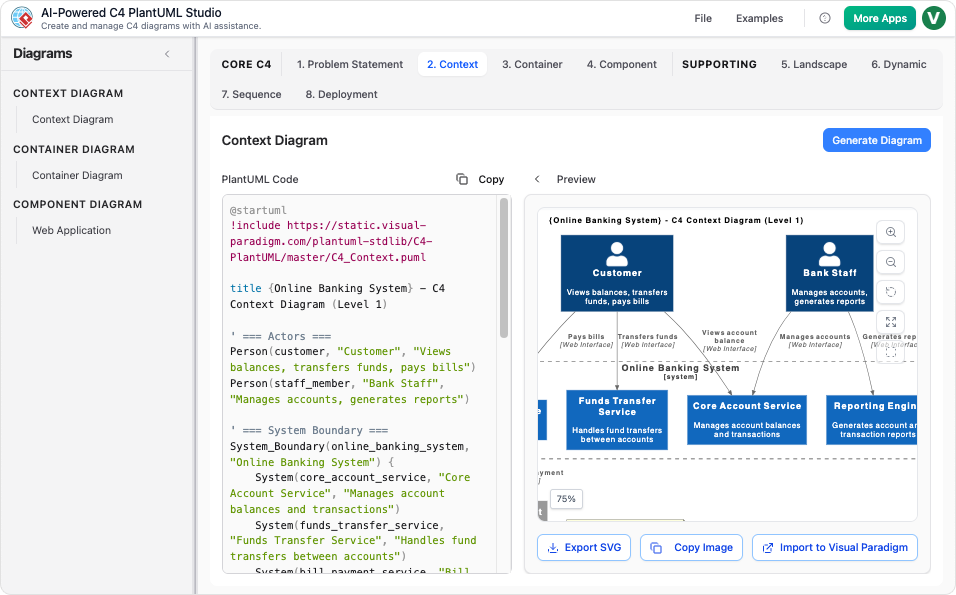
While generic LLMs often struggle to distinguish between different levels of architectural abstraction, Visual Paradigm’s AI is engineered to generate all six C4 views. This includes System Landscape, Dynamic, and Deployment diagrams, providing a comprehensive visual map of software architecture that goes beyond simple container diagrams.
Diverse Framework Support
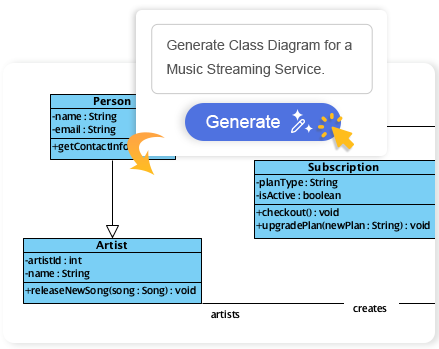
The capabilities extend well beyond the C4 model. The AI Diagramming Chatbot is equipped to handle standard technical modeling languages including UML, SysML, and ArchiMate. Furthermore, it supports over 20 different business strategy frameworks, such as Mind Maps, the Ansoff Matrix, and SWOT analysis, making it a versatile tool for both technical and strategic planning.
Specialized Logic for Hierarchies
Standard text editors often fail to manage the complexity of hierarchical software maps. VP addresses this with the C4-PlantUML Studio, which features an “Interactive Navigator” and a “Tabbed Workflow” specifically designed to handle nested structures and complex logic that generic tools cannot process effectively.
Eliminating Syntax and Compliance Errors
Generic LLMs operate on probabilistic text interpretation. While impressive, this approach frequently results in syntax errors, non-compliant notation, or code that simply refuses to render. Visual Paradigm eliminates this uncertainty through rigorous architectural enforcement.
- Built-in Compliance: The AI engine is trained specifically on official C4 standards. This ensures that every box, label, and relationship automatically adheres to correct notation, removing the burden of manual validation.
- High Accuracy Generation: By utilizing specialized tools, VP achieves 95%+ accuracy in converting natural language into PlantUML code. This high degree of precision significantly reduces the time developers spend debugging broken code generated by less specialized AI.
- Structured Workflows: To prevent logical inconsistencies, the tool enforces a dependency flow. For instance, the system requires a user to select a parent Container before generating a nested Component diagram, ensuring the model remains logically sound.
Solving the “Hard-to-Edit” Problem
A major bottleneck in using AI for diagrams is the output format. Generic models often produce static images or raw text that is cumbersome to modify. Visual Paradigm transforms this into a dynamic, iterative process.
Conversational Refinement
Users are not forced to rewrite code manually to make changes. Instead, they can employ natural language commands to refine the model. Commands such as “Add a Kafka container for event streaming” or “Rename component X to Y” are processed instantly, updating both the visual model and the underlying code.
Live Preview and Hybrid Editing
The C4-PlantUML Studio provides instant visual feedback by displaying the rendered diagram adjacent to the code. This setup supports a hybrid editing approach, allowing users to switch between text-based code editing for precise version control and visual drag-and-drop interfaces for layout adjustments.
Bridge to Professional Modeling
For diagrams requiring deep technical refinement or enterprise-level management, Visual Paradigm offers a clear path from AI generation to professional execution.
- Direct Import: AI-generated diagrams are not siloed; they can be imported directly into VP Desktop or Online. Once imported, users have absolute manual control to adjust layouts, add custom attributes, and link models to other enterprise standards.
- Version Control Integration: Because diagrams are generated as valid PlantUML code, they are inherently ready for version control. Teams can manage these artifacts via Git and integrate them into CI/CD pipelines, effectively treating documentation as living code.
Summary: The Architectural Difference
To understand the distinction between these approaches, consider this analogy: Using a generic LLM for architectural diagrams is comparable to hiring a general artist to draw a blueprint. The artist might create something that looks like a house, but it likely lacks the structural calculations required for a building permit. Conversely, using Visual Paradigm is like utilizing an AI-powered architectural CAD system. It understands the “building codes” (C4 and UML standards), ensures the “pipes and wires” (relationships) are logically connected, and provides a professional suite of tools to finalize the construction once the initial draft is complete.

