
Introduction
In the complex world of software architecture and system design, the difference between project success and failure often hinges on having the right modeling tools. While Unified Modeling Language (UML) has become the universal language for software visualization, the tools you choose to implement it can make or break your development workflow. Many teams struggle with diagramming tools that offer surface-level functionality but lack the depth needed for enterprise-scale projects, resulting in disconnected diagrams, lost traceability, and wasted development time.
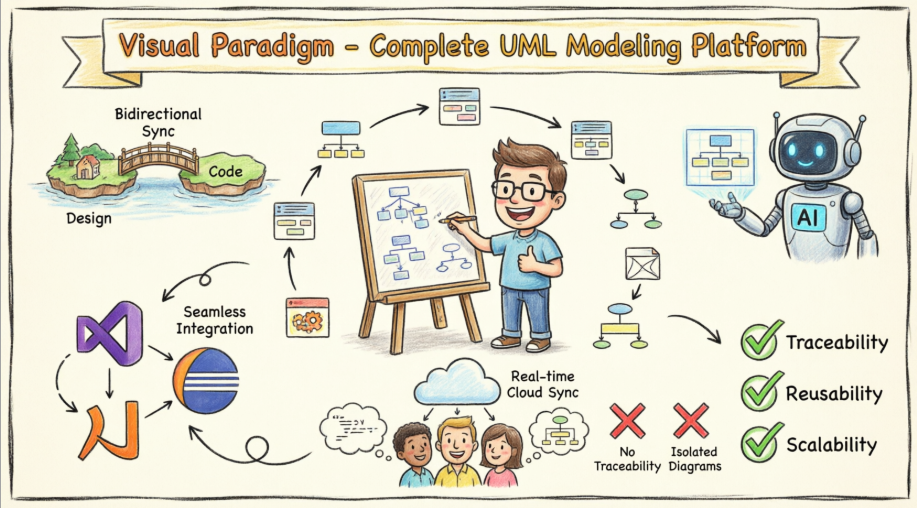
Visual Paradigm emerges as a comprehensive solution that transcends traditional diagramming software. It’s not merely a tool for drawing boxes and arrows—it’s an intelligent modeling ecosystem that bridges the gap between conceptual design and working software. From AI-powered diagram generation to seamless IDE integration, from agile backlog management to automated code engineering, Visual Paradigm provides the sophisticated toolset that modern development teams demand. This guide explores how Visual Paradigm transforms the way organizations approach software modeling, offering features that scale from individual developers to enterprise teams working on mission-critical systems.
Getting Started with Visual Paradigm


Why Visual Paradigm Stands Out
UML (Unified Modeling Language) has become the widely used industry standard for modeling software systems. However, we need good process and modeling tool support to unleash the full power of visual modeling capability provided by UML. The business world is complex, dynamic, and fast-changing, and there is no “one-size-fits-all” methodology. Visual Paradigm provides a rich variety of UML design tools for developers to pick and match for today’s challenging projects.
-
Previous Slide◀︎ Next Slide▶︎

A comprehensive UML tool that supports latest UML 2.x diagrams and notations.
Key Capabilities at a Glance:
-
Best UML Tool for Visual Modeling
-
Class Diagram
-
Integrate UML with BPMN
-
Create Product Backlog from Use Case Model
-
Use Case Scenario Sequence Diagram Generation
-
Wireframe in Use Case
-
IDE Integration
-
Synchronization between ERD and UML Class Diagram
-
Document Generation
-
Communicate Software Design
-
Online Sequence Diagram Tool
Understanding the Challenges: Why Traditional Tools Fall Short
Before exploring solutions, it’s crucial to understand the pain points that development teams face with conventional diagramming tools:
Performance and Scalability Limitations
Web or cloud-based diagrammers may seem attractive initially with zero configuration, but they perform poorly in terms of capabilities on enterprise-scale features when modeling complex diagrams.
Critical Issues with Conventional Tools:
❌ No Model Reusability
A model (such as a class) created in one diagram cannot be referenced elsewhere within the diagram as a view (referenced shape) or in other diagrams, let alone sharing among model elements in different projects—making them unsuitable for enterprise-scale modeling.
❌ Zero Traceability
All diagrams become separate pieces of work without any traceability among them, creating silos of information that are difficult to maintain and synchronize.
❌ Limited Development Support
No strong supporting toolset to unleash the full power of UML for serving different activities required in software development such as teamwork, agile development, UX modeling, code engineering, and enterprise project management.
❌ Drawing vs. Modeling
Diagramming tools like Visio are only suitable for drawing simple diagrams and lack good editing features for complex diagram layout and modification. What you get is a set of standalone diagrams that aren’t powerful enough to scale with the entire software development process.
Visual Paradigm: The Comprehensive Solution
1. Excellent Visual Modeling Toolset
Unlike other UML diagramming tools with very limited support in UML notations, Visual Paradigm supports the latest UML 2.x standard with 14 different types of diagrams, plus related visual modeling standards such as:
-
BPMN (Business Process Model and Notation)
-
Mind maps
-
Project Management Toolset (ArchiMate, Fishbone, PERT, Gantt, WBS, Radar Chart, and many more!)
2. Integrate UML with Agile/Scrum Process
Apply use case modeling seamlessly with agile development by integrating use cases with story maps for backlog management and release planning.
Key Agile Features:
-
Send multiple sources of visual models (requirements) to agile product backlog such as identifying requirements from use cases, activities in UML Activity Diagram, tasks or activities from BPMN, or nodes from mind map diagrams
-
Identify large requirements such as use cases and transform them into a set of manageable user stories or epics at your choice, accommodating them in a manageable story map structure
-
Once you transform use cases into related user stories, they can be further broken down into tasks and subsequently managed automatically by the task manager
3. Code Engineering Toolset
Bridge the gap between design and implementation with powerful code engineering capabilities:
-
Generate code from class and state diagrams for popular programming languages
-
Generate database from ERDs and subsequently to class diagrams, seamlessly mapping objects to relational databases using the Hibernate framework (supporting the most popular databases in the market)
-
Integrate Visual Paradigm with leading IDEs including Visual Studio, IntelliJ, NetBeans, Eclipse, and Android Studio
4. Inter-Model Traceability
Maintain consistency across your entire project ecosystem:
-
Support model traceability through model references (one model with multiple views), sub-diagrams model elaboration, reference visual models across multiple projects, annotations, and reference attachments
-
Generate sequence diagrams or activity diagrams from use case scenarios
-
Elaborate use case scenarios with wireframe tools
-
Identify classes from sequence diagrams and relate models to one another through the Model Transitor feature
5. On-Demand Report Designer
Communicate your designs effectively to stakeholders:
-
Simply drag & drop model elements or diagrams created to compose your own reports and output them to desirable formats such as Word, PDF, or HTML
-
Alternatively, embed model elements or diagrams from the Visual Paradigm project into the content of your corporate reports or documents with the Fill-in Documentation Composer
6. Team Collaboration
Work together seamlessly, regardless of location:
-
Your team can concurrently edit the UML project with automatic version control, modification merge, and conflict resolution
-
Share, discuss, and comment on diagrams or models online over the cloud through the PostMania feature
-
Attach and classify references and documents into a handy, visual File Cabinet
7. Web Diagrams and Samples Online
Access your models from anywhere:
-
The first phase of Web Diagram online feature is in place (including BPMN, business process Diagram, ArchiMate® Diagram, class diagram, use case diagram, sequence diagram, flow chart, PERT, ITIL, AWS, and Microsoft Azure diagram). All existing Visual Paradigm users can take advantage of web diagrams online with no additional cost
-
Try sample diagrams online in the Visual Paradigm Community Circle by importing them straight to your application for learning and experimentation, or adopt off-the-shelf templates for solving your problems
Comprehensive UML Diagram Support
Visual Paradigm supports all 14 UML 2.x diagram types, each designed for specific modeling purposes.
Use Case Diagram
Capture functional requirements with the UML use case diagram tool. Each use case in a use case diagram represents a high-level business goal that yields a measurable result of business value. UML Actors are connected with use cases to represent the roles that interact with the functions.

Class Diagram
The UML modeling tool lets you model the structure of a system by modeling its classes, their attributes, and operations in a UML class diagram. The UML class diagram is a blueprint of the classes (code level) required to build a software system. Programmers implement a software system with the help of both the class diagram and the class specification.

Sequence Diagram
Visualize the interactions between users, systems, and sub-systems over time through message passing between objects or roles. If the class diagram represents the skeleton of classes by showing their attributes and methods, the UML sequence diagram completes the classes by representing the programming logic to be filled in methods’ bodies.

Communication Diagram
Collaboration between objects at runtime can be modeled in the UML tool with a UML communication diagram. In a communication diagram, objects, called lifelines, are connected to represent the need for communication during the execution of an interaction. Messages can be added on top of the connectors to list the calls made from and to those lifelines.

Activity Diagram
Use the UML activity diagram, a flowchart-based diagram, to model the flow of control. Partition actions according to the type of participant involved.

State Machine Diagram
The state machine diagram is a critical design model for event-driven systems. A well-designed state machine shows accurately the essential states of objects as well as the triggers of state change, which facilitates the development of error-free state machines.

Component Diagram
Component diagrams are used to model the structure of systems by showing how small parts of the system gear up in forming a bigger part, or forming the entire software system.

Deployment Diagram
Model the physical deployment of software components with the UML deployment diagram. In a deployment diagram, hardware components (e.g., web server, mail server, application server) are presented as nodes, with the software components that run inside the hardware components presented as artifacts.

Package Diagram
Arrange and organize models for large-scale projects with package diagrams. Package diagrams are also good for visualizing structure and dependency between sub-systems or modules.

Object Diagram
View a snapshot of instances of classifiers in UML class diagrams. Similar to class diagrams, object diagrams show the static design of a system from a prototypical perspective.

Composite Structure Diagram
Visualize the internal structure of a class or collaboration with the UML composite structure diagram. Model a system from a micro point-of-view using the UML composite structure diagram.

Timing Diagram
Timing diagrams model the behavior of objects throughout a given period. It is a commonly used UML tool for designing real-time and distributed systems. Just drag to move a time unit back and forth. Have a timing frame updated automatically according to your change.

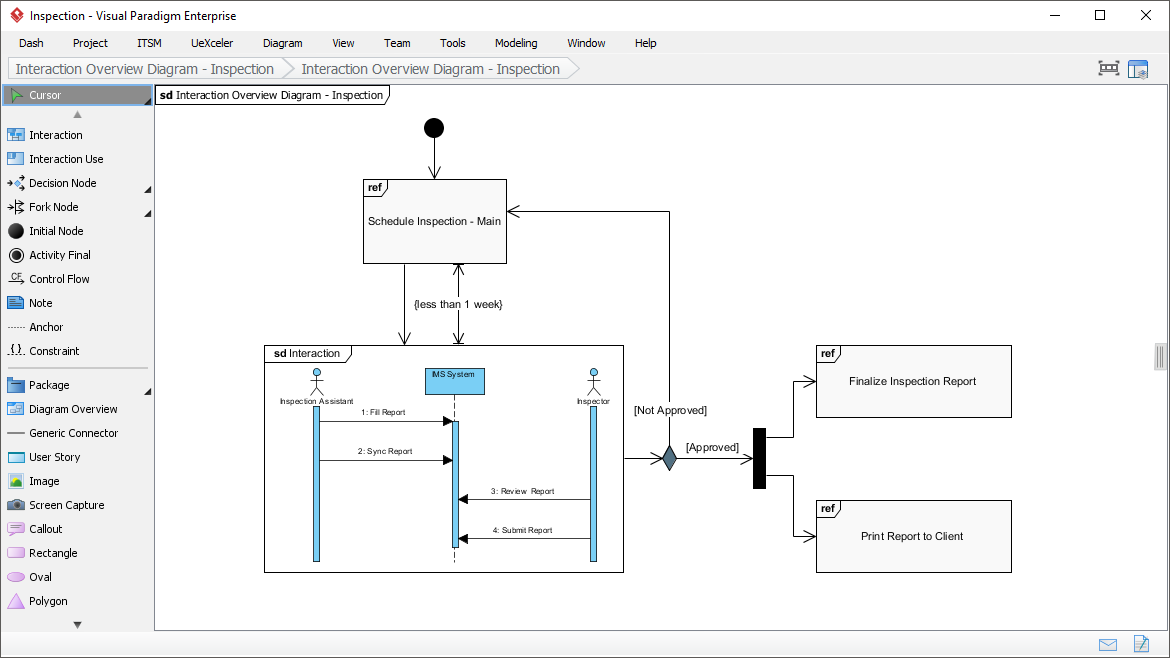
Interaction Overview Diagram
View the sequence of interactions with the UML interaction overview diagram. The interaction overview diagram helps represent complex scenarios that involve multiple interactions presented as multiple UML sequence diagrams.
Profile Diagram
A visual way to define stereotypes to use in your project. Draw stereotypes, define their tags and their inter-relationships like generalizations and associations. Specify formatting options like background color and icons.

Advanced Modeling Features
Model Element Referencing

Add diagrams, shapes, model elements as internal references
Make internal links between different kinds of project artifacts. Those references work both in Visual Paradigm and in any document and Web contents generated from your design.
Add business documents as external references
Maintain reference between software design and business documents to help find out why a design decision was made.
Mark in shape body when reference is added
Glance over a design. The tiny marker that appears in shapes’ bodies indicates that the shapes have references added.
Reference model element in description
Insert model element references to rich text descriptions. The referenced model elements will be linked and highlighted.
Architecture Meets Intelligence: AI-Powered UML Modeling
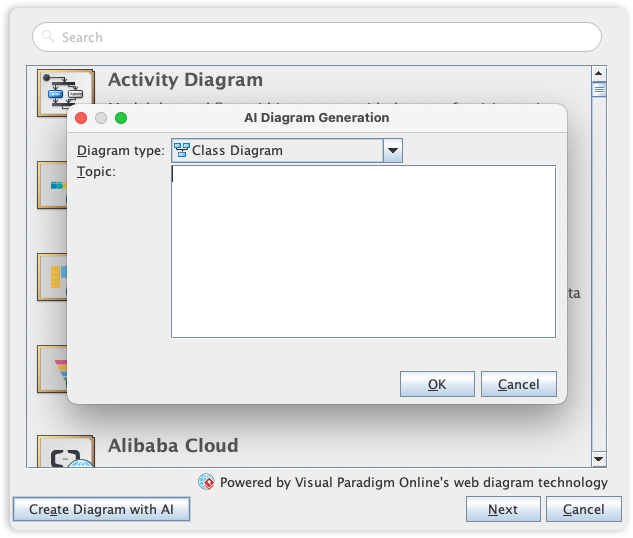
Visual Paradigm’s UML toolset is the industry standard for software modeling, offering the full range of diagrams needed to bridge the gap between requirements and implementation. We are now elevating the entire modeling experience by integrating comprehensive UML support into our AI Diagram Generator, enabling you to visualize system behavior and structure with unprecedented speed.
This capability allows you to instantly generate a wide array of UML diagrams—including Use Case, Class, Sequence, State Machine, Requirement, and Object Diagrams—from a simple textual description. By leveraging AI to interpret your system requirements, the tool automatically maps out the necessary entities, relationships, and interactions, allowing you to move directly to design validation and architectural refinement instead of starting from a blank canvas.
Quick Access Resources
Conclusion
Visual Paradigm represents a fundamental shift from conventional diagramming tools to a comprehensive visual modeling platform that supports the entire software development lifecycle. By addressing the critical limitations that plague traditional tools—isolated diagrams, poor scalability, lack of traceability, and insufficient development integration—Visual Paradigm empowers development teams to create, maintain, and evolve complex software systems with unprecedented efficiency and confidence.
The platform’s comprehensive support for all 14 UML 2.x diagram types, combined with seamless agile integration, powerful code engineering capabilities, AI-powered diagram generation, and robust team collaboration features, makes it an indispensable asset for modern software development. Whether you’re architecting enterprise-scale systems, adopting agile methodologies, or seeking to bridge the gap between business requirements and technical implementation, Visual Paradigm provides the sophisticated toolset needed to transform visual models into working software systems.
In an era where software complexity continues to accelerate and development cycles demand ever-greater speed without sacrificing quality, having a modeling platform that scales with your needs while maintaining consistency, traceability, and seamless integration is not merely advantageous—it’s essential. Visual Paradigm delivers precisely that comprehensive solution, establishing itself as the premier choice for professional software modeling and design in today’s competitive development landscape.
References
- AI-Powered Visual Modeling and Design Solutions: This resource highlights AI-driven tools for visual modeling and diagramming that accelerate software development workflows.
- AI Textual Analysis – Transform Text into Visual Models Automatically: AI identifies system elements from unstructured descriptions to automatically generate UML diagrams, such as class and use case models.
- AI-Powered UML Class Diagram Generator: This tool utilizes AI-assisted automation to generate accurate UML class diagrams directly from natural language input.
- Mastering UML Activity Diagrams with AI: This article explores how AI features enhance the creation and optimization of UML activity diagrams for developers and analysts.
- Visual Paradigm – AI-Powered UML Sequence Diagrams: This resource explains how to generate professional UML sequence diagrams instantly using AI within a modeling suite.
- AI-Powered Use Case to Activity Diagram Tutorial: A step-by-step guide demonstrating how to automatically convert use case descriptions into detailed activity diagrams using AI automation.
- The Future of Modeling: AI and UML Diagram Generation: This analysis discusses how artificial intelligence is transforming UML diagram creation by streamlining complex modeling tasks.
- AI-Powered Component Diagrams with Visual Paradigm Chatbot: This article details how the AI chatbot simplifies component diagram creation by transforming natural language into precise models.
- UML Package Diagram: Structuring Your Codebase with AI: A guide on using AI to aid in structuring systems, managing dependencies, and maintaining scalable software architecture through UML package diagrams.
- How AI Chatbot Can Help You Learn UML Faster: This blog post explains how AI assistants support interactive UML learning by providing real-time feedback and visualizing concepts instantly.