
Venture capital is a business of probability and pattern recognition. While many founders focus on product features or market size, experienced investors look deeper. They scrutinize the foundational architecture of the startup. One of the most effective tools for this scrutiny is the Business Model Canvas (BMC). It is not merely a one-page diagram; it is a strategic framework that reveals the logic of how an organization creates, delivers, and captures value. For early-stage teams, the canvas serves as a litmus test for operational maturity and strategic alignment.
When venture capitalists review a pitch deck, they often pivot to the business model immediately. The canvas condenses complex operational realities into nine building blocks. This allows investors to quickly identify gaps in the team’s planning, potential execution risks, and the scalability of the proposed solution. Understanding how top-tier firms utilize this tool provides founders with a clearer roadmap for preparation.
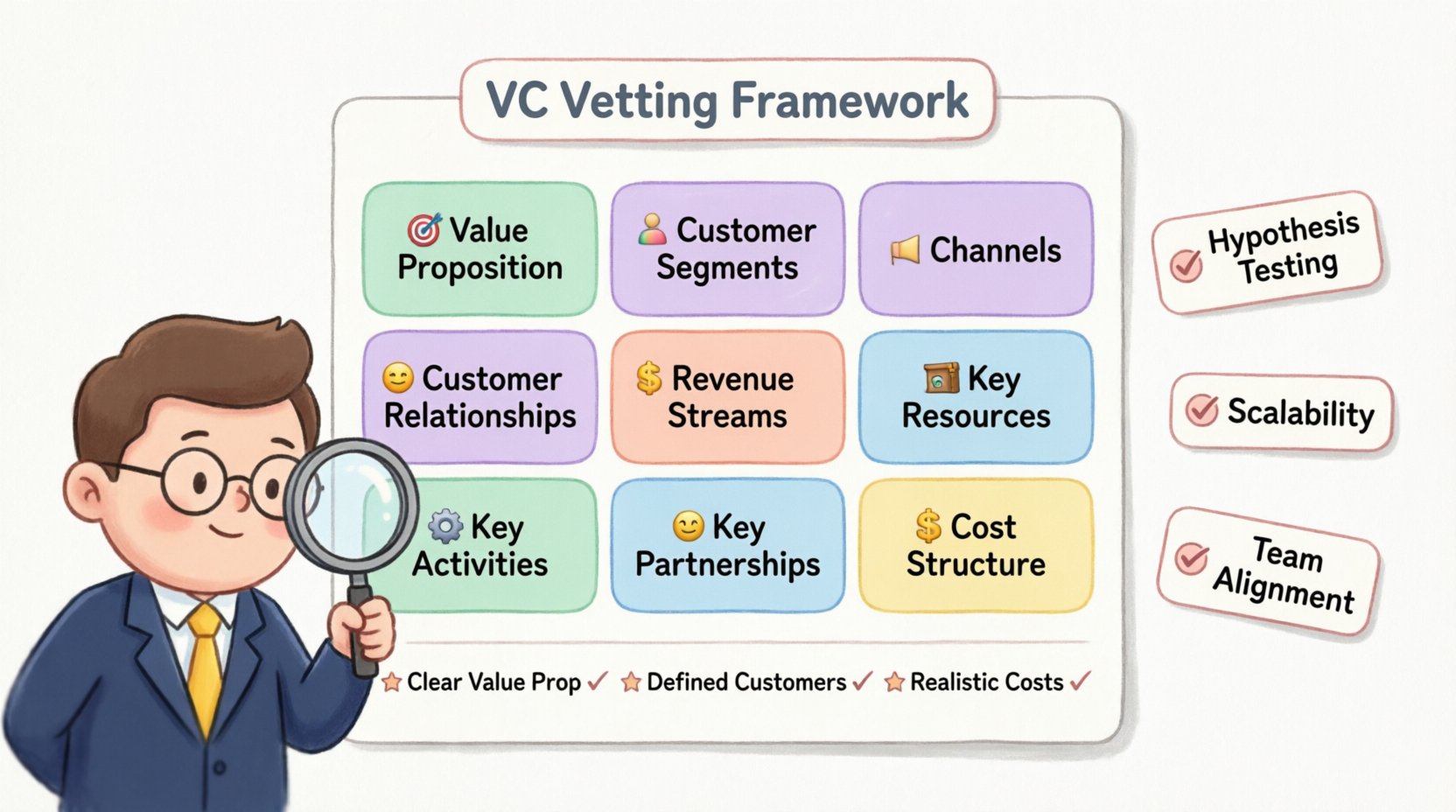
🧠 The VC Perspective on the Business Model Canvas
To an investor, the Business Model Canvas represents a set of hypotheses. Each block is an assumption about the market that requires validation. Early-stage startups are defined by uncertainty. The canvas helps VCs map that uncertainty. It forces the founding team to articulate assumptions that might otherwise remain unspoken.
- Hypothesis Testing: Every element on the canvas is a bet. VCs assess the confidence level of these bets based on the team’s experience.
- Resource Allocation: It shows where the team plans to spend time and money. Misallocation is a common failure point.
- Scalability Indicators: The model reveals if the business relies heavily on manual effort or if it can grow without linear cost increases.
Top investors do not expect perfection at the seed stage. They expect clarity. A well-constructed canvas demonstrates that the founders understand the mechanics of their business beyond the technology itself.
🔍 Deconstructing the 9 Blocks for Due Diligence
The canvas consists of nine distinct modules. Each module offers specific insights into team capability and market fit. Here is how venture capitalists analyze each section during the vetting process.
1. Value Proposition 🎯
This block defines the bundle of products and services that create value for a specific customer segment. Investors look for specificity.
- Problem-Solution Fit: Is the value proposition solving a real pain point or a nice-to-have? VCs prioritize acute problems.
- Unfair Advantage: Does the value proposition rely on proprietary technology, network effects, or exclusive partnerships? If it is easily replicable, the risk increases.
- Clarity: Can the team explain the value in one sentence? If the founders struggle to define the core benefit, the product may lack focus.
2. Customer Segments 👥
Who are the most important people or organizations the business serves? Early-stage teams often make the mistake of targeting “everyone.” VCs penalize this approach.
- Niche Focus: Successful early ventures often dominate a small market before expanding. The canvas should reflect a specific beachhead.
- Accessibility: Does the team understand the demographics and behaviors of these customers? A lack of customer insight suggests a higher risk of product-market misfit.
- Segmentation Strategy: Are there distinct segments with different needs? The canvas should show how the team plans to prioritize these segments.
3. Channels 📢
How does the company communicate with and reach its customer segments to deliver the value proposition? This block highlights go-to-market competence.
- Customer Acquisition Cost (CAC): The chosen channels dictate the cost of acquiring a user. VCs analyze if the projected channels are cost-effective.
- Integration: How well do the channels integrate with the customer journey? Disconnected channels lead to friction and churn.
- Team Expertise: Does the founding team have prior experience in these channels? A tech founder trying to sell via cold calling without sales experience raises red flags.
4. Customer Relationships 🤝
What type of relationship does each customer segment expect? This defines the customer experience and retention strategy.
- Retention Mechanism: Is the relationship automated, personal, or community-based? High-touch models require more headcount than low-touch models.
- Support Structure: How does the team plan to handle inquiries and issues? A lack of support planning indicates a lack of operational foresight.
- Lifetime Value (LTV): Strong relationships drive higher LTV. Investors look for models that encourage long-term engagement.
5. Revenue Streams 💰
For what value are customers really willing to pay? This block assesses the economic viability of the business.
- Pricing Models: Subscription, transactional, licensing, or freemium? The model must align with customer expectations.
- Revenue Recognition: How and when is revenue recognized? This impacts cash flow management.
- Profitability Path: When does the model become profitable? VCs use this to estimate the runway required for the company to reach sustainability.
6. Key Resources 🏗️
What key resources does the value proposition require? These are the physical, intellectual, human, or financial assets needed to make the business work.
- Team Composition: Does the current team possess these resources? If the business requires AI expertise but the team is purely marketing-focused, a gap exists.
- Asset Ownership: Does the company own its data and IP, or does it rely on third-party platforms? Dependency on external platforms increases risk.
- Funding Requirements: How much capital is needed to secure these resources? This informs the investment ask.
7. Key Activities ⚙️
What key activities do the value proposition require? These are the most important things a company must do to make its business model work.
- Operational Focus: Is the focus on production, problem-solving, or platform management? The team should be aligned with the primary activity.
- Execution Capability: Can the team execute these activities efficiently? A software team that cannot ship code is a major liability.
- Scalability: Do the activities become more efficient as volume increases? Manual-heavy activities limit growth.
8. Key Partnerships 🤝
Who are the key suppliers and partners? This block explores the network that surrounds the business model.
- Strategic Alliances: Are there partnerships that provide leverage or distribution? VCs look for partners that add strategic value.
- Outsourcing: Which functions are outsourced? Understanding the division of labor helps assess control and risk.
- Supply Chain Stability: Are there dependencies on single suppliers? Diversification reduces risk.
9. Cost Structure 💸
All costs incurred to operate a business model. This block ensures financial discipline.
- Fixed vs. Variable: Is the cost structure lean? High fixed costs require high utilization to survive.
- Burn Rate: How does the cost structure impact the monthly burn? This determines the funding timeline.
- Efficiency: Can costs be optimized as revenue grows? Investors want to see a path to margin expansion.
👥 The Team Connection: Vetting Human Capital
The title of this guide focuses on vetting teams. The Business Model Canvas is a mirror that reflects the team’s capability. A mismatch between the canvas and the team is a common reason for funding rejection.
Alignment Analysis
Investors compare the Key Activities and Key Resources against the founding team’s background.
- Technical Gap: If the canvas requires complex engineering but the team lacks technical co-founders, the risk is high.
- Sales Gap: If the Channels require aggressive outbound sales but the team is product-focused, execution will stall.
- Domain Knowledge: Do the founders have specific industry experience relevant to the Customer Segments?
Execution History
Venture capitalists also look at past performance relative to the canvas.
- Previous Ventures: How did the team handle similar blocks in the past?
- Adaptability: Did they pivot the canvas when data suggested a change? Flexibility is a key trait.
- Resource Management: How did they manage Cost Structures previously? Did they stay within budget?
⚠️ Risk Assessment via the Canvas
The canvas highlights where the business model is fragile. VCs use it to stress-test the startup.
| Building Block | Common Risk Indicator | VC Mitigation Strategy |
|---|---|---|
| Value Proposition | Generic solution for a common problem | Require data on user retention and willingness to pay |
| Customer Segments | Targeting too broad a market | Ask for a defined beachhead strategy and traction metrics |
| Key Activities | Reliance on manual processes | Review automation roadmap and technical debt |
| Cost Structure | High fixed costs early on | Analyze cash runway and break-even timeline |
| Revenue Streams | Unclear monetization path | Request unit economics and pricing sensitivity analysis |
| Key Partnerships | Dependency on single vendor | Assess contract terms and alternative supplier options |
🛠️ Common Mistakes Founders Make
Even experienced founders stumble when applying the canvas. Identifying these errors helps teams avoid them.
1. Misaligned Blocks
The Value Proposition does not match the Revenue Streams. For example, offering a free tool but expecting to charge for basic features creates friction. Investors spot this inconsistency immediately.
2. Ignoring Costs
Founders often focus on revenue and ignore the Cost Structure. A business that generates revenue but loses money on every unit is not sustainable. VCs scrutinize the unit economics derived from this block.
3. Static Planning
Some teams treat the canvas as a static document. In reality, it is a living artifact. Markets change, and the canvas must evolve. Investors prefer teams that update their models based on feedback rather than sticking to an initial plan.
4. Lack of Evidence
Statements on the canvas must be backed by data. Claiming a certain Customer Segment exists without validation is a red flag. VCs look for surveys, interviews, or beta usage data.
📈 Iteration and Validation
The canvas is a tool for learning, not just presentation. Top VCs encourage teams to use it for rapid iteration.
- Canvas Workshops: Regular sessions where the team revisits the canvas to incorporate new learnings.
- Experimentation: Changing one block (e.g., Channels) to test a new hypothesis without rebuilding the whole model.
- Feedback Loops: Integrating customer feedback directly into the Value Proposition and Customer Relationships.
This iterative approach demonstrates to investors that the team is agile. It shows they value truth over ego. A founder who can admit a block is wrong and pivot is more valuable than one who insists on an incorrect model.
🌐 Future-Proofing the Model
Scalability is a major concern for venture capital. The canvas helps visualize the path from startup to scale-up.
Infrastructure Readiness
Does the Key Resources block support growth? Cloud infrastructure, automated support systems, and scalable hiring plans must be in place. Investors check if the operational backbone can handle 10x or 100x growth.
Network Effects
Does the model create value as more users join? This is often reflected in Customer Relationships and Channels. Businesses with network effects command higher valuations because they create barriers to entry.
Global Expansion
Can the Channels and Customer Segments expand geographically? The canvas should outline how localization will be handled without exploding the Cost Structure.
📋 Due Diligence Checklist for Founders
Before pitching, founders should review their canvas against this checklist to ensure readiness.
- Is the Value Proposition specific and measurable?
- Are the Customer Segments clearly defined with data?
- Do the Channels align with where customers actually search?
- Is the Pricing Model tested and validated?
- Does the team have the resources to execute Key Activities?
- Are the Cost Structures transparent and realistic?
- Are Key Partnerships documented with LOIs or contracts?
- Is the model updated with the latest market data?
🔗 Integrating the Canvas into the Pitch
While the canvas is internal, it often informs the external pitch deck. VCs appreciate when the narrative aligns with the visual model.
- Storytelling: Use the flow of the canvas to structure the pitch deck narrative.
- Transparency: Be open about risks identified in the Cost Structure or Partnerships. Hiding risks destroys trust.
- Visual Aid: Including a simplified version of the canvas in the appendix can show depth of thought without cluttering the main deck.
Investors respect founders who understand their own business model intimately. When the canvas is clear, the conversation shifts from “Can they do it?” to “How fast can they do it?”
🎓 Final Thoughts on Strategic Alignment
The Business Model Canvas is more than a planning tool; it is a communication device between founders and investors. It translates abstract ideas into concrete operational plans. For venture capitalists, it is a diagnostic tool that reveals the health and potential of an early-stage team.
By understanding how to vet teams through this framework, founders can better prepare for scrutiny. They can identify weaknesses before investors do and fortify their strategy. The goal is not to create a perfect document, but to demonstrate a rigorous approach to building a business. When the canvas reflects deep thought, clear strategy, and honest assessment of capabilities, it opens the door to partnership.
Successful investing is about backing teams that can navigate uncertainty. The canvas maps that uncertainty. It highlights the path forward and the obstacles in the way. A team that masters the logic of the canvas is a team that is ready to build a scalable, enduring company.