
Design patterns serve as the foundation for robust software architecture. Among the creational patterns, the Singleton pattern is frequently discussed, yet often misunderstood. It guarantees that a class has only one instance, providing a global point of access to it. While this sounds beneficial for managing resources, it introduces significant challenges regarding global state management. This guide explores the mechanics of the Singleton pattern, the risks associated with global state, and strategies to mitigate these issues within Object-Oriented Analysis and Design.
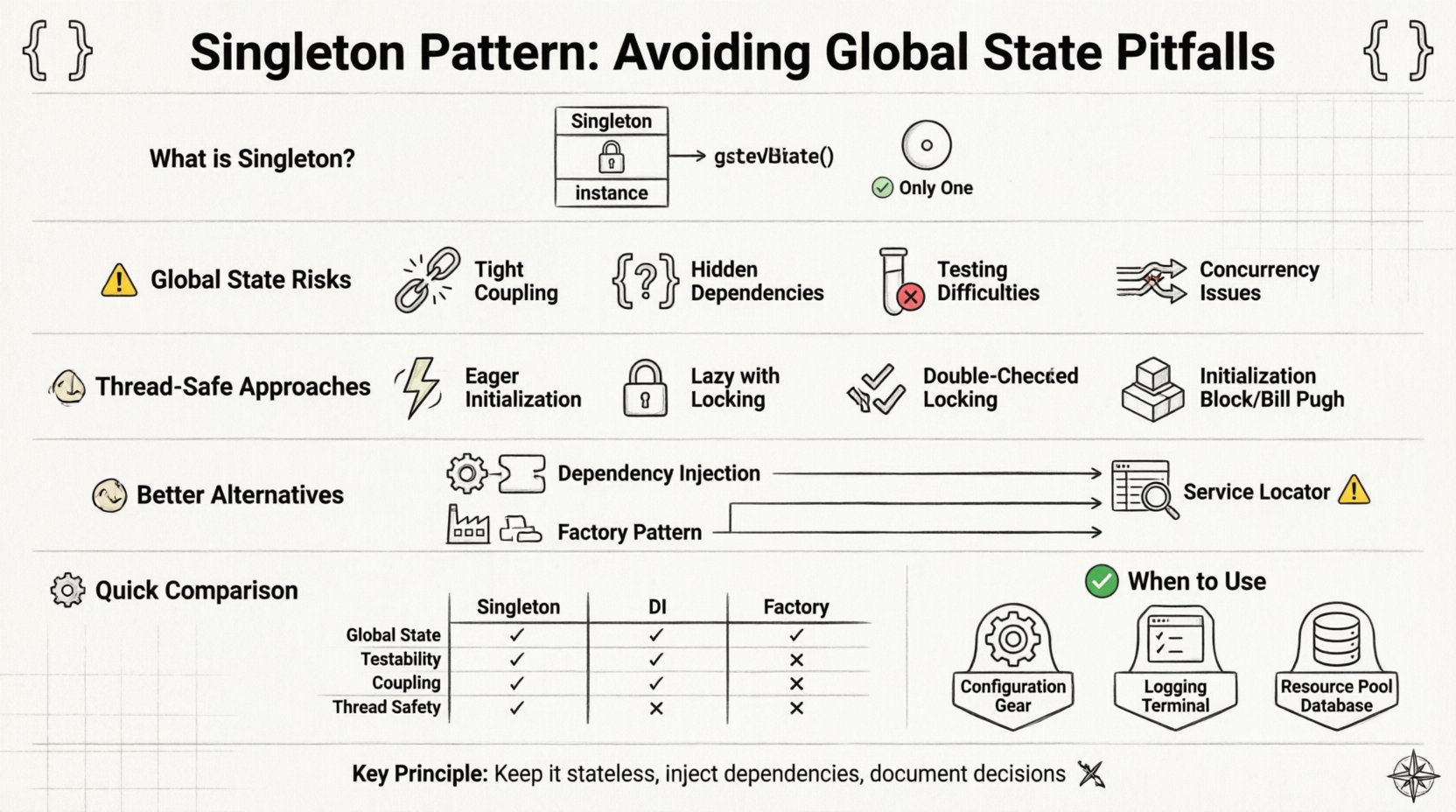
🧩 Understanding the Singleton in OOP
The Singleton pattern ensures that a class has only one instance and provides a global point of access to it. In Object-Oriented Analysis and Design, this is often used for managing configurations, connection pools, or logging services. The core requirement is strict control over instantiation.
- Private Constructor: Prevents external instantiation using the
newkeyword. - Static Instance: Holds the reference to the single object within the class.
- Public Accessor: A static method that returns the instance.
While the implementation seems straightforward, the architectural implications extend far beyond a single method call. The pattern effectively creates a global variable, which is a specific type of global state. Global state refers to any data or resource that is accessible from anywhere in the system, regardless of the scope of the calling code.
🚫 The Hidden Cost of Global State
Global state is often cited as an anti-pattern in modern software engineering. While the Singleton pattern is not inherently evil, it exacerbates the problems associated with global state. Understanding these problems is the first step toward mitigating them.
1. Tight Coupling
When a class depends on a Singleton, it relies on a concrete implementation rather than an abstraction. This makes the code rigid. If the requirements change and you need to swap the implementation, every class that references the Singleton must be updated. This violates the Dependency Inversion Principle.
2. Hidden Dependencies
Dependencies are best made explicit. With a Singleton, the dependency is implicit. A method may call a Singleton without indicating in its signature that it requires a specific resource. This makes the code harder to read and understand. New developers must trace the entire call stack to discover what resources are being used.
3. Testing Difficulties
Testing is the most significant casualty of global state. When a unit test runs, it expects the system to be in a known state. If a Singleton holds mutable state from a previous test, the current test may fail unpredictably. Resetting a Singleton often requires breaking encapsulation or using reflection, which introduces fragility into the test suite.
4. Concurrency Issues
In multi-threaded environments, accessing a shared instance without proper synchronization can lead to race conditions. If the Singleton is initialized lazily, two threads might attempt to create the instance simultaneously, resulting in multiple instances being created. This breaks the core contract of the pattern.
⚡ Implementing Thread-Safe Singletons
To use the Singleton pattern safely, one must address concurrency. There are several approaches to ensure thread safety without compromising performance.
- Eager Initialization: The instance is created when the class is loaded. This is inherently thread-safe because class loading is synchronized by the runtime environment. However, it may waste resources if the instance is never used.
- Lazy Initialization with Locking: The instance is created on first access. A lock ensures only one thread creates it. This is simple but can be a performance bottleneck if the accessor is called frequently.
- Double-Checked Locking: Checks if the instance exists before acquiring a lock. This reduces locking overhead but requires careful handling of memory barriers to prevent reordering issues.
- Initialization Block: Using a static block or an inner static helper class (Bill Pugh solution) ensures thread safety without explicit locks. The JVM handles the synchronization during class loading.
Each method has trade-offs. Eager initialization is simple but inflexible. Double-checked locking is efficient but complex. The Initialization Block is often the recommended approach for static singletons.
🔄 Alternatives to the Singleton Pattern
Given the pitfalls of global state, many architects prefer alternatives that achieve similar goals without the drawbacks. These patterns promote loose coupling and easier testing.
1. Dependency Injection (DI)
Dependency Injection is the standard alternative. Instead of a class fetching a Singleton directly, the Singleton (or the service it represents) is passed into the class, usually via a constructor. This makes the dependency explicit and allows the consumer to receive a mock or stub during testing.
Example Logic:
- Define an Interface for the service.
- Create a concrete implementation.
- Register the implementation with a Container or pass it manually.
- Inject the interface into the class that needs it.
2. Service Locator
A Service Locator is a registry of services. A class asks the locator for a service rather than creating it. While this reduces coupling compared to direct Singleton access, it still hides dependencies. It is often considered a variant of the Anti-Service Locator anti-pattern.
3. Factory Pattern
A Factory creates objects. If the Factory ensures only one object is ever created and caches it, it mimics Singleton behavior. However, the Factory itself can be injected, allowing the logic to be swapped or mocked without affecting the client code.
📊 Comparison of State Management Approaches
The following table summarizes the trade-offs between managing state via Singleton, Dependency Injection, and Factory patterns.
| Feature | Singleton | Dependency Injection | Factory |
|---|---|---|---|
| Global State | High | Low | Medium |
| Testability | Low | High | Medium |
| Thread Safety | Requires Manual Handling | Managed by Container | Managed by Implementation |
| Coupling | Tight | Loose | Loose |
| Performance | Fast (Direct Access) | Variable (Injection Overhead) | Variable (Factory Overhead) |
📦 Managing State for Testability
If you must use a Singleton, you must ensure it can be tested. This requires treating the Singleton as a resource that can be reset or replaced.
- Use Interfaces: Always depend on an interface, not the concrete Singleton class. This allows you to inject a mock implementation.
- Reset Mechanisms: Provide a static method to clear the instance. This should be used only in test environments to ensure state isolation between test cases.
- Scope Management: In web applications, manage the lifecycle of the Singleton per request or session if it holds user-specific data. A true Singleton should not hold transient user data.
Consider the scenario where a Singleton holds a database connection. If the test suite runs multiple tests that modify the database, the state persists. Using a DI container allows you to provision a new connection for each test, ensuring isolation.
🛠️ Refactoring Singletons to Avoid Global State
Refactoring a legacy system to remove global state requires a systematic approach. You cannot simply delete the Singleton without breaking the application.
- Identify Dependencies: List all classes that directly call the Singleton.
- Introduce an Interface: Create an interface that defines the methods used by the Singleton.
- Implement the Interface: Ensure the Singleton implements this interface.
- Inject the Interface: Modify the dependent classes to accept the interface via constructor or setter injection.
- Wire the Instance: At the application entry point, instantiate the Singleton and pass it to the root objects.
- Verify: Run the test suite to ensure behavior remains consistent.
This process transforms a hidden dependency into an explicit one. It increases code clarity and reduces the risk of side effects.
⚖️ When to Use Singletons
Despite the risks, Singletons are still appropriate in specific scenarios. The key is to limit their scope and usage.
- Configuration Managers: Reading settings at startup is a common use case. Since configuration rarely changes during runtime, the global access is acceptable.
- Logging Systems: A centralized logging mechanism often benefits from a single point of control to manage output streams and formatting.
- Resource Pools: Connection pools or thread pools need to manage a finite set of resources. A Singleton ensures the pool is shared efficiently across the application.
In these cases, the state is minimal or immutable. The Singleton manages the resource, not the business logic. This distinction is crucial. A Singleton that contains business logic is a code smell.
🔒 Security Considerations
Global state introduces security risks. If a Singleton holds sensitive data, such as encryption keys or authentication tokens, it becomes a high-value target. Any code in the system can access it.
- Least Privilege: Ensure that only necessary components have access to the Singleton.
- Data Isolation: Do not store user-specific data in a process-level Singleton. Use session-specific storage instead.
- Encryption: If sensitive data must be stored, ensure it is encrypted at rest and in memory.
📉 Performance Implications
Using a Singleton can improve performance by reducing the overhead of object creation. However, this benefit is often negligible in modern environments where object allocation is cheap. The cost of locking for thread safety can outweigh the savings of a single instance.
Furthermore, if the Singleton holds state that is frequently modified, it can become a bottleneck. Multiple threads accessing the same object may contend for locks, reducing throughput. In high-concurrency systems, stateless services are often preferred over stateful Singletons.
🧭 Architectural Guidelines
To maintain a clean architecture, adhere to these guidelines when dealing with Singletons:
- Keep it Stateless: Prefer Singletons that act as managers or coordinators rather than holders of data.
- Limit Scope: If possible, use a Request-Scope or Session-Scope instead of Application-Scope.
- Document Usage: Clearly document why a Singleton is used. If the reason is “it makes it easy to access,” that is not sufficient justification.
- Avoid Nested Singletons: Do not create Singletons that depend on other Singletons. This creates a web of hidden dependencies.
By following these principles, you can leverage the benefits of the Singleton pattern while minimizing the risks associated with global state. The goal is not to ban the pattern entirely, but to use it with intention and discipline.
🔍 Final Thoughts on Implementation
The decision to use a Singleton should be architectural, not incidental. It requires a clear understanding of the lifecycle of the data it manages. When global state is unavoidable, it must be managed with the same rigor as any other shared resource. Synchronization, isolation, and testability must be built into the design from the start.
Modern frameworks often provide built-in mechanisms for managing single instances through dependency injection containers. These tools abstract the complexity of thread safety and lifecycle management, allowing developers to focus on business logic. Leveraging these tools is generally safer than implementing a custom Singleton.
Ultimately, the health of a software system depends on its maintainability. Code that relies heavily on global state is difficult to maintain, refactor, and extend. By prioritizing explicit dependencies and controlled state, you build systems that are resilient and adaptable to change.