
Entering a software engineering role requires more than just coding syntax knowledge. It demands a deep understanding of how systems are structured, analyzed, and designed before a single line of code is written. Object-Oriented Analysis (OOA) forms the backbone of modern software development lifecycles. It focuses on modeling the system using objects and their interactions.
During technical interviews, candidates are frequently tested on their grasp of OOA principles. Interviewers look for clarity in thought, the ability to apply theoretical concepts to real-world scenarios, and an understanding of how data flows through a system. This guide provides a comprehensive look at the most common questions, what they aim to uncover, and how to structure a professional response.
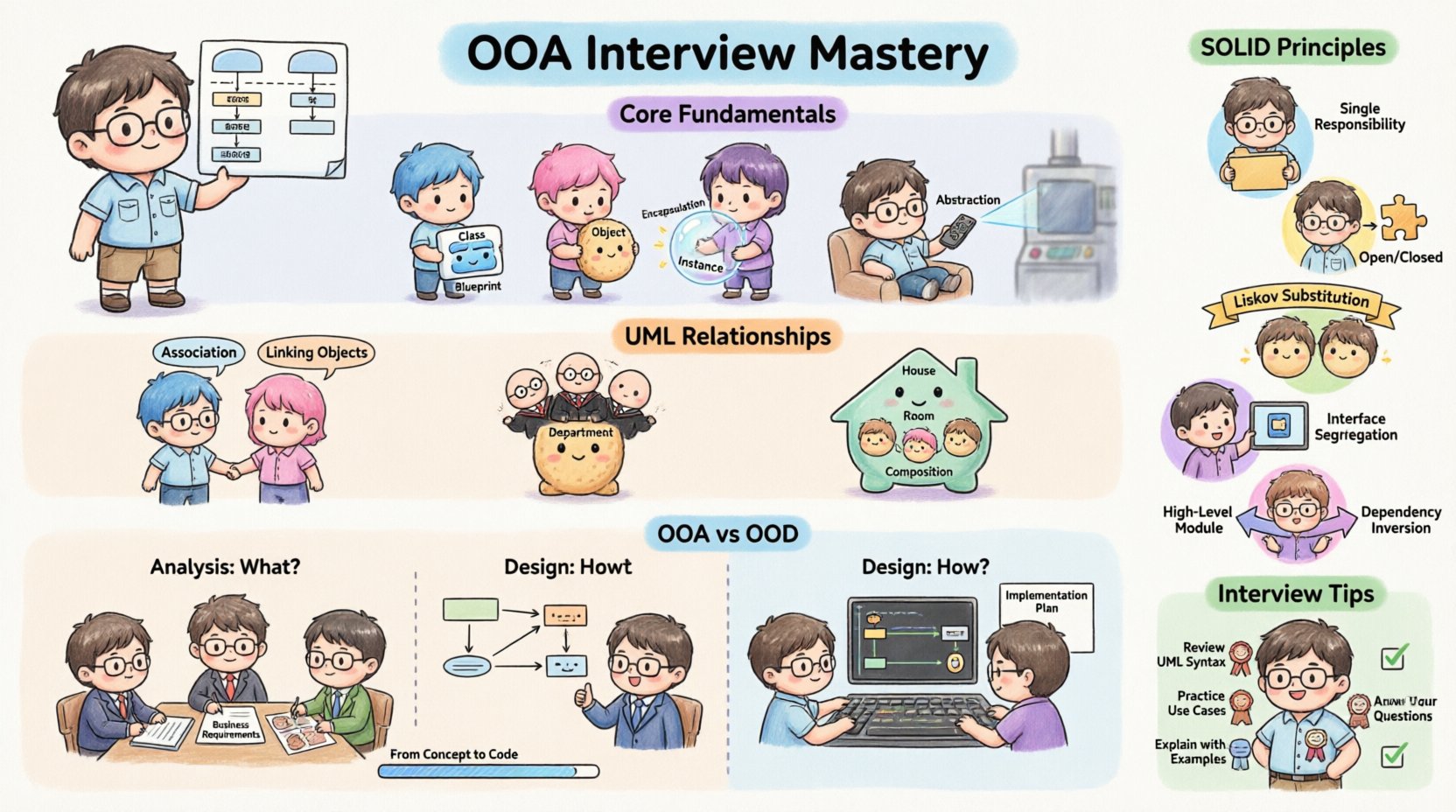
1. Core Fundamentals of Object-Oriented Analysis 🧱
Before diving into complex diagrams, every candidate must demonstrate a firm grasp of the basic building blocks. These questions verify that you understand the terminology and the philosophical approach behind OOA.
Q1: What is Object-Oriented Analysis, and how does it differ from Functional Analysis?
Interviewer Intent: They want to see if you understand the paradigm shift from process-oriented thinking to object-oriented thinking.
Key Points to Cover:
- Definition: OOA is the process of identifying objects and their relationships to define system requirements.
- Focus: It focuses on what the system does rather than how it does it initially.
- Contrast: Functional Analysis focuses on data flow and processes. OOA focuses on the behavior of objects.
- Outcome: OOA results in a conceptual model that serves as the blueprint for design.
Q2: Explain the difference between a Class and an Object.
Interviewer Intent: This is a classic question to test basic terminology accuracy.
Key Points to Cover:
- Class: A blueprint or template. It defines the structure (attributes) and behavior (methods) common to all instances.
- Object: An instance of a class. It is the concrete realization of the blueprint at runtime.
- Analogy: Think of a Class as a cookie cutter and Objects as the actual cookies made from it.
- Memory: Classes exist as definitions in code, while objects occupy memory space.
Q3: Why is Encapsulation considered a cornerstone of OOA?
Interviewer Intent: To assess your understanding of data security and modularity.
Key Points to Cover:
- Definition: Encapsulation bundles data and methods into a single unit (the class).
- Access Control: It restricts direct access to some of an object’s components (private vs public).
- Benefit: It protects the internal state from unintended modification.
- Maintainability: Changes to internal implementation do not affect external code, reducing coupling.
Q4: How do you define Abstraction in the context of OOA?
Interviewer Intent: Testing your ability to separate interface from implementation.
Key Points to Cover:
- Concept: Abstraction hides complex implementation details and shows only essential features.
- Interface: Users interact with an interface without knowing the underlying logic.
- Use Case: A remote control allows you to change channels without knowing how the TV processes the signal.
- Implementation: Achieved via abstract classes or interfaces in code.
2. Relationships and UML Modeling 📊
Visual communication is vital in software engineering. You must be able to articulate how objects relate to one another using standard notation.
Q5: Describe the difference between Association, Aggregation, and Composition.
Interviewer Intent: This is a critical distinction. Confusing these terms often signals a lack of depth in OOA knowledge.
Key Points to Cover:
- Association: A general structural relationship. One object is connected to another.
- Aggregation: A “has-a” relationship where the lifecycle of the child is independent of the parent. (e.g., A Department has Professors, but Professors exist without the Department).
- Composition: A stronger “owns” relationship where the child cannot exist without the parent. (e.g., A House has Rooms; if the House is destroyed, the Rooms cease to exist).
- Visuals: UML uses different arrows or diamonds to denote these strengths.
Q6: When should you use Inheritance versus Composition?
Interviewer Intent: “Favor composition over inheritance” is a common adage. They want to know if you follow best practices.
Key Points to Cover:
- Inheritance: Use for “is-a” relationships. It promotes code reuse but creates tight coupling.
- Composition: Use for “has-a” relationships. It offers more flexibility and easier testing.
- Risk: Deep inheritance hierarchies can become fragile and difficult to maintain.
- Strategy: Start with composition. Move to inheritance only when the relationship is strictly hierarchical.
Q7: Which UML diagrams are most useful during the Analysis phase?
Interviewer Intent: Checking your knowledge of the toolset used for documentation.
Key Points to Cover:
- Use Case Diagrams: Define actor interactions and system goals.
- Class Diagrams: Show static structure, attributes, and relationships.
- Sequence Diagrams: Illustrate object interactions over time.
- State Machine Diagrams: Describe the lifecycle of an object.
- Note: Activity diagrams are also common for workflow analysis.
Q8: What is Polymorphism, and how does it benefit system design?
Interviewer Intent: To test understanding of flexibility and extensibility.
Key Points to Cover:
- Definition: The ability of different objects to respond to the same method call in different ways.
- Types: Compile-time (Overloading) and Runtime (Overriding).
- Benefit: Allows for code that is generic and handles various types without changing the interface.
- Example: A base
Animalclass with aspeak()method, implemented differently byDogandCat.
3. Design Principles and Patterns 🛠️
Analysis leads to Design. Understanding the principles that guide good design is essential for senior-level roles.
Q9: Explain the SOLID Principles briefly.
Interviewer Intent: A standard benchmark for software quality.
Key Points to Cover:
- Single Responsibility Principle: A class should have one reason to change.
- Open/Closed Principle: Open for extension, closed for modification.
- Liskov Substitution Principle: Subtypes must be substitutable for base types.
- Interface Segregation Principle: Clients should not be forced to depend on interfaces they do not use.
- Dependency Inversion Principle: Depend on abstractions, not on concretions.
Q10: How do you handle changing requirements in an OOA model?
Interviewer Intent: To assess your approach to flexibility and maintainability.
Key Points to Cover:
- Abstraction: Use interfaces to decouple logic from implementation.
- Modularity: Break the system into small, independent components.
- Documentation: Keep models updated to reflect changes.
- Communication: Regularly validate assumptions with stakeholders.
4. Scenario-Based Questions 🧩
Real-world application is where theory meets practice. These questions simulate actual work environments.
Q11: Scenario: Design a system for a Library Management System. Identify the key classes.
Interviewer Intent: Evaluating your ability to extract objects from a narrative.
Key Points to Cover:
- Identify Entities: Book, Member, Librarian, Loan, Fine.
- Attributes: Book (ISBN, Title), Member (ID, Name).
- Relationships: Member borrows Book. Librarian manages Loans.
- Logic: A Book can be borrowed by multiple Members over time.
- Constraints: A member can only borrow a certain number of books.
Q12: Scenario: You need to design a Payment Gateway. How do you handle different payment methods?
Interviewer Intent: Testing polymorphism and the Strategy Pattern.
Key Points to Cover:
- Abstraction: Create a base
PaymentMethodinterface. - Implementation: Create specific classes for
CreditCard,PayPal,Crypto. - Benefit: Adding a new payment method does not require changing existing payment logic.
- Context: The system processes the payment via the interface, unaware of the specific type.
5. Comparison Table: OOA vs OOD ⚖️
Understanding the distinction between Analysis and Design is crucial for clarity during interviews.
| Feature | Object-Oriented Analysis (OOA) | Object-Oriented Design (OOD) |
|---|---|---|
| Focus | Problem Domain | Solution Domain |
| Goal | What the system must do | How the system will do it |
| Artifacts | Use Case Models, Domain Models | Class Diagrams, Sequence Diagrams |
| Language | Business Terminology | Programming Constructs |
| Stakeholders | Users, Business Analysts | Developers, Architects |
6. Preparation Tips for Candidates 🎯
To succeed in these interviews, preparation goes beyond memorizing definitions. It requires practicing articulation and understanding the “why” behind the concepts.
Review Your Projects
- Look at code or diagrams you have worked on previously.
- Identify where you used OOA principles.
- Be ready to explain trade-offs you made during design.
Practice Drawing Diagrams
- Whiteboard sessions are common.
- Practice drawing Class and Sequence diagrams quickly.
- Ensure your notation is standard (UML).
Understand the Business Context
- Don’t just talk about code. Talk about value.
- Explain how your design choices improve user experience or system stability.
- Relate technical constraints to business goals.
7. Common Pitfalls to Avoid 🚫
Even experienced engineers stumble on specific points. Avoid these common mistakes to maintain a professional image.
- Confusing Analysis with Design: Do not jump straight to implementation details when asked about requirements.
- Ignoring Non-Functional Requirements: Security, performance, and scalability are part of OOA.
- Over-Engineering: Don’t suggest complex patterns for simple problems. Simplicity is preferred.
- Vague Terminology: Be precise. Use terms like “Aggregation” correctly, not as synonyms for “Connection”.
- Lack of Examples: Abstract concepts are harder to sell without concrete examples.
8. Advanced Concepts & Questions 🔍
For senior roles, expect questions that probe deeper into architecture and scalability.
Q13: What is the role of a Domain Model in OOA?
Answer: The Domain Model represents the business concepts and their relationships. It serves as the bridge between business language and technical implementation. It is technology-agnostic.
Q14: How do you handle circular dependencies in your models?
Answer: Circular dependencies indicate tight coupling. I analyze the responsibility of each class to ensure single responsibility is met. I might introduce an intermediary interface or event-driven mechanism to break the cycle.
Q15: Describe the process of creating a Use Case.
Answer: I identify the actor, the goal, and the pre-conditions. Then, I outline the main flow, alternative flows, and post-conditions. This ensures all interaction paths are documented.
9. Final Thoughts on OOA Mastery 🌟
Object-Oriented Analysis is not a static set of rules; it is a mindset for organizing complexity. The ability to model a system effectively demonstrates that you can think clearly under pressure.
When answering interview questions, structure your thoughts logically. Start with the definition, explain the application, and provide an example. This triad of theory, practice, and illustration is the most robust way to communicate technical competence.
Remember that the goal of OOA is to reduce risk. By analyzing the system thoroughly before coding, you minimize the cost of changes later in the lifecycle. Keep this perspective in mind during discussions, as it aligns you with business goals.
10. Quick Reference Checklist ✅
Before your interview, ensure you can answer these core prompts without hesitation:
- Define OOA and its primary output.
- Distinguish between Class and Object.
- Explain Encapsulation, Abstraction, Inheritance, and Polymorphism.
- Differentiate Association, Aggregation, and Composition.
- List the SOLID principles and their purpose.
- Draw a basic Class Diagram from memory.
- Explain a time you refactored a design for better maintainability.
Preparation is the key to confidence. By understanding these questions and the principles behind them, you position yourself as a candidate who brings value to the engineering team from day one.