
Executive Summary
The TOGAF Guide-Through Approach is a specialized methodology and software solution, primarily delivered by Visual Paradigm, designed to simplify the execution of the Architecture Development Method (ADM) defined in the TOGAF standard. Traditional implementations often struggle with complexity, leading to “blank canvas anxiety” among architects. The Guide-Through approach transforms this challenging process into an interactive wizard, breaking the 10-phase ADM cycle into manageable, sequential steps. It acts as an intelligent co-pilot, integrating forms, instructions, and automated deliverables directly into the workflow to ensure consistency, reduce error rates, and accelerate enterprise architecture delivery.
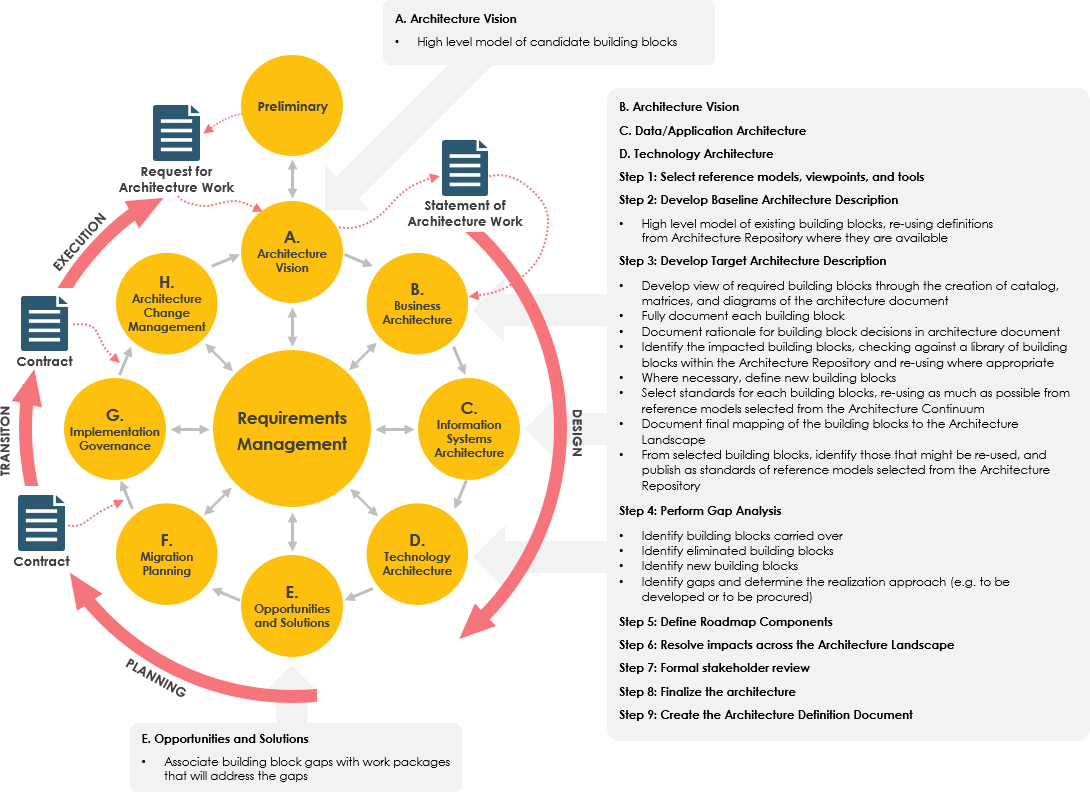
1. Understanding the Traditional Challenges
Before exploring the solution, it is essential to understand the痛点 (pain points) of traditional TOGAF implementation:
-
Complexity Overload: The standard’s 10 phases and numerous activities can overwhelm even experienced practitioners.
-
Manual Fragmentation: Reliance on separate spreadsheets, manual drawing, and disjointed documentation tools often leads to missed steps and inconsistent artifacts.
-
Resource Intensity: A significant portion of time is spent on technical syntax, diagramming, and formatting rather than strategic decision-making.
-
Learning Curve: Junior architects often lack the experience to navigate the full ADM cycle without constant supervision.
2. The Guide-Through Methodology: Core Features
The Guide-Through approach solves these issues by functioning as a comprehensive interactive wizard that guides users step-by-step through the ADM.
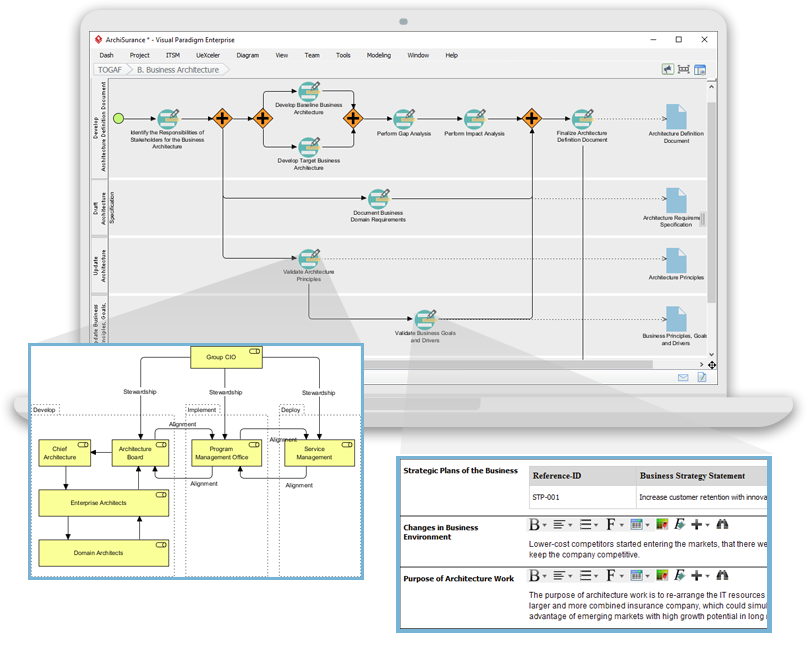
2.1 Step-by-Step Navigation (The Process Navigator)
Unlike reading a static book, this method utilizes a Process Navigator that acts as a dynamic roadmap.
-
Next Steps: It explicitly tells the user exactly what activity to perform next.
-
Milestones: It tracks progress, ensuring that no phases or specific deliverables within a phase are skipped.
-
Contextual Awareness: The tool adapts the workflow based on the current phase and the specific enterprise context.
2.2 Built-in Actionable Guidance
To lower the barrier to entry, the tool provides immediate support:
-
Inline Instructions: Detailed explanations appear within the specific activity context.
-
Real-world Samples: Users can reference sample artifacts to understand best practices.
-
Templates: Reusable templates are provided for common deliverables, ensuring a professional standard from the first draft.
2.3 Automated Deliverables
One of the most distinct features is the automation of output:
-
Generation: As activities are completed, the tool automatically generates professional-standard documents and ArchiMate diagrams.
-
Archiving: These deliverables are immediately archived in a structured repository, eliminating the manual effort of file management.
2.4 Integrated Repository
All artifacts created throughout the ADM cycle are automatically sorted into a structured architecture repository.
-
Consistency: Ensures that definitions, viewpoints, and models remain consistent across the project.
-
Reusability: Assets can be quickly retrieved and reused in future projects or subsequent phases (e.g., taking inputs from Phase B to Phase E).
3. The AI-Powered Evolution: Intelligent Co-Pilot
Recent advancements have integrated Generative AI into the Guide-Through process, turning the software from a passive guide into an active intelligence co-pilot.
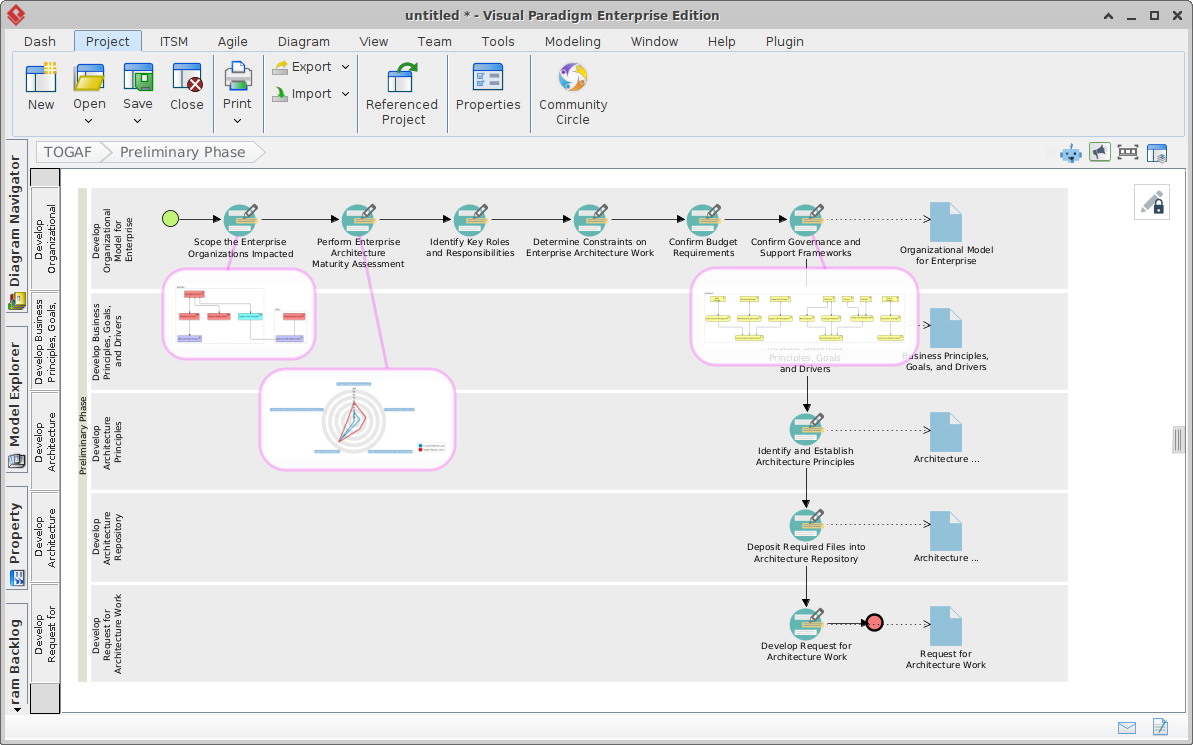
3.1 Natural Language to Artifacts
The AI allows architects to bypass manual diagramming for initial conceptualizations:
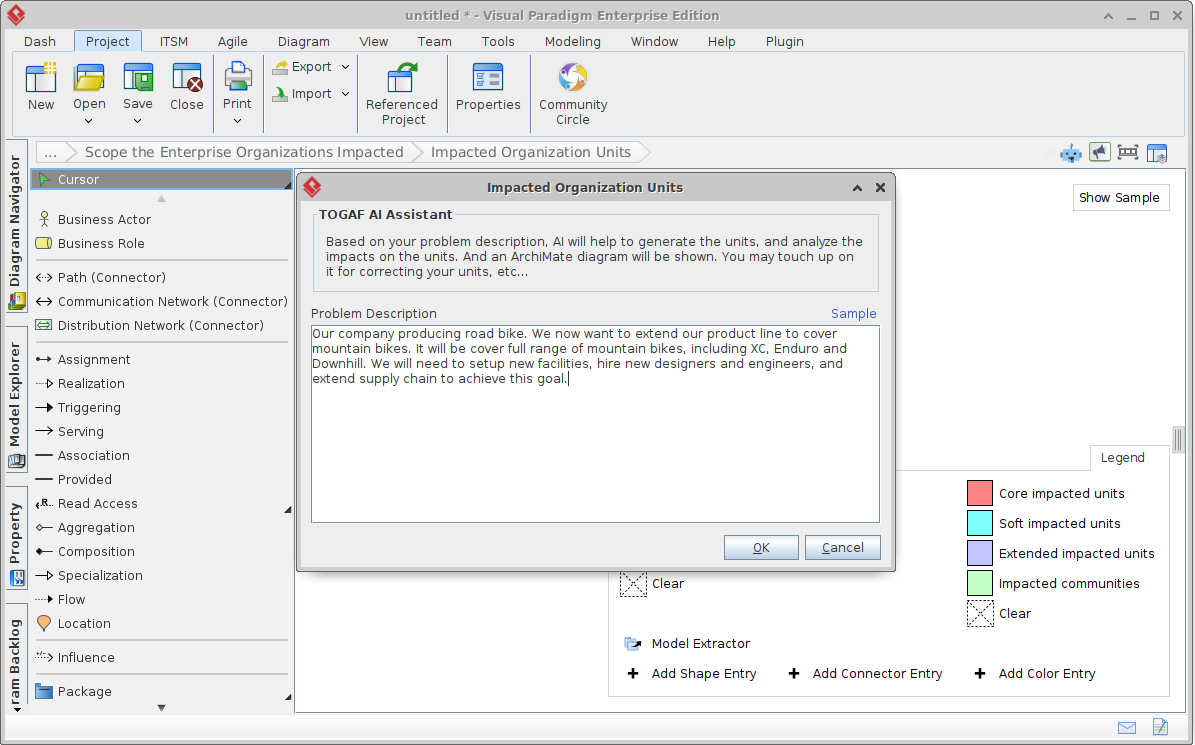
-
How it works: The user provides a brief problem description in natural language (e.g., “Modernizing a coffee shop chain to support mobile ordering”).
-
Instant Output: The AI instantly generates high-quality ArchiMate diagrams, maturity radar charts, and gap analysis models based on that description.
3.2 Automated Assessment
Intelligence extends to capability maturity modeling:
-
Capability Scoring: The AI analyzes business and IT descriptions to score current capabilities against target states.
-
Visualization: It renders professional charts for the Preliminary and Vision phases (Phase A) automatically, providing a data-driven baseline without manual survey design.
3.3 Consistency Across Phases
A major risk in traditional ADM is misalignment between the initial vision and the final implementation plan.
-
Traceability: AI outputs carry forward logically into subsequent steps (e.g., Gap Analysis in Phase B leads to Roadmaps in Phase E).
-
Alignment: This ensures that the Migration Roadmap (Phase E) aligns perfectly with the Initial Architecture Vision, reducing the risk of scope creep and technical debt.
4. Quantifiable Benefits
The shift to an AI-powered Guide-Through approach addresses the resource-intensive nature of Enterprise Architecture:
-
Time Reduction: By automating the “heavy lifting” of diagramming and documentation, artifact creation time is reduced by up to 80%.
-
Strategic Focus: Architects are freed from technical syntax and manual drafting, allowing them to focus on strategic decision-making, stakeholder management, and innovation.
-
Quality Assurance: Integrated checks reduce the likelihood of non-compliance with the TOGAF standard.
5. Best Practices for Implementation
-
Start with Vision: Use the AI to rapidly prototype the Architecture Vision (Phase A) to ensure stakeholder buy-in before deep-dive analysis.
-
Iterative Refinement: Treat AI-generated artifacts as drafts. Always validate them against business constraints and expert opinion.
-
Leverage the Repository: Do not store artifacts locally; strictly use the integrated repository to maintain a single source of truth.
-
Continuous Learning: Use the interactive guidance features to mentor junior architects and standardize knowledge transfer within the team.
Reference List
- Comprehensive Guide to Visual Paradigm TOGAF ADM Tool and Archimate Integration: A detailed exploration of how Visual Paradigm’s tool integrates with Archimate to streamline the TOGAF ADM process.
- Comprehensive TOGAF ADM Tool Evaluation Guide: An analytical review evaluating various tools available for implementing the TOGAF ADM framework effectively.
- AI-Powered TOGAF Guide Through Release: Official release notes detailing the new Generative AI features introduced in the latest Update of the Visual Paradigm TOGAF tool.
- Mastering Enterprise Architecture with Visual Paradigm’s TOGAF ADM Guide Through Process: A master class guide on utilizing the Guide-Through process to manage large-scale enterprise architecture projects.
- AI Powered TOGAF ADM Guide – Visual Paradigm: An article describing the capabilities of the AI-powered Guide for automating ADM activities and generating artifacts.
- TOGAF Guide Through Process Solution: The main product page for the TOGAF Guide-Through Process solution within the Visual Paradigm software suite.
- Working with TOGAF ADM Guide Through Documentation: Technical documentation providing step-by-step instructions on using the tool’s specific features and workflows.
- AI TOGAF ADM Tool Features: A feature breakdown of the specific AI functionalities available in the TOGAF ADM tool, focusing on generation and analysis.
- AI TOGAF ADM Tool Overview: A general overview of the AI capabilities aimed at accelerating the TOGAF ADM lifecycle.
- AI-Powered TOGAF Guide Through Release Notes: Detailed changes and new features included in the latest software update for TOGAF practitioners.
- Practical Usage Best Practices: Traditional vs AI Enhanced Workflow: A comparative analysis highlighting the efficiency gains of moving from traditional manual workflows to the AI-enhanced Guide-Through approach.