Now Reading: The End of Document Drift: How the Consistency Engine Revolutionizes Software Design
-
01
The End of Document Drift: How the Consistency Engine Revolutionizes Software Design



The End of Document Drift: How the Consistency Engine Revolutionizes Software Design
The Evolution of Software Architecture Alignment
In the traditional landscape of software development, maintaining strict alignment between initial business requirements and the resulting technical artifacts has been a persistent, often insurmountable challenge. For decades, architects and analysts have struggled to keep documentation synchronized with evolving project needs. However, the release of the AI-Powered Use Case Modeling Studio in January 2026 introduced a transformative solution: the Consistency Engine. This technology addresses the fundamental flaws of manual modeling, ensuring that a system’s design remains accurate, synchronized, and reliable throughout the entire project lifecycle.

The Problem: The Fragility of Manual Modeling
Traditional use case modeling is a cornerstone of software design, but it is notoriously manual and fragmented. When business analysts or architects work without automated assistance, they are often forced to spend countless hours writing specifications in word processors and drawing UML diagrams by hand in separate vector tools.
Defining “Document Drift”
The primary risk in this manual approach is a phenomenon known as “document drift.” This occurs when a specific requirement is changed—such as a use case being renamed or a step in a user flow being modified—but those updates are not manually reflected in every related diagram, test plan, or report. Because the artifacts exist in silos, a change in one does not trigger a change in another.
This fragmentation inevitably leads to significant project risks:
- Inconsistencies: Diagrams and textual specifications that contradict one another, leaving developers guessing which version is correct.
- Miscommunication: Stakeholders, testers, and development teams working from outdated information, leading to features that do not match the business intent.
- Resource Drain: Hundreds of hours wasted on repetitive manual updates to maintain documentation, often referred to as “technical grunt work.”
The Solution: The Consistency Engine
The AI-Powered Studio eliminates these risks through its built-in Consistency Engine. Unlike traditional tools that treat text documents and visual diagrams as separate files, this studio treats the entire project data as an integrated, relational whole. It bridges the gap between semantic understanding and visual representation.
How Automatic Propagation Works
When a user modifies a high-level element within the studio, such as a use case name or a specific flow description, the engine ensures that the changes automatically propagate across every linked artifact within milliseconds. This synchronization is bidirectional and comprehensive.
For example, if an analyst renames a “Book Table” use case to “Reserve Dining Space” in the text-based specification tab, the name is instantly updated in:

- Use Case Diagrams: The visual actors and ellipses update immediately.
- Behavioral Models: Activity and Sequence Diagrams reflect the new terminology in their logical flows.
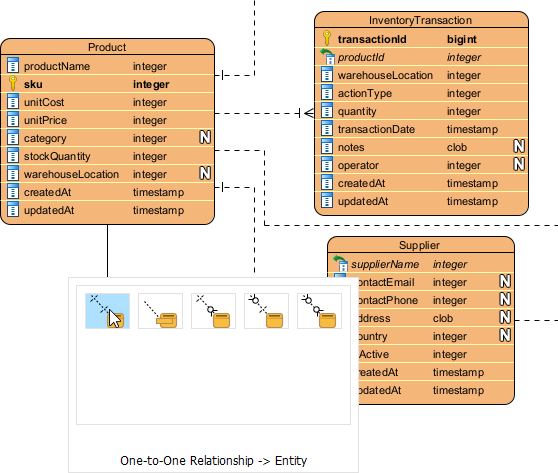
- Structural Models: Class Diagrams and Entity Relationship Diagrams (ERDs) adjust associated data entities.
- AI-Generated Test Plans: Validation scripts and acceptance criteria are rewritten to match the new scope.
Establishing a “Single Source of Truth”
The most critical benefit of the Consistency Engine is the establishment of a genuine “single source of truth.” By starting with a structured Scope Statement that feeds all downstream generations, the studio ensures that the final architecture is directly and visibly tied to the original business needs.
The One-Click Software Design Document (SDD)
This synchronization extends to the generation of the comprehensive One-Click Software Design Document (SDD). Because all artifacts are linked, the resulting PDF or Markdown report is guaranteed to be consistent. It provides stakeholders with a professional, accurate overview that proves the technical design fulfills the initial vision, without the need for manual collation or editing.
Strategic Focus vs. Manual Labor
By automating these updates, the studio significantly reduces the risk of miscommunication between analysts, testers, and developers. Teams no longer have to cross-reference multiple documents to check for discrepancies; instead, they can trust that the Interactive Project Dashboard and all exported reports represent the current, validated state of the project.
This automation allows designers to shift their energy away from tedious manual labor and toward high-level strategy, validation, and innovation. The studio handles the technical execution, ensuring the plan makes sense from a technical perspective while following the established rules of software design.
Analogy: GPS vs. Paper Maps
To understand the magnitude of this shift, consider the difference between traditional navigation and modern technology:
Traditional modeling is comparable to hand-drawing a map of a new city while walking through it. It is a slow process, it is easy to get lost in the details, and it is incredibly difficult to update the entire map when a single new road is built.
Using the AI-Powered Use Case Modeling Studio is akin to using GPS-mapped satellite imagery. You simply provide the destination, and the system instantly generates the fastest routes and street views. Crucially, it updates every single perspective automatically the moment a path changes, ensuring you never navigate with obsolete data.