
Building a technology startup is an exercise in solving complex problems with limited resources. Many founders focus heavily on product development, user acquisition, and early revenue. However, there is a specific component of the Business Model Canvas that frequently causes high-performing teams to hit a ceiling they cannot break. This is the Economy of Scale section.
Research indicates that approximately 80% of tech co-founders struggle to model this correctly. They build products that work, but they fail to build businesses that grow profitably at volume. This failure is not usually due to a lack of technical skill or vision. It is often a structural misalignment in how costs and revenues are projected as the company expands.
In this guide, we will dissect why this section is so critical, where the common errors lie, and how to structure your financial assumptions to support genuine growth. We will look at unit economics, cost behaviors, and revenue models without relying on hype or generic advice.
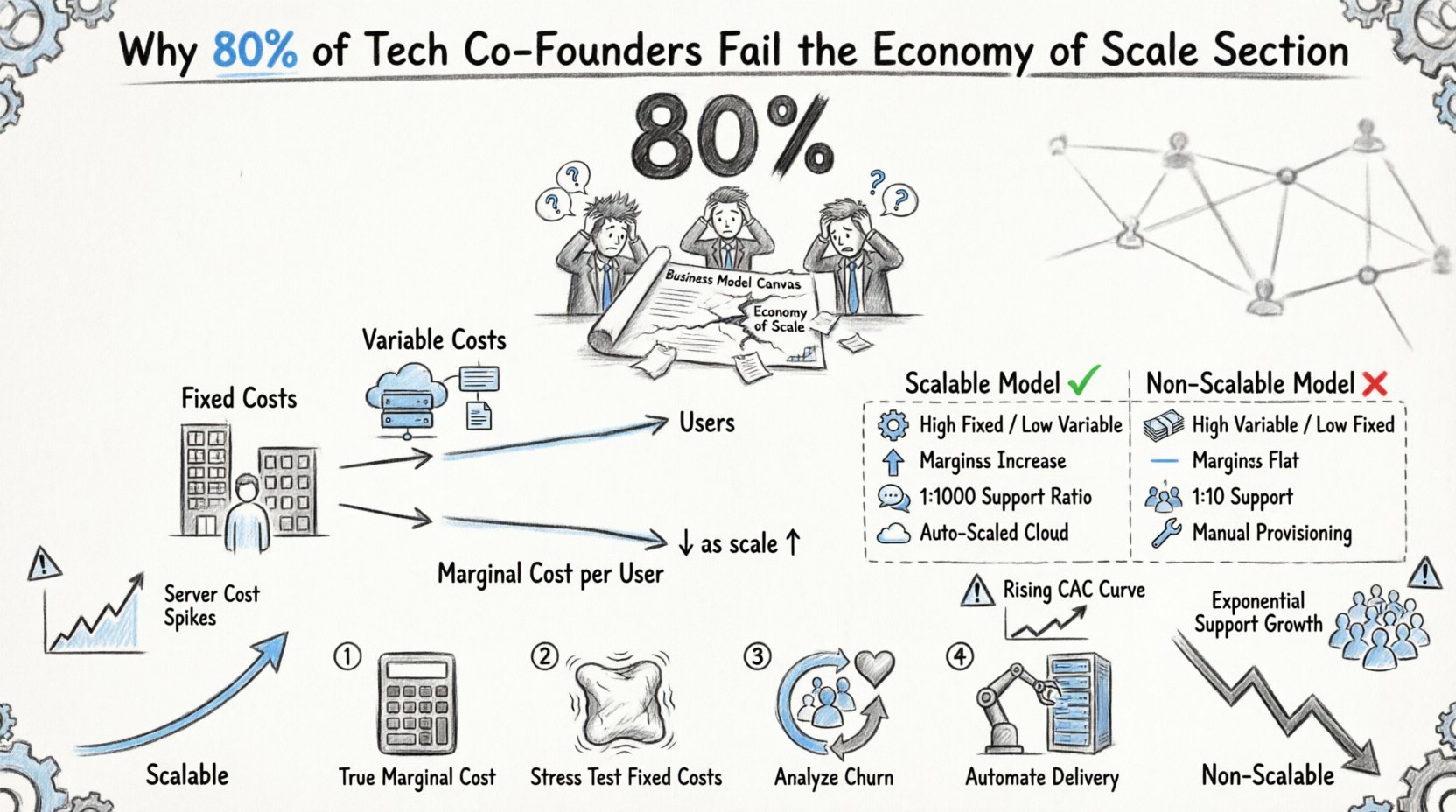
What Does Economy of Scale Mean in the BMC? 🧩
The Business Model Canvas is a strategic management template for developing new business models. It provides a visual chart with elements describing a firm’s value proposition, infrastructure, customers, and finances. Within the financial infrastructure, the Economy of Scale refers to the competitive advantage that arises when the cost per unit of output decreases as the quantity of output increases.
For a tech co-founder, this is often misunderstood as simply “selling more.” It is actually about the relationship between your Fixed Costs and your Variable Costs.
- Fixed Costs: Expenses that do not change with the level of output (e.g., salaries, rent, infrastructure setup).
- Variable Costs: Expenses that vary directly with production or sales (e.g., server usage per user, transaction fees, support tickets).
When the Economy of Scale is modeled correctly, the marginal cost of serving an additional customer drops significantly as the customer base grows. When it fails, the company burns cash faster than it generates profit, regardless of how many new users join.
The Common Pitfalls in Modeling Scale 🚫
Most failures in this section stem from optimistic assumptions that do not hold up under pressure. Below are the specific areas where founders typically deviate from reality.
1. Ignoring Infrastructure Marginal Costs 💻
Tech products are often assumed to be “digital,” implying that distribution costs are near zero. This is rarely true. As you scale:
- Server costs do not remain linear; they often spike due to latency management and redundancy requirements.
- Database complexity increases exponentially, requiring more specialized engineering time to maintain.
- Third-party API costs often scale with usage, creating hidden variable cost burdens.
2. Underestimating Customer Acquisition Cost (CAC) 📢
Founders often project a constant CAC. In reality, as you saturate your initial market, the cost to acquire the next customer rises. The Economy of Scale model must account for the diminishing returns of marketing channels.
3. Linear Support Assumptions 🎧
A common error is assuming that support costs remain flat or grow linearly with users. In many SaaS models, support costs grow exponentially if the product is not sufficiently robust. Every bug, every feature request, and every onboarding issue costs money to resolve.
Technical Debt vs. Economic Debt ⚙️
There is a direct correlation between the quality of the codebase and the efficiency of the economy of scale. Technical debt is often viewed as a coding issue, but it is fundamentally an economic issue.
If the architecture is not built for scale, every new feature or user requires disproportionate engineering effort to maintain. This inflates the Fixed Costs of the business. When Fixed Costs are high relative to Variable Costs, the break-even point for scale becomes unreachable.
Key Considerations for Technical Co-Founders:
- Modularity: Can you add capacity without refactoring the whole system?
- Automation: Does the system self-heal, or does it require human intervention?
- Integration: Does adding a new partner or client require custom code?
When the technical foundation requires manual labor for every unit of scale, the Economy of Scale section of your canvas is broken.
Unit Economics vs. Aggregate Scale 📊
To understand why 80% of founders fail here, we must distinguish between Unit Economics and Aggregate Scale. Unit economics look at the profitability of a single customer or transaction. Aggregate scale looks at the total P&L of the company.
Many companies show healthy aggregate revenue while bleeding money on every individual unit. This is a dangerous position. You cannot scale a business on aggregate revenue if the unit economics are negative.
The following table outlines the critical differences between a scalable model and a non-scalable one.
| Feature | Scalable Model ✅ | Non-Scalable Model ❌ |
|---|---|---|
| Cost Structure | High Fixed, Low Variable | High Variable, Low Fixed |
| Margin Trend | Margins increase with volume | Margins decrease or stay flat |
| Support Ratio | 1:1000 (Self-serve) | 1:10 (High touch) |
| Infrastructure | Auto-scaled Cloud | Manual Provisioning |
| Break-Even | Reached at moderate volume | Never reached or too high |
Notice how the Non-Scalable Model often looks better in the early stages because it requires less capital upfront. However, it hits a wall when growth demands more resources per unit than the revenue can support.
Cost Structure Misinterpretations 📉
The “Cost Structure” block in the Business Model Canvas is where the Economy of Scale is most often misrepresented. Founders frequently categorize costs incorrectly.
1. Treating Engineering as a Variable Cost
Engineering salaries are typically fixed costs. They do not change if you have 10 users or 10,000 users (unless you hire more people). If you model engineering as variable (e.g., $10 per user), your projections will be wildly inaccurate. You must recognize that adding users to a fixed-cost structure is where the scale benefit lies.
2. Ignoring Compliance and Legal Costs
As companies scale, regulatory scrutiny increases. Data privacy laws, tax compliance, and industry-specific regulations often introduce new fixed and variable costs. These are often overlooked in early-stage planning but become significant drag on the economy of scale later.
3. The “Hidden” Sales Cycle Costs
For B2B tech, the sales cycle length affects cash flow. If you sell a product that takes 12 months to close, your variable costs (sales commissions, travel, demos) are front-loaded, but revenue is back-loaded. This creates a liquidity gap that hurts the ability to scale.
Revenue Models That Don’t Scale 📈
Not all revenue models are created equal when it comes to the Economy of Scale. Some models inherently limit growth potential due to their pricing structure.
1. Time-Based Pricing (Hourly)
Charging by the hour caps your revenue at the number of hours available. This is the antithesis of the Economy of Scale. You cannot scale your revenue without scaling your labor, which is expensive.
2. Per-Seat Licensing without Tiers
While common, flat per-seat pricing can limit upside. A better model involves tiered usage or value-based pricing that captures more value as the customer gets more out of the product. This aligns your revenue growth with their success, creating a positive feedback loop.
3. One-Time Fees
Revenue from one-time fees does not recur. To sustain growth, you need recurring revenue to cover the fixed costs of infrastructure and personnel. Relying on one-time fees forces you to constantly restart the acquisition cycle.
Correcting the Approach: A Step-by-Step Analysis 🛠️
How do you fix the Economy of Scale section if your current model is flawed? You need to audit your assumptions rigorously.
Step 1: Calculate True Marginal Cost
Identify exactly how much it costs to serve one additional customer. Include:
- Hosting and bandwidth
- Transaction fees
- Customer support time
- Marketing attribution costs
If this number is higher than your revenue per user, you have a negative margin problem that scale will worsen.
Step 2: Stress Test Fixed Costs
Ask yourself: What happens if we double our user base tomorrow? Which fixed costs become variable? For example, if you need to double your server capacity, do you need to hire more DevOps engineers? If yes, your fixed cost is actually variable at that threshold.
Step 3: Analyze Churn Impact
Economy of scale relies on retention. If your churn rate is high, you are constantly rebuilding the base just to stand still. High churn negates the benefits of scale because you are spending acquisition costs on users who leave quickly.
Step 4: Optimize the Delivery Mechanism
Can you automate the delivery of value? The more you can remove human touchpoints from the delivery process, the better the scale. Focus on self-service onboarding, automated billing, and AI-driven support tools.
The Role of Network Effects 🌐
While not always present, Network Effects can significantly improve the Economy of Scale. This occurs when a product becomes more valuable as more people use it.
- Direct Network Effects: Users invite other users (e.g., messaging apps).
- Indirect Network Effects: More users attract more partners (e.g., marketplaces).
When network effects are active, the Cost of Acquisition often decreases as the network grows. This is a powerful accelerator for the Economy of Scale section. However, relying on this without a solid unit economics foundation is risky.
Operational Efficiency as a Lever ⚙️
Efficiency is the engine of scale. If your operations are manual, you cannot scale. You must invest in operational efficiency early.
- Process Documentation: If a process exists only in someone’s head, it cannot scale.
- Tooling: Use standard tools to manage workflows rather than building custom ones for every task.
- Data Visibility: You cannot improve what you do not measure. Ensure your analytics track the specific costs and revenues mentioned above.
Real-World Scenarios of Failure 🛑
Consider a platform that connects freelancers to clients. Early on, the founder manually matches every job. Revenue looks great. However, as the volume of jobs increases, the manual matching becomes a bottleneck. The cost per transaction skyrockets because the founder’s time is finite. The Economy of Scale fails because the Fixed Cost (founder’s time) is too high relative to the Variable Revenue.
Consider a software company that charges based on data volume. As users store more data, the company pays more for storage. If the storage costs rise faster than the subscription fees, the margin shrinks as the company grows. This is a classic scaling trap.
Strategic Recommendations for Co-Founders 🤝
To navigate these challenges, co-founders must align their technical and business perspectives.
- Align on Metrics: Ensure the CTO and CEO agree on the definition of profitability and scale.
- Review Quarterly: Revisit the Business Model Canvas every quarter. Market conditions change, and so do cost structures.
- Focus on Retention: It is cheaper to keep a customer than to find a new one. Prioritize retention to improve unit economics.
- Build for Automation: Every manual process identified is a barrier to scale. Eliminate it.
Final Thoughts on Sustainable Growth 💡
Building a tech company is a marathon, not a sprint. The Economy of Scale is the finish line strategy. It determines whether the company survives the growth phase or collapses under its own weight.
By understanding the relationship between fixed and variable costs, avoiding common modeling traps, and prioritizing automation and unit economics, co-founders can avoid the 80% failure rate. This requires discipline and a willingness to make hard decisions about pricing, cost structure, and operational efficiency.
The goal is not just to grow, but to grow profitably. When the numbers work at scale, the business becomes resilient, valuable, and sustainable. This is the true measure of success in the technology sector.