
The landscape of financial technology has shifted dramatically over the last decade. At the center of this transformation was a company that prioritized developer experience and infrastructure over traditional banking models. By applying structured strategic frameworks, the organization was able to identify critical gaps in their initial approach and pivot effectively. This article examines the application of the Business Model Canvas to this specific growth trajectory.
Understanding the Strategic Framework 🧩
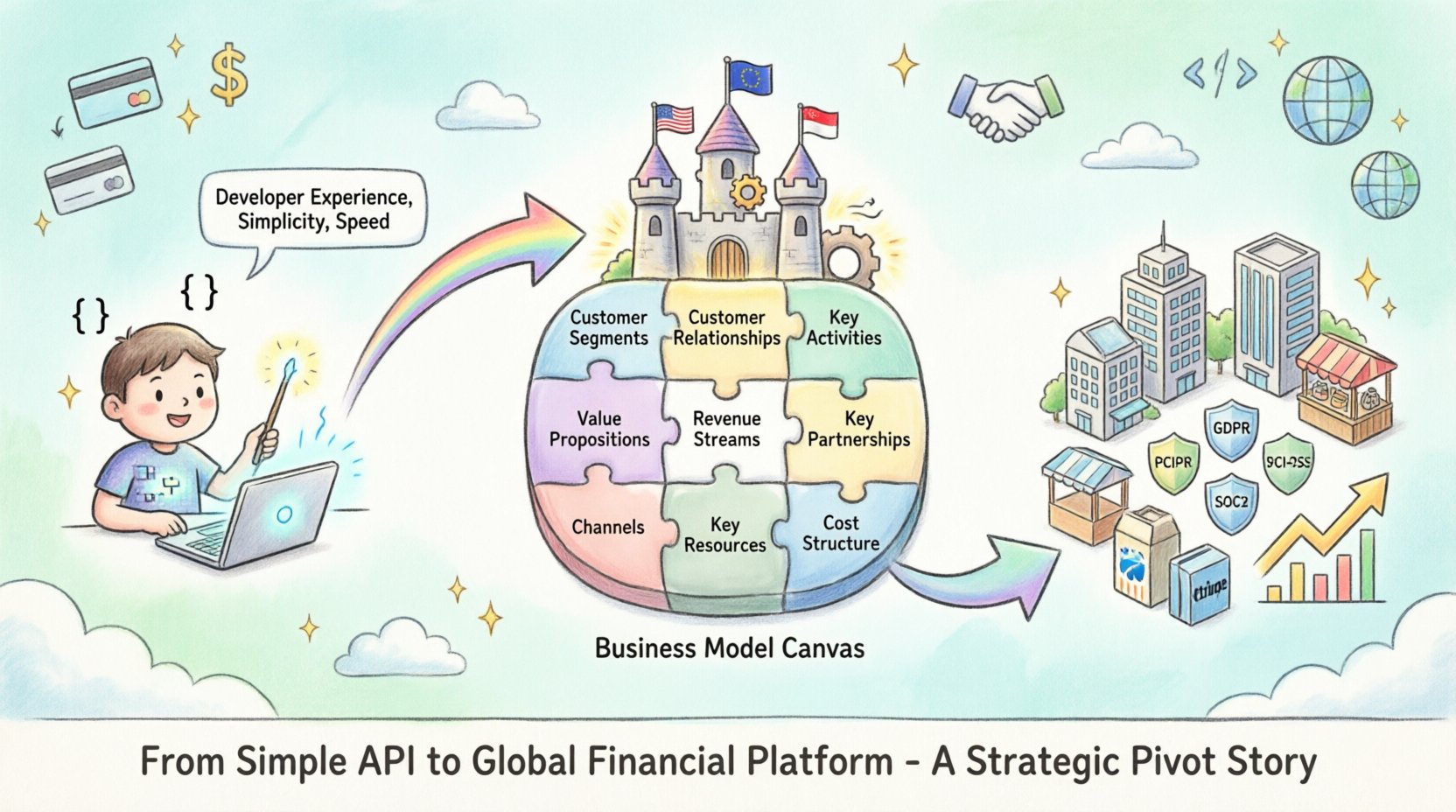
The Business Model Canvas is a visual chart with elements describing a firm’s or product’s value proposition, infrastructure, customers, and finances. It allows teams to map out the nine building blocks of a business model. These blocks include Customer Segments, Value Propositions, Channels, Customer Relationships, Revenue Streams, Key Resources, Key Activities, Key Partnerships, and Cost Structure.
For a startup operating in a high-compliance industry, clarity is essential. A clear map helps leaders see where value is created and where costs are incurred. This tool facilitates a shift from intuition-based decisions to data-driven strategic planning. In the early stages, the focus was often on product development. Later, the focus shifted to market fit and scalability.
The Initial Value Proposition 💎
When the organization first entered the market, the value proposition was straightforward. They offered an API that simplified the integration of payment processing. Before this solution, integrating payments required significant technical debt and complex compliance checks. The new approach reduced this friction significantly.
- Developer Experience: The primary target audience was software engineers.
- Simplicity: Documentation was designed to be readable and functional.
- Speed: Integration time was reduced from weeks to minutes.
This focus on the developer community created a grassroots adoption model. Engineers became advocates for the infrastructure, driving organic growth without traditional marketing spend. This aligns with the “Product-Led Growth” concept, where the product itself drives acquisition.
Customer Segments and Relationships 👥
Identifying the right customer segments is vital for resource allocation. Initially, the company targeted startups and online merchants. These groups had high needs for flexibility and low tolerance for legacy banking hurdles. However, as the business matured, the segments expanded.
| Segment | Needs | Relationship Type |
|---|---|---|
| Early Startups | Low friction, speed, documentation | Self-Service |
| Enterprise Firms | Security, compliance, support | Direct Sales |
| Marketplaces | Split payments, multi-party flows | Partner Support |
The relationship model shifted from purely self-service to a hybrid approach. For larger clients, dedicated support became necessary to handle complex compliance requirements and custom integration needs. This evolution required a change in the operational model to support human interaction alongside automated systems.
Channels and Key Activities 📢
Channels are the touchpoints through which a company communicates with and reaches its customer segments. For this organization, the primary channel was the digital interface itself. Documentation, code examples, and support forums served as the main communication line.
- Documentation: High-quality, up-to-date guides were crucial.
- Community: Forums and Slack channels allowed peer-to-peer support.
- Events: Technical conferences and hackathons built brand presence.
Key activities revolved around maintaining uptime, processing transactions, and ensuring security. Security was not just a feature but a core activity. Every transaction required validation against fraud patterns. This required constant monitoring and algorithmic adjustments.
Revenue Streams and Cost Structure 💰
The revenue model was designed to scale with usage. Instead of a fixed monthly fee, the pricing was based on a percentage of transaction volume. This aligned the company’s success with the success of its customers. If the customer grew, the company grew.
Key cost drivers included infrastructure maintenance, compliance licensing, and personnel. Infrastructure costs scaled linearly with transaction volume. However, compliance costs were fixed regardless of volume, creating a leverage point as volume increased.
- Transaction Fees: A percentage of every payment processed.
- Value-Added Services: Additional fees for specialized tools.
- Global Expansion: Costs increased as new currencies were added.
This cost structure allowed for significant reinvestment. Profits were funneled back into research and development to maintain the technological edge. This cycle of investment created a barrier to entry for competitors who could not match the infrastructure depth.
The Pivot Moment 🔀
A pivot is a structured course correction. In this case, the company shifted from a singular focus on online payments to a broader financial infrastructure provider. The initial canvas showed a clear path for online merchants. However, the market demand indicated a need for physical retail integration and global expansion.
The pivot involved several strategic adjustments:
- Product Diversification: Adding tools for identity verification and payroll.
- Geographic Expansion: Moving beyond the initial domestic market.
- Service Depth: Offering more than just payment processing.
This transition required a re-evaluation of the Business Model Canvas. The Value Proposition expanded from “payment processing” to “financial infrastructure.” The Customer Segments broadened to include global enterprises. The Key Partnerships evolved to include local banks and regulatory bodies.
Scaling Implications 🌍
Scaling a business model requires maintaining the core value while adapting to new constraints. As the organization grew, the complexity of operations increased exponentially. Managing regulatory compliance across multiple jurisdictions became a key activity.
The canvas helped visualize these constraints. For example, entering a new market required new Key Partnerships with local financial institutions. This added to the Cost Structure and required new Key Resources in the form of legal and compliance teams.
Scaling also impacted the Customer Relationships. Automated support systems had to be enhanced to handle the increased volume of inquiries. This meant investing in knowledge bases and automated ticketing systems to maintain the self-service model for smaller clients.
Lessons on Strategic Flexibility 📚
The evolution of this business model offers several insights for other organizations:
- Start with the Value: Ensure the core offering solves a real problem.
- Monitor Costs: Understand how fixed and variable costs interact.
- Listen to Users: Customer feedback should drive product evolution.
- Plan for Compliance: Regulatory hurdles are costs of doing business.
By using a structured framework, the team could see the impact of potential changes before implementation. This reduced risk and allowed for more confident decision-making. The canvas served as a living document, updated as the market conditions changed.
Conclusion on Business Design 🏁
The success of this organization was not solely due to technology. It was due to a clear understanding of how the business operated as a system. The Business Model Canvas provided the necessary structure to analyze, critique, and improve that system over time. It allowed the team to see the connections between revenue, costs, and value delivery.
For any organization looking to scale, a similar approach is recommended. Map the current state, identify the gaps, and design the future state. This process ensures that growth is sustainable and aligned with long-term goals. The framework remains a valuable tool for navigating complex market environments.
Ultimately, the strategy was about alignment. Aligning the product with the market, the costs with the revenue, and the team with the vision. This alignment created a resilient business capable of weathering economic shifts and technological changes. The journey from a simple API to a global financial platform demonstrates the power of strategic planning.
Key Takeaways for Practitioners 📝
When applying these principles to your own context, consider the following:
- Define Value Clearly: Avoid ambiguity in what you offer.
- Segment Precisely: Different customers have different needs.
- Optimize Channels: Meet customers where they are.
- Manage Relationships: Build trust through reliability.
- Align Revenue: Ensure pricing supports growth.
These elements form the foundation of a robust business model. By regularly reviewing them, organizations can maintain agility. The canvas is not a one-time exercise but a continuous process of refinement. It helps teams stay focused on the essential drivers of success.
As the digital economy continues to evolve, the need for clear business design becomes more critical. Companies that ignore these fundamentals risk inefficiency and stagnation. Those that embrace structured analysis position themselves for long-term viability. The story of this fintech leader serves as a testament to the power of disciplined strategic thinking.
In summary, the integration of strategic tools like the Business Model Canvas can transform a startup into a scalable enterprise. It provides clarity in chaos and direction in uncertainty. For leaders navigating complex markets, these frameworks are indispensable.