
Software systems grow. Requirements evolve. Business rules change. In the early stages of development, it is tempting to rely on straightforward control flow mechanisms to handle varying behaviors. Conditional logic—the use of if, else, and switch statements—feels immediate and intuitive. However, as complexity accumulates, this approach often leads to bloated classes and rigid codebases. Enter the Strategy Pattern, a fundamental design pattern in Object-Oriented Analysis and Design (OOAD) intended to manage behavior encapsulation and promote flexibility.
This guide provides a comprehensive comparison between these two approaches. We will explore the structural implications, the impact on maintainability, and the architectural principles at stake. Whether you are refactoring legacy systems or designing new modules, understanding when to apply polymorphism over explicit branching is critical for sustainable software engineering.
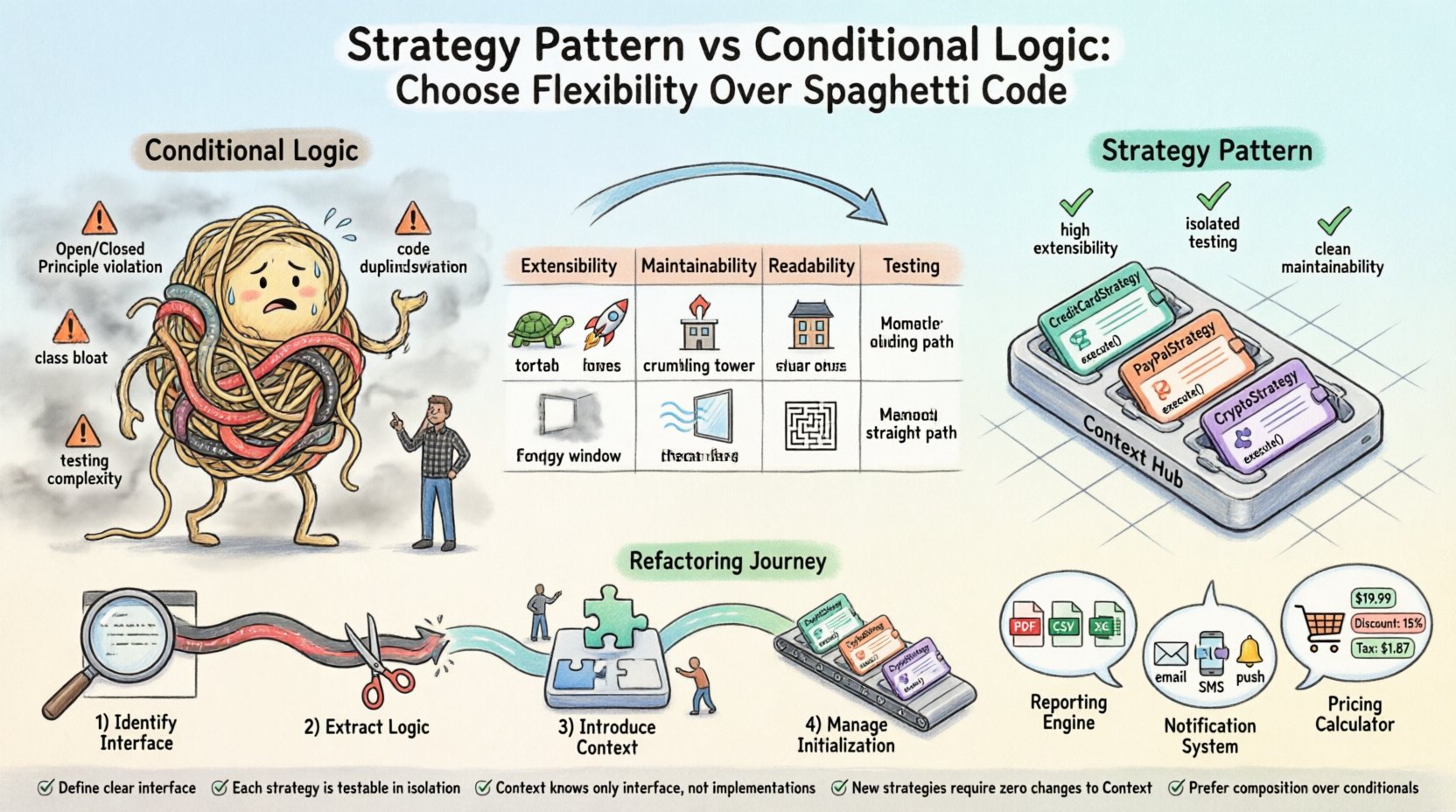
📊 Understanding the Status Quo: Conditional Logic
Conditional logic is the most basic form of control flow in programming. It allows a program to execute different blocks of code based on specific criteria. In a typical object-oriented context, this often manifests within a single class that handles multiple scenarios via branching statements.
🔹 How It Works
Imagine a system that processes payments. Depending on the payment type, the system calculates fees, logs transactions, or validates limits. A developer might write logic that checks the payment type and executes specific code paths.
- Visibility: The logic for all variations resides in one location.
- Execution: The runtime evaluates a condition, then jumps to the corresponding block.
- Dependency: The class holding this logic is aware of every specific variation (e.g., Credit Card, PayPal, Crypto).
🔹 The Hidden Costs
While simple for small scripts, conditional logic introduces significant technical debt as the system scales.
- Violation of Open/Closed Principle: The class is open for modification but closed for extension. To add a new payment type, you must modify the existing class. This increases the risk of introducing bugs into unrelated features.
- Code Duplication: Similar logic often repeats across different branches. If the validation rule changes, it must be updated in every
ifblock. - Class Bloat: Classes become massive, making them difficult to read and navigate. The cognitive load on developers increases significantly.
- Testing Complexity: Unit tests must cover every single branch. A single missing condition can lead to runtime errors that are hard to trace.
Consider a scenario where you have five payment methods. Your logic might look like a chain of five if-else blocks. If a sixth method is added, the chain grows. If a seventh is added, the class becomes unwieldy. This is often referred to as spaghetti code when the branching becomes deeply nested.
🧩 Introducing the Strategy Pattern
The Strategy Pattern is a behavioral design pattern that enables selecting an algorithm at runtime. Instead of implementing a single algorithm directly inside a class, the behavior is extracted into separate, interchangeable classes known as Strategies.
🔹 Structural Components
To implement this pattern effectively, three key components are required:
- Context: The class that maintains a reference to a Strategy object. It delegates the work to the strategy.
- Strategy Interface: An abstract definition (interface or abstract class) that declares the method(s) the strategies must implement.
- Concrete Strategies: Specific implementations of the strategy interface, each representing a distinct algorithm or behavior.
🔹 How It Works
Using the payment example again, the Context class would hold a reference to a Strategy. At runtime, the Context is assigned a specific implementation (e.g., CreditCardStrategy or PayPalStrategy). The Context does not know the specifics of the calculation; it only knows to call the execute method.
This decouples the algorithm from the client. If a new payment method is introduced, you create a new Concrete Strategy class. The Context class remains untouched. This adheres strictly to the Open/Closed Principle.
⚖️ Side-by-Side Comparison
The following table outlines the critical differences between using conditional logic and the Strategy Pattern. This comparison focuses on architectural impact rather than syntax.
| Feature | Conditional Logic | Strategy Pattern |
|---|---|---|
| Extensibility | Low. Requires modifying existing code. | High. Add new classes without changing existing ones. |
| Maintainability | Decreases as branches grow. | Increases. Behavior is isolated per class. |
| Readability | Declines with nesting depth. | High. Each strategy is self-contained. |
| Testing | Complex. Must test all branches in one class. | Simple. Test each strategy class independently. |
| Performance | Faster (no indirection). | Minimal overhead (indirect call). |
| Complexity | Low initially, high later. | Higher initially, lower later. |
🔄 The Refactoring Journey: From If/Else to Strategy
Moving from conditional logic to the Strategy Pattern is a structured process. It is not merely about changing syntax; it is about rethinking the distribution of responsibility.
🔹 Step 1: Identify the Common Interface
Look at the conditional branches. What method is being called in each block? What data is being passed? Extract the common behavior into an interface. This interface defines the contract that all future variations must follow.
- Define an interface named
PaymentProcessor. - Specify a method, such as
calculateFee(amount).
🔹 Step 2: Extract Logic into Classes
Take the code inside each if or case block. Create a new class for each block. Implement the interface defined in Step 1. Move the logic from the original class into these new classes.
- Create
CreditCardProcessorimplementingPaymentProcessor. - Create
CryptoProcessorimplementingPaymentProcessor. - Ensure each class handles its specific logic independently.
🔹 Step 3: Introduce the Context
The original class that held the switch statement becomes the Context. It should no longer contain the branching logic. Instead, it should hold a reference to the PaymentProcessor interface.
- Remove the
switchstatement. - Add a setter or constructor injection to accept a
PaymentProcessorinstance. - Delegate the call to
calculateFeeto the injected strategy.
🔹 Step 4: Manage Initialization
Where does the specific strategy come from? In a production environment, this is often managed by a factory or dependency injection container. The Context does not need to know how to create the strategy, only that it has one.
- Use a factory method to instantiate the correct strategy based on configuration.
- Ensure the Context can switch strategies dynamically if the business rules allow runtime changes.
🧪 Impact on Testing and Verification
One of the most significant advantages of the Strategy Pattern is the improvement in testability. When logic is buried inside a large class with conditionals, testing becomes fragile. You must mock the inputs to trigger specific branches.
🔹 Isolated Unit Testing
With the Strategy Pattern, each concrete strategy is its own unit. You can write a test suite specifically for CryptoProcessor without worrying about the logic in CreditCardProcessor. This isolation ensures that a change in one strategy does not break the tests of another.
- Before: A test suite for the main class requires 10 test cases for 10 different payment types.
- After: A test suite for
CryptoProcessorrequires only the relevant 10 test cases. The main class needs only one test to ensure it delegates correctly.
🔹 Regression Safety
Refactoring conditional logic often introduces regressions. If you add a new if block, you might inadvertently break an existing one. With separate classes, the boundary is clear. The compiler or type checker ensures that every implementation adheres to the interface contract.
⚡ Performance Considerations
It is important to address the performance myth. Some developers avoid design patterns due to perceived overhead. In reality, the performance difference between a switch statement and a virtual function call (polymorphism) is negligible in most application scenarios.
🔹 Indirection Overhead
Polymorphism introduces a level of indirection. The program must look up the correct method implementation in a vtable (in compiled languages) or a dispatch table (in interpreted languages). This adds a tiny amount of latency.
- Conditional Logic: Direct memory access or jump instructions.
- Strategy Pattern: Method dispatch lookup.
However, modern compilers and runtimes optimize virtual calls aggressively. Unless you are processing millions of records in a microsecond-critical loop, this overhead is irrelevant compared to the cost of I/O or network latency.
🔹 When to Avoid
There are rare cases where the Strategy Pattern might be overkill.
- Simple Calculations: If the logic is a simple math formula that will never change, a function is sufficient.
- One-Off Scripts: For temporary scripts or prototypes, the boilerplate of a pattern might slow down development.
- Performance-Critical Loops: If profiling shows that method dispatch is a bottleneck, inlining the logic or using conditional logic might be justified.
🧭 Decision Framework: When to Use Which?
Choosing between these approaches is not binary. It depends on the lifecycle of the software. Use the following criteria to guide your architectural decisions.
🔹 Use Conditional Logic When:
- The behavior is simple and unlikely to change.
- The number of variations is fixed and small (e.g., exactly two states).
- Performance is the absolute highest priority and profiling dictates it.
- The code is part of a temporary proof-of-concept.
🔹 Use Strategy Pattern When:
- You anticipate future variations in behavior.
- The business rules are complex and distinct.
- You want to isolate testing for specific behaviors.
- The code is part of a long-term product or platform.
- You need to allow users or administrators to switch algorithms dynamically.
🚫 Common Pitfalls to Avoid
Even with the best intentions, implementing the Strategy Pattern can go wrong if not applied correctly. Below are common mistakes to watch out for.
🔹 The “God Strategy” Anti-Pattern
Avoid creating a single Strategy class that contains logic for everything. This defeats the purpose of the pattern. Each strategy class should do one thing well.
- Bad: A
PaymentStrategyclass that contains nestedifstatements to handle all card types. - Good:
VisaStrategy, MastercardStrategy, AmexStrategy subclasses.
🔹 Over-Engineering
Do not apply the Strategy Pattern to every minor variation. If you have three variations of a sorting algorithm, a simple enum with a factory might be cleaner than a full strategy hierarchy. Balance the complexity of the solution with the complexity of the problem.
🔹 Ignoring the Interface
The power of the pattern lies in the interface. If the Context class needs to know specific details of the concrete strategy (e.g., casting to a specific type), the coupling is not broken. Ensure the interface exposes only the methods the Context actually needs.
📈 Long-Term Architectural Benefits
The decision to use the Strategy Pattern is an investment in the future. While it requires more upfront effort to define interfaces and classes, the return on investment manifests over time.
- Parallel Development: Different developers can work on different strategy implementations without merging conflicts in a massive file.
- Debugging: When an error occurs, you can isolate it to a specific strategy class. You do not need to trace through hundreds of lines of branching logic.
- Documentation: The structure of the code itself documents the available strategies. A reader can see the list of strategies in the repository and understand the supported behaviors immediately.
🔍 Real-World Scenarios
To further illustrate the application of these concepts, consider these generic scenarios found in enterprise systems.
🔹 Reporting Engines
A reporting system needs to export data. The export format (PDF, CSV, Excel) changes the output logic. Using conditional logic means the ReportGenerator class checks the file type and builds the file differently. Using the Strategy Pattern, you have PDFExporter, CSVExporter, and ExcelExporter. The Generator simply calls export.
🔹 Notification Systems
A user can be notified via Email, SMS, or Push Notification. The content preparation might differ slightly. The Context holds the user data and the selected notification strategy. Adding a new channel like Slack does not require touching the core user management code.
🔹 Pricing Calculators
E-commerce platforms often have complex pricing rules. Discount algorithms, tax calculations, and shipping fees vary by region or product type. Encapsulating these in strategies allows the pricing engine to swap rules dynamically based on the customer’s profile without rewriting the engine.
📝 Summary of Best Practices
To summarize the key takeaways for applying these concepts effectively:
- Start Simple: Do not refactor immediately. Write the conditional logic first if the requirement is new. Refactor when the repetition or complexity becomes painful.
- Define Contracts Early: Before extracting logic, define the interface. It guides the extraction process.
- Keep Strategies Small: A strategy class should ideally be focused on a single concern.
- Use Dependency Injection: Do not instantiate strategies directly in the Context if possible. Use injection to make the system testable and flexible.
- Monitor Complexity: If you find yourself adding more and more strategies without a clear hierarchy, reconsider the design. You might need a Composite or Factory pattern instead.
The choice between conditional logic and the Strategy Pattern is a choice between immediate convenience and long-term stability. In professional software engineering, stability and maintainability are paramount. By understanding the mechanics of polymorphism and encapsulation, developers can build systems that adapt to change rather than breaking under it.