
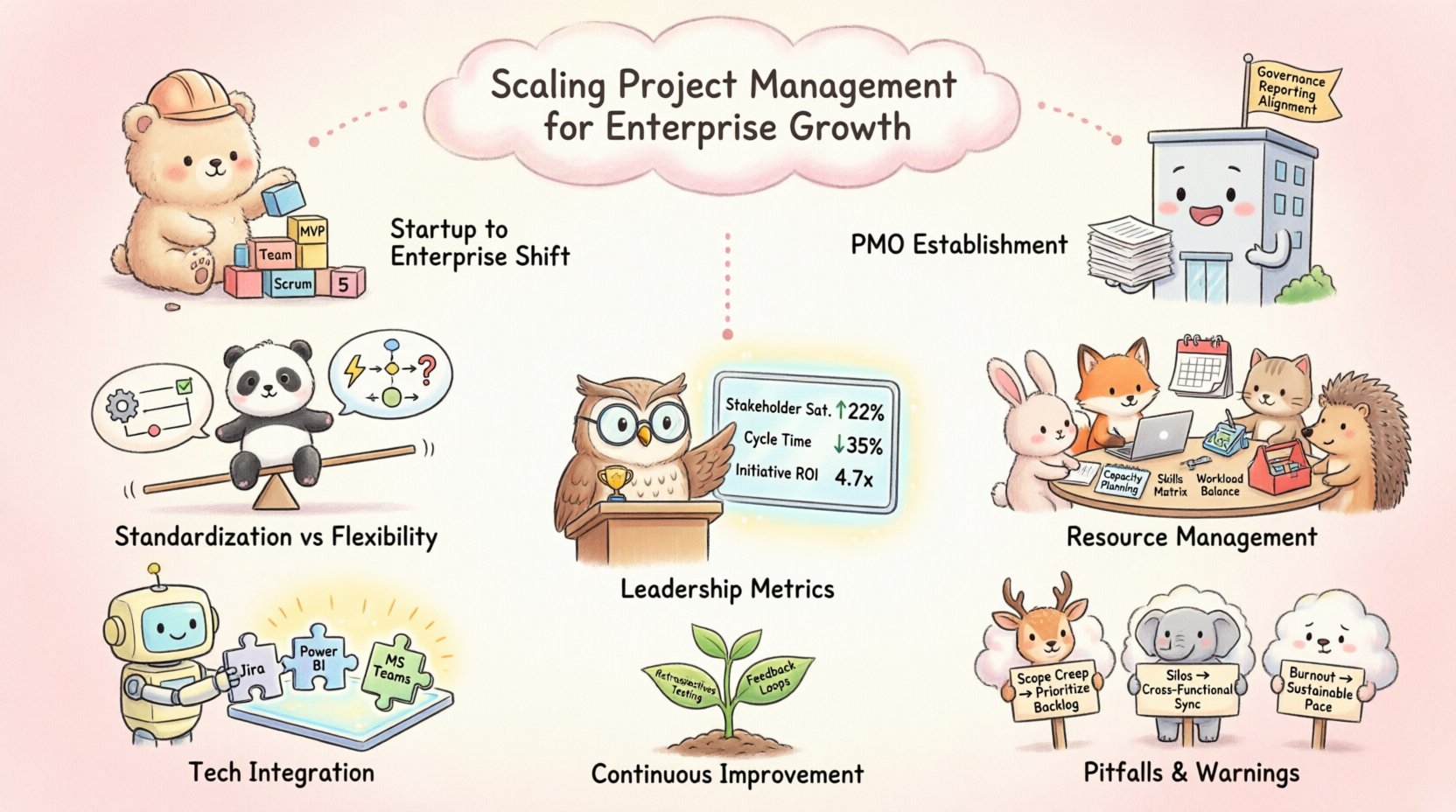
As organizations expand, the complexity of their operational workflows increases exponentially. What worked for a team of five does not function for a workforce of five hundred. Scaling project management is not merely about adding more resources; it is about restructuring how work is initiated, tracked, and delivered. This transition requires a shift from ad-hoc processes to a robust framework that supports rapid growth without sacrificing quality or team morale.
Enterprise growth introduces specific challenges: resource contention, communication silos, and inconsistent delivery standards. To navigate this, leaders must establish a foundation that balances standardization with the flexibility needed for innovation. This guide outlines the critical steps for building a scalable project management infrastructure that supports long-term success.
🏗️ The Shift from Startup Agility to Enterprise Structure
In the early stages, speed is often the primary currency. Teams move quickly, bypassing documentation to ship features. However, as the organization matures, the risk of technical debt and operational chaos rises. The goal is not to slow down, but to introduce guardrails that prevent errors while maintaining velocity.
Key indicators that scaling is necessary include:
- Recurring bottlenecks: Projects stall due to unclear ownership or approval chains.
- Inconsistent metrics: Different departments report success using different definitions.
- Resource conflicts: Teams compete for the same specialists or budget allocations.
- Communication overload: Important decisions get lost in excessive email threads or chat logs.
Addressing these issues requires a deliberate approach to governance. The structure must evolve to support cross-functional collaboration without creating bureaucracy that stifles progress.
🔗 Establishing a Project Management Office (PMO)
For many enterprises, the Project Management Office acts as the central nervous system for delivery. It does not need to be a bureaucratic entity that blocks work; rather, it should serve as a center of excellence that provides tools, training, and standards.
Core functions of a modern PMO include:
- Standardization: Defining templates for project charters, status reports, and risk registers.
- Methodology Guidance: Advising teams on whether Agile, Waterfall, or Hybrid approaches fit specific project types.
- Resource Capacity Planning: Forecasting talent needs months in advance to prevent burnout.
- Portfolio Visibility: Ensuring leadership sees the health of all initiatives in a single view.
When implementing a PMO, avoid mandating compliance for compliance’s sake. The value lies in the data and insights provided to stakeholders, not in the paperwork itself.
📊 Balancing Standardization and Flexibility
One of the most common pitfalls in scaling is over-standardization. If every team must follow the exact same process, innovation suffers. Different departments have unique needs. Marketing campaigns require different tracking than software development or construction projects.
To manage this balance, organizations should adopt a modular framework:
- Core Requirements: Mandatory elements for all projects, such as budget tracking and risk assessment.
- Optional Modules: Additional workflows that teams can toggle based on project complexity.
- Escalation Paths: Clear protocols for when a project exceeds its original scope or budget.
This approach allows high-risk initiatives to follow strict controls while low-risk experiments maintain agility.
💼 Resource Management at Scale
As the number of concurrent projects grows, the likelihood of resource contention increases. A developer might be assigned to three critical projects simultaneously, leading to context switching and reduced productivity. Effective scaling requires a strategic view of human capital.
Strategies for optimizing resource allocation include:
- Centralized Talent Pools: Maintaining a shared database of skills and availability across the organization.
- Utilization Rates: Monitoring workload to ensure no individual is consistently over 80% capacity.
- Cross-Training: Developing backup resources to mitigate risks associated with single points of failure.
- Forecasting: Aligning hiring plans with the projected workload from the project pipeline.
Without visibility into resource availability, managers make decisions based on assumptions rather than facts. This leads to missed deadlines and frustrated teams.
📈 Metrics and Reporting for Leadership
Leadership requires data to make strategic decisions. However, too many metrics can obscure the truth. The focus should be on outcome-based indicators rather than activity-based vanity metrics.
The following table outlines key performance indicators suitable for enterprise-level reporting:
| Category | Key Metric | Why It Matters |
|---|---|---|
| Financial | Budget Variance | Tracks spending against the approved plan to prevent overruns. |
| Time | On-Time Delivery Rate | Measures reliability and the effectiveness of planning. |
| Quality | Defect Density | Indicates the stability of the final deliverable. |
| Team Health | Employee Turnover Rate | High turnover often signals unsustainable workloads or poor management. |
| Portfolio | Strategic Alignment Score | Ensures projects are contributing to broader business goals. |
Reporting cadence is also critical. Weekly status updates are useful for project teams, but executive dashboards should be reviewed monthly or quarterly to identify trends.
🔌 Technology and Integration
Enterprise environments often suffer from tool fragmentation. Sales teams use one system, engineering another, and finance a third. This isolation creates data silos that hinder visibility.
Building a scalable tech stack requires focusing on integration capabilities rather than feature lists. The chosen platforms must allow data to flow seamlessly between departments. Key considerations include:
- Single Source of Truth: Ensuring that the budget in the finance system matches the budget in the project tracking system.
- API Connectivity: The ability to push and pull data from external applications automatically.
- Security and Compliance: Ensuring data access controls align with organizational policies.
- User Adoption: Tools should be intuitive enough that training time remains minimal.
Investing in a unified system reduces the administrative burden on teams and ensures that everyone is working from the same information.
⚠️ Common Pitfalls to Avoid
Even with a solid plan, scaling often encounters resistance. Understanding common failure points can help mitigate risks.
- Ignoring Change Management: Introducing new processes without training or buy-in leads to shadow systems where teams revert to old habits.
- Micromanagement: Attempting to control every detail at the enterprise level slows down decision-making.
- Underestimating Cultural Impact: A shift to structured management can feel like a loss of autonomy to creative teams.
- Lack of Leadership Support: Without visible commitment from C-level executives, new frameworks often fail to gain traction.
🌱 Continuous Improvement
Scaling is not a destination; it is a continuous cycle. As the organization grows, the management framework must evolve to meet new demands. Regular retrospectives on the project management process itself are essential.
Ask the following questions periodically:
- Are our reporting requirements adding value or creating noise?
- Is our resource planning accurate enough to prevent delays?
- Are our new hires equipped to handle our current workflows?
- Does our technology stack support our current volume of work?
By treating the project management system as a product that requires iteration, organizations can maintain efficiency even as complexity increases. The objective is not to achieve a perfect state, but to build a resilient system capable of adapting to change.
🔍 Final Thoughts
Scaling project management for enterprise growth demands a shift in mindset. It moves beyond simple task tracking to a holistic view of organizational capacity, risk, and strategy. By establishing clear governance, optimizing resource allocation, and leveraging integrated technology, leaders can navigate expansion with confidence.
The path forward is not about controlling every outcome, but about creating an environment where success is repeatable. With the right frameworks in place, growth becomes manageable, and the organization remains agile enough to respond to market shifts.