
Building a Software as a Service (SaaS) company involves more than just writing code and hoping users show up. Many founders make the mistake of treating revenue as an outcome rather than a structural element. When revenue is an afterthought, growth becomes unpredictable, and cash flow management turns into a guessing game. To move from speculation to strategy, you need a framework that maps out exactly how value is created, delivered, and captured. This is where the Business Model Canvas (BMC) becomes essential.
For SaaS businesses, the BMC is not just a static diagram; it is a dynamic financial model in disguise. By dissecting the nine building blocks of the canvas specifically for subscription-based software, you can identify the precise levers that drive Monthly Recurring Revenue (MRR), Annual Recurring Revenue (ARR), and ultimately, net profit. This guide breaks down every component, explaining how each influences your financial health and why ignoring any single block can lead to revenue leakage.
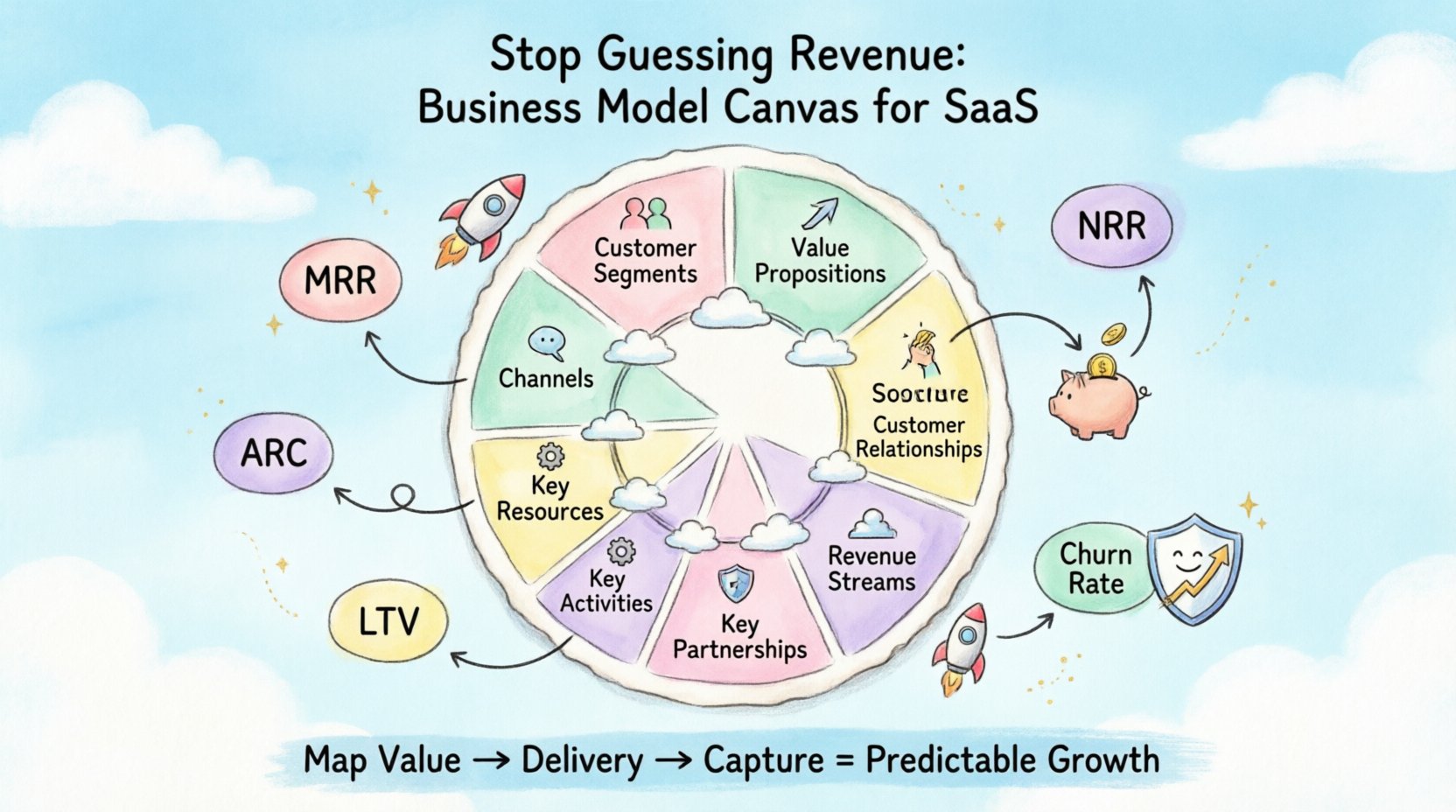
Why Revenue Guessing Fails SaaS Companies 📉
Traditional business models often rely on one-time sales or physical inventory turnover. SaaS is different. It relies on recurring billing, customer retention, and lifetime value. When you guess your revenue, you are likely overlooking critical variables such as churn rates, upgrade paths, and customer acquisition costs (CAC). Without a structured breakdown, you might project growth based on optimistic user acquisition numbers while underestimating the cost of support or the technical debt required to scale.
Accurate revenue forecasting requires a clear understanding of the relationship between your operational inputs and financial outputs. The Business Model Canvas forces you to articulate these relationships explicitly. Instead of assuming a feature will lead to sales, you define the Value Proposition that justifies the price. Instead of hoping for partners, you define the Key Partnerships that reduce your acquisition costs.
When you stop guessing, you start managing. You shift focus from vanity metrics like total sign-ups to actionable metrics like revenue per employee and net revenue retention. This shift begins with a rigorous analysis of the canvas components.
The Nine Building Blocks: A SaaS Overview 🧩
The Business Model Canvas consists of four main areas: Infrastructure, Offerings, Customers, and Finance. In a SaaS context, these areas translate into specific operational realities. Below is a high-level mapping of the standard blocks to SaaS-specific functions.
| Building Block | SaaS Focus Area | Primary Financial Impact |
|---|---|---|
| Customer Segments | Target Market & Persona | Pricing Power & Acquisition Cost |
| Value Propositions | Product Features & Benefits | Conversion Rate & Retention |
| Channels | Marketing & Sales Paths | CAC & Distribution Efficiency |
| Customer Relationships | Support & Onboarding | Churn Rate & LTV |
| Revenue Streams | Pricing Models & Billing | MRR, ARR, & Revenue Recognition |
| Key Resources | Talent & Infrastructure | Fixed Costs & Scalability |
| Key Activities | Dev, Sales, Marketing | Variable Costs & Burn Rate |
| Key Partnerships | Integrations & Resellers | Market Reach & Cost Reduction |
| Cost Structure | OpEx & Infrastructure | Gross Margin & Net Profit |
1. Customer Segments: Who Pays the Bill? 👥
Revenue is not generated by the product alone; it is generated by a specific group of people willing to pay for it. In the Business Model Canvas, this is the Customer Segments block. For SaaS, defining this is the first step in revenue accuracy.
- Demographics and Firmographics: Are you targeting small businesses, enterprises, or individual consumers? Enterprise clients typically have higher Average Contract Values (ACV) but longer sales cycles. Consumer apps have lower ACV but require massive scale.
- Behavioral Needs: Does the customer need the software to save time, reduce risk, or increase revenue? A tool that saves time justifies a lower price than a tool that directly generates revenue for the client.
- Segmentation by Usage: Some SaaS models segment users by usage volume (e.g., number of API calls, storage space). This allows for tiered pricing that scales with customer success.
If you do not clearly define who the customer is, your marketing spend becomes inefficient. You cannot calculate Customer Acquisition Cost (CAC) accurately if you are chasing the wrong audience. A precise segment definition ensures that your revenue projections are grounded in the reality of who is actually buying.
2. Value Propositions: The Reason to Buy 🚀
Once you know who the customer is, you must define the Value Proposition. This is the bundle of products and services that create value for a specific customer segment. In SaaS, this is often where the revenue model is validated.
- Problem-Solution Fit: Does the software solve a painful problem? Revenue is a byproduct of value. If the value is low, the price must be low, and volume must be high.
- Quantifiable Benefits: Can you prove the ROI? If a tool costs $100/month but saves the user $500/month in labor, the value proposition is clear. This clarity directly impacts conversion rates.
- Differentiation: Why pay for your software instead of a spreadsheet or a competitor? Unique features or superior user experience can justify a premium price point.
A strong value proposition reduces the friction in the sales cycle. When the value is obvious, the decision to purchase is faster, improving the velocity of revenue recognition. Conversely, a vague value proposition leads to long sales cycles and high churn, as customers fail to see the ongoing benefit.
3. Revenue Streams: The Mechanics of Income 💵
This is the core of the prompt: stopping the guessing game. The Revenue Streams block details how the company captures value. In SaaS, this is rarely a single line item. It is a complex mix of pricing strategies.
- Subscription Fees: The standard model. Recurring billing (monthly or annually). This provides predictable cash flow but requires constant value delivery to prevent churn.
- Freemium Models: Basic features are free, premium features are paid. This lowers the barrier to entry but requires a high conversion rate from free to paid to sustain revenue.
- Usage-Based Pricing: Customers pay for what they use (e.g., per seat, per transaction, per GB). This aligns your revenue with customer success. If they use more, you earn more.
- Transaction Fees: Taking a cut of the money processed through your platform. This scales with the customer’s business volume.
- Professional Services: Charging for implementation, training, or customization. This is often one-time revenue that can subsidize lower subscription margins.
To forecast revenue accurately, you must model each stream separately. A subscription model requires assumptions about renewal rates. A usage model requires assumptions about volume growth. Mixing these without clear definitions leads to inaccurate financial statements.
4. Channels: How You Reach the Wallet 📢
The Channels block describes how you communicate with your customer segments and deliver your value proposition. In SaaS, channels are often digital, but they vary significantly in cost and effectiveness.
- Direct Sales: High-touch, high-cost. Effective for enterprise deals. Revenue is recognized when contracts are signed, but the cost to acquire is high.
- Inbound Marketing: SEO, content, and webinars. Lower cost per lead, but longer conversion time. Revenue is more organic but harder to scale quickly.
- Self-Service: Users sign up and pay without talking to anyone. This scales well but requires a product that sells itself.
- Marketplaces: Listing your software in an app store or directory. This provides instant credibility but often involves revenue sharing.
Choosing the right channel impacts your Gross Margin. If your primary channel is paid advertising with a high CAC, your net margin will suffer unless your Lifetime Value (LTV) is very high. Mapping channels to specific revenue segments helps you allocate budget efficiently.
5. Customer Relationships: Keeping the Money Flowing 🤝
In SaaS, the sale is just the beginning. The Customer Relationships block defines how you retain customers. High churn destroys revenue forecasts. Retention builds them.
- Personal Assistance: Dedicated account managers for high-value clients. This increases retention and allows for upselling.
- Automated Services: Chatbots and help centers. Low cost, but may not solve complex issues that lead to churn.
- Communities: User forums and groups. Creates network effects and increases stickiness.
- Onboarding: The first 30 days are critical. A structured onboarding process ensures customers realize value quickly, reducing early churn.
A strong relationship strategy directly influences Net Revenue Retention (NRR). If you can upsell existing customers while keeping churn low, your revenue grows without needing new sales. This is the most efficient path to profitability.
6. Key Resources: What You Need to Operate 🛠️
The Key Resources block identifies the assets required to make the business model work. For SaaS, these are primarily intellectual and human.
- Intellectual Property: The code, algorithms, and data that make the software unique.
- Human Capital: Developers, sales teams, and support staff. Talent drives innovation and customer satisfaction.
- Financial Resources: Cash reserves to fund operations until profitability is reached.
- Infrastructure: Cloud hosting, servers, and security systems.
Resource constraints often limit revenue potential. If you lack engineering talent, you cannot release features that drive upgrades. If you lack cloud infrastructure, you cannot handle traffic spikes. Understanding your resource needs allows you to budget for the growth required to hit revenue targets.
7. Key Activities: What You Must Do Daily ⚙️
Key Activities are the most important things a company must do to make its business model work. In SaaS, these activities are the engine of revenue generation.
- Software Development: Continuous iteration and bug fixing. Keeps the product viable.
- Sales and Marketing: Generating leads and closing deals. Directly drives top-line revenue.
- Customer Support: Resolving issues and maintaining satisfaction. Protects recurring revenue.
- Platform Maintenance: Ensuring uptime and security. Prevents revenue loss from outages.
Allocating resources to these activities determines your burn rate. If you spend too much on development and not enough on sales, revenue growth stalls. If you spend too much on sales and not enough on support, churn increases. Balancing these activities is key to sustainable financial health.
8. Key Partnerships: Leveraging External Strengths 🤝
The Key Partnerships block outlines the network of suppliers and partners that make the business model work. Partnerships can reduce risk and optimize operations.
- Cloud Providers: Hosting partners. They handle infrastructure costs and scaling.
- Resellers: Third parties who sell your software. They expand reach but take a cut of revenue.
- Integration Partners: Companies whose software integrates with yours. This increases the value of your product for the customer.
- Affiliates: Individuals who refer customers for a commission. Performance-based marketing.
Strategic partnerships can lower your CAC. For example, an integration with a popular platform can provide access to a built-in audience. This reduces the marketing spend required to acquire new users, improving overall unit economics.
9. Cost Structure: The Foundation of Profit 🏗️
Finally, the Cost Structure block defines all costs incurred to operate the business model. In SaaS, costs are often heavily weighted towards fixed costs (salaries, hosting) rather than variable costs.
- Fixed Costs: Salaries, rent, software subscriptions. These must be covered regardless of revenue.
- Variable Costs: Payment processing fees, cloud usage costs that scale with traffic. These scale with revenue.
- Acquisition Costs: Marketing spend, sales commissions. These are upfront investments.
- Retention Costs: Support salaries, success team bonuses.
Understanding the cost structure is vital for margin analysis. SaaS companies often operate at a loss initially to fund growth. Knowing exactly where the money goes allows you to plan for the break-even point. If your fixed costs are too high, you need higher revenue to survive. If variable costs are high, your margins will be thin.
Connecting the Blocks: The Financial Logic 🧠
The true power of the Business Model Canvas lies in the connections between these blocks. Revenue is not isolated; it is the result of the interaction between value, delivery, and cost.
For instance, consider the relationship between Channels and Cost Structure. If you choose a high-touch sales channel, your cost structure increases due to salaries and commissions. To maintain profitability, your Value Proposition must be strong enough to command a higher price, or your Customer Relationships must be strong enough to ensure long-term retention.
Consider the link between Key Resources and Revenue Streams. If your key resource is a proprietary algorithm, your revenue stream can be usage-based. If your resource is a large sales team, your revenue stream is likely subscription-based with high upfront costs.
By mapping these connections, you can stress-test your financial model. Ask yourself: “If our customer acquisition cost doubles, what part of the business model breaks?” Or, “If we lose our key hosting partner, how does that impact our service levels and revenue retention?”
Common Pitfalls in SaaS Revenue Modeling 🚫
Even with a canvas, founders often stumble on specific financial assumptions. Being aware of these pitfalls helps you refine your model.
- Ignoring Churn: Many models assume 100% retention. In reality, churn is inevitable. You must model a realistic churn rate to forecast future revenue.
- Overestimating Conversion: Assuming everyone who signs up will pay. Free trials and demos have conversion rates that vary widely.
- Underestimating Support Costs: As you scale, support costs often rise faster than expected. This eats into margins.
- Confusing Revenue with Cash: Subscription revenue is recognized over time. Cash flow can be different due to billing cycles and discounts.
- Neglecting Expansion Revenue: Focusing only on new logos. Existing customers often spend more over time (upsell/cross-sell).
Implementation Steps for a Robust Model 📝
To move from theory to practice, follow these steps to apply the canvas to your SaaS revenue strategy.
- Define Your Segments: List every potential customer type. Assign a value to each.
- Map Value to Price: For each segment, determine what problem you solve and set a price that reflects that value.
- Calculate Unit Economics: For each segment, calculate CAC and LTV. Ensure LTV is significantly higher than CAC.
- Identify Channels: Decide how you will reach each segment. Estimate the cost of each channel.
- Model Costs: List all fixed and variable costs associated with serving these segments.
- Stress Test: Run scenarios. What happens if churn increases by 5%? What happens if CAC doubles?
- Review Quarterly: The market changes. Update the canvas to reflect new data and customer feedback.
This iterative process ensures your revenue model remains grounded in reality. It transforms the canvas from a one-time planning document into a living strategic tool.
Final Considerations for Sustainable Growth 🌱
Building a SaaS business is a marathon, not a sprint. Accurate revenue forecasting is not about predicting the future with perfect precision; it is about understanding the mechanics of your business well enough to navigate uncertainty. The Business Model Canvas provides the structure to do this.
By breaking down revenue into its component parts—segments, value, channels, relationships, streams, resources, activities, partners, and costs—you gain visibility into the drivers of your financial performance. You stop guessing. You start measuring. You start managing.
When you align your operational activities with your financial goals, growth becomes less of a gamble and more of a calculated outcome. Focus on the value you deliver, the costs you incur, and the customers you serve. The revenue will follow the structure you build.