

Now Reading: Revolutionizing Software Development with Visual Paradigm’s All-in-One Platform: AI Innovation, Seamless Collaboration, and Unmatched Support
-
01
Revolutionizing Software Development with Visual Paradigm’s All-in-One Platform: AI Innovation, Seamless Collaboration, and Unmatched Support



Revolutionizing Software Development with Visual Paradigm’s All-in-One Platform: AI Innovation, Seamless Collaboration, and Unmatched Support

In today’s rapidly evolving technology landscape, software development demands more than just coding expertise—it requires streamlined processes, intelligent automation, robust collaboration, and a unified ecosystem that empowers teams from concept to deployment. Enter Visual Paradigm, a next-generation, all-in-one platform that is redefining how software is designed, developed, and delivered. With deep integration of visual modeling, agile project management, code engineering, and cutting-edge AI capabilities, Visual Paradigm stands at the forefront of modern development innovation.
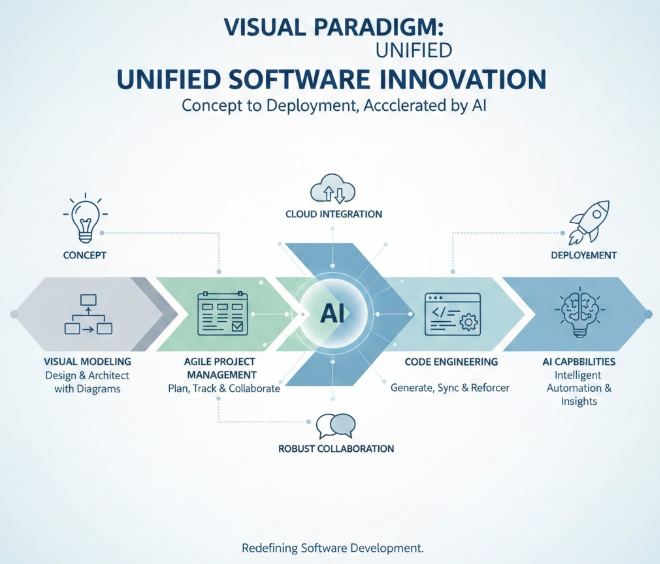
This comprehensive article explores how Visual Paradigm’s integrated platform is transforming the software development lifecycle—offering developers, architects, and project managers a powerful, cohesive environment that eliminates fragmentation, accelerates time-to-market, and enhances team productivity.
🛠️ The All-in-One Platform for Modern Software Development
Visual Paradigm is not just another modeling tool. It’s a unified digital workspace designed to support every phase of software development, from business analysis and system design to agile execution, code generation, and deployment planning.
📊 Comprehensive Visual Modeling Suite
At the heart of the platform lies a rich set of industry-standard modeling tools, supporting key notations such as:
-
UML (Unified Modeling Language) – for object-oriented design
-
BPMN (Business Process Model and Notation) – for business process modeling
-
ArchiMate – for enterprise architecture (TOGAF ADM-aligned)
-
DFD (Data Flow Diagram) – for data-centric system analysis
-
ERD (Entity-Relationship Diagram) – for database design
-
SysML & SoaML – for systems and service-oriented modeling
-
CMMN (Case Management Model and Notation) – for case-driven workflows
With an intuitive drag-and-drop interface, users can create complex diagrams with ease. Features like element reusability, syntax validation, and custom formatting ensure consistency and accuracy across projects—whether you’re designing a microservices architecture or mapping customer journey flows.
✅ Example: Architects using TOGAF ADM can seamlessly transition from business architecture to application and technology views using built-in templates and guided workflows.
🏃♂️ Agile Development Made Effortless
For agile teams, Visual Paradigm offers full Scrum support directly within the platform:
-
User story mapping with drag-and-drop functionality
-
Affinity estimation tables for sprint planning
-
Sprint backlog management with automated burndown charts
-
Scrum Process Canvas – a one-page visual guide covering roles, events, and artifacts
-
Automated retrospective reports and progress tracking
This integration allows teams to manage sprints, track velocity, and generate real-time insights—all without leaving the environment.
🔄 Seamless Workflow: From high-level requirements to detailed user stories, from backlog grooming to sprint execution—everything happens in one place.
🔗 Powerful Integrations & Code Engineering
Visual Paradigm bridges the gap between design and implementation through advanced code engineering capabilities:
-
Code generation for over 10 programming languages, including Java, Python, C#, Go, and TypeScript
-
Reverse engineering from code to diagrams (UML class, sequence, component)
-
Support for Hibernate ORM, REST API design, and database modeling (ERD)
-
Bidirectional synchronization between code and models
-
Integration with Atlassian Jira, Confluence, GitHub, GitLab, and Azure DevOps
Cloud-based repositories enable real-time collaboration, version control, and task tracking—making it ideal for distributed teams.
🎯 Use Case: A developer can generate a REST API specification from a UML class diagram, then auto-generate code stubs and test cases—all in minutes.
🎨 Intuitive User Interface: Built for Complexity, Designed for Clarity
The platform’s clean, modern interface supports complex diagramming tasks with ease. Whether creating detailed sequence diagrams, deployment diagrams, or state machine charts, the editor remains responsive and intuitive.
🖼️ Visual Preview: The interface showcases a well-structured sequence diagram, demonstrating how even intricate interactions can be visualized clearly and efficiently.
🤖 Harnessing AI for Smarter, Faster Development
One of the most groundbreaking advancements in Visual Paradigm is its AI-powered enhancement suite, which automates repetitive tasks and accelerates design cycles—turning natural language into actionable models.
🧠 Generative AI: From Text to Diagrams in Seconds
The Generative Modeling feature allows users to describe a system or process in plain English, and Visual Paradigm instantly generates corresponding diagrams:
-
Class diagrams from descriptions like “A university has students and professors. Each student is enrolled in multiple courses.”
-
Flowcharts for business logic or decision trees
-
Activity diagrams, sequence diagrams, and deployment diagrams via natural language prompts
This capability is especially valuable during early-stage ideation, where speed and clarity are critical.
💬 Example:
Prompt: “Create a user login system with authentication, password reset, and role-based access.”
Output: A fully editable UML class diagram with relationships, attributes, and methods.
🤖 Intelligent Chatbot for Conversational Design
The AI Chatbot enables conversational modeling, allowing users to refine diagrams through back-and-forth dialogue:
-
“Add a ‘logout’ feature to the login system.”
-
“Show how the password reset workflow interacts with the user and admin.”
-
“Convert this to a BPMN process diagram.”
This iterative, chat-based approach makes design more intuitive and accessible—even for non-technical stakeholders.
📚 AI App Library: 50+ Specialized Tools for Every Need
The AI App Library offers over 50 pre-built AI-powered applications, tailored for specific use cases:
-
Use Case Generator – creates detailed use case descriptions from requirements
-
Relationship Analyzer – identifies base, extend, and include relationships automatically
-
Scenario Analyzer – validates use case scenarios for completeness and consistency
-
Report Creator – generates comprehensive documentation from models
-
Activity Diagram Converter – transforms use case descriptions into visual workflows
These tools reduce manual effort, minimize oversight, and ensure requirements are captured with precision.
📈 Real-World Impact of AI Integration
-
Reduces design time by up to 70% in early-stage projects
-
Minimizes human error in diagram creation and requirement analysis
-
Enables non-technical team members (e.g., product owners, business analysts) to contribute effectively
-
Accelerates documentation, freeing developers to focus on innovation
🔍 Insight: AI doesn’t replace design thinking—it enhances it, turning abstract ideas into structured, actionable models faster than ever.
🛡️ Robust Support Ecosystem: Empowering Users at Every Level
Visual Paradigm doesn’t just deliver powerful tools—it delivers complete support to help users succeed, from onboarding to enterprise deployment.
📞 Multi-Channel Customer Support
Users can reach out through:
-
Ticket submission via the support portal
-
Email: [email protected]
-
Phone: +852 2744 8722 (Hong Kong)
-
Fax for formal requests
-
Customer Service Center for license management and renewals
Support is available for both technical issues and licensing inquiries, ensuring minimal downtime.
📚 Extensive Knowledge Resources
A wealth of learning materials is available to help users master the platform:
-
Step-by-step tutorials for beginners
-
In-depth articles on UML, Agile, Enterprise Architecture, and more
-
Comprehensive guides for Scrum, TOGAF, and BPMN
-
Diagram examples – full sets of UML and BPMN templates
-
Product booklets and user’s guides with practical examples
-
Free online training courses (including video and quizzes)
-
Product demos and best practice know-how tips
These resources are ideal for individuals, teams, and organizations looking to upskill or standardize practices.
🤝 Community & Partnership Programs
-
Community Forum: A vibrant Q&A space where users share tips, troubleshoot issues, and collaborate on solutions.
-
Academic Partner Program: Offers free or discounted licenses to universities and educators—empowering the next generation of software engineers.
-
Reseller Program: Supports regional partners in distributing Visual Paradigm, ensuring local support and service.
🎓 Impact: Over 100 academic institutions worldwide use Visual Paradigm to teach software engineering and enterprise architecture.
✅ Conclusion: The Future of Software Development is Unified, Intelligent, and Collaborative
Visual Paradigm’s all-in-one platform is not just a tool—it’s a transformation engine for modern software development. By unifying:
-
Visual modeling
-
Agile project management
-
Code engineering
-
AI-driven automation
-
Enterprise-grade collaboration
…Visual Paradigm eliminates the friction caused by fragmented tools, reduces context switching, and accelerates delivery.
With AI-powered generative modeling, intelligent chatbots, and a vast ecosystem of support, it empowers teams of all sizes—whether a solo developer prototyping a startup idea or an enterprise architect designing a multi-tier system.
🚀 Ready to Transform Your Development Workflow?
Whether you’re a developer, software architect, product owner, or enterprise CIO, Visual Paradigm offers the tools, intelligence, and support to:
-
Turn ideas into models faster
-
Deliver high-quality software with fewer errors
-
Collaborate seamlessly across teams
-
Scale your development process with confidence
🌐 Visit www.visual-paradigm.com today to explore the platform, access free trials, and start building smarter.
Empower Your Team. Accelerate Innovation. Build with Vision.
Visual Paradigm – Where Design Meets Intelligence.
-
AI-Powered UML Class Diagram Generator by Visual Paradigm: This advanced AI-assisted tool automatically generates UML class diagrams from natural language descriptions, significantly streamlining software design and modeling.
-
AI-Powered Sequence Diagram Refinement Tool: Discover how this feature enhances software design by automatically improving and optimizing sequence diagrams with intelligent suggestions.
-
AI Textual Analysis – Transform Text into UML Models Automatically: This resource explains how to use AI to analyze text documents and automatically generate UML diagrams for faster modeling and documentation.
-
Generate Activity Diagrams from Use Cases Instantly: Learn how the AI engine enables rapid and accurate conversion of use case descriptions into professional activity diagrams with minimal effort.
-
How AI Chatbot Can Help You Learn UML Faster: This article details how users can practice UML interactively, visualize concepts instantly, and receive immediate feedback to improve their modeling skills.
-
AI-Powered MVC System Architecture Generator: A specialized tool that leverages AI to automatically generate clean, scalable MVC (Model-View-Controller) system architectures through automated modeling.
-
Major Upgrade to AI UML Component Diagram Generation: An official update detailing enhancements that make the AI assistant an indispensable tool for generating modular software structures.
-
Definitive Guide to UML State Machine Diagrams with AI: A detailed technical guide on using AI-enhanced tools to model dynamic object behavior and complex state-driven logic.
-
AI Use Case Description Generator by Visual Paradigm: An AI-powered tool that automatically generates detailed use case descriptions from user inputs, accelerating system analysis and documentation.
-
Real-Life Case Study: Generating UML Class Diagrams with AI: A detailed case study demonstrating how an AI assistant successfully transformed textual requirements into accurate UML class diagrams for a real-world project.


