
Modern project management environments rarely operate under a single framework. Organizations frequently manage portfolios where some teams utilize Agile methodologies while others rely on predictive or waterfall approaches. This diversity creates a complex landscape for resource planning. Effective allocation requires a deep understanding of how different workflows demand different types of capacity. When resources are shared across these varying models, friction often occurs. This article outlines the structural approaches needed to manage these hybrid environments without compromising efficiency or team morale.
Defining the Mixed-Methodology Environment 🌍
A mixed-methodology portfolio consists of projects that do not adhere to a singular standard. One department might be delivering software updates in two-week sprints, while another is constructing a physical infrastructure project with fixed milestones. This is not a failure of strategy but often a reflection of the specific needs of the domain. Regulatory requirements, client expectations, and product lifecycles dictate the approach.
Managing resources in this context demands flexibility. A static resource plan will fail because it cannot account for the velocity differences between methods. The goal is to create a unified view of capacity that respects the distinct rhythms of each workstream.
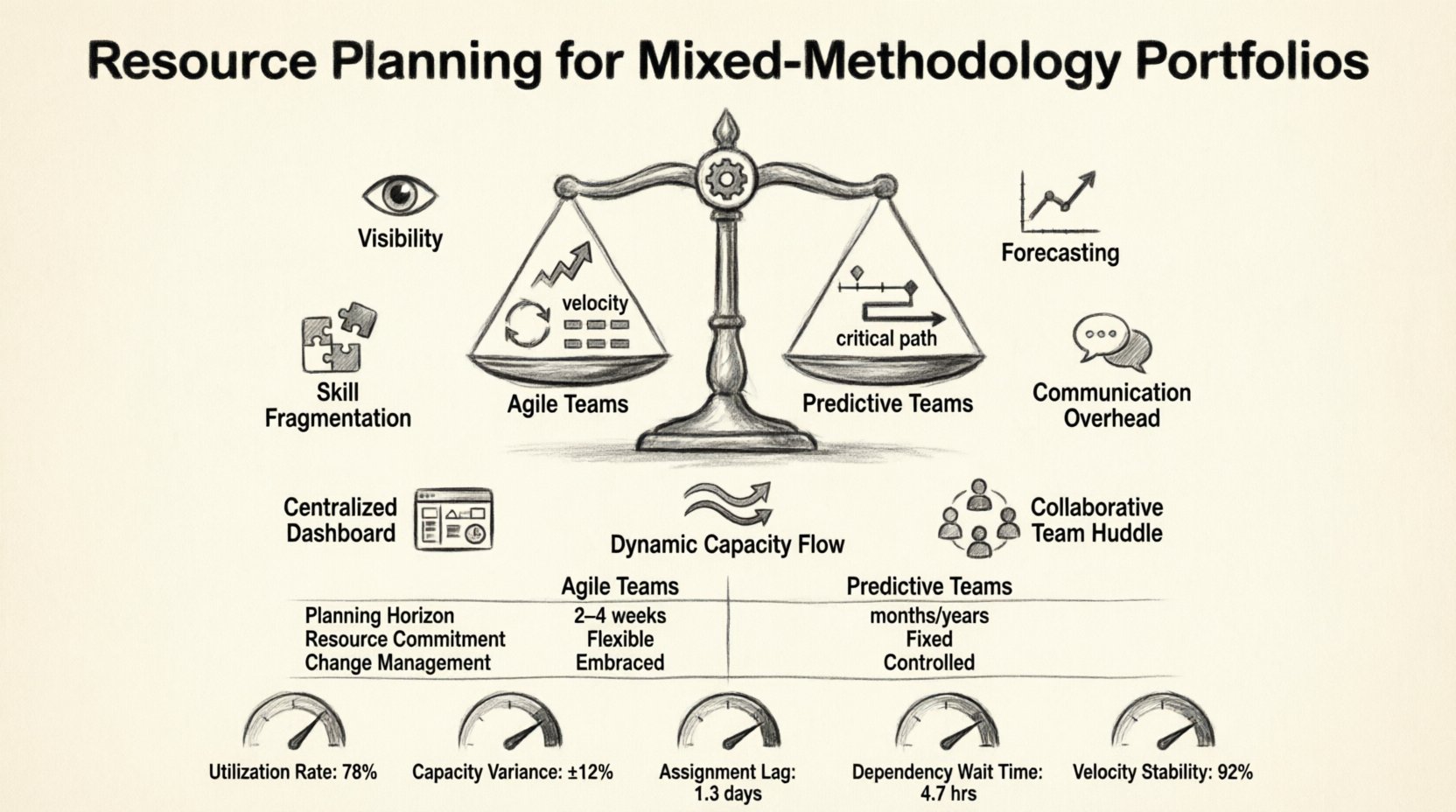
- Agile Teams: Focus on velocity, capacity planning per sprint, and iterative delivery.
- Predictive Teams: Focus on critical path, milestone adherence, and long-term forecasting.
- Hybrid Teams: Often bridge the gap, requiring both fixed deadlines and adaptive planning.
Key Challenges in Resource Allocation ⚖️
When attempting to plan for these diverse groups, several structural hurdles emerge. These challenges are not merely logistical; they are often cultural. Understanding them is the first step toward a viable solution.
1. Visibility and Transparency
Without a unified view, managers cannot see where bottlenecks are forming. If an Agile team needs a specific skill set that a Predictive team is hoarding, conflict arises. Data silos prevent the organization from seeing the full picture of who is available and when.
2. Forecasting Accuracy
Predictive models rely on detailed upfront planning. Agile models rely on empirical data from previous sprints. Merging these forecasts is difficult. A resource manager cannot simply average the numbers. They must understand the confidence intervals associated with each method.
3. Skill Set Fragmentation
Specialized skills are often required for specific methodologies. A project manager who excels at Waterfall may struggle to facilitate an Agile sprint. Conversely, a Scrum Master may not have the experience to manage strict regulatory compliance requirements. Identifying the right talent for the right workflow is critical.
4. Communication Overhead
Different methodologies require different communication cadences. Agile teams stand up daily; Predictive teams might meet weekly. Aligning these rhythms for resource coordination adds administrative burden. This overhead can reduce the actual time available for value creation.
Strategic Approaches to Balanced Planning 📅
To navigate these challenges, organizations must adopt specific strategies that bridge the gap between flexibility and control. The following approaches provide a framework for stability.
Centralized Visibility
Establish a single source of truth for resource availability. This does not mean forcing everyone into the same tool, but rather ensuring data flows into a central dashboard. Leaders need to see total capacity versus total demand.
- Map all resources to their primary and secondary skills.
- Track allocation percentages across all active projects.
- Identify over-allocated individuals before burnout occurs.
Dynamic Capacity Management
Static plans are obsolete in mixed environments. Capacity must be reviewed and adjusted regularly. This involves looking at available hours, planned leave, and non-project work.
- Review capacity at the beginning of every planning cycle.
- Build buffers into the plan for unexpected interruptions.
- Allow for resource shifting between projects based on priority changes.
Cross-Functional Collaboration
Resource planning should not be an isolated administrative task. It requires input from the people doing the work. Their feedback on actual effort versus estimated effort is invaluable for future planning.
- Conduct retrospective meetings to discuss resource constraints.
- Involve team leads in the forecasting process.
- Encourage open dialogue about capacity limits.
Bridging Agile and Predictive Workflows 🔄
The core friction point in mixed portfolios is the difference in cadence. Agile operates in short iterations; Predictive operates in phases. Aligning these requires a structured approach to hand-offs and dependencies.
The table below outlines the fundamental differences that impact resource planning.
| Aspect | Agile / Adaptive | Predictive / Waterfall |
|---|---|---|
| Planning Horizon | Sprint-based (2-4 weeks) | Project-based (Months/Years) |
| Resource Commitment | Flexible, team-based | Fixed, role-based |
| Change Management | Embraced, low cost | Controlled, high cost |
| Success Metrics | Velocity, Customer Satisfaction | On Time, On Budget |
| Resource Contention | High (Shared across sprints) | Medium (Defined by phase) |
When planning resources, managers must respect these distinctions. Forcing a Predictive timeline onto an Agile team creates unnecessary pressure. Forcing an Agile scope onto a Predictive team creates compliance risks.
Metrics That Matter 📊
To maintain control over a mixed portfolio, specific metrics must be tracked. These indicators help identify trends and potential failures before they impact delivery.
- Resource Utilization Rate: Measures the percentage of time a resource is billed or working on projects. High utilization (>85%) often leads to burnout and reduced quality.
- Capacity Variance: Compares planned capacity against actual capacity delivered. High variance indicates poor forecasting.
- Assignment Lag: Measures the time between a resource becoming available and being assigned to a new task. Long lags indicate inefficiency.
- Dependency Wait Time: Tracks how long a task waits for a resource from another methodology to complete a prerequisite.
- Team Velocity Stability: Monitors if the Agile team’s output is consistent over time. Sudden drops often signal resource issues.
Managing Risk in Hybrid Models 🛡️
Hybrid models introduce unique risks. A delay in a Predictive phase can block an Agile team that is waiting on a deliverable. Conversely, an Agile delay can make a Predictive milestone impossible to hit.
Effective risk management involves identifying these interdependencies early.
- Map Interdependencies: Create a dependency map that links tasks across different methodologies.
- Establish Buffers: Add time buffers to critical path items that rely on external inputs.
- Define Escalation Paths: Ensure everyone knows who to contact when a resource conflict threatens a deadline.
- Monitor Critical Resources: Identify the few individuals who are critical to multiple projects and protect their capacity.
Building a Culture of Transparency 🤝
Ultimately, resource planning is a human endeavor. Tools and processes are secondary to the trust between managers and team members. A culture of transparency allows for honest conversations about capacity.
When team members feel safe admitting they are at capacity, managers can adjust plans before work is compromised. This requires leadership to model this behavior. Leaders must be willing to say no to new work if the current load is full.
- Share capacity data openly with teams.
- Involve resources in the decision-making process regarding their workload.
- Prioritize sustainability over speed.
- Recognize that saying no to a request is a valid planning decision.
Adapting to Future Changes 🔄
The landscape of work is constantly evolving. New methodologies emerge, and existing ones adapt. A resource plan must be resilient enough to absorb these changes without collapsing.
Regular reviews of the portfolio strategy are essential. Are the methodologies still appropriate for the current projects? Do the resource skills match the current demands? These questions should be asked quarterly, not just at the start of a fiscal year.
By focusing on visibility, flexibility, and human factors, organizations can manage complex portfolios effectively. The goal is not to force everyone into a single mold, but to create an environment where diverse approaches can coexist and contribute to the broader organizational goals. Success lies in the balance between structure and adaptability.