
In the domain of object-oriented analysis and design, the architecture of a software system determines its longevity and adaptability. One of the most critical metrics for evaluating design quality is the degree of coupling between components. Reducing coupling is not merely a theoretical exercise; it is a practical necessity for maintaining systems that must evolve over time. When dependencies are minimized, the system becomes more flexible, allowing changes to be isolated and deployed with confidence.
This guide explores the mechanics of coupling, the types of dependencies that hinder flexibility, and the specific strategies used to achieve a loosely coupled architecture. By understanding these principles, developers can create systems that are easier to test, maintain, and extend without unintended side effects.
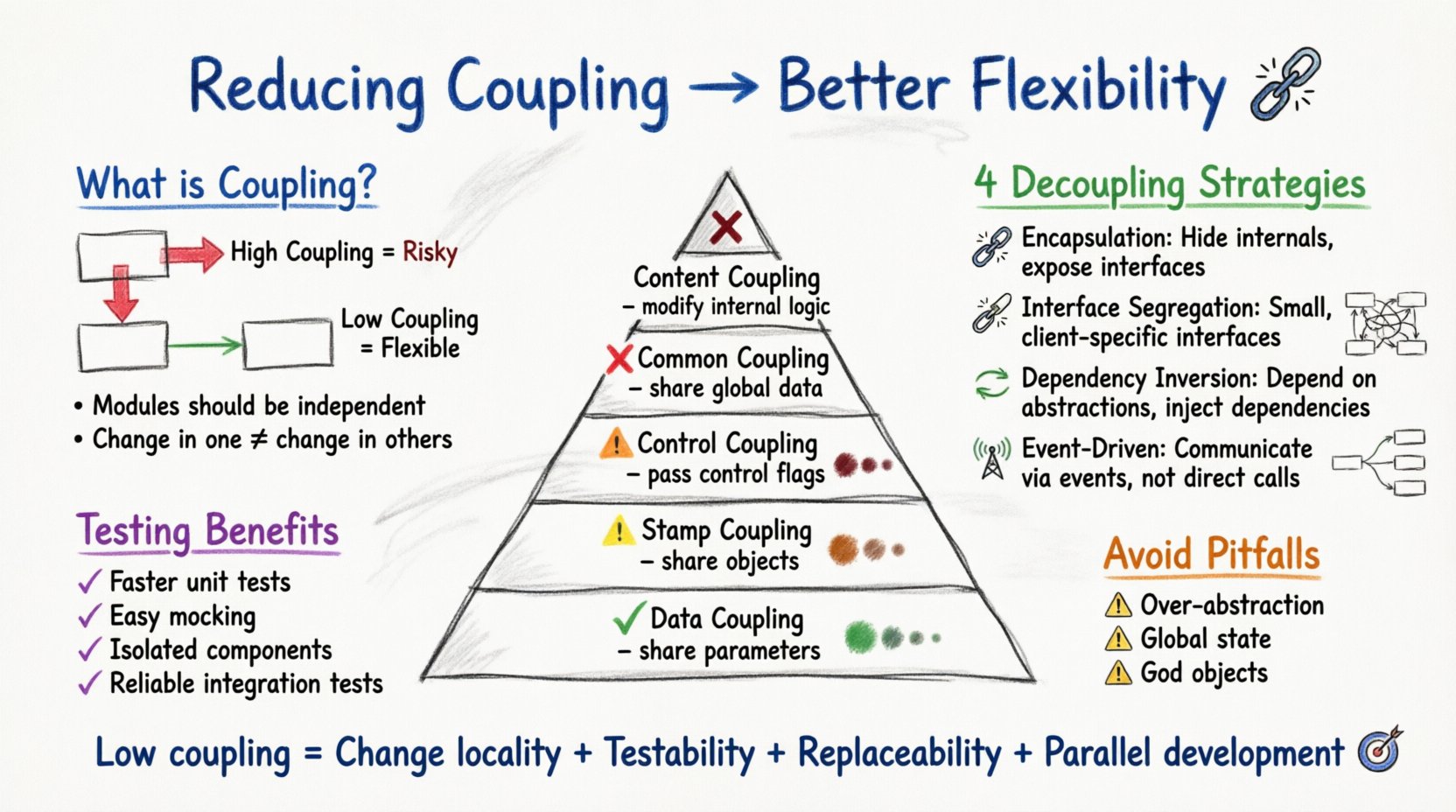
Understanding the Concept of Coupling 🔗
Coupling refers to the degree of interdependence between software modules. It measures how closely connected two routines or modules are. In a well-designed system, modules should be independent enough that a change in one does not necessitate a change in another. High coupling creates a web of dependencies where a modification in a single class can ripple through the entire application, causing instability.
Conversely, low coupling implies that modules are loosely connected. This separation allows teams to work on different parts of the system simultaneously without constant coordination. The goal is to reduce coupling while maintaining high cohesion, where the elements within a single module are strongly related to one another.
- High Coupling: Modules rely heavily on internal details of other modules. Changes are difficult and risky.
- Low Coupling: Modules interact through stable interfaces. Changes are localized and contained.
Types of Coupling 📊
To effectively reduce coupling, one must first understand the various forms it takes. Different levels of coupling exist, ranging from benign to highly detrimental. The table below outlines the common types of coupling found in object-oriented systems.
| Type of Coupling | Description | Impact on Flexibility |
|---|---|---|
| Data Coupling | Modules share data through parameters. | Low Impact (Desirable) |
| Stamp Coupling | Modules share a composite data structure (object). | Moderate Impact |
| Control Coupling | One module passes control flags to another. | High Impact |
| Common Coupling | Modules share global data. | Very High Impact |
| Content Coupling | One module modifies the internal logic of another. | Critical Impact |
While some coupling is inevitable, the objective is to minimize the severity of these dependencies. Data coupling is often acceptable as it represents simple information passing. However, control and content coupling introduce hidden logic flows that make the system brittle.
The Impact on Maintenance and Testing 🛠️
When coupling is high, the cost of maintenance increases exponentially. Developers spend more time understanding how a change in one area affects another than writing new code. This phenomenon is often referred to as the “ripple effect.” A small bug fix in a utility class can break the core business logic, leading to regression errors.
Testing Challenges
Unit testing becomes significantly more difficult with tight coupling. If a class depends on a database connection, a network service, or a specific file system path, it cannot be tested in isolation. Tests become slow, flaky, and require complex setup.
- Mocking Difficulty: Dependencies must be mocked or stubbed to run tests.
- Test Fragility: Changes in dependent classes break existing tests.
- Integration Complexity: Tests must spin up external services, slowing down the feedback loop.
Maintenance Costs
Flexibility is directly correlated to the ability to change the system. Tight coupling reduces the ability to swap implementations. For example, if a payment processing module is tightly coupled to a specific payment gateway API, switching providers requires rewriting the core logic. Loose coupling allows the implementation to change while the interface remains stable.
Strategies for Decoupling 🧩
Reducing coupling requires intentional design decisions. It is not a process that happens automatically; it must be engineered into the system from the outset. The following strategies provide a framework for achieving independence between components.
1. Encapsulation and Abstraction
Encapsulation hides the internal state of an object. By exposing only necessary methods, you prevent other modules from accessing or modifying internal data directly. This reduces the surface area for potential errors.
- Define clear interfaces for what a class does, not how it does it.
- Keep data private and provide public getters or setters only when absolutely necessary.
- Avoid exposing implementation details like internal arrays or database schemas.
2. Interface Segregation
Interfaces should be client-specific. A large, monolithic interface forces clients to depend on methods they do not use. This creates unnecessary coupling. By splitting interfaces into smaller, focused ones, modules only depend on the functionality they actually need.
- Break down large interfaces into smaller, cohesive groups.
- Ensure that no module depends on an interface that contains irrelevant methods.
- This allows implementations to vary without affecting unrelated clients.
3. Dependency Inversion
High-level modules should not depend on low-level modules. Both should depend on abstractions. This principle allows the system to swap out low-level details without altering the high-level logic.
- Use interfaces or abstract classes to define dependencies.
- Inject dependencies rather than creating them directly within the class.
- This enables the use of different implementations (e.g., a mock for testing, a real service for production) without changing the consumer code.
4. Event-Driven Architecture
Instead of direct method calls, modules can communicate through events. When a module emits an event, other modules that are listening can react to it. This removes the need for the emitter to know who is listening.
- Decouple the sender from the receiver.
- Allow multiple listeners to respond to a single event.
- Reduce the need for direct references between components.
Dependency Management 🔄
Managing dependencies is a critical aspect of reducing coupling. In modern development, dependencies are often managed through frameworks or containers. However, the concept applies even without specific tools.
Constructor Injection
Passing dependencies through the constructor ensures that the required components are available when the object is instantiated. It makes dependencies explicit and mandatory.
- Prevents objects from being created in an invalid state.
- Makes the object immutable regarding its dependencies.
- Facilitates easier testing by allowing mock objects to be passed in.
Service Locators
While sometimes used to avoid passing objects around, service locators can introduce hidden dependencies. The code does not explicitly state what it needs; it asks the locator. This can make the system harder to understand and trace.
- Prefer explicit injection over implicit lookups.
- Ensure the location of dependencies is clear in the code.
Testing Implications 🧪
Low coupling is the foundation of effective testing. When components are decoupled, they can be tested in isolation. This leads to faster test suites and more reliable validation.
Unit Testing
With loose coupling, unit tests focus on the logic of a single class. They do not need to instantiate databases or network connections. This results in tests that run in milliseconds.
- Isolate the class under test from external services.
- Use dependency injection to provide test doubles.
- Focus on behavior rather than implementation.
Integration Testing
Even with low coupling, integration testing is necessary to verify that components work together. However, the scope is reduced because the internal details of each component are trusted.
- Focus on the contract between components.
- Verify data flow across boundaries.
- Minimize the number of integration points that require verification.
Common Pitfalls ⚠️
Achieving low coupling is not without challenges. Developers often fall into traps that reintroduce dependency.
Over-Abstraction
Creating too many interfaces can add complexity without reducing coupling. If every class has an interface, the code becomes harder to navigate. Interfaces should be created where they provide value, not as a rule.
Global State
Using global variables or static methods creates common coupling. Any part of the system can access or modify these states, making the flow of data unpredictable.
- Avoid static state that persists across requests.
- Pass state explicitly through method parameters.
- Use dependency injection to manage shared state.
God Objects
A “God Object” is a class that knows too much or does too much. It becomes a hub for dependencies, creating high coupling with everything it touches.
- Refactor God Objects into smaller, specialized classes.
- Apply the Single Responsibility Principle.
- Limit the number of methods and data fields in a single class.
Evaluating Flexibility 📊
How do you know if your system is flexible enough? There are several indicators that suggest coupling has been reduced successfully.
- Change Locality: Changes in one module do not require changes in others.
- Testability: Modules can be tested without complex setup.
- Replaceability: Implementations can be swapped without modifying the consumer.
- Parallel Development: Multiple developers can work on different modules without conflict.
Refactoring for Independence 🛠️
Refactoring is the process of improving the internal structure of code without changing its external behavior. When reducing coupling, refactoring is often required to break existing dependencies.
Extract Method
Move logic from a large method into a new method. This can help separate concerns and reduce the coupling within a single class.
Replace Conditional Logic with Polymorphism
Switch statements that handle different types can be replaced with polymorphic behavior. This removes the need for the caller to know the specific type, reducing coupling to implementation details.
Introduce Interfaces
If two classes share behavior but are not related, introduce an interface that defines that behavior. This allows other classes to depend on the interface rather than the concrete class.
Final Considerations 🏁
Reducing coupling is a continuous process. As systems grow, new dependencies inevitably form. The goal is not to eliminate all coupling, but to manage it effectively. A system with zero coupling is impossible, but a system with managed, low coupling is highly resilient.
By prioritizing interfaces, dependency injection, and clear boundaries, developers can build architectures that withstand change. Flexibility is not a feature; it is a quality of the design. It ensures that the system remains a tool for business value rather than a source of technical debt.
Remember that technical decisions have business implications. A flexible system reduces the time to market for new features. It lowers the risk of regression errors. It empowers the development team to innovate without fear of breaking existing functionality. These are the tangible benefits of focusing on coupling reduction.
Start by auditing your current codebase. Identify high-coupling areas and prioritize them for refactoring. Small, incremental changes are often more effective than large, risky overhauls. Document the interfaces and dependencies to ensure clarity. Finally, encourage a culture where decoupling is valued as a standard practice, not an exception.
Ultimately, the strength of an object-oriented design lies in its ability to adapt. By reducing coupling, you build a foundation that supports growth, change, and evolution. This is the essence of sustainable software engineering.