
Time is the most finite resource for anyone building a technology venture. Founders spend countless hours debugging code, managing engineering teams, and dealing with user acquisition. Strategic planning often falls to the bottom of the priority list, yet it remains the compass that guides long-term viability. This guide outlines a focused protocol to map your business model in fifteen minutes. This sprint strips away unnecessary complexity to focus on the core mechanics of your value creation.
Tech founders often overcomplicate strategy. We assume we need extensive market research, competitor analysis, and financial modeling before we can define the model. This is not the case. The Business Model Canvas (BMC) offers a visual architecture that fits on a single page. By condensing this into a sprint, you force clarity. You identify assumptions and gaps immediately. This document serves as your operational manual for that sprint.
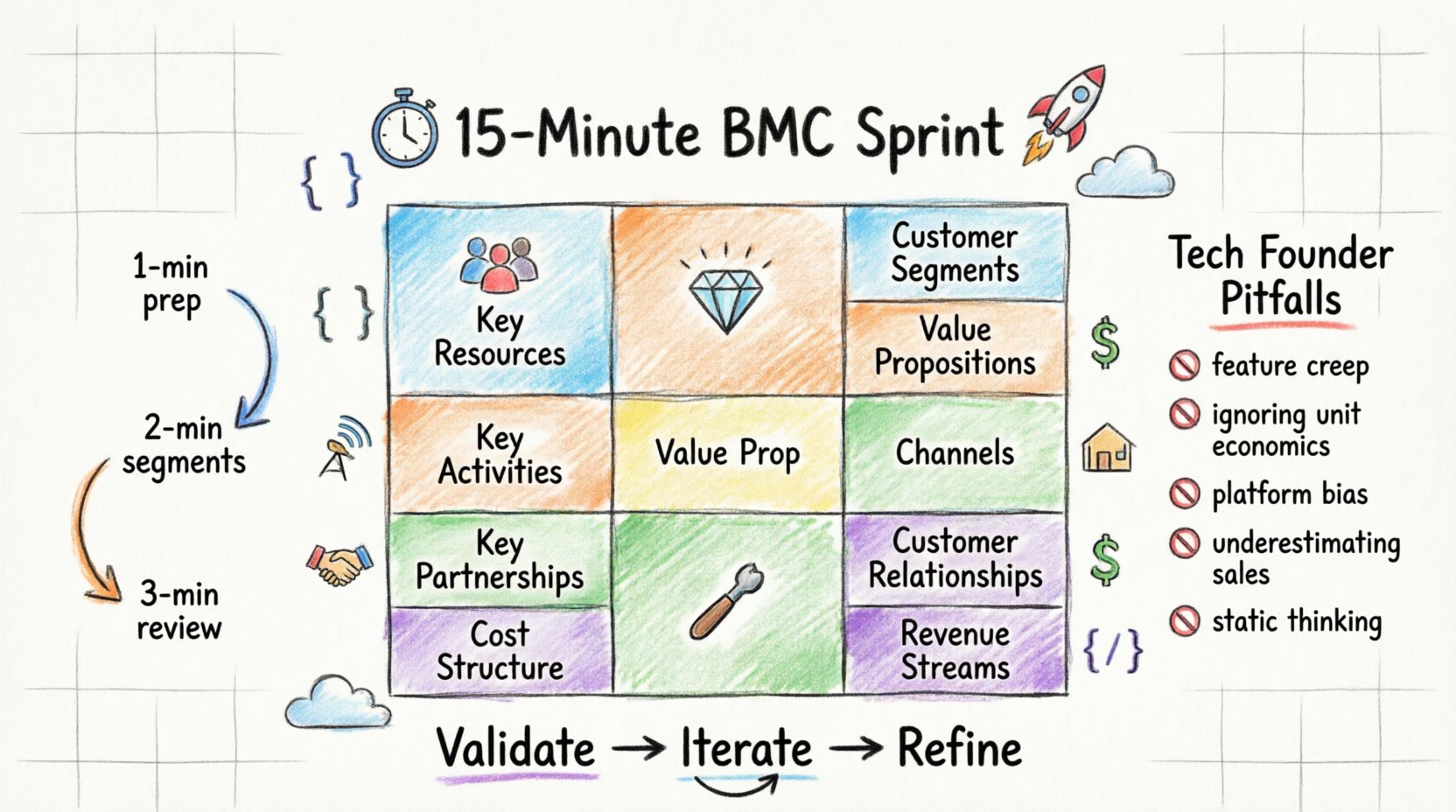
Why the 15-Minute Sprint? 🕒
The standard approach to business modeling is often a 10-hour workshop. It involves extensive debate, whiteboarding sessions, and consensus building. For a solo founder or a small technical team, this friction is costly. The goal of the sprint is not perfection. It is momentum. It is about capturing the current state of your thinking to validate against reality.
When you limit the time, you limit the scope for perfectionism. You must decide what matters most. This aligns with the principles of lean methodology. You are building a Minimum Viable Product for your strategy, not a full-scale enterprise architecture. The 15-minute window forces you to prioritize the blocks that drive revenue and the blocks that drive cost.
This approach is particularly effective for technology companies because software allows for rapid iteration. Just as you refactor code, you refactor your business model. The sprint provides the snapshot needed to begin that iteration cycle.
The 9 Building Blocks Explained 🔍
The Business Model Canvas consists of nine distinct building blocks. Each block represents a fundamental aspect of how an organization creates, delivers, and captures value. Below is a detailed breakdown of each block, tailored specifically for the context of technology ventures. Understanding the nuance of each section ensures your sprint yields actionable insights rather than vague statements.
1. Customer Segments 👥
This block defines the different groups of people or organizations you aim to reach and serve. For tech founders, the temptation is to define the segment too broadly. Avoid saying “everyone with a smartphone.” Specificity drives product-market fit.
- Mass Market: Standardized products for a large audience (e.g., consumer apps).
- Niche Market: Specialized needs for a specific industry (e.g., medical software for radiologists).
- Segmented: Distinct groups with different needs (e.g., free tier vs. enterprise tier).
- Multi-Sided Platforms: Two or more interdependent groups (e.g., drivers and riders).
In a technical context, ask: Who pays? Who uses? Who influences the decision? Often, the user is not the customer in B2B scenarios. The IT Director might approve the budget while the Developer uses the tool. Your canvas must reflect this distinction.
2. Value Propositions 💎
This block describes the bundle of products and services that create value for a specific customer segment. It is the reason a customer chooses you over a competitor. For technology products, value often stems from efficiency, performance, or integration.
- Innovation: New products or services that have not existed before.
- Performance: How the product performs relative to the competition.
- Customization: Tailoring the service to individual needs.
- Design: Aesthetic and functional appeal of the interface.
- Brand/Status: The perception of the product in the market.
- Price: The cost structure relative to value.
- Cost Reduction: Helping the customer save money.
- Risk Reduction: Mitigating security or compliance risks.
- Convenience/Usability: Ease of implementation and use.
- Newness: Solving a problem previously considered unsolvable.
When filling this block, avoid generic terms like “user-friendly.” Be specific. Does your API reduce integration time by 50%? Does your encryption protocol lower compliance costs? Quantifiable value propositions are easier to validate in the market.
3. Channels 📡
Channels describe how a company communicates with and reaches its customer segments to deliver a value proposition. In the digital age, channels are often direct but can be indirect through partners.
- Owned Channels: Your website, mobile app, blog, or physical offices.
- Partner Channels: Resellers, affiliates, or app marketplaces.
- Communication Channels: Social media, email newsletters, or paid advertising.
- Customer Touchpoints: The specific interactions a customer has with the brand.
For software founders, the channel is often the platform itself. If you are building a SaaS, your website is the primary channel. If you are building a mobile game, the App Store is the channel. Consider the customer lifecycle. Awareness, evaluation, purchase, delivery, and after-sales support all have different channel requirements. Mapping these ensures you do not lose leads during handoff.
4. Customer Relationships 🤝
This block describes the types of relationships a company establishes with specific customer segments. Relationships can range from personal assistance to automated self-service. The cost of acquisition and retention varies significantly based on the relationship type.
- Personal Assistance: Direct human interaction (e.g., account managers).
- Self-Service: The customer does everything themselves without human interaction.
- Automated Services: Technology-driven interactions (e.g., chatbots, tutorials).
- Communities: Creating a space for users to interact with each other.
- Co-Creation: Partnering with customers to create value together.
Tech founders often default to self-service to scale. However, high-touch relationships can justify higher price points in B2B enterprise sales. Determine the expected relationship model early. If you plan to offer enterprise support, this must be reflected in your cost structure and resource allocation.
5. Revenue Streams 💰
Revenue streams represent the cash a company generates from each customer segment. It is crucial to define not just the source, but the pricing mechanism. Pricing strategy is a critical lever in technology business models.
- Asset Sale: Selling ownership of a physical product.
- Usage Fee: Charging based on how much the product is used (e.g., API calls).
- Subscription Fee: Recurring revenue for access to a service.
- Lending/Renting/Leasing: Temporary access to assets.
- Advertising: Charging for space to display ads.
- Brokerage Fees: Fees for facilitating a transaction.
For SaaS, the subscription fee is standard. For platforms, the brokerage fee is common. Be explicit about the unit of measurement. Is it per user? Per seat? Per transaction? Per gigabyte? Vague pricing models lead to vague revenue forecasts. Define the currency and the frequency clearly.
6. Key Resources 🏗️
Key resources are the most important assets required to make a business model work. These can be physical, intellectual, human, or financial. In technology startups, intellectual and human resources often dominate.
- Physical: Buildings, vehicles, machines, IT infrastructure.
- Intellectual: Brands, patents, copyrights, proprietary algorithms, customer databases.
- Human: The team, engineers, sales staff, management.
- Financial: Cash, lines of credit, equity.
Identify which resources are critical. If you lose your lead engineer, does the business stop? If you lose your patent, does the moat disappear? This block helps prioritize resource allocation. It highlights where you need to invest capital to maintain operations.
7. Key Activities 🛠️
Key activities are the most important things a company must do to make its business model work. These are the actions taken to create value, reach markets, and maintain relationships.
- Production: Designing, making, and delivering a product in quantity or specific quality.
- Solving: Problem-solving activities for customers (e.g., consulting).
- Platform/Network: Managing and maintaining platforms (e.g., servers, apps).
For tech founders, “Platform/Network” is often the primary activity. This involves server maintenance, security updates, and API management. “Production” might involve code deployment cycles. “Solving” applies to custom integrations for enterprise clients. Ensure your team has the capacity to execute these activities daily.
8. Key Partnerships 🤝
The network of suppliers and partners that make the business model work. Companies form partnerships to optimize their business models, reduce risk, or acquire resources.
- Non-Competitors: Partnerships that allow for complementary offerings.
- Optimization: Outsourcing non-core activities to reduce costs.
- Acquisition: Gaining access to specific technologies or markets.
- Resource Acquisition: Partnering to secure supply chains or data.
Do not build everything. If you need payment processing, use Stripe. If you need email delivery, use SendGrid. Identify the partners that allow you to focus on your core differentiation. This block also includes strategic alliances where you might integrate with another platform to gain traction.
9. Cost Structure 💸
The cost structure describes all costs incurred to operate a business model. It is the flip side of the revenue streams. Understanding costs is vital for sustainability.
- Fixed Costs: Costs that remain the same regardless of production volume (e.g., salaries, rent).
- Variable Costs: Costs that change with the volume of output (e.g., hosting fees per user).
- Economies of Scale: Costs that decrease as volume increases.
- Economies of Scope: Costs that decrease as the variety of products increases.
Tech businesses often have high fixed costs (engineering salaries) and low variable costs (cloud hosting). This creates a leverage effect. However, if user acquisition costs are high, variable costs can spike. Map your costs against your revenue streams to ensure the margin is healthy.
The Sprint Protocol: Step-by-Step 🏃
To execute this sprint effectively, follow this specific sequence. Do not deviate. The time limit is the constraint that drives the quality of the output.
- Preparation (1 Minute): Gather a whiteboard or digital canvas. Set a timer for 15 minutes. Invite a co-founder or a trusted advisor to act as a challenger.
- Customer Segments (2 Minutes): Write down who you are serving. Be specific.
- Value Proposition (3 Minutes): Define the core benefit. Why them? Why now?
- Channels & Relationships (2 Minutes): How do they find you? How do you keep them?
- Revenue & Cost (2 Minutes): How do you make money? What does it cost to get there?
- Resources, Activities, Partners (3 Minutes): What do you need to build this?
- Review & Refine (2 Minutes): Look for gaps. Does the cost match the revenue? Do the activities match the resources?
This sequence flows logically from the customer outward to the infrastructure. It prevents the common error of designing the technology before understanding the customer.
Tech Founder Pitfalls to Avoid 🚫
Even with a structured sprint, technical founders face specific cognitive traps. Awareness of these pitfalls improves the accuracy of the canvas.
- Feature Creep: Focusing on technical capabilities rather than customer value. The canvas should reflect value, not features.
- Ignoring Unit Economics: Assuming that growth will solve profitability. The Revenue and Cost blocks must align mathematically.
- Platform Bias: Assuming your product is the platform when it is a tool. This affects the Key Partnerships and Revenue Streams.
- Underestimating Sales: Tech founders often think “build it and they will come.” The Channels block must account for active sales efforts.
- Static Thinking: Treating the canvas as a final document. It is a living map. Update it quarterly or after major pivots.
Strategic Alignment Table 📊
Use the table below to track the alignment between your blocks during the sprint. This ensures consistency across the model.
| Block | Key Question | Tech Context Example |
|---|---|---|
| Value Prop | What problem are we solving? | Reducing latency in data processing. |
| Key Activities | What do we need to do? | Optimizing algorithms and scaling servers. |
| Key Resources | What do we need to own? | Proprietary codebase and GPU clusters. |
| Revenue | How do we charge? | Per API call or monthly subscription. |
| Costs | What are the expenses? | Cloud hosting fees and engineering salaries. |
Reviewing these rows helps identify mismatches. For instance, if your Key Activities are high-touch consulting, but your Value Prop is automated software, you have a misalignment. The sprint forces you to spot this contradiction immediately.
Validation and Iteration 🔄
Completing the canvas is the beginning, not the end. The output of the sprint is a hypothesis. You must test it against the market. This involves talking to customers, running experiments, and analyzing data.
Do not fall into the trap of thinking the canvas is a strategy. It is a tool for strategy. The real strategy emerges from the interaction between the canvas and customer feedback. If the Customer Segments block does not match real-world behavior, adjust it. If the Revenue Streams block does not generate cash, change the pricing model.
Keep the canvas visible. Place it in your office or pin it to your project management tool. It serves as a reminder of the assumptions you are making. Every product decision should be traceable back to one of the nine blocks. This maintains strategic discipline.
Final Thoughts on Execution ⚙️
Busy tech founders need tools that respect their time. The 15-minute Business Model Canvas sprint respects that constraint. It provides a structured way to think about the business without getting lost in the details. By focusing on the nine blocks, you ensure that no critical aspect of the model is overlooked.
The discipline of timeboxing forces clarity. It removes the option to hide behind indecision. You must make a choice about the customer, the value, and the revenue. These choices are better than vague aspirations. As you iterate on your product, iterate on the canvas. The relationship between the code and the business model is symbiotic. Both require constant refinement.
Start the timer. Grab a pen. Map the model. The clarity you gain will be worth the fifteen minutes spent.