


In the complex ecosystem of software development, clarity is the ultimate currency. While code defines behavior, structure defines stability. Package diagrams serve as the blueprint for this stability, offering a high-level view of the system’s organization. They abstract away implementation details to focus on relationships, dependencies, and boundaries between modules. Understanding package diagram patterns allows architects to design systems that are maintainable, scalable, and resilient to change.
This guide explores the standard architectural structures found in package diagrams. It moves beyond basic syntax to examine the logic behind grouping, the rules of dependency, and the implications of structural choices. By recognizing these patterns, teams can align their visual models with their engineering goals.
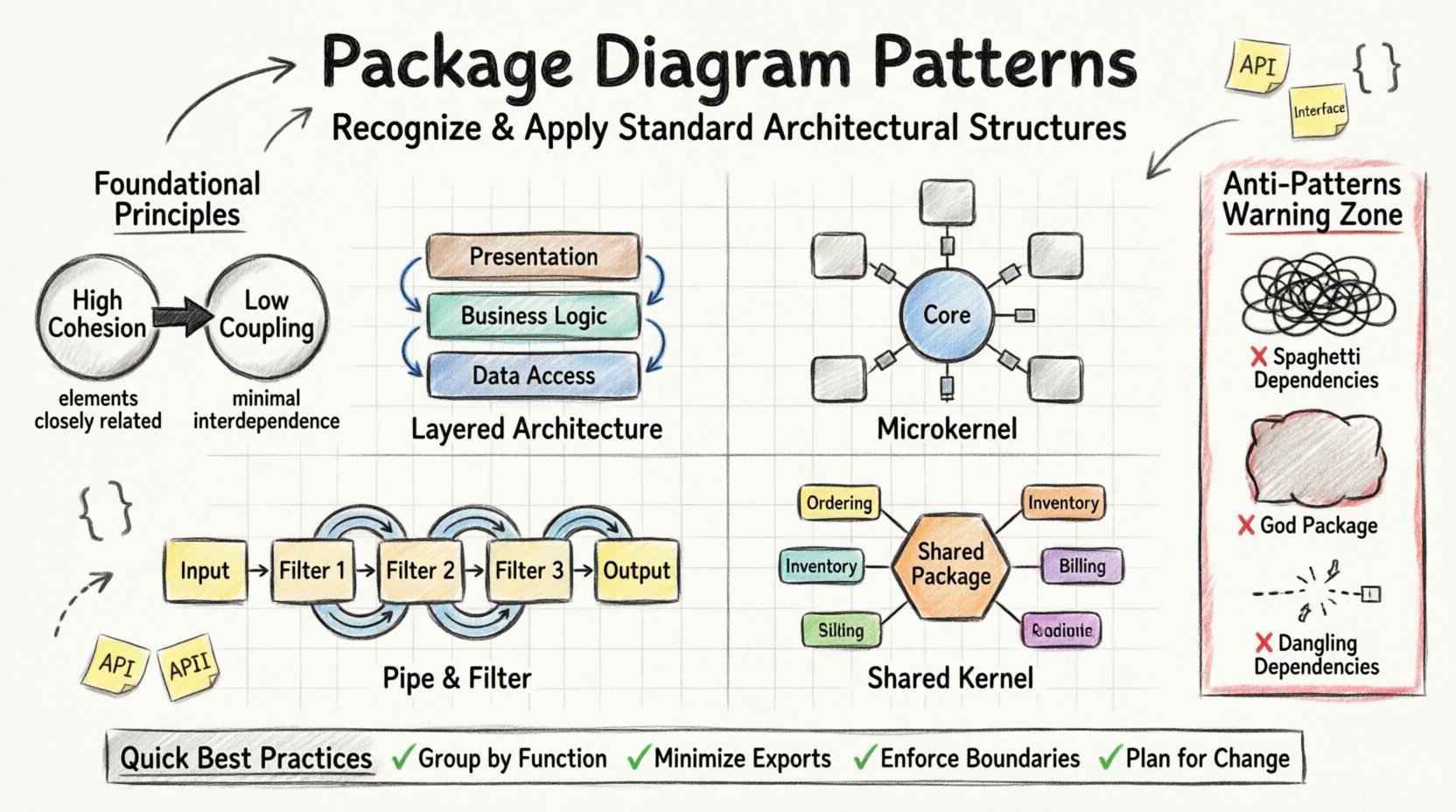
🧱 Foundational Principles of Package Organization
Before applying specific patterns, one must understand the underlying mechanics that govern package diagrams. These diagrams are not merely visual decorations; they represent logical boundaries. Two primary principles dictate the effectiveness of any package structure:
- Cohesion: Elements within a package should be closely related. If a package contains unrelated functionalities, it becomes difficult to understand and modify. High cohesion ensures that a change in one area does not ripple unpredictably through the entire system.
- Coupling: This measures the degree of interdependence between packages. Low coupling is the goal. When packages rely on specific implementations rather than abstractions, the system becomes rigid. Effective patterns minimize coupling to allow independent evolution.
Package diagrams visualize these concepts. Arrows indicate dependencies. The direction of the arrow shows which package requires the other. A well-designed diagram shows a clear flow of information, avoiding tangled webs of circular dependencies.
🔍 Recognizing Standard Architectural Patterns
Architectural patterns are recurring solutions to common problems. In the context of package diagrams, these patterns define how packages are arranged and how they interact. Identifying the correct pattern early prevents structural debt later.
1. Layered Architecture
The layered pattern is perhaps the most common structure in enterprise systems. It organizes packages into horizontal layers based on their level of abstraction or responsibility. Each layer interacts only with the layer immediately below it.
- Structure: Packages are stacked vertically. The top layer (e.g., Presentation) depends on the middle layer (e.g., Business Logic), which depends on the bottom layer (e.g., Data Access).
- Dependency Rule: Dependencies must flow in one direction. The top layer cannot depend on the bottom layer directly. This enforces separation of concerns.
- Benefit: It simplifies testing and allows swapping of layers without affecting others, provided interfaces remain stable.
2. Microkernel Architecture
This pattern separates the core functionality from the extensions. It is ideal for systems that require extensibility, such as IDEs or content management platforms.
- Structure: One central package contains the core logic. Surrounding it are multiple extension packages.
- Dependency Rule: The core package defines interfaces. Extension packages implement these interfaces. The core package never depends on the extensions, but extensions depend on the core.
- Benefit: New features can be added without modifying the core system, reducing the risk of regression.
3. Pipe and Filter
Best suited for data processing pipelines, this pattern breaks the system into processing units (filters) connected by data streams (pipes).
- Structure: Each package represents a specific transformation step. Data flows from one package to the next.
- Dependency Rule: Filters depend on the data schema but not on each other. They communicate via the pipe (interface).
- Benefit: High reusability. A filter designed for one pipeline can be reused in another if the data format matches.
4. Shared Kernel
This pattern involves multiple subsystems sharing a common set of packages. It is useful when distinct products share a significant amount of core logic.
- Structure: A central package contains shared code. Peripheral packages contain unique code for specific subsystems.
- Dependency Rule: Peripheral packages depend on the shared kernel. The shared kernel should remain stable and unchanging.
- Benefit: Reduces duplication. Ensures consistency across different products or modules.
📊 Comparison of Structural Patterns
The following table summarizes the key characteristics of these patterns to assist in selection.
| Pattern | Primary Goal | Dependency Direction | Best Use Case |
|---|---|---|---|
| Layered | Separation of Concerns | Top to Bottom | Enterprise Applications |
| Microkernel | Extensibility | Core to Extension | Plugin-based Systems |
| Pipe & Filter | Data Transformation | Sequential Flow | ETL, Data Processing |
| Shared Kernel | Code Reuse | Radial (Outward) | Product Families |
⚠️ Identifying Anti-Patterns
Just as there are standard structures, there are common pitfalls that degrade system quality. Recognizing these anti-patterns is as important as identifying valid ones.
1. Spaghetti Dependencies
This occurs when packages have numerous, unstructured dependencies. There is no clear flow or hierarchy. The diagram looks like a tangled mess.
- Signs: Many arrows crossing between packages. Circular dependencies where Package A depends on B, and B depends on A.
- Impact: Changes become dangerous. Fixing a bug in one package may break functionality in multiple others.
2. The God Package
A package that contains too many responsibilities. It acts as a dumping ground for classes that do not fit elsewhere.
- Signs: A single package with a disproportionately large number of classes compared to others.
- Impact: Low cohesion. The package becomes a bottleneck for development and a source of high coupling.
3. Dangling Dependencies
Dependencies exist that are not actually used, or dependencies on packages that do not exist in the final build.
- Signs: Import statements that reference code paths which are dead or removed.
- Impact: Build failures and confusion during refactoring.
🛠️ Applying Patterns to Existing Systems
Refactoring an existing system to align with standard architectural patterns requires a methodical approach. It is not enough to draw a new diagram; the code must reflect the model.
- Assess Current State: Generate a package diagram from the existing codebase. Identify the dominant pattern (if any) and the anti-patterns present.
- Define Boundaries: Decide where the logical boundaries lie. Do not split packages based on file names alone; split based on functionality and data ownership.
- Introduce Interfaces: To reduce coupling, introduce interfaces between packages. This allows the implementation to change without affecting the consumer.
- Iterative Refactoring: Move classes in small batches. Ensure tests pass after every move. Do not attempt to restructure the entire system in one release.
- Update Documentation: The package diagram must be updated immediately after structural changes. If the model is not current, it becomes misleading.
🔒 Managing Dependencies and Interfaces
The health of a package structure depends on how dependencies are managed. This involves strict rules about what a package can access.
Dependency Inversion
High-level modules should not depend on low-level modules. Both should depend on abstractions. In package terms, this means a business logic package should not depend on a database package directly. Instead, it should depend on an interface defined in a common package.
- Rule: Abstractions should not depend on details. Details should depend on abstractions.
- Benefit: This decouples the business logic from the persistence mechanism, allowing for easier testing and swapping of databases.
Package Stability
Not all packages are created equal. Some are stable and widely used; others are volatile and specific to a module. The Dependency Rule states that stability depends on direction.
- Direction: Stable packages must not depend on unstable packages.
- Reason: If a stable package depends on an unstable one, changes in the unstable package will force changes in the stable one, negating its stability.
- Application: Core infrastructure packages should remain at the bottom of the dependency graph. Application-specific packages should sit on top.
🔄 Maintenance and Evolution
A package structure is not a one-time setup. It evolves as the system grows. Continuous maintenance is required to prevent structural decay.
- Code Reviews: Include package structure in code reviews. Ask: “Does this new class belong in an existing package, or does it require a new one?”
- Metrics: Track metrics such as coupling and cohesion. Automated tools can highlight packages that exceed dependency thresholds.
- Refactoring Sprints: Dedicate time in the development cycle to address technical debt related to architecture. Do not let it accumulate.
- Standardization: Establish naming conventions for packages. Use a consistent hierarchy (e.g.,
com.organization.project.module) to make the structure predictable.
📈 The Impact of Structure on Performance
While package diagrams are logical views, they have physical implications. How packages are compiled and deployed affects performance.
- Load Times: If a package contains heavy initialization logic, it can slow down system startup. Separate initialization packages from runtime logic.
- Memory Footprint: Tight coupling can lead to loading entire modules to access a single class. Modularizing allows for lazy loading of features.
- Parallel Development: Well-defined package boundaries allow multiple teams to work on different modules without conflicting changes. This increases overall velocity.
🧭 Guiding Questions for Design
When creating or reviewing a package diagram, ask these questions to validate the design:
- Is there a single reason for a package to change? (Single Responsibility)
- Do the classes in this package share the same level of abstraction?
- Are there any circular dependencies between packages?
- Can this package be understood without looking at its internal implementation?
- Does the dependency direction match the business logic flow?
🎯 Summary of Best Practices
Effective package design relies on discipline and adherence to proven patterns. It requires a shift from thinking in terms of files to thinking in terms of logical modules.
- Group by Function: Do not group by type (e.g., all “Utils” in one place). Group by feature or domain.
- Minimize Exports: Only expose what is necessary. Keep implementation details hidden within packages.
- Enforce Boundaries: Use tools and checks to prevent packages from importing each other in forbidden ways.
- Visual Consistency: Ensure the diagram reflects the reality of the code. Discrepancies lead to confusion.
- Plan for Change: Assume the system will evolve. Design boundaries that can accommodate new features without breaking existing ones.
The choice of pattern depends on the specific context of the project. A microkernel might be overkill for a simple utility, while a layered approach might be insufficient for a real-time data stream. The architect’s role is to select the structure that best balances stability, flexibility, and complexity.
By mastering the recognition and application of these structures, teams build systems that are easier to understand and cheaper to maintain. The package diagram is the map that guides the team through the complexity of the codebase. Ensure the map is accurate, and the journey will be smoother.
Remember, architecture is not about drawing pretty pictures. It is about managing complexity. Every line drawn and every dependency established should have a purpose. When the structure serves the business goals, the software delivers value.
🔗 Next Steps for Implementation
To begin applying these concepts:
- Review your current system’s package diagram.
- Identify the dominant pattern currently in use.
- List the top three anti-patterns causing friction.
- Select one pattern to refactor in the next sprint.
- Update the documentation to reflect the new structure.
Continuous improvement of the architectural model ensures the system remains aligned with the team’s capabilities and the market’s demands.