

Now Reading: Mastering Software Architecture with Visual Paradigm’s AI-Powered C4 PlantUML Studio
-
01
Mastering Software Architecture with Visual Paradigm’s AI-Powered C4 PlantUML Studio



Mastering Software Architecture with Visual Paradigm’s AI-Powered C4 PlantUML Studio
Introduction to AI-Driven Architecture
In the fast-paced world of software development, documentation is often the first casualty. Traditional diagramming methods—akin to hand-painting a landscape—are time-consuming, prone to human error, and quickly become obsolete as code evolves. Visual Paradigm has addressed this critical gap with its AI-powered C4 ecosystem, specifically the C4-PlantUML Studio and the AI Diagramming Chatbot. This comprehensive guide explores how this technology bridges the gap between natural language and standardized modeling, transforming how software architecture is documented, shared, and maintained.
What is Visual Paradigm C4 AI Studio?
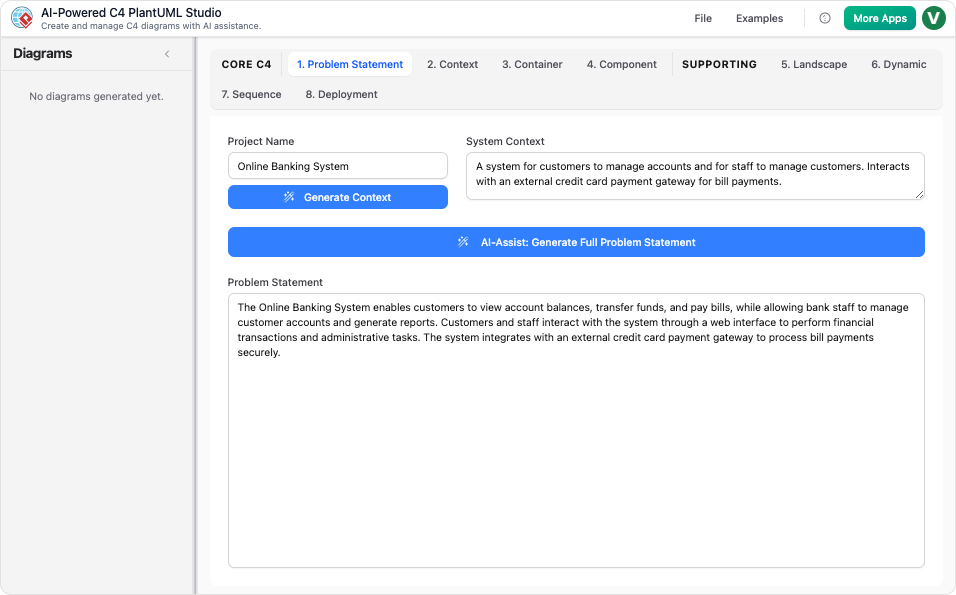
The AI-Powered C4 PlantUML Studio, also known as the AI C4 Diagram Generator, is a specialized “text-to-code” tool designed to modernize architectural modeling. Unlike traditional drag-and-drop interfaces, this innovative, browser-based application allows users to transform plain-language descriptions into a full suite of clear, standardized C4 diagrams instantly.
 At its core, the tool leverages PlantUML for reliable, code-based rendering. This technical foundation ensures that all diagrams are not merely static images but are precise, version-controllable artifacts that fit seamlessly into modern development workflows.
How the AI Studio Solves Architectural Challenges
Visual Paradigm’s solution addresses several persistent pain points in software design through intelligent automation and conversational interfaces.
Eliminating the “Blank Canvas” Paralysis
Starting a diagram from scratch is often the hardest part of the process. The AI engine removes this hurdle by drafting initial Problem Statements and System Contexts automatically. By providing a strong starting point without manual drawing, architects can focus on refinement rather than composition.
Conversational Iteration with the AI Chatbot
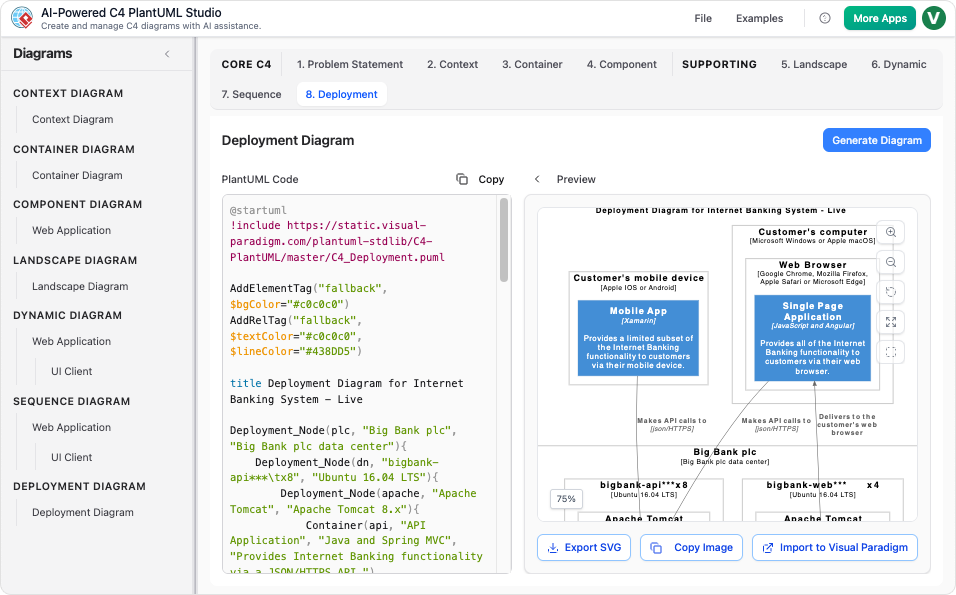
The integration of an AI Diagramming Chatbot allows users to essentially “talk” to their architecture. Rather than searching through menus for specific shapes, users can issue natural language commands such as “Add a payment gateway” or “Rename component.” The system updates both the visual model and the underlying PlantUML code immediately, facilitating rapid prototyping.
Automated Hierarchical Enforcement
The C4 model relies on a strict hierarchy (Context, Container, Component, Code). Visual Paradigm’s tool enforces a structured C4 workflow, automatically handling dependencies. For instance, the system requires the selection of a parent Container before generating a nested Component diagram, ensuring logical consistency across the model.

Enabling Living Documentation
Perhaps the most significant advantage is the creation of maintainable, “living” documentation. When developers refactor a component, a simple text prompt can update the diagram in seconds. This capability keeps documentation in sync with the evolving codebase, solving the historic problem of stale architectural diagrams.
Target Audience: Who Benefits Most?
The C4-PlantUML Studio is versatile, catering to various roles within the software development lifecycle:
- Software Architects and Tech Leads: For rapidly prototyping complex systems and communicating architectural visions for both greenfield projects and legacy systems.
- Developers: To grasp structural depth and ensure synchronization between the high-level architecture and the actual code implementation.
- Product Managers and Business Analysts: To verify that business requirements map clearly to technical implementations, ensuring nothing is lost in translation.
- Educators and Students: To learn C4 principles effectively and produce professional-grade models in a fraction of the time usually required.
Strategic Implementation: When to Use It
Understanding when to deploy this tool can maximize its value within an organization.
- Initial Technical Design: Use it during project kickoffs to establish a shared vision and strictly define system boundaries before a single line of code is written.
- Agile Sprints: When rapid prototyping and stakeholder alignment are critical for moving tasks into development without administrative delay.
- Onboarding and Reviews: It provides new developers with a clear “map of the world,” facilitating faster onboarding, and streamlines security and operational reviews by providing accurate visuals.
- Planning Refactoring: It is ideal for modeling “as-is” and “to-be” states, allowing teams to visualize the impact of major architectural decisions before implementation.
The Technical Advantage: Why Choose Visual Paradigm AI?
While there are many diagramming tools available, Visual Paradigm’s AI approach offers distinct advantages focused on speed, compliance, and portability.
Unmatched Speed and Efficiency
Tasks that traditionally take hours of manual drag-and-drop can be completed in minutes. A full set of C4 diagrams can be generated in under 10 minutes, significantly freeing up valuable engineering time.
Strict Compliance and Consistency
Manual diagramming often leads to notation errors. The AI ensures every diagram adheres to official C4 standards, automatically applying the correct notation, color coding, and hierarchical relationships without user intervention.
Technical Portability and DevOps Integration
Because the tool generates PlantUML code, the diagrams are treated as code. They are version-controllable via Git, editable for fine-tuning, and can be integrated directly into CI/CD pipelines. This turns documentation into a technical asset rather than a static administrative burden.
Conclusion: An Analogy for the Modern Architect
To understand the shift this tool represents, think of traditional diagramming like hand-painting a landscape: every tree and hill must be carefully placed by hand, and correcting a mistake often means starting over. Using the C4 AI Studio is like using a high-end architectural simulator. You describe the environment and the buildings you want, and the AI generates the 3D model instantly. If you need to change the color of a roof or move a wall, you simply tell the simulator, and it adjusts the entire set of blueprints and visual models simultaneously. This is the future of agile, accurate, and efficient software architecture.
-
Ultimate Guide to C4 Model Visualization Using Visual Paradigm’s AI Tools: A comprehensive guide on leveraging Visual Paradigm’s AI-powered tools to automate and enhance C4 model visualization for faster, smarter software architecture design.
-
Leveraging Visual Paradigm’s AI C4 Studio for Streamlined Architecture Documentation: A detailed guide on using Visual Paradigm’s AI-enhanced C4 Studio to create clean, scalable, and maintainable software architecture documentation.
-
The Ultimate Guide to C4-PlantUML Studio: Revolutionizing Software Architecture Design – Visual Paradigm Blog: 2 weeks ago – Software architecture documentation is often a bottleneck—time-consuming, error-prone, and quickly outdated. The C4-PlantUML Studio, developed by Visual Paradigm, changes this by combining AI-driven automation, the C4 model’s clarity, and PlantUML’s flexibility into a single, powerful tool.
-
A Comprehensive Guide to Visual Paradigm’s AI-Powered C4 …: Dec 3, 2025 · Enter Visual Paradigm ’s AI-Powered C4 PlantUML Studio, released November 14, 2025 — a purpose-built tool that transforms natural language into correct, layered C4 diagrams. But how is it different from just asking ChatGPT or Claude to “draw a system diagram”? And can it really generate valid C4? Let’s unpack it all.
-
C4-PlantUML Studio | AI-Powered C4 Diagram Generator – Visual Paradigm: An AI-powered tool to automatically generate C4 software architecture diagrams from simple text descriptions.
-
Comprehensive Tutorial: Generating and Modifying C4 Component …: Dec 16, 2025 · This tutorial is based on the official Visual Paradigm product demo video, demonstrating how to use the AI-powered Chatbot to create and iteratively refine a C4 Component Diagram for a car park booking system. The C4 model (Context, Containers, Components, and Code) is a popular approach for visualizing software architecture, and the Component level focuses on the internal structure of a …
-
AI-Powered C4 Diagram Generator – Visual Paradigm AI: C4 & Supporting Diagrams The AI-Powered C4 Diagram Generator supports the four core levels of the C4 Model (Context, Container, Component, Deployment) plus essential supporting views to provide comprehensive architectural documentation. Core C4 Diagrams The Core C4 Diagrams are fundamental for documenting the static structure of your software system, detailing how it is broken down …
-
Visual Paradigm Full C4 Model Support Release: This release announcement details the integration of full C4 model support in Visual Paradigm, enabling users to create and manage architecture diagrams at multiple abstraction levels.
-
New: Full C4 Model Support Added to Visual Paradigm Desktop – ArchiMetric: 6 days ago · The C4 Model: A Comprehensive Guide to Visualizing Software Architecture with AI-Powered Tools …
-
Visual-paradigm: Our AI supports a wide range of diagrams across various domains, including UML, C4 models for software architecture, and strategic frameworks like SWOT and PESTLE analysis.

