

Now Reading: Mastering Diagram Refinement: How Visual Paradigm AI Preserves Layout Integrity
-
01
Mastering Diagram Refinement: How Visual Paradigm AI Preserves Layout Integrity



Mastering Diagram Refinement: How Visual Paradigm AI Preserves Layout Integrity
In the evolving landscape of automated modeling, the ability to refine diagrams without losing structural coherence is a critical differentiator between general-purpose AI and specialized modeling tools. Visual Paradigm AI maintains layout integrity during refinement by treating diagrams as persistent objects rather than isolated, static blocks of text or code. While general Large Language Models (LLMs) typically lack state management—meaning a single change requires the model to regenerate the entire diagram from scratch—Visual Paradigm preserves the existing visual structure as a continuous state.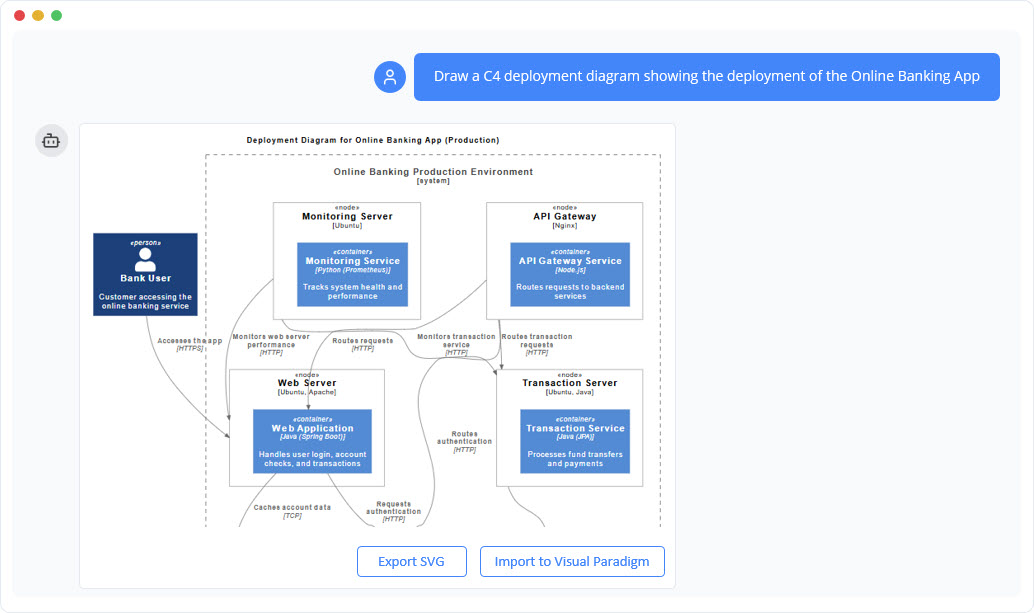
The Core Philosophy: Persistent Objects vs. Static Blocks
The fundamental challenge with standard generative AI is its stateless nature regarding visual output. When a user asks a general LLM to modify a diagram, it often redraws the entire image or code block, resulting in a completely new layout that ignores the user’s previous manual adjustments. Visual Paradigm approaches this differently by embedding the AI within a professional modeling ecosystem. This integration ensures that the diagram is understood as a collection of interconnected, persistent objects.
This maintenance of integrity is achieved through several specialized mechanisms that function in unison to ensure a smooth, non-destructive workflow.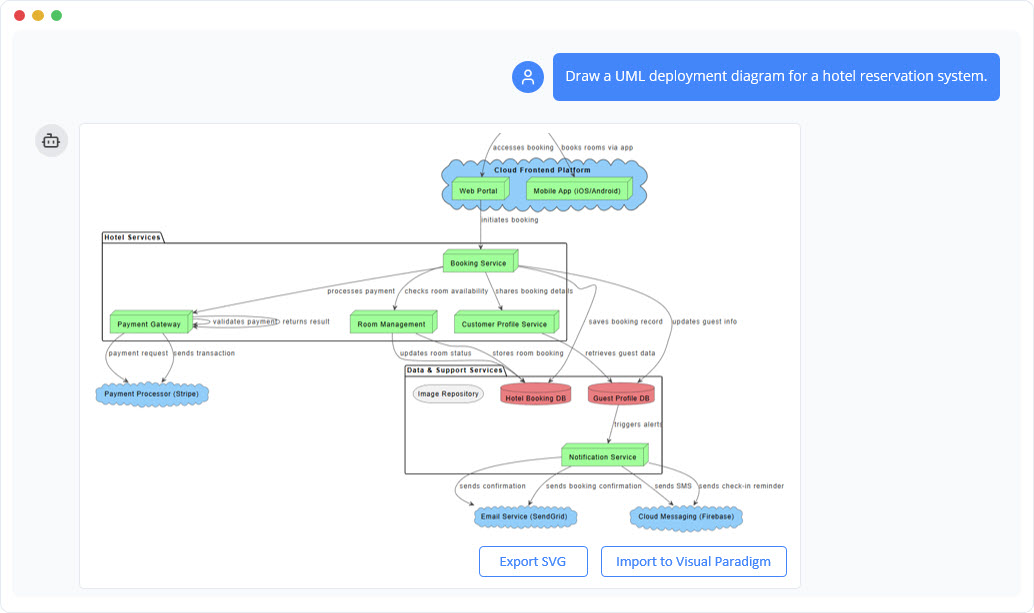
Key Mechanisms Behind Layout Integrity
1. Proprietary “Diagram Touch-Up” Technology
The platform utilizes proprietary “Diagram Touch-Up” technology designed specifically for iterative, conversational editing. In a traditional workflow, changing a diagram often means redrawing significant portions. However, Visual Paradigm allows users to issue follow-up commands naturally.
For example, if a user commands the system to “add a two-factor authentication step” or “rename this actor,” the AI isolates these specific instructions. It modifies only the relevant components while preserving the original layout, connectors, and shapes. This selective updating prevents the chaotic restructuring common in less specialized tools.
2. Precise State Management
Because the AI is integrated into a professional modeling ecosystem, it possesses a deep understanding of the semantic rules and structural integrity of the diagram. This context allows the system to distinguish between a cosmetic change and a structural overhaul.
This precise state management ensures that refinement is non-destructive. It actively prevents common issues such as “broken connectors,” floating elements, or misaligned layouts that frequently occur when using siloed AI tools or manual drawing methods. The system remembers the relationships between entities, ensuring that moving one object intelligently adjusts connected flows without breaking them.
3. Format Preservation and Alignment
Beyond simple connectivity, professional diagrams rely heavily on readability and visual hierarchy. Visual Paradigm automatically handles format preservation, maintaining the exact positioning of text within boxes, the alignment of parallel flows, and the directional paths of arrows.
This capability allows teams to “drill down” into the logic of a system or expand its scope without losing the shared conceptual baseline established in earlier drafts. Teams can iterate on complex diagrams with the confidence that their carefully organized visual logic will remain intact.
4. Context-Aware Recognition
Different modeling languages operate under different rules. Visual Paradigm’s AI utilizes context-aware recognition to identify specific diagram types, such as UML, BPMN, or C4 architecture diagrams. It interprets commands based on those specific domain logics.
This prevents structural errors by ensuring that added elements adhere to the official specifications of the modeling standard being used. For instance, the AI understands that a message flow in BPMN behaves differently than an association in a UML Class diagram, and it preserves the layout accordingly.
Analogy: The Difference Between Stock Photos and CAD
To fully appreciate the technological leap Visual Paradigm offers, it is helpful to compare it to other digital asset creation methods.
- General LLMs (The Stock Photo Analogy): Using a general LLM is like asking a search engine for a stock photo. If you generate an image of a person and decide you want to change the color of their shirt, you usually cannot edit just the shirt. Instead, you must start a whole new search or generation process, resulting in a different person, a different pose, and a different background. The context is lost with every iteration.
- Visual Paradigm AI (The CAD Analogy): Visual Paradigm AI acts like a professional architect’s studio equipped with a CAD system. It provides a technically sound draft, but importantly, it allows you to move walls, add rooms, and refine the plumbing in real-time without the entire house falling apart. The structure persists, allowing for true engineering refinement.
Conclusion
By shifting the paradigm from static image generation to persistent object management, Visual Paradigm AI solves the most significant pain point in automated diagramming: the loss of context during iteration. Through Diagram Touch-Up technology and precise state management, it offers a robust environment where technical diagrams can evolve alongside the systems they represent.
-
AI Chatbot Feature – Intelligent Assistance for Visual Paradigm Users: Leverage AI-powered chatbot functionality to get instant guidance, automate tasks, and enhance productivity within Visual Paradigm.
-
Visual Paradigm AI Chatbot Enhances Multi-Language Support …: 7 hours ago · Discover the latest updates to Visual Paradigm ‘s AI -Powered visual modeling software, including multi-language UI and improved chat content localization. Experience seamless AI diagram generation in languages like Spanish, French, Chinese, and more with our AI chatbot for UML and other diagrams.
-
AI Chatbot for Diagramming: How It Works with Visual Paradigm: The Visual Paradigm AI chatbot is an AI -powered modeling assistant that turns natural language into diagrams. It doesn’t require users to learn specific modeling standards or syntax.
-
Case Study: Enhancing System Modeling Efficiency with Visual Paradigm’s AI-Powered Chatbot: This case study demonstrates how Visual Paradigm’s AI chatbot improves productivity and accuracy in system modeling by enabling conversational diagram creation.
-
Visual Paradigm AI Chatbot: The World’s First Purpose-Built AI Assistant for Visual Modeling: Visual Paradigm launches its groundbreaking AI chatbot, designed specifically to assist users in visual modeling tasks with natural language interactions and intelligent guidance.
-
Introducing Visual Paradigm AI Chatbot: Intelligent Design Assistance: Discover how Visual Paradigm’s AI chatbot enhances design workflows by offering real-time suggestions and automating repetitive tasks.
-
Mastering Sequence Diagrams with Visual Paradigm: AI Chatbot Tutorial: A beginner-friendly tutorial using Visual Paradigm to create sequence diagrams, illustrated through a real-world e-commerce chatbot use case.
-
Integrating AI Activity Diagrams into Your Visual Paradigm …: Sep 12, 2025 · Learn how to use AI -powered modeling software to generate and refine activity diagrams with natural language. Discover the benefits of AI chatbot diagram generation in UML workflows.
-
Beginner’s Tutorial: Create Your First Professional Sequence Diagram in Minutes: A beginner-friendly guide to generating professional sequence diagrams quickly using Visual Paradigm’s AI chatbot feature.
-
Comprehensive Tutorial: Generating and Modifying C4 Component …: Dec 16, 2025 · This tutorial is based on the official Visual Paradigm product demo video, demonstrating how to use the AI-powered Chatbot to create and iteratively refine a C4 Component Diagram for a car park booking system. The C4 model (Context, Containers, Components, and Code) is a popular approach for visualizing software architecture, and the Component level focuses on the internal structure of a …
-
SWOT Analysis via AI Chat in Visual Paradigm: This interactive page allows users to generate SWOT analyses through an AI-powered chat interface within the Visual Paradigm environment.
-
Meet the AI SWOT Assistant: How Visual Paradigm’s Chatbot …: Sep 11, 2025 · Discover how the visual paradigm chatbot provides natural language diagram generation for business frameworks like SWOT , PEST, and more—turning ideas into clear strategic models with AI -powered analysis .
-
How to Create SWOT Analysis Instantly with AI-Powered Diagramming: How to Create a SWOT Analysis Instantly Using Visual Paradigm’s AI Chatbot Creating a SWOT analysis traditionally requires time, manual effort, and a clear understanding of business frameworks.
-
Turn SWOT Insights into Action Plans with AI-Powered Modeling: The shift from static SWOT analysis to dynamic, AI -powered modeling for business strategies is already underway. Visual Paradigm leads this transformation by combining deep knowledge of business frameworks with real-time diagram generation. For users looking to turn SWOT insights into action plans, the AI chatbot provides an accessible, accurate, and practical solution. Whether you’re a …
-
How Visual Paradigm’s Chatbot Outperforms Generic AI Tools for SWOT Analysis: Discover how the visual paradigm chatbot delivers accurate swot analysis with AI, enabling natural language to diagram conversion for business & strategic …
-
Visual Paradigm AI Suite: A Comprehensive Guide to Intelligent Modeling Tools – Cybermedian: 6 days ago – Strategic Frameworks: SWOT Analysis, PEST/PESTLE Analysis, Ansoff Matrix, and Blue Ocean Four Actions Framework. Systems Engineering: SysML Block Definition, Internal Block, and Requirement diagrams. Architecture: ArchiMate diagrams and C4 models. General Business: Organization Charts, Mind Maps, and PERT Charts. While the AI Chatbot is a cloud-based feature of VP Online, it is seamlessly integrated into the Visual Paradigm Desktop environment.
-
PESTLE Analysis – AI Chatbot: Get a 360-degree view of your market with an AI PESTLE analysis tool. Analyze Political, Economic, Social, Technological, Legal, and Environmental factors.
-
Launch SaaS with AI-Powered PESTLE Analysis: Visual Paradigm’s AI is not a generic chatbot. It is trained on established business frameworks and real-world industry data. It understands the nuances of SaaS …
-
What Makes Visual Paradigm’s AI Chatbot Different from Other AI Diagram Tools? – Visual Paradigm Blog: October 14, 2025 – Business Frameworks: SWOT, PEST, PESTLE, SOAR, Eisenhower Matrix, Ansoff Matrix, Blue Ocean Four Actions · Data Visualization: Bar, line, area, pie, scatter, radar charts · This coverage enables users to transition seamlessly between technical and strategic modeling—something most ai …
-
Why I’m Ditching Generic AI for Visual Paradigm ’s Modeling Chatbot: The team at Visual Paradigm quietly rolled out one of the most powerful AI modeling assistants I’ve seen yet — and it’s not just another ChatGPT wrapper. This thing actually understands modeling languages, business frameworks, and systems engineering standards at a scary level of…
-
How to Do a PESTLE Analysis with AI: Identify Market Threats …: Sep 19, 2025 · How to Do a PESTLE Analysis with AI : Identify Market Threats & Opportunities Concise Answer for Featured Snippet A PESTLE analysis identifies political, economic, social, technological, legal, and environmental factors affecting a business. With an AI chatbot for visual modeling, you can generate a PESTLE diagram quickly, refine it with context, and understand how each factor impacts strategy.
-
PESTLE Analysis Explained: The Ultimate AI Guide: Sep 10, 2025 · Visual Paradigm ’s AI chatbot supports the generation of diagrams for several key business frameworks, including SWOT, PESTLE , Ansoff, BCG, and C4 models. These are not standalone tools but components of a holistic strategic analysis toolkit.
-
AI Chatbot for Diagram and Model Generation: This page features an AI-powered chatbot that enables users to generate diagrams and models through natural language input.
-
Introducing Visual Paradigm AI Chatbot: A Smarter Way to …: Sep 29, 2025 · Discover how the Visual Paradigm AI Chatbot enables natural language diagram generation, smart editing, and contextual analysis for enterprise modeling and planning.
-
Visual Paradigm AI Chatbot – Intelligent Diagram Generation …: A Visual Paradigm Online Feature: The AI Chatbot is a powerful cloud-based feature from VP Online, made accessible directly within your desktop software. Access for Desktop Users: If you have a VP Desktop license and subscribe to VP Online, you can use the Chatbot without ever leaving your desktop application.
-
Visual Paradigm AI Chatbot: Turn Your Ideas into Diagrams Instantly – Visual Paradigm Blog: October 13, 2025 – The AI Chatbot in Visual Paradigm Online is an advanced assistant that lets you create diagrams using natural language .
-
How to Turn Requirements into Diagrams with an AI Chatbot – Visual Paradigm Blog: October 13, 2025 – The AI chatbot is just the beginning—your diagrams can grow from text into full system designs. Ready to turn your project requirements into clear, visual models? Start your conversation today at https://chat.visual-paradigm.com/.
-
How AI Chatbot Can Help You Learn UML Faster – Visual Paradigm Blog: October 17, 2025 – AI is not just changing how diagrams … Online’s AI Chatbot, you can practice UML interactively, visualize every concept instantly, and receive feedback that helps you improve continuously ….
-
Visual Paradigm Desktop Product Updates – Visual Paradigm Product Updates: 1 month ago – We are excited to announce significant improvements to our AI-Powered visual modeling software, the Visual Paradigm AI Chatbot.
-
AI in Architecture Modeling: Keeping Complex Systems Aligned – Visual Paradigm Blog: October 20, 2025 – Instead of redrawing or rebuilding diagrams from scratch, the chatbot examines your current model and interprets your latest instruction in context. When you request changes — for example, “Add a reporting service under the application layer and link it to the data warehouse” — the AI understands your existing diagram and updates it accordingly. It maintains naming consistency, connection logic, and visual organization, ensuring that each revision fits smoothly into the overall architecture.
-
AI Sequence Diagram Example: Video Streaming Playback Initiation | Visual Paradigm: 5 days ago – It started with a straightforward prompt: “Create a sequence diagram that explains how a video streaming platform starts playback when a user clicks play.” The Visual Paradigm AI Chatbot didn’t just generate a diagram—it acted as a modeling partner, interpreting intent, anticipating needs, and refining logic in real time.
-
The Future of Collaborative Modeling: AI as Your Team’s Co-Designer – Visual Paradigm Blog: October 20, 2025 – Visual Paradigm Online’s AI Chatbot empowers you to do just that: create clear, standards-compliant diagrams from natural language, then share your insights with others in a structured, visual way .
-
Visual Paradigm AI-Powered Diagram Generation Tutorial: This YouTube video demonstrates how to use AI-driven features in Visual Paradigm to automatically generate diagrams from natural language input.
-
AI-Powered Chatbot Development Using Visual Paradigm: This video demonstrates how to build an AI-driven chatbot using automated diagramming tools and AI-assisted modeling techniques.
-
Comprehensive Tutorial: Visual Paradigm AI … – Cybermedian: Visual Paradigm’s AI-Powered Visual Modeling Chatbot (accessible at https://chat.visual-paradigm.com) lets you go from a simple text prompt to a complete …
-
AI Diagram Examples – AI Chatbot: Security Overview. Report Abuse. ©2025 by Visual Paradigm .
-
Chart: A Complete Guide to AI-Powered Data Visualization – AI Chatbot: Discover how AI transforms data into ready-to-use charts—making visualization effortless for business, learning, and decision-making.
-
C4 Model AI Generator: Automate Context … – Ez Knowledge –: Visual Paradigm’s new AI Chatbot is purpose-built to automate the full C4 modeling lifecycle using conversational prompts, guaranteeing consistency across all …
-
How to Generate Diagrams in Your Native Language with Visual Paradigm …: Visual Paradigm has addressed this challenge head-on with significant updates to its AI-Powered visual modeling software. The Visual Paradigm AI Chatbot now boasts enhanced multi-language support, allowing users to create, refine, and analyze diagrams in their native languages.
-
AI Diagram Chatbot Update: Better ArchiMate & SysML Support: 12 Dec 2025 · Latest AI Chatbot update brings higher stability, improved relevance, and better handling of complex prompts for ArchiMate diagrams (all …
-
Why the Visual Paradigm AI Chatbot Is Uniquely Engineered for …: VP-specific JSON schema for lossless round-tripping between Desktop and Online. Teams practicing Infrastructure-as-Code, GitOps, or documentation-as-code can …
-
Creating SysML Block Definition Diagrams with an AI… – Cybermedian: With Visual Paradigm AI Chatbot, you simply describe your idea in plain English—like “Create a SysML Block Definition Diagram for a Weather Forecasting System with sensors and…
-
Mastering AI-Driven Systems Engineering… – Cybermedian: Case Study : Enhancing System Modeling Efficiency with Visual Paradigm ’s AI-Powered Chatbot. Mastering Data Flow Diagrams with Visual Paradigm : A Step-by-Step Guide.
-
Generate Reports from Diagrams Using AI Chatbot: Use Visual Paradigm’s AI chatbot to automatically generate professional reports from diagrams.
-
How to Use Visual Paradigm AI Chatbot’s Multi-Language Features: Step-by-step tutorial on using Visual Paradigm AI Chatbot’s new multi-language support. Learn to switch UI languages and generate UML diagrams in Spanish, French, Chinese, and more.
-
Major Upgrade to AI UML Component Diagram Generation in Visual Paradigm AI Chatbot: 2 hours ago · These enhancements solidify Visual Paradigm’s AI Chatbot as an indispensable tool for software developers, system architects, and students.
-
Comprehensive Guide to Visual Paradigm AI Chatbot: A detailed overview of the AI-powered chatbot features in Visual Paradigm for diagramming and modeling.
-
AI-Powered Component Diagrams with Visual Paradigm Chatbot: Explore how the Visual Paradigm AI chatbot enhances component diagram creation through natural language input.
-
AI Chatbot – Visual Paradigm AI: Go from a simple text prompt to a complete, presentation-ready diagram in seconds. Let our AI handle the complex drawing, so you can focus on building great …
-
AI-Powered UML Chatbot State Diagrams: Explores how AI enhances the creation and interpretation of UML state diagrams for chatbot systems.
-
AI Archives – Visual Paradigm Guides: Oct 9, 2025 · The visual paradigm ai chatbot changes the game by turning vague ideas into professional diagrams with just a few sentences. Instead of digging through spreadsheets or sketching on a napkin, you describe your vision, and the system generates a… continue reading →
-
Visual Paradigm AI Chatbot: Learn about the AI chatbot feature in Visual Paradigm that assists users with diagramming guidance.
-
Comprehensive Review: Generic AI Chatbots vs. Visual Paradigm’s C4 Tools – ArchiMetric: 1 week ago – While generic AI chatbots (like … Generator, AI Diagramming Chatbot, and C4 PlantUML Studio

