


The Evolution of Architectural Documentation
In the modern software development lifecycle, static architectural diagrams often become bottlenecks. They are typically drawn once, saved as binary image files, and quickly become obsolete as the code evolves. Visual Paradigm’s AI C4 ecosystem addresses this challenge by introducing C4-PlantUML Studio, a platform that implements architectural documentation as “Living Code.”
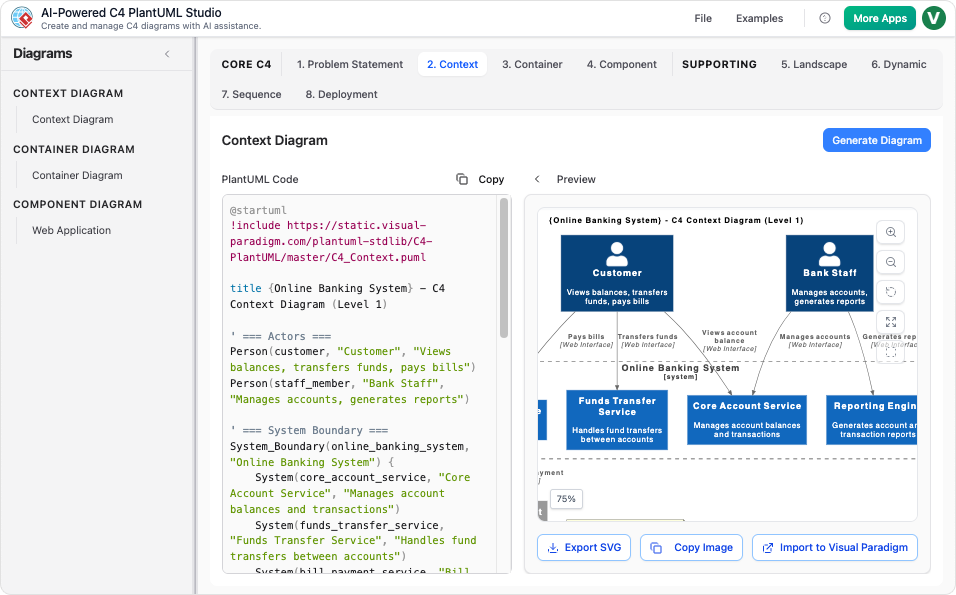
This comprehensive guide explores how this tool transforms standard diagrams into PlantUML, a widely recognized text-based standard. By treating architecture as code, teams can bridge the gap between high-level design and actual implementation, ensuring that documentation remains dynamic, versionable, and integrated.
Understanding the “Living Code” Paradigm
The core philosophy behind the C4-PlantUML Studio is the transition from manual drawing to code generation. Instead of manipulating shapes on a canvas, the system renders diagrams directly into PlantUML code. This shift facilitates Living Documentation, a state where architecture maps are not stagnant artifacts but evolving entities that stay in sync with the codebase.
The Power of Version Control
Because the underlying format of the diagrams is text-based code, architectural maps gain all the benefits of software source code. This approach makes diagrams inherently version-controllable. Teams can utilize standard tools like Git to manage changes. This allows for:
- Branching and Merging: Architects can create branches for proposed changes without disrupting the master documentation.
- History Tracking: Every modification to the diagram is tracked, allowing teams to revert to previous versions or audit changes over time.
- Collaborative Workflows: Multiple developers can work on documentation simultaneously, resolving conflicts through standard merge requests.
Automated Refactoring via AI
One of the most significant friction points in maintaining documentation is the manual effort required to update diagrams after a code refactor. Visual Paradigm leverages AI to eliminate this hurdle. Users can interact with the system using simple conversational prompts via an AI Chatbot.
The AI handles the complex syntax generation, translating natural language descriptions into strict PlantUML code instantly. This means a developer can update a diagram in seconds following a refactor, ensuring adherence to strict C4 compliance and hierarchical consistency without needing to manually redraw boxes and lines.
Hybrid Editing and Visualization
While the code-based approach provides robustness, visual validation remains crucial. The C4-PlantUML Studio offers hybrid editing capabilities. This dual-view interface allows users to toggle seamlessly between:
- Text-Based Code: For precise editing, copying, scripting, and versioning.
- Live Visual Preview: For immediate visual feedback to ensure the layout accurately represents the intended design.
Integration into CI/CD Pipelines
To truly embed architecture into the development lifecycle, documentation must be automated. The diagrams generated within the studio can be exported as JSON. This structured data format allows for backup and direct integration into CI/CD pipelines. By automating the generation and publication of diagrams during the build process, teams ensure that the documentation deployed is always consistent with the software being released.
Comparing Static vs. Living Documentation
The following table illustrates the operational differences between traditional diagramming and the Living Code approach:
| Feature | Traditional Static Diagrams | Living Code (C4-PlantUML) |
|---|---|---|
| Format | Binary Images (PNG, JPG) | Text-based Source (PlantUML, JSON) |
| Versioning | Difficult / Impossible (Binary blobs) | Native Git Support |
| Updates | Manual Redrawing | AI-Assisted Text Updates |
| Consistency | Prone to Human Error | Strict C4 Compliance via Automation |
Advanced Modeling and Extensibility
The utility of the “Living Code” extends beyond the Studio itself. Once the initial diagrams are generated and refined, the code can be imported directly into Visual Paradigm Desktop or Online. This interoperability allows architects to take a lightweight C4 sketch and evolve it into a comprehensive technical model, ensuring that the architecture remains a continuous and accurate part of the software development lifecycle.
Conceptual Analogy
To better understand the impact of this technology, consider the following analogy provided by the ecosystem’s philosophy:
Using “Living Code” for architecture is like having a blueprint that updates itself whenever you move a wall in the physical house. Instead of manually erasing and redrawing lines on a paper map, you simply update a line of text in the master plan, and the entire structure remains synchronized and accurate to the actual building.
Ultimate Guide to C4 Model Visualization Using Visual Paradigm’s AI Tools: A comprehensive guide on leveraging Visual Paradigm’s AI-powered tools to automate and enhance C4 model visualization for faster, smarter software architecture design.
Leveraging Visual Paradigm’s AI C4 Studio for Streamlined Architecture Documentation: A detailed guide on using Visual Paradigm’s AI-enhanced C4 Studio to create clean, scalable, and maintainable software architecture documentation.
The Ultimate Guide to C4-PlantUML Studio: Revolutionizing Software Architecture Design – Visual Paradigm Blog: 2 weeks ago – Software architecture documentation is often a bottleneck—time-consuming, error-prone, and quickly outdated. The C4-PlantUML Studio, developed by Visual Paradigm, changes this by combining AI-driven automation, the C4 model’s clarity, and PlantUML’s flexibility into a single, powerful tool.
A Comprehensive Guide to Visual Paradigm’s AI-Powered C4 …: Dec 3, 2025 · Enter Visual Paradigm ’s AI-Powered C4 PlantUML Studio, released November 14, 2025 — a purpose-built tool that transforms natural language into correct, layered C4 diagrams. But how is it different from just asking ChatGPT or Claude to “draw a system diagram”? And can it really generate valid C4? Let’s unpack it all.
C4-PlantUML Studio | AI-Powered C4 Diagram Generator – Visual Paradigm: An AI-powered tool to automatically generate C4 software architecture diagrams from simple text descriptions.
Comprehensive Tutorial: Generating and Modifying C4 Component …: Dec 16, 2025 · This tutorial is based on the official Visual Paradigm product demo video, demonstrating how to use the AI-powered Chatbot to create and iteratively refine a C4 Component Diagram for a car park booking system. The C4 model (Context, Containers, Components, and Code) is a popular approach for visualizing software architecture, and the Component level focuses on the internal structure of a …
AI-Powered C4 Diagram Generator – Visual Paradigm AI: C4 & Supporting Diagrams The AI-Powered C4 Diagram Generator supports the four core levels of the C4 Model (Context, Container, Component, Deployment) plus essential supporting views to provide comprehensive architectural documentation. Core C4 Diagrams The Core C4 Diagrams are fundamental for documenting the static structure of your software system, detailing how it is broken down …
Visual Paradigm Full C4 Model Support Release: This release announcement details the integration of full C4 model support in Visual Paradigm, enabling users to create and manage architecture diagrams at multiple abstraction levels.
New: Full C4 Model Support Added to Visual Paradigm Desktop – ArchiMetric: 6 days ago · The C4 Model: A Comprehensive Guide to Visualizing Software Architecture with AI-Powered Tools …
Visual-paradigm: Our AI supports a wide range of diagrams across various domains, including UML, C4 models for software architecture, and strategic frameworks like SWOT and PESTLE analysis.
Visual Paradigm AI Suite: A Comprehensive Guide to Intelligent Modeling Tools – Cybermedian: 6 days ago – Strategic Frameworks: SWOT Analysis, PEST/PESTLE Analysis, Ansoff Matrix, and Blue Ocean Four Actions Framework. Systems Engineering: SysML Block Definition, Internal Block, and Requirement diagrams. Architecture: ArchiMate diagrams and C4 models. General Business: Organization Charts, Mind Maps, and PERT Charts. While the AI Chatbot is a cloud-based feature of VP Online, it is seamlessly integrated into the Visual Paradigm Desktop environment.
Visual-paradigm: Our AI supports a wide range of diagrams across various domains, including UML, C4 models for software architecture, and strategic frameworks like SWOT and PESTLE analysis.