
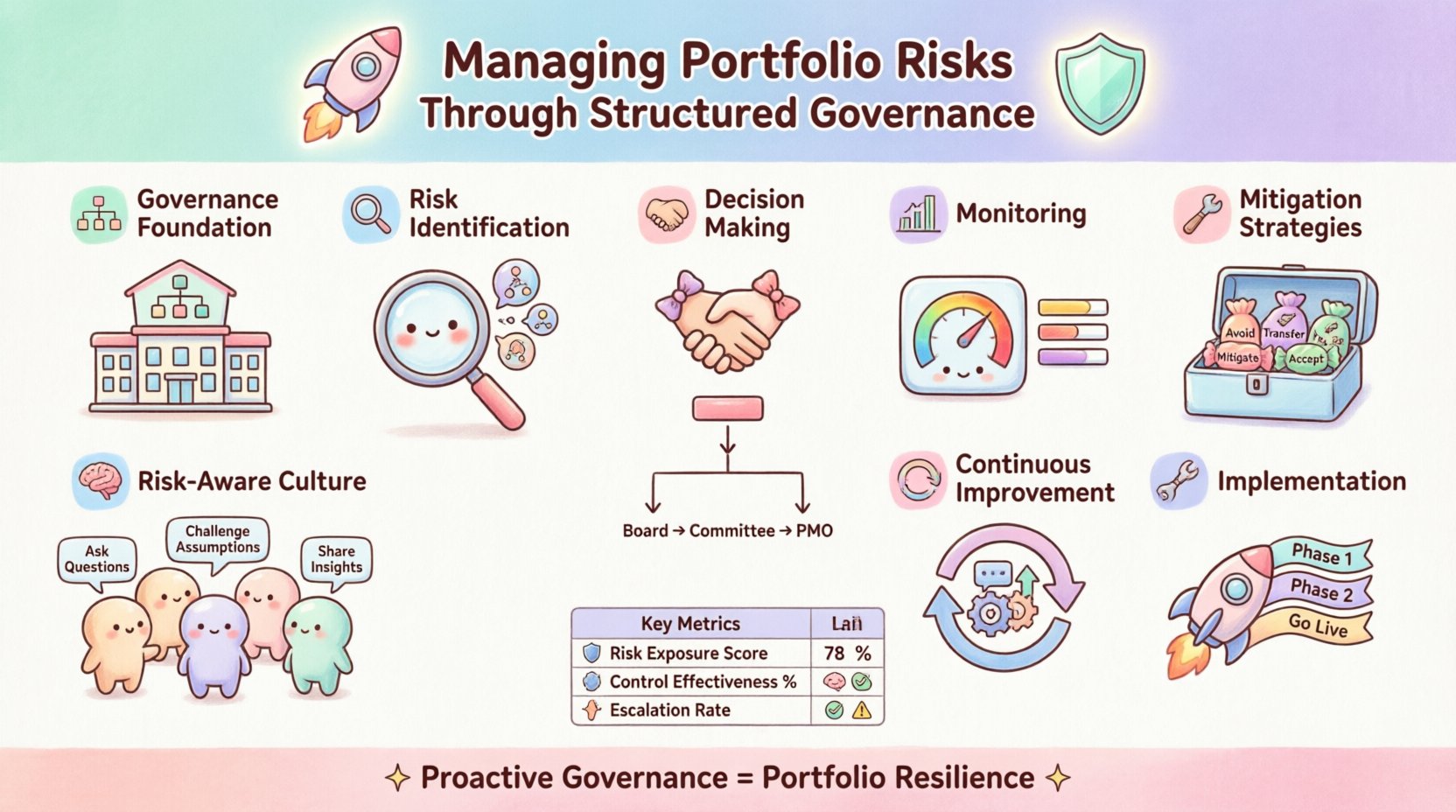
In the complex landscape of project management, a portfolio is not merely a collection of initiatives. It is a strategic asset that requires deliberate oversight to ensure alignment with organizational goals. Without a robust framework, individual project successes can mask systemic failures. Structured governance provides the necessary scaffolding to identify, assess, and mitigate risks that threaten the collective value of the portfolio. This approach moves beyond reactive fire-fighting to proactive risk management, ensuring resilience across all operations.
Effective governance does not rely on tools or software but on defined processes, clear roles, and transparent communication channels. It establishes the rules of engagement for how risks are handled at different levels of the organization. By embedding risk management into the decision-making fabric, leaders can make informed choices that balance potential rewards against inherent uncertainties.
🏛️ The Foundation of Governance Frameworks
Before addressing specific risks, an organization must define the architecture of its governance. This architecture dictates how authority is distributed and how information flows between project teams and executive leadership. A well-designed framework clarifies who is responsible for what, preventing ambiguity during critical moments.
- Clear Authority Lines: Define who has the power to approve risk responses and who must escalate issues.
- Standardized Processes: Ensure all projects follow the same methodology for reporting and tracking risks.
- Defined Roles: Assign specific responsibilities to roles such as Portfolio Managers, Risk Owners, and Steering Committees.
- Communication Protocols: Establish how and when risk information is shared across the organization.
When these elements are in place, the organization moves from ad-hoc reactions to systematic management. Governance acts as the central nervous system, ensuring that signals from the periphery (individual projects) are accurately interpreted and acted upon by the core (strategic leadership).
🔍 Identifying Risks Across the Portfolio
Risk identification is the first practical step in managing portfolio risks. Unlike single-project risk management, portfolio-level identification requires a broader view. It involves looking at interdependencies, resource contention, and market shifts that affect multiple initiatives simultaneously. A risk in one project can cascade into others, creating compound effects that are often underestimated.
Categories of Portfolio Risks
To manage these effectively, risks are typically categorized to ensure comprehensive coverage. Common categories include:
- Strategic Risks: Misalignment with long-term business objectives or market changes.
- Operational Risks: Failures in day-to-day execution, resource availability, or supply chain disruptions.
- Financial Risks: Budget overruns, currency fluctuations, or funding gaps.
- Compliance Risks: Violations of regulatory standards or internal policies.
- Technological Risks: Obsolescence, integration failures, or security breaches.
Identifying these risks requires regular engagement with project managers and stakeholders. It is not a one-time activity but a continuous process. Workshops, interviews, and data analysis help uncover hidden vulnerabilities before they materialize into issues.
🤝 Governance Structures and Decision Making
Once risks are identified, governance structures determine how they are addressed. This involves setting up committees or boards that review risk reports and authorize mitigation strategies. The structure must be agile enough to handle urgent matters but rigorous enough to prevent rash decisions.
Decision-making authority should be tiered based on the impact of the risk. Minor risks may be resolved at the project level, while significant threats require executive attention. This hierarchy ensures that leadership focus is directed toward issues that truly matter to the strategic outcome.
Key Decision Points
- Risk Thresholds: Define the levels of impact and probability that trigger escalation.
- Approval Workflows: Map out the steps required to approve a risk response plan.
- Resource Allocation: Determine how budget and personnel are assigned to mitigation efforts.
- Portfolio Rebalancing: Decide whether to continue, pause, or cancel projects based on risk exposure.
📊 Monitoring and Reporting Mechanisms
Visibility is critical for effective risk management. Without accurate and timely reporting, risks can grow unchecked. Governance frameworks must mandate regular reporting cycles that provide a clear picture of the risk landscape. These reports should not just list problems but highlight trends and potential future scenarios.
Reporting should focus on the status of risk responses. Are the mitigation actions being implemented as planned? Are they effective? This requires a feedback loop where data from the field informs strategic adjustments. Dashboards and scorecards can visualize this data, making it easier for stakeholders to grasp the overall health of the portfolio.
Essential Metrics for Governance
| Metric | Purpose | Frequency |
|---|---|---|
| Risk Heat Map | Visualizes high-priority risks by impact and probability | Monthly |
| Mitigation Status | Tracks completion of action plans | Weekly |
| Resource Utilization | Shows capacity available for risk response | Quarterly |
| Strategic Alignment Score | Measures portfolio fit with business goals | Quarterly |
| Issue Escalation Count | Highlights unresolved critical problems | Monthly |
These metrics provide a quantitative basis for qualitative discussions. They help governance bodies move from opinion-based decisions to evidence-based strategies.
🛠️ Mitigation Strategies and Response
When a risk is deemed unacceptable, a response must be formulated. Governance frameworks should outline the standard approaches for handling risks. These responses are not generic; they must be tailored to the specific context of the portfolio.
Standard Response Strategies
- Avoid: Change the plan to eliminate the risk entirely.
- Transfer: Shift the risk to a third party, such as through insurance or contracts.
- Mitigate: Take action to reduce the probability or impact of the risk.
- Accept: Acknowledge the risk and prepare contingency plans if it occurs.
Choosing the right strategy requires cost-benefit analysis. Sometimes, the cost of mitigation exceeds the potential loss, making acceptance the logical choice. Governance ensures this analysis is documented and approved by the appropriate authority.
Contingency planning is also vital. If a risk occurs, the organization needs a pre-defined path forward. This reduces panic and ensures a swift recovery. Governance structures should mandate that contingency funds and resources are reserved for high-priority risks.
🧠 Building a Risk-Aware Culture
Processes and structures are only as good as the people who use them. A risk-aware culture encourages transparency and honesty. Team members should feel safe reporting bad news without fear of retribution. If individuals hide risks, the governance framework becomes ineffective.
Leadership plays a crucial role in shaping this culture. When leaders openly discuss risks and demonstrate that they value transparency over blind optimism, it sets a tone for the entire organization. Training and workshops can further reinforce these behaviors, helping staff understand their role in risk management.
- Psychological Safety: Create an environment where raising concerns is rewarded.
- Training Programs: Educate staff on risk identification and reporting.
- Recognition: Acknowledge teams that successfully identify and mitigate risks.
- Open Dialogue: Hold regular forums where risk topics are discussed openly.
This cultural shift turns risk management from a compliance exercise into a strategic advantage. It empowers everyone to contribute to the stability and success of the portfolio.
🔄 Continuous Improvement Loops
Finally, governance is not static. The environment changes, and so must the governance framework. Regular reviews and audits ensure that the processes remain relevant and effective. Lessons learned from past projects should be captured and applied to future initiatives.
Post-project reviews are essential for this. They provide data on what worked and what did not. This feedback loop helps refine the risk management methodology over time. It prevents the repetition of past mistakes and encourages innovation in how risks are handled.
Updating the governance framework involves:
- Reviewing risk thresholds and adjusting them based on current capacity.
- Refining reporting templates to reduce administrative burden.
- Training new leaders on established protocols.
- Integrating new risk types that emerge from market shifts.
By treating governance as a living system, organizations ensure they remain resilient. They adapt to change rather than being overwhelmed by it. This flexibility is a hallmark of mature project management practices.
🚀 Implementing the Framework
Implementation requires careful planning. Rushing into a new governance model can cause resistance. It is better to roll out changes incrementally, starting with high-impact areas. Pilot programs can test the effectiveness of new processes before full deployment.
Stakeholder engagement is key throughout this phase. Understanding the concerns of different groups helps tailor the implementation to fit the organizational context. Communication should emphasize the benefits of the new framework, such as better resource allocation and clearer decision paths.
Success is measured by the reduction in unexpected disruptions and the improvement in project delivery rates. Monitoring these outcomes validates the effort invested in governance. Over time, the portfolio becomes more predictable, and strategic objectives are met with greater consistency.
Structured governance transforms risk management from a theoretical concept into a practical discipline. It provides the clarity and control needed to navigate uncertainty. By focusing on processes, people, and continuous improvement, organizations can safeguard their investments and drive sustainable growth.