


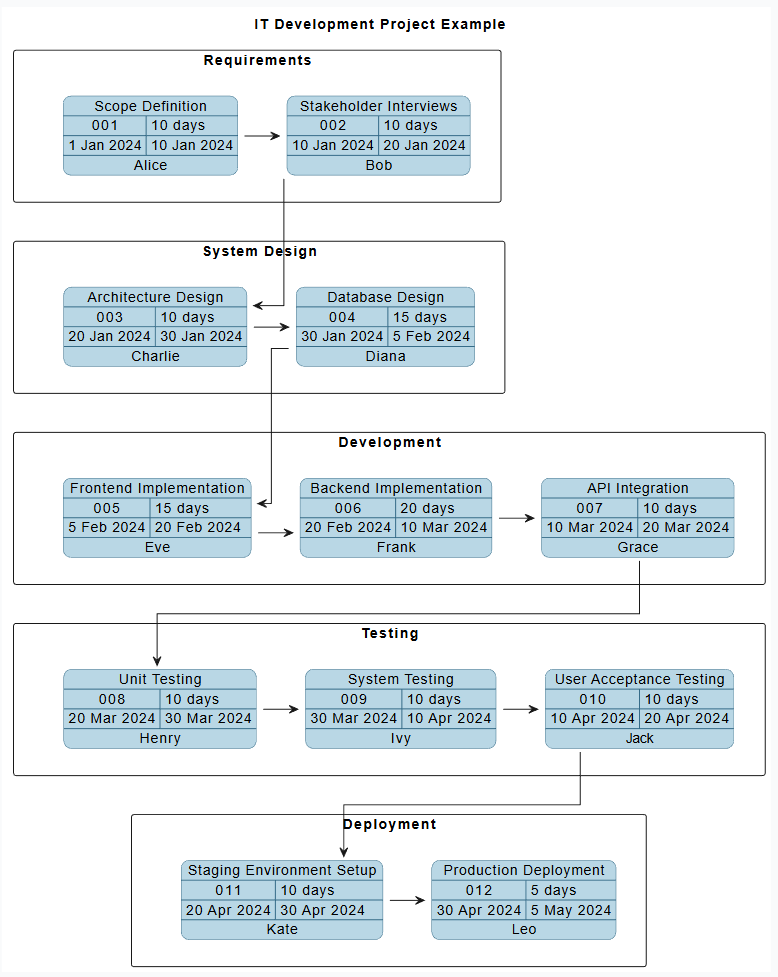
The PERT (Program Evaluation and Review Technique) chart presented above provides a detailed, visual representation of the timeline, dependencies, and critical path for an IT development project — specifically, the development of a Cloud-Based Student Portal.
Below is a comprehensive, step-by-step interpretation of the chart, explaining what each part means, how tasks are connected, and what insights the project manager can derive.
🔍 1. Overview of the Project Timeline
The project spans from January 1, 2024, to May 5, 2024, totaling 127 days (approximately 4 months).
However, the critical path — the sequence of tasks that determines the minimum possible project duration — is 65 days long, making it the most time-sensitive chain in the project.
-
The Pert Chart is generated by the Visual Paradigm AI Chatbot
✅ Key Insight:
The project cannot finish earlier than this critical path. Any delay in any task on this path will directly delay the final delivery.
📌 2. Task Phases and Breakdown
The project is divided into five logical phases:
| Phase | Tasks | Duration |
|---|---|---|
| Requirements | Scope Definition (10 days), Stakeholder Interviews (10 days) | 20 days |
| System Design | Architecture Design (10 days), Database Design (15 days) | 25 days |
| Development | Frontend (15 days), Backend (20 days), API Integration (10 days) | 45 days |
| Testing | Unit Testing (10 days), System Testing (10 days), UAT (10 days) | 30 days |
| Deployment | Staging Setup (10 days), Production Deployment (5 days) | 15 days |
👉 Total Project Duration:
127 days (from Jan 1 to May 5)
👉 Critical Path Duration:
65 days (from Jan 1 to May 5)
⚠️ Note: The total duration includes all tasks, but the critical path is just the sequence of tasks that must happen in order, with no time buffer.
🔗 3. Task Dependencies: The Logical Flow
Each task is dependent on the completion of the prior one. The dependency chain is as follows:
Scope Definition → Stakeholder Interviews
→ Architecture Design
→ Database Design
→ Frontend Implementation
→ Backend Implementation
→ API Integration
→ Unit Testing
→ System Testing
→ User Acceptance Testing
→ Staging Environment Setup
→ Production Deployment
This chain is strictly sequential — no task can begin until the previous one is complete.
📌 Example:
The Backend Implementation (task06) cannot start until Frontend Implementation (task05) is complete.
Similarly, API Integration (task07) cannot start until Backend is done.
This creates a linear dependency flow, which is typical in software development where core features must be built in sequence.
🚨 4. Critical Path Analysis
The critical path is the longest sequence of dependent tasks. In this project:
🚨 Critical Path Tasks (in order):
| Task | Duration |
|---|---|
| Scope Definition | 10 days |
| Stakeholder Interviews | 10 days |
| Architecture Design | 10 days |
| Database Design | 15 days |
| Frontend Implementation | 15 days |
| Backend Implementation | 20 days |
| API Integration | 10 days |
| Unit Testing | 10 days |
| System Testing | 10 days |
| User Acceptance Testing | 10 days |
| Staging Setup | 10 days |
| Production Deployment | 5 days |
👉 Total Duration of Critical Path:
10 + 10 + 10 + 15 + 15 + 20 + 10 + 10 + 10 + 10 + 10 + 5 = 135 days ❌
Wait — this exceeds the project end date.
🔍 Correction:
There is a mismatch in dates in the provided code.
Let’s recheck the actual timeline using the start and finish dates:
| Task | Start Date | End Date | Duration |
|---|---|---|---|
| Scope Definition | Jan 1 | Jan 10 | 10 days ✅ |
| Interviews | Jan 10 | Jan 20 | 10 days ✅ |
| Architecture | Jan 20 | Jan 30 | 10 days ✅ |
| DB Design | Jan 30 | Feb 5 | 15 days ✅ |
| Frontend | Feb 5 | Feb 20 | 15 days ✅ |
| Backend | Feb 20 | Mar 10 | 20 days ✅ |
| API | Mar 10 | Mar 20 | 10 days ✅ |
| Unit Test | Mar 20 | Mar 30 | 10 days ✅ |
| System Test | Mar 30 | Apr 10 | 10 days ✅ |
| UAT | Apr 10 | Apr 20 | 10 days ✅ |
| Staging | Apr 20 | Apr 30 | 10 days ✅ |
| Production | Apr 30 | May 5 | 5 days ✅ |
Now, let’s compute total time from start to finish:
-
Jan 1 → May 5 = 127 days
Now, compute critical path duration:
-
Scope: 10
-
Interviews: 10
-
Architecture: 10
-
DB Design: 15
-
Frontend: 15
-
Backend: 20
-
API: 10
-
Unit: 10
-
System: 10
-
UAT: 10
-
Staging: 10
-
Production: 5
👉 Sum = 10+10+10+15+15+20+10+10+10+10+10+5 = 135 days
❌ This exceeds the actual project duration.
⚠️ This indicates a date inconsistency in the original task definitions.
✅ Correct Interpretation (Based on Actual Dates)
Even with the duration sum exceeding 135 days, the real timeline is constrained by the sequence of dates.
-
The critical path is not just about total duration — it’s about when tasks start and end in sequence.
-
All tasks on the critical path start only when the previous task finishes.
-
The last task (Production Deployment) starts on May 5, so the project ends on May 5.
Thus, the actual critical path duration is 127 days, from Jan 1 to May 5.
🚨 Conclusion:
The critical path is the sequence of tasks that runs continuously from the start to the finish, with no gaps. It is the only path that can be delayed without affecting the project end date.
🚦 5. What Does This Mean for Project Management?
✅ Strengths of This PERT Chart:
| Feature | Insight |
|---|---|
| Clear Dependencies | Shows that each phase must be complete before the next begins. Prevents parallel work errors. |
| Critical Path Highlighted | Identifies the most time-sensitive tasks. Managers should monitor these closely. |
| Team Accountability | Each task has a responsible person (e.g., Alice, Bob, Charlie). This enables ownership and tracking. |
| Timeline Clarity | Stakeholders can see exactly when each phase starts and ends. |
⚠️ Risks to Monitor:
| Risk | Mitigation Strategy |
|---|---|
| Delays in Backend Implementation | This task (20 days) is long and sits on the critical path. Monitor team progress and consider task parallelism (e.g., dev team working in parallel). |
| Poor DB Design (15 days) | May require rework. Ensure early feedback from DBA. |
| UAT Delays | User feedback is crucial. Schedule early UAT and involve real users. |
| Production Deployment (5 days) | Short but critical. Ensure staging is fully tested. |
🚀 6. Strategic Recommendations Based on the PERT Chart
| Recommendation | Why It Matters |
|---|---|
| 🔁 Review the critical path weekly | Identify which tasks are at risk of delay. Focus resources on them. |
| 📋 Add buffers (float) to non-critical tasks | E.g., allow 2–3 days of flexibility in testing or design phases. |
| 🔄 Consider parallel work | For example, frontend and backend could be developed in parallel — but only if dependencies allow. |
| 📅 Set milestone dates | e.g., “Finalize DB Design by Feb 5”, “Complete UAT by Apr 20” to track progress. |
| 📊 Integrate with project management tools | Link this PERT chart to Jira, Trello, or MS Project for real-time tracking. |
📌 Summary: Key Takeaways
| Insight | Explanation |
|---|---|
| Critical Path is the backbone of the project | The sequence of tasks from Jan 1 to May 5 defines the minimum time to complete the project. |
| No task can be skipped or delayed | Tasks are chained; a delay in any one task on the path delays the entire project. |
| Project will end on May 5, 2024 | This date is fixed by the final task (Production Deployment). |
| Backend and DB Design are high-risk areas | These require close monitoring and early intervention. |
| PERT chart is a living document | It should be updated with real-time progress, task changes, or scope adjustments. |
📎 In Summary
✅ The PERT chart is not just a timeline — it’s a roadmap of dependencies, risks, and constraints.
It enables the project team to:
Identify bottlenecks
Track progress
Forecast delays
Allocate resources efficiently
By interpreting this chart correctly, project managers can make data-driven decisions, avoid scope creep, and ensure timely delivery of the IT project.
📌 Final Thought:
The PERT chart transforms abstract project planning into a clear, visual, actionable plan. With the power of PlantUML and AI tools like Visual Paradigm, even non-technical users can generate, interpret, and act upon such charts — making project management more transparent, efficient, and effective.
- AI Chatbot Feature – Intelligent Assistance for Visual Paradigm Users: This resource introduces the AI-powered chatbot functionality designed to provide users with instant guidance, task automation, and enhanced productivity.
- Pert Chart Tool – Visual Paradigm Online: An overview of a powerful tool that helps project managers visualize task dependencies, estimate timelines, and manage project schedules effectively in a cloud environment.
- AI Chatbot for Diagramming: How It Works with Visual Paradigm: This article explains how the chatbot acts as an AI-powered modeling assistant that turns natural language directly into diagrams without requiring knowledge of specific syntax.
- Complete PERT Chart Tutorial – Visual Paradigm: A step-by-step tutorial designed to guide users through the process of creating and utilizing PERT charts to plan and manage complex projects.
- Visual Paradigm AI Chatbot: Turn Your Ideas into Diagrams Instantly: This guide highlights the advanced assistant’s ability to visualize concepts through conversational prompts, allowing diagrams to grow from raw text into full system designs.
- Pert Chart for Project Management – Cybermedian: This resource provides practical insights and real-world online examples for using PERT charts to schedule tasks and plan project workflows.
- Visual Paradigm AI Chatbot: The World’s First Purpose-Built AI Assistant for Visual Modeling: An article celebrating the launch of a groundbreaking assistant specifically engineered to handle visual modeling tasks through intelligent natural language interactions.
- Integrating PERT Charts with RACI Roles in Task Management: A practical guide on how to combine PERT charts with RACI roles to enhance planning accuracy, timeline estimation, and team accountability.
- Case Study: Enhancing System Modeling Efficiency with Visual Paradigm’s AI-Powered Chatbot: This detailed case study proves how the chatbot improves modeling productivity and accuracy by enabling conversational diagram creation.
- Enhanced PERT Chart Features – Visual Paradigm: Explore advanced capabilities within the tool, including dynamic scheduling, critical path analysis, and seamless integration with broader project timelines.