
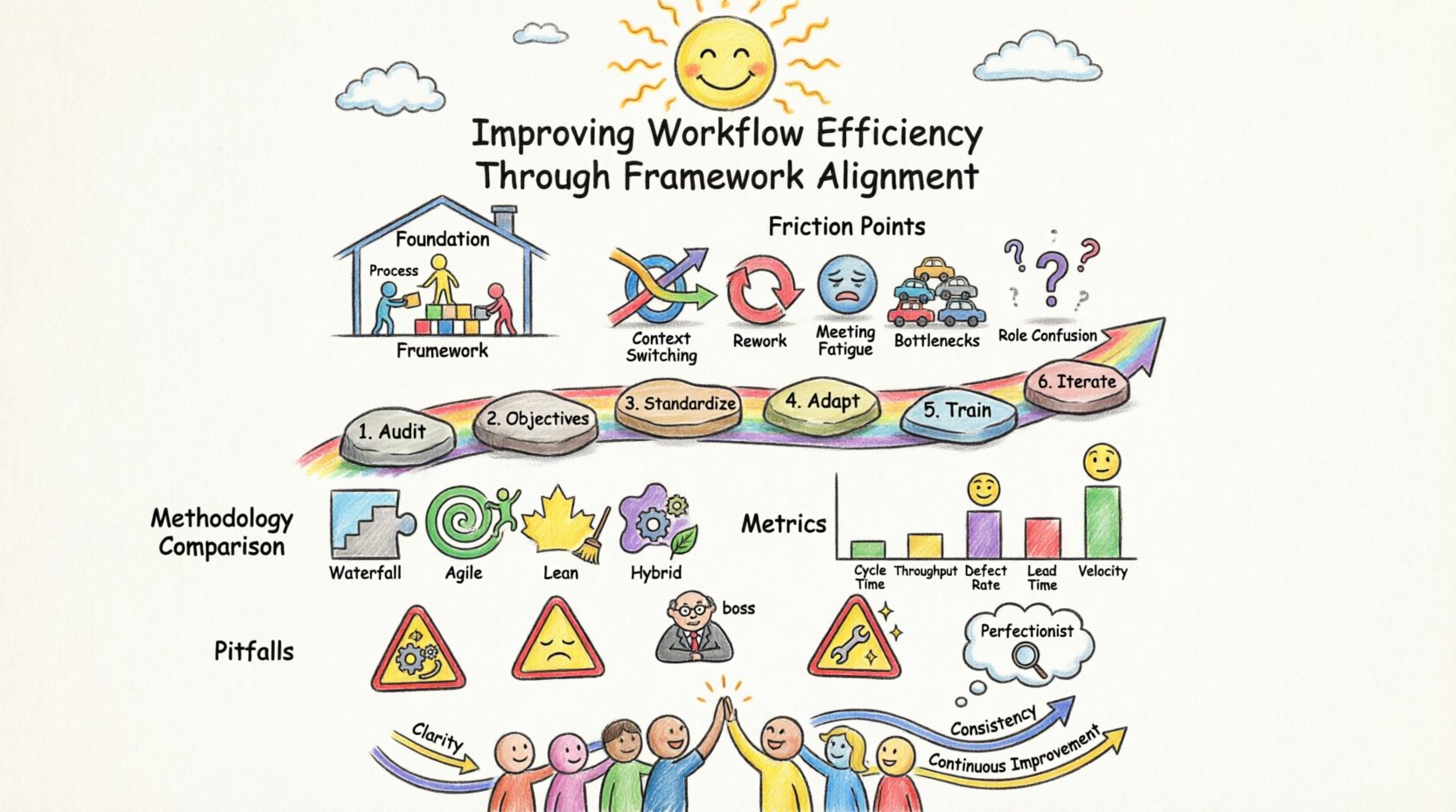
In the modern landscape of project management, efficiency is often conflated with speed. However, true velocity comes from structure. Many teams operate under the assumption that adding more tools or increasing work hours will yield better results. This approach frequently leads to burnout and fragmented output. The core issue is rarely the effort expended, but rather the misalignment between the operational framework and the actual work required.
Framework alignment refers to the deliberate synchronization of methodologies, processes, and organizational structures to support specific project goals. When workflows are aligned, friction decreases, communication clarifies, and delivery becomes predictable. This article explores how to achieve this alignment, identify bottlenecks, and sustain improvements without relying on hype or unproven methodologies.
📐 The Foundation of Framework Alignment
Understanding the distinction between a framework and a process is the first step. A framework provides the structural rules and boundaries within which work happens. A process is the specific sequence of actions taken to complete a task. Alignment occurs when the process fits the constraints and capabilities defined by the framework.
Consider a construction project. The framework might dictate safety regulations, budget caps, and timeline milestones. The process involves the specific steps the crew takes to pour concrete. If the crew follows a process that ignores the safety regulations of the framework, the project fails regardless of how fast they work. Similarly, in digital project management, a methodology like Agile dictates how feedback loops occur. If the team attempts to use a rigid, waterfall-style reporting process within an Agile framework, the feedback loop breaks.
To improve workflow efficiency, organizations must ensure that the chosen methodology matches the nature of the work. One size does not fit all. Some projects require the predictability of iterative planning, while others demand the flexibility of adaptive management. Recognizing this variance is key to structural integrity.
🛑 Identifying Structural Friction
Before implementing changes, one must diagnose the current state of the workflow. Misalignment often presents as recurring friction points. These symptoms are not just annoyances; they are indicators that the framework is not serving the team.
Common signs of misalignment include:
- Context Switching: Team members constantly shifting between tasks due to unclear priorities or conflicting processes.
- Repetitive Rework: Work being done multiple times because requirements were misunderstood or processes were bypassed.
- Meeting Fatigue: Excessive time spent in status updates rather than execution, suggesting a lack of trust in automated tracking or reporting mechanisms.
- Bottlenecks: Specific stages of the project where work consistently piles up, indicating a resource or approval constraint not accounted for in the framework.
- Role Confusion: Uncertainty regarding who is responsible for decision-making at critical junctures.
Addressing these symptoms requires a deep dive into the operational mechanics. It is not enough to tell the team to work faster. The system itself must be audited to find where the friction originates.
🛠️ Strategic Implementation Steps
Aligning frameworks is a systematic process. It involves assessment, adaptation, and validation. Rushing this phase often leads to resistance and failure. The following steps outline a disciplined approach to integration.
- Audit Existing Processes: Document how work is currently done. Map out the flow from initiation to completion. Identify where the documented rules differ from actual practice. This gap is where inefficiency hides.
- Define Clear Objectives: Establish what efficiency means for the specific team. Is it faster delivery? Higher quality? Reduced cost? The definition of success dictates the framework design.
- Standardize Core Elements: Select the non-negotiable elements of the workflow. These might include communication protocols, approval hierarchies, or quality gates. Keep these consistent to reduce cognitive load.
- Empower Local Adaptation: Allow teams to adapt peripheral processes to their specific context. Rigid centralization can stifle creativity and responsiveness. Find the balance between governance and autonomy.
- Train and Communicate: Ensure every stakeholder understands the new alignment. Training should focus on the why, not just the how. Understanding the purpose of a process increases compliance and reduces friction.
- Iterate Based on Feedback: Treat the framework as a living document. Regularly review its effectiveness against the defined objectives. Adjust as necessary.
🔄 Methodology Compatibility
Different types of work require different frameworks. Aligning the wrong methodology to a project type is a primary cause of inefficiency. Below is a comparison of common approaches to help determine the best fit for specific scenarios.
| Framework Type | Best Suited For | Key Characteristic |
|---|---|---|
| Waterfall | Projects with fixed requirements and low uncertainty. | Sequential phases; rigid scope. |
| Agile | Projects requiring flexibility and rapid feedback. | Iterative cycles; adaptive planning. |
| Lean | Processes focused on waste reduction and flow. | Continuous improvement; value stream mapping. |
| Hybrid | Complex projects needing structure and flexibility. | Combines predictive and adaptive elements. |
When selecting a framework, consider the stability of the requirements. If requirements change frequently, a rigid Waterfall approach will create constant rework. If the environment is highly regulated and stable, an Agile approach might introduce unnecessary overhead. The goal is to match the framework to the environment.
📊 Measuring Impact and Iteration
Without measurement, improvement is guesswork. To validate that framework alignment is improving workflow efficiency, specific metrics must be tracked. These metrics should focus on flow and quality rather than just activity.
- Cycle Time: The time it takes to complete a task from start to finish. A reduction here indicates improved flow.
- Throughput: The number of work items completed within a specific timeframe. Higher throughput suggests better capacity utilization.
- Defect Rate: The percentage of work that requires rework. Alignment should reduce errors caused by process confusion.
- Lead Time: The total time from request to delivery. This measures the responsiveness of the entire system.
- Team Velocity: The amount of work a team can complete in a set period. Consistency is more important than raw speed.
It is crucial to track these metrics over time to establish a baseline. Short-term fluctuations are normal. Look for trends that persist over several cycles. If a metric worsens after an alignment change, the change may have introduced new friction.
⚠️ Common Pitfalls to Avoid
Even with a solid plan, teams often stumble during the implementation of aligned frameworks. Awareness of these common pitfalls can help navigate challenges.
- Over-Engineering: Creating processes that are too complex for the team to follow. Simplicity is the ultimate sophistication in workflow design.
- Ignoring Culture: Implementing a framework that contradicts the team’s working style. Culture eats strategy for breakfast.
- Lack of Leadership Support: If management does not adhere to the new framework, the team will revert to old habits. Leaders must model the behavior.
- Tool Obsession: Believing that a new software solution will fix process issues. Tools enable processes; they do not create them.
- Perfectionism: Waiting for the framework to be perfect before starting. Better to launch a minimum viable framework and refine it.
Success in workflow alignment is a journey of continuous refinement. It requires patience and a willingness to admit when a process does not work. By focusing on structural integrity and removing friction, teams can achieve sustainable efficiency.
🌱 Moving Forward
Workflow efficiency is not a destination but a practice. It requires constant attention to the relationship between the team’s methods and their environment. By auditing current states, selecting compatible frameworks, and measuring outcomes objectively, organizations can build systems that support their people rather than hinder them. The focus remains on clarity, consistency, and continuous improvement. When frameworks align with reality, the work flows naturally, allowing teams to deliver value with confidence and reduced stress.