
Most founders and strategists treat the Business Model Canvas (BMC) as a static document. They fill in the boxes and assume the strategy is set. However, a critical error often lurks in the top right corner: Key Partnerships. This section is frequently overlooked or treated as an afterthought. Yet, ignoring these relationships can quietly erode value, increase costs, and stifle growth until it becomes a crisis. 🛑
Understanding the strategic weight of alliances is not about networking for the sake of social capital. It is about structural integrity. When you build a business model, you are defining how value is created, delivered, and captured. Partnerships are the backbone that often supports the entire structure. Without them, the load falls entirely on internal resources, which are rarely infinite.
This guide explores why neglecting Key Partnerships is a silent threat to organizational health. We will examine the mechanics of these alliances, how they integrate with other canvas blocks, and the specific risks associated with poor partnership management. By the end, you will understand how to fortify your model against external fragility. 🛡️
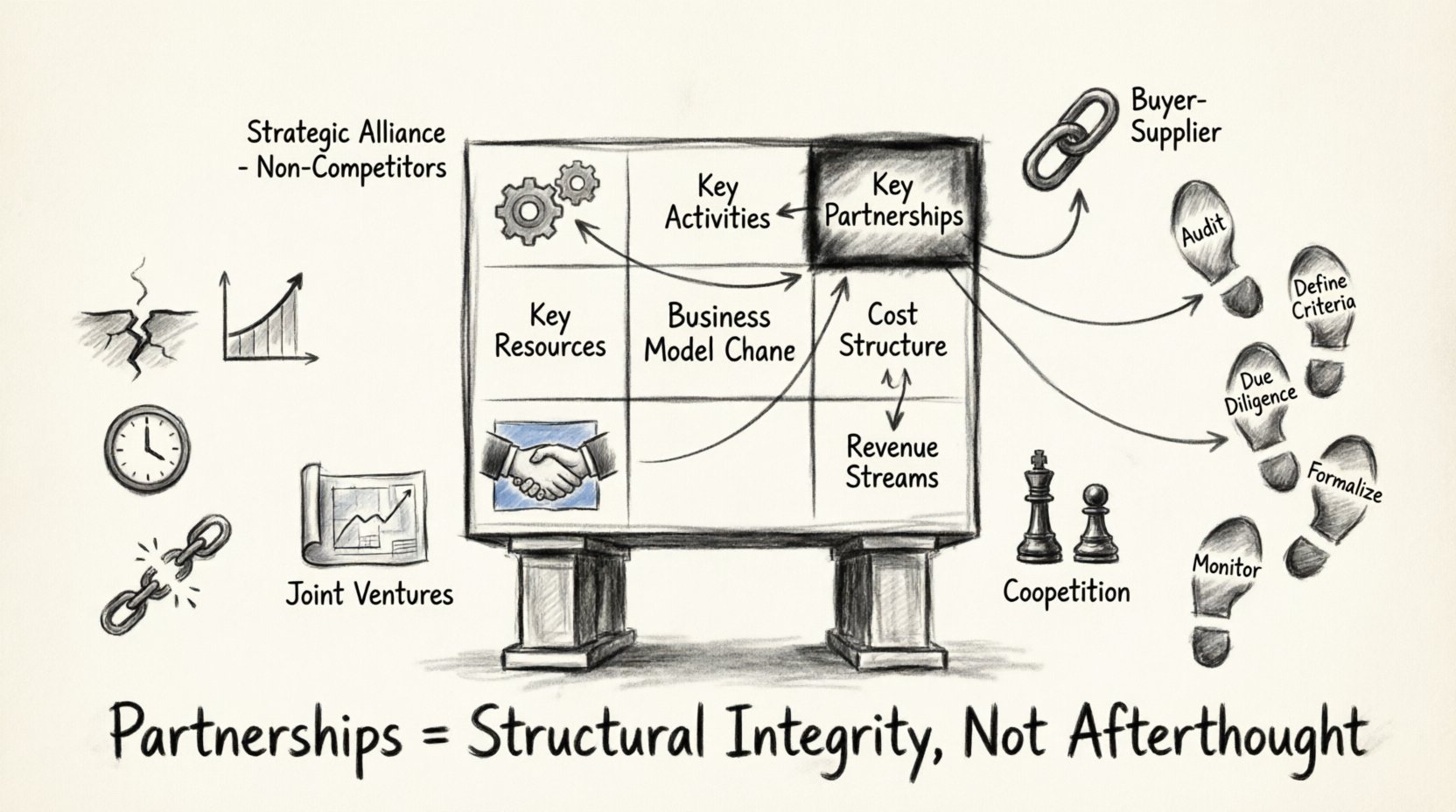
Defining Key Partnerships in the BMC Context 🤝
Key Partnerships refer to the network of suppliers and partners that make a business model work. They are not merely vendors; they are entities that enable you to optimize operations, reduce risk, or acquire resources you cannot generate internally. In the BMC framework, this block sits adjacent to Key Activities and Key Resources.
There is a misconception that partnerships are only for large corporations. Small startups and established enterprises alike rely on external ecosystems. The distinction lies in dependency. If your business cannot function without a specific relationship, that relationship is a Key Partnership.
Why is this distinction vital? Because treating a critical partner as an optional vendor leads to brittle supply chains. When a key partner fails, your entire value proposition may collapse. Therefore, identifying and managing these relationships requires the same rigor as managing internal teams.
Core Objectives of Strategic Alliances
Partnerships generally serve one of four primary functions within a business model:
- Optimization and Efficiency: Outsourcing non-core activities allows the organization to focus on its unique strengths. This reduces overhead and improves speed.
- Reduction of Risk and Uncertainty: Sharing the burden of new ventures or volatile markets protects the core business from catastrophic loss.
- Resource Acquisition: Accessing specialized knowledge, capital, or distribution channels that do not exist within the company.
- Coopetition: Competitors collaborating on specific projects to expand the overall market size or set industry standards.
The Four Types of Strategic Alliances 🏗️
Not all partnerships are created equal. To manage them effectively, you must categorize them based on their strategic intent. A clear classification system prevents resource misallocation.
| Type of Partnership | Description | Example Scenario |
|---|---|---|
| Strategic Alliance between Non-Competitors | Collaboration between companies in different industries to create complementary value. | A ride-sharing app partnering with a car insurance provider. |
| Joint Ventures | Creation of a new, independent entity to pursue a specific opportunity together. | Two tech firms building a new hardware division together. |
| Coopetition | Competitors collaborating on specific areas like R&D or infrastructure while competing elsewhere. | Automakers sharing battery technology standards. |
| Buyer-Supplier Relationships | Long-term commitments to ensure supply chain stability and quality control. | A furniture maker securing exclusive wood sourcing. |
Recognizing which category your partnerships fall into helps determine the level of investment required. A Joint Venture demands significant legal and operational oversight, whereas a Buyer-Supplier relationship focuses on contract adherence and delivery timelines.
Why Ignoring Them Costs You Revenue 💸
When the “Key Partnerships” block is left blank or filled with generic entries, the business model develops blind spots. These blind spots manifest as tangible financial and operational losses over time.
1. Increased Cost Structure
Without strategic outsourcing, you are forced to perform every activity in-house. This includes marketing, logistics, IT support, and manufacturing. Internalizing these costs often leads to higher fixed expenses. Partnerships allow you to convert fixed costs into variable costs. When you ignore this, your break-even point rises significantly.
2. Slower Time to Market
Building everything from scratch takes time. If you partner with an entity that already possesses the necessary infrastructure or customer base, you bypass the long development phase. Ignoring this leverage means you launch slower, giving competitors the opportunity to capture market share first.
3. Limited Reach and Distribution
Your product might be excellent, but if it lacks distribution channels, it remains unseen. Key Partnerships often provide access to established networks. Ignoring this means you are trying to sell to a market without a map. You spend more on customer acquisition because you lack referral networks.
4. Fragile Supply Chains
If you do not identify key suppliers as critical partners, you treat them as interchangeable commodities. When a shortage occurs, you scramble for alternatives. A strategic partnership ensures priority access during scarcity. Ignoring this leads to stockouts and revenue loss.
Integration with Other Canvas Blocks 🔗
The Business Model Canvas is an interconnected system. Changing one block affects the others. The Key Partnerships block has the most direct influence on four other areas: Key Activities, Key Resources, Cost Structure, and Revenue Streams.
- Impact on Key Activities: Partnerships often determine what activities you perform versus what you outsource. If you partner with a logistics firm, your Key Activity shifts from “Fulfillment” to “Quality Control”.
- Impact on Key Resources: You might own fewer physical assets if you partner. This changes your asset-light strategy. You rely on the partner’s IP or infrastructure instead of your own.
- Impact on Cost Structure: As mentioned, partnerships shift costs from CapEx to OpEx. They also introduce new cost elements like partnership fees or revenue sharing.
- Impact on Revenue Streams: Partners can become channels for sales. They might also create new revenue streams through bundled offerings or cross-selling opportunities.
Consider a software company. If they partner with a hardware manufacturer, the partnership influences the distribution channel (Activity), the device availability (Resource), the licensing fees (Cost), and the hardware sales commission (Revenue). All these connections must be mapped explicitly.
Common Pitfalls in Partnership Management 🚫
Even when you acknowledge the importance of partnerships, execution often fails. Here are the most common reasons why these alliances turn toxic or ineffective.
1. Lack of Clear Value Exchange
Every partnership requires a mutual benefit. If one party feels they are giving more than they receive, the relationship will sour. Ensure that the value proposition is clear for both sides. Ask: “What does the partner get out of this?” If the answer is vague, the partnership is unsustainable.
2. Misaligned Incentives
One party might prioritize speed, while the other prioritizes stability. These conflicting goals lead to friction. For example, a startup wants to pivot quickly, but a large partner wants to maintain process consistency. This misalignment must be addressed in the initial agreement.
3. Cultural Mismatch
Business culture dictates how decisions are made. A hierarchical company working with a flat, agile startup often faces communication breakdowns. Understanding the organizational culture of your partner is as important as understanding their financials.
4. Over-Dependency
Relying too heavily on a single partner creates vulnerability. If that partner raises prices or goes out of business, your model collapses. Diversification is key. Identify backup options and maintain relationships with secondary suppliers.
5. Ignoring Exit Strategies
Not all partnerships last forever. Without a clear exit strategy, ending a relationship can be messy and damaging to your reputation. Define the terms of separation upfront, including data handling and customer transfer protocols.
Building a Robust Partnership Strategy 📈
To avoid these pitfalls, you need a proactive strategy for identifying, vetting, and managing partners. This process should be as systematic as your hiring process.
Step 1: Audit Your Current Model
Review your existing Business Model Canvas. Look at the Key Partnerships block. Is it populated? Are the entries specific? If you see generic terms like “suppliers” or “partners,” replace them with specific entity names or categories. Identify which activities are currently outsourced and which are internal.
Step 2: Define Partnership Criteria
Before seeking partners, define what you need. Do you need technology? Distribution? Capital? Reputation? Create a checklist of requirements. This prevents you from accepting a partnership that looks good on paper but does not solve your specific problem.
Step 3: Conduct Due Diligence
Investigate potential partners thoroughly. Check their financial stability, reputation, and capacity. Talk to their existing clients. Ask about their decision-making speed and conflict resolution style. This step saves time in the long run.
Step 4: Formalize the Agreement
Do not rely on handshake deals. Document the scope, responsibilities, and performance metrics. Ensure the contract covers intellectual property rights, confidentiality, and termination clauses. Clear documentation reduces ambiguity.
Step 5: Monitor and Review
Partnerships require maintenance. Schedule regular review meetings to discuss performance against agreed KPIs. Are you delivering the promised value? Is the cost structure still viable? Adjust the relationship as the business evolves.
Measuring Partnership Health 📊
How do you know if a partnership is working? You need quantitative and qualitative metrics. Relying on gut feeling is insufficient for long-term strategy.
- Revenue Contribution: What percentage of total sales comes from this partner?
- Cost Savings: Have operational costs decreased due to outsourcing or resource sharing?
- Customer Satisfaction: Are customers reporting better experiences because of the partner?
- Innovation Rate: Is the partnership leading to new product features or services?
- Retention Rate: How long does the partnership last compared to the industry average?
If a partner fails to meet these metrics consistently, you must intervene. Either improve the collaboration terms or seek an alternative. Keeping a underperforming partner on the canvas creates a drag on the entire model.
Future-Proofing Your Network 🔮
The business landscape changes rapidly. New technologies emerge, regulations shift, and consumer behaviors evolve. Your partnerships must be flexible enough to adapt.
Consider the rise of digital platforms. Traditional distribution partners may struggle to compete with direct-to-consumer models. You might need to diversify your network to include digital marketplaces alongside traditional retailers. This hybrid approach mitigates risk.
Furthermore, consider sustainability. Partners who fail to meet environmental or social standards can damage your brand reputation. Ensure your partners align with your long-term values. This alignment protects your license to operate in a socially conscious market.
Finally, prepare for disruption. If your business model relies on a technology that could be rendered obsolete, your partners should be investing in the next generation of that technology. Encourage innovation within your network.
Final Considerations 🧭
The Key Partnerships block is not a decorative element of the Business Model Canvas. It is a structural pillar. Ignoring it invites risk. Managing it well creates resilience.
When you fill this block, you are acknowledging that no business is an island. You are admitting that you need help to scale. This admission is a sign of strategic maturity, not weakness. By treating partnerships as core assets, you build a model that can withstand market volatility.
Take the time to map these relationships. Define the value exchange. Monitor the performance. And remember that a strong network is one of the most valuable assets you can own. It is the difference between a fragile startup and a resilient enterprise. 🏗️