

Now Reading: How Visual Paradigm’s AI Chatbot Enhances UML Modeling for Development Teams
-
01
How Visual Paradigm’s AI Chatbot Enhances UML Modeling for Development Teams



How Visual Paradigm’s AI Chatbot Enhances UML Modeling for Development Teams

In modern software development, efficient collaboration, rapid prototyping, and accurate system modeling are critical to delivering high-quality software on time. Enter Visual Paradigm, a leading visual modeling and development platform that has evolved beyond traditional diagramming tools by integrating AI-powered capabilities, most notably its AI Chatbot. This powerful feature significantly enhances how development teams create, manage, and collaborate on UML (Unified Modeling Language) diagrams throughout the Software Development Life Cycle (SDLC).
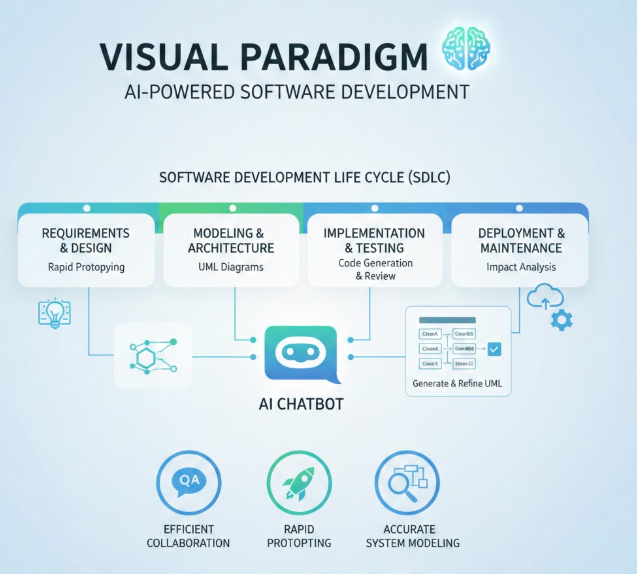
Overview of Visual Paradigm’s AI Chatbot
Visual Paradigm’s AI Chatbot is an intelligent, natural language-driven assistant embedded directly within the Visual Paradigm IDE and web-based platform. It leverages advanced Large Language Models (LLMs) to understand user requests, generate UML diagrams, refine existing models, and even convert text descriptions into code or documentation.
Key Features of the AI Chatbot:
-
Natural language input (e.g., “Create a class diagram for a library system with Book, Member, and Loan classes”)
-
Automatic generation of UML diagrams (Class, Sequence, Use Case, Activity, etc.)
-
Real-time suggestions and auto-completion
-
Code generation from UML models
-
Documentation generation and explanation of diagrams
-
Integration with SDLC workflows (e.g., Jira, GitHub, Confluence)
How the AI Chatbot Transforms UML Modeling for Teams
✅ 1. Accelerates UML Diagram Creation
Traditionally, creating UML diagrams requires deep knowledge of syntax and structure. The AI Chatbot eliminates this barrier.
Example:
User Input: “Generate a sequence diagram showing a user logging in to a web app.”
Output: Visual Paradigm instantly generates a clean, accurate Sequence Diagram with Actor, System, and message flow — all in seconds.
This speeds up the Requirements Analysis and Design phases of SDLC, allowing teams to prototype and validate system behavior rapidly.
✅ 2. Bridges Communication Gaps Across Roles
UML is often misunderstood by non-technical stakeholders. The AI Chatbot helps bridge this gap:
-
Product Owners/PMs can describe features in plain language:
“Show me how a customer places an order with payment and shipping.”
→ The AI generates a Use Case Diagram and Activity Diagram. -
Developers get immediate visual feedback to align with requirements.
-
Testers can extract test scenarios from generated Activity or State Machine Diagrams.
This promotes cross-functional collaboration and ensures alignment across teams.
✅ 3. Enables Rapid Iteration and Refinement
During design reviews or feedback loops, teams often need to revise diagrams. The AI Chatbot allows for:
-
Natural language edits: “Change the association between Book and Member to be one-to-many.”
-
Auto-correct and suggestions: If a class is missing a method, the AI suggests adding it.
-
Refactoring support: “Rename the ‘Customer’ class to ‘User’ and update all references.”
This supports agile development cycles, where models evolve quickly with user feedback.
✅ 4. Integrates Seamlessly with SDLC Tools
Visual Paradigm’s AI Chatbot doesn’t exist in isolation. It integrates with:
-
Jira: Automatically generate UML diagrams from user stories.
-
GitHub: Sync diagrams with code repositories (e.g., auto-generate class diagrams from Java/C# files).
-
Confluence: Embed UML diagrams directly into documentation.
-
CI/CD Pipelines: Use UML models as part of automated testing or documentation generation.
This integration ensures UML models are not just static artifacts but living documents that evolve with the project.
✅ 5. Supports Code Generation and Reverse Engineering
One of the most powerful aspects of the AI Chatbot is its ability to generate code from UML and reverse-engineer UML from code.
-
Forward Engineering:
“Generate Java code from this class diagram.”
→ Instantly produces clean, well-structured classes with attributes and methods. -
Reverse Engineering:
“Create a class diagram from the ‘OrderService.java’ file.”
→ Automatically parses the file and generates a UML Class Diagram.
This accelerates the Implementation and Testing phases, reducing boilerplate work and ensuring consistency between design and code.
✅ 6. Educates and Onboards New Team Members
For junior developers or new hires, understanding complex UML models can be daunting. The AI Chatbot acts as a real-time tutor:
-
“Explain this sequence diagram step by step.”
-
“What does this dashed arrow mean in the class diagram?”
-
“How does the state machine work in the payment process?”
This self-service learning capability reduces onboarding time and improves team-wide understanding of system architecture.
Real-World Use Case: Agile Team Using AI Chatbot in Sprint Planning
Scenario: A product team is planning a sprint to implement a user authentication system.
-
During Sprint Planning:
Product Owner says: “I want a user to sign up, verify email, and log in.”
→ AI Chatbot generates a Use Case Diagram and Activity Diagram. -
During Design Phase:
Developer types: “Create a class diagram with User, EmailVerification, and AuthService.”
→ AI generates a full UML Class Diagram with relationships and methods. -
During Implementation:
Developer says: “Generate Java code from this class diagram.”
→ Code is auto-generated and pushed to GitHub. -
During Testing:
Tester uses the Activity Diagram to derive test cases for email verification flow. -
Documentation:
Team exports the diagrams to Confluence using AI-generated summaries.
👉 Result: The team delivers the feature faster, with fewer misunderstandings and higher code quality.
Why This Matters: UML + AI = Smarter Development
Visual Paradigm’s AI Chatbot transforms UML from a static documentation tool into a dynamic, intelligent co-pilot for software teams. It:
-
Reduces time spent on modeling by up to 70%.
-
Minimizes errors from miscommunication.
-
Promotes consistency across models and code.
-
Encourages agile, iterative design.
Conclusion: The Future of UML is AI-Powered
While UML has long been a cornerstone of software design, its adoption was often hindered by complexity and time investment. Visual Paradigm’s AI Chatbot removes these barriers, making UML accessible, powerful, and deeply integrated into the SDLC workflow.
For development teams, this means:
-
Faster design iterations.
-
Better collaboration across roles.
-
Higher-quality, consistent code and documentation.
-
Stronger alignment between business needs and technical implementation.
In short: Visual Paradigm’s AI Chatbot doesn’t just support UML—it elevates it from a design tool to a strategic asset in modern software development.
Get Started
If your team is serious about agile, scalable, and collaborative software development, integrating Visual Paradigm with its AI Chatbot is a step toward smarter modeling, faster delivery, and better outcomes.
👉 Try the AI Chatbot today at https://www.visual-paradigm.com and turn your ideas into UML models — in seconds, in plain language.
Final Thought:
“The best way to predict the future is to create it.”
With Visual Paradigm’s AI-powered UML modeling, your team isn’t just predicting—it’s building the future, one diagram at a time.
-
AI-Powered UML Class Diagram Generator by Visual Paradigm: This advanced AI-assisted tool automatically generates UML class diagrams from natural language descriptions, significantly streamlining software design and modeling.
-
AI-Powered Sequence Diagram Refinement Tool: Discover how this feature enhances software design by automatically improving and optimizing sequence diagrams with intelligent suggestions.
-
AI Textual Analysis – Transform Text into UML Models Automatically: This resource explains how to use AI to analyze text documents and automatically generate UML diagrams for faster modeling and documentation.
-
Generate Activity Diagrams from Use Cases Instantly: Learn how the AI engine enables rapid and accurate conversion of use case descriptions into professional activity diagrams with minimal effort.
-
How AI Chatbot Can Help You Learn UML Faster: This article details how users can practice UML interactively, visualize concepts instantly, and receive immediate feedback to improve their modeling skills.
-
AI-Powered MVC System Architecture Generator: A specialized tool that leverages AI to automatically generate clean, scalable MVC (Model-View-Controller) system architectures through automated modeling.
-
Major Upgrade to AI UML Component Diagram Generation: An official update detailing enhancements that make the AI assistant an indispensable tool for generating modular software structures.
-
Definitive Guide to UML State Machine Diagrams with AI: A detailed technical guide on using AI-enhanced tools to model dynamic object behavior and complex state-driven logic.
-
AI Use Case Description Generator by Visual Paradigm: An AI-powered tool that automatically generates detailed use case descriptions from user inputs, accelerating system analysis and documentation.
-
Real-Life Case Study: Generating UML Class Diagrams with AI: A detailed case study demonstrating how an AI assistant successfully transformed textual requirements into accurate UML class diagrams for a real-world project.


