Now Reading: Hospital Data Mastery: Professional Design via DB Modeler AI
-
01
Hospital Data Mastery: Professional Design via DB Modeler AI



Hospital Data Mastery: Professional Design via DB Modeler AI
In the contemporary landscape of software engineering, the architectural integrity of a data repository determines the ultimate scalability and performance of the enterprise application it supports. Visual Paradigm Online introduces DB Modeler AI, a professional AI-powered database modeling tool designed to facilitate the seamless translation of complex business requirements into sophisticated, normalized database schemas. By leveraging advanced artificial intelligence, this application mitigates the traditional risks associated with manual schema definition, providing a structured, seven-step methodology that ensures every entity, attribute, and relationship is precisely aligned with the overarching project objectives. Whether one is architecting a localized solution or an expansive enterprise system, this tool provides the precision required for modern development.
-
Automated Artifact Generation: Effortlessly transform high-level business descriptions into technical diagrams and SQL code.
-
Guided 7-Step Workflow: A logical progression from conceptual domain models to finalized, normalized database schemas.
-
Intelligent Normalization: Built-in assistance for achieving Third Normal Form (3NF) to ensure data integrity and reduce redundancy.
-
Interactive Schema Validation: A dedicated playground environment to test SQL commands and verify the design before deployment.
-
Comprehensive Documentation: Automatically generate detailed final reports summarizing the entire design process for stakeholders.
The Genesis of Design: Transforming Problems into Solutions
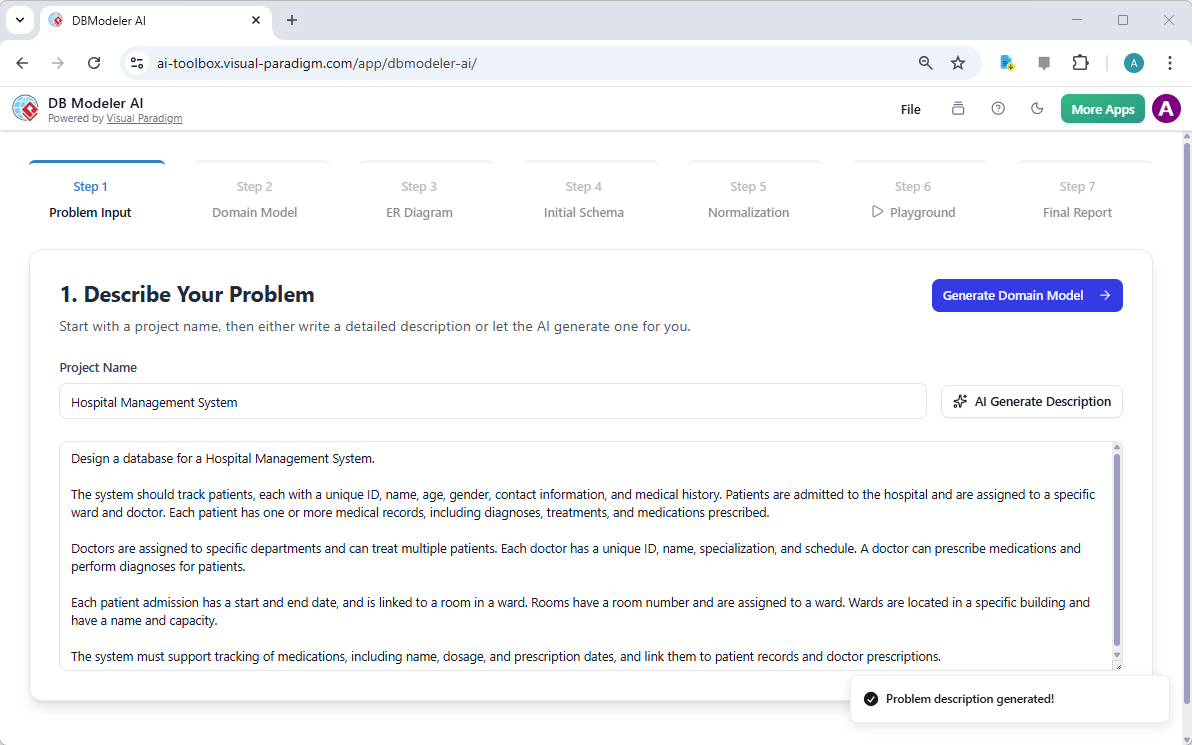
The journey toward a robust database begins with a clear articulation of the business problem, a phase that often suffers from ambiguity in traditional workflows. Within DB Modeler AI, the process is initiated by defining the project scope, such as a Hospital Management System, where the user provides a detailed narrative of the required functionalities. The AI assistant possesses the analytical capability to parse these requirements, identifying critical entities like patients, doctors, and medical records, thereby establishing a solid foundation for the subsequent technical layers. This initial clarity is paramount, as it ensures that the resulting technical architecture remains strictly relevant to the business logic it is intended to serve.
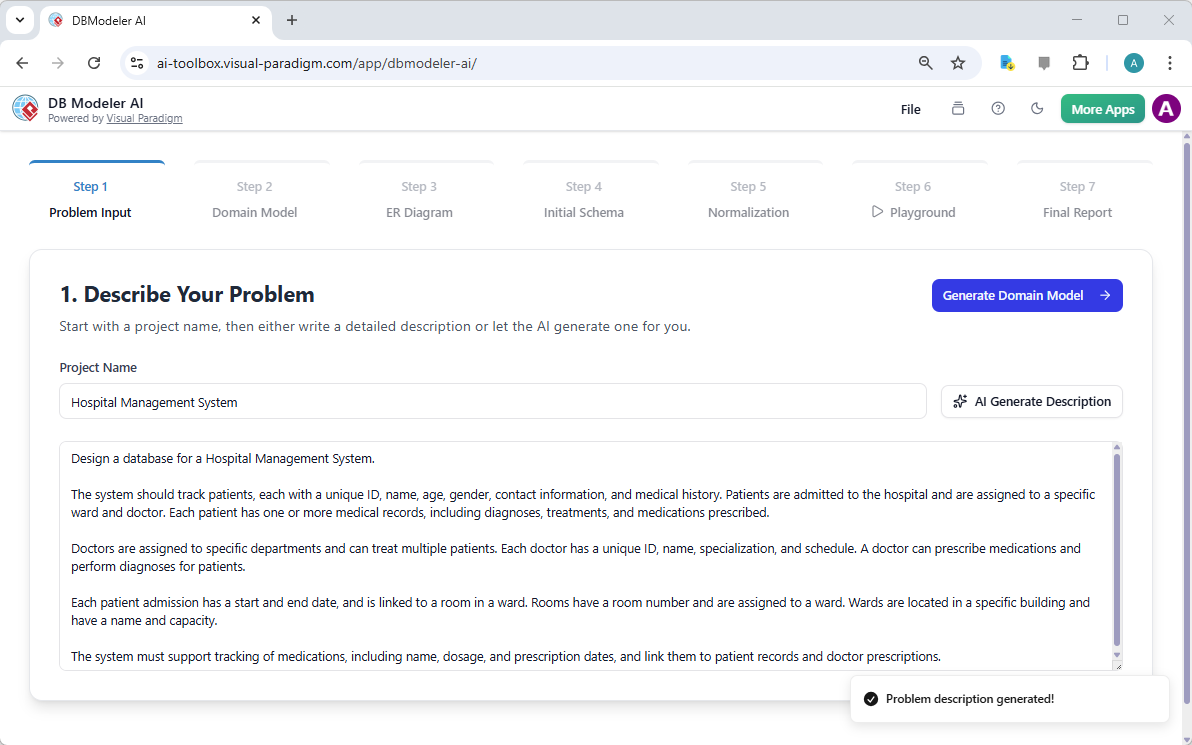
As illustrated in the initial interface, the application prompts the user for a comprehensive problem description, which can be manually drafted or augmented through the AI’s generative capabilities to ensure no operational detail is overlooked. This collaborative start sets the stage for a highly accurate modeling experience that prioritizes the user’s strategic goals.
From Conceptual Domain Models to Logical ER Diagrams
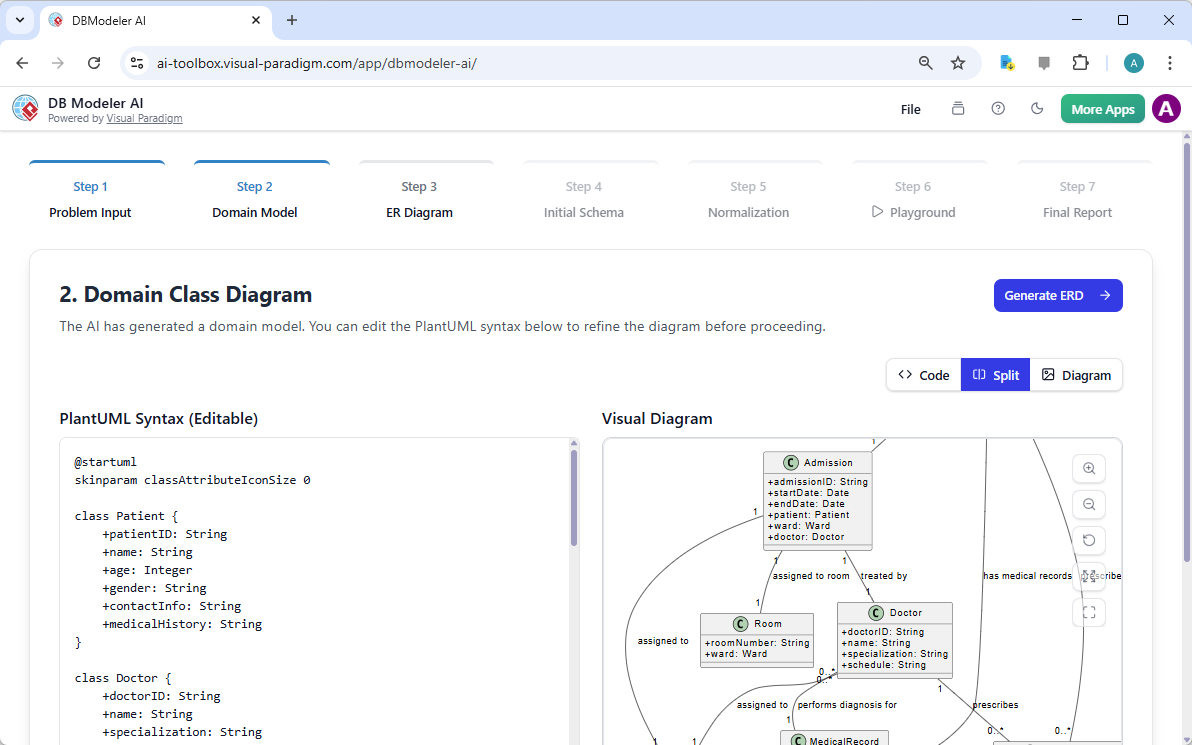
Once the problem is defined, this professional AI-powered database modeling tool transitions into the visualization of abstract concepts through a Domain Class Diagram. This stage focuses on high-level business entities and their inherent relationships, providing a bridge between non-technical stakeholders and developers. The AI interprets the hospital management requirements to generate classes such as “Patient,” “Doctor,” and “Admission,” complete with their respective attributes. This visual representation allows for early-stage validation of the business logic, ensuring that the relationships—such as how a doctor performs a diagnosis—are captured with absolute precision before any technical constraints are applied.
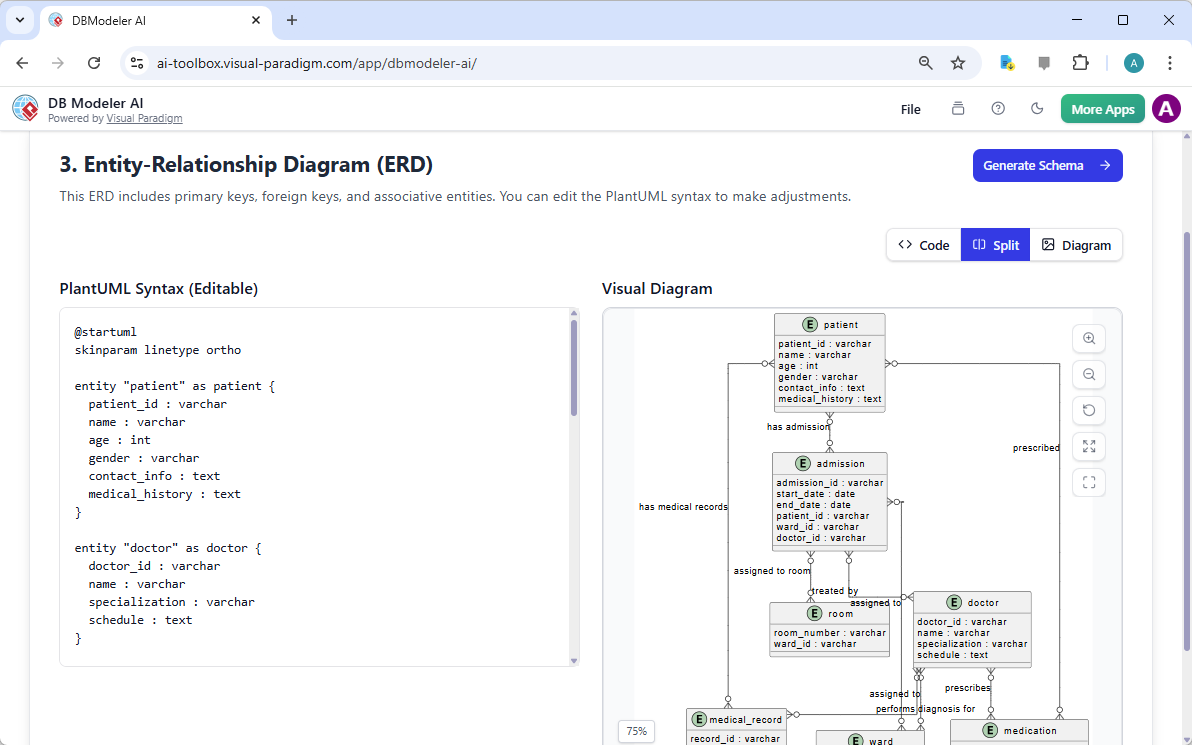
Following the confirmation of the domain model, the tool advances to the creation of an Entity-Relationship Diagram (ERD). This logical model introduces specific database constraints, including primary keys, foreign keys, and associative entities necessary for handling many-to-many relationships. For instance, the transition from a conceptual “Medical Record” to a logical entity involves defining data types like Varchar and Integer, which are essential for the eventual physical implementation. The AI’s ability to maintain consistency between these disparate modeling layers is a testament to Visual Paradigm’s commitment to design best practices and technical excellence.
Refining Architecture through SQL Generation and Normalization
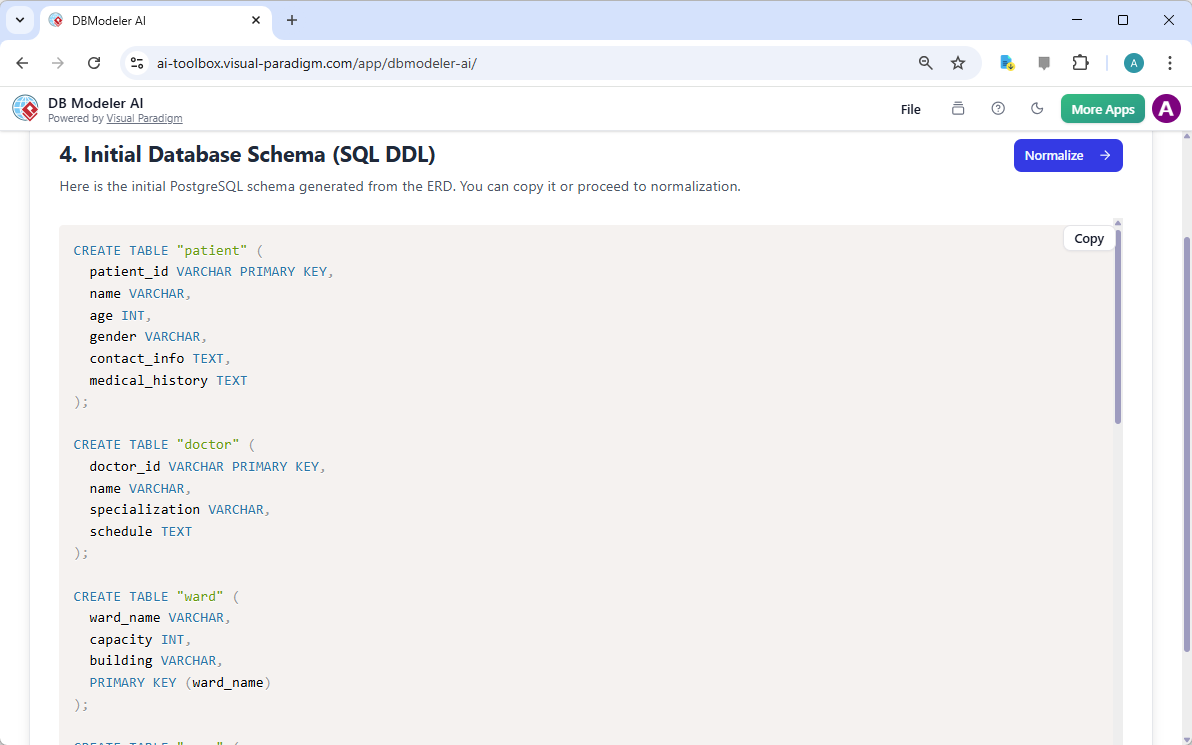
The transition from a visual diagram to a functional database is often where errors occur; however, DB Modeler AI automates this transition by generating a precise Initial Database Schema (SQL DDL). Based on the confirmed ERD, the tool produces clean, standards-compliant PostgreSQL DDL statements that define tables for patients, wards, and medications. This automation not only accelerates the development lifecycle but also ensures that the physical database structure is an exact reflection of the logical design. Developers can review the generated CREATE TABLE statements, ensuring that all constraints and data types are optimized for their specific environment.
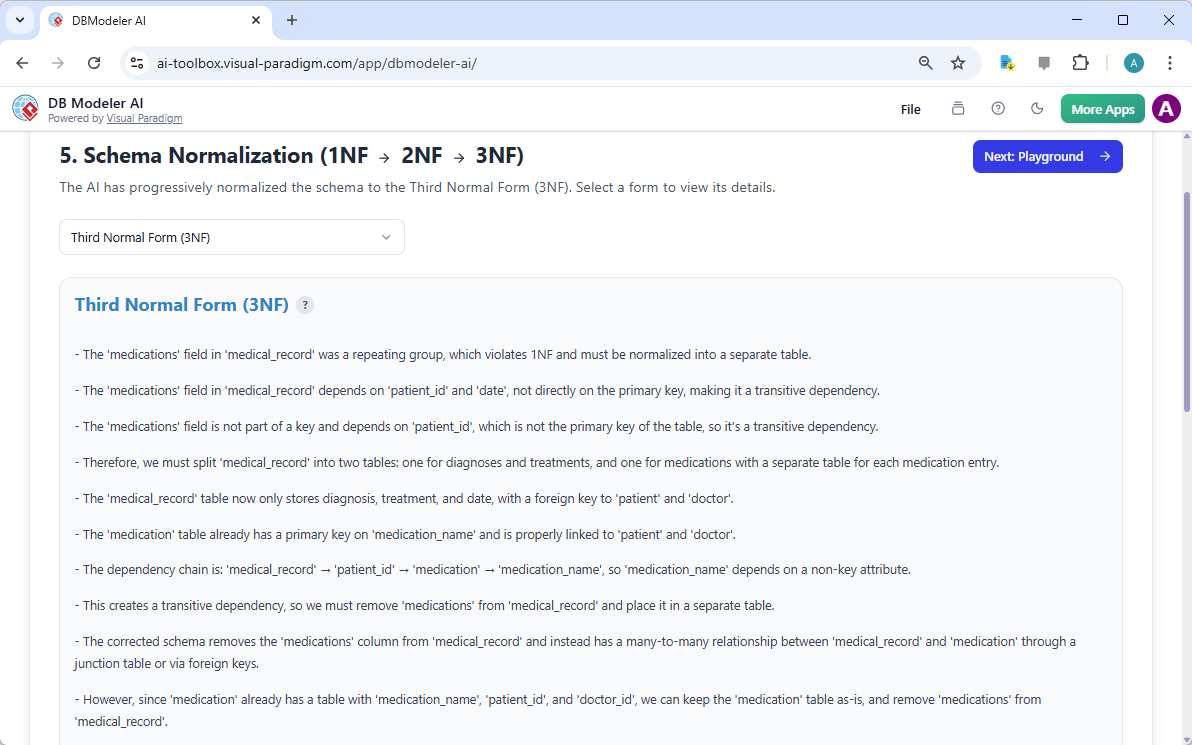
True database excellence is defined by the absence of redundancy and the preservation of data integrity, which is achieved through the rigorous process of Normalization. Step 5 of the workflow provides a sophisticated interface where the AI assists the user in refining the schema through the first, second, and third normal forms. By identifying transitive dependencies and repeating groups—such as separating medications from general medical records into a dedicated table—the tool ensures the database is resilient and scalable. This guided normalization process is invaluable for both seasoned DBAs and aspiring data professionals, as it demystifies a historically complex aspect of database theory.
Validation and Finalization: The Interactive Playground
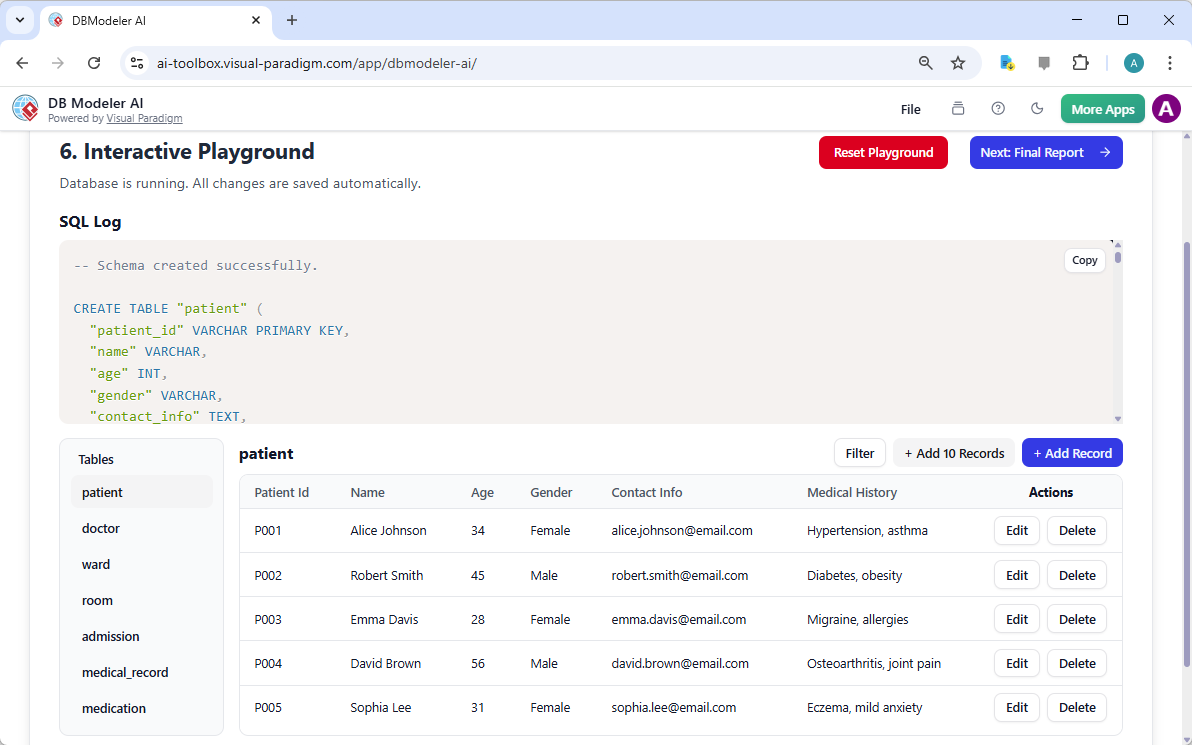
Before a design is exported for production, it must be validated within a functional context. DB Modeler AI includes a unique Interactive Playground, an environment where the generated DDL is executed in a simulated space. Users can interact with the schema by adding sample records, such as patient data for “Alice Johnson” or “Robert Smith,” and performing standard CRUD operations. As users interact with the visual tables, the corresponding SQL statements are displayed, providing a transparent look at how the data interacts with the schema. This sandbox approach allows for the immediate identification of potential design flaws, ensuring that the final output is battle-tested and ready for implementation.
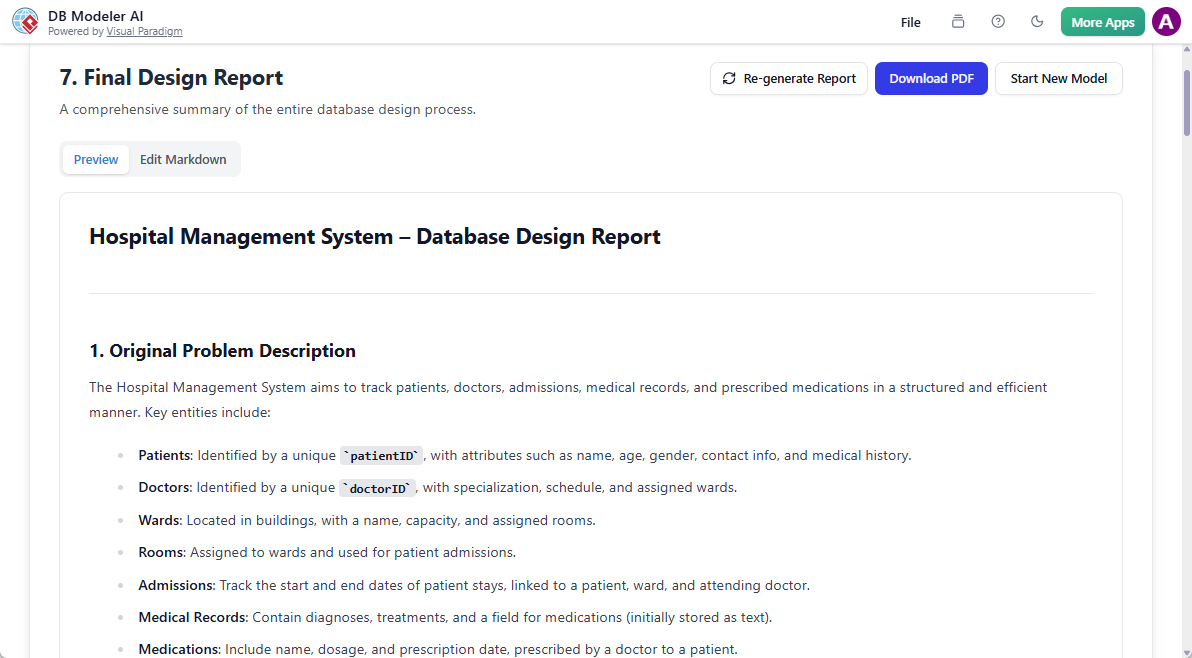
The design journey culminates in the generation of a Final Design Report, a comprehensive document that synthesizes all artifacts created during the seven-step process. This report includes the original problem description, the visual diagrams, the normalized SQL schema, and a summary of the entities involved. Such documentation is vital for project handovers, stakeholder reviews, and long-term system maintenance. By consolidating these complex technical details into a single, professional report, Visual Paradigm ensures that the knowledge remains accessible and organized throughout the project’s lifespan.
Conclusion: Elevating Your Data Strategy
In summary, Visual Paradigm Online has redefined the standards of database architecture by providing a professional AI-powered database modeling tool that balances automation with user control. From the initial conceptualization of a Hospital Management System to the final generation of a production-ready SQL schema, every step is designed to maximize efficiency and minimize error. By integrating visual modeling, intelligent normalization, and interactive testing, this tool empowers teams to build robust, scalable, and highly optimized data structures. For those seeking to bridge the gap between business requirements and technical execution, DB Modeler AI stands as the premier choice for modern database design.
Optimize your next project today. Experience the future of database architecture by exploring the capabilities of our AI-driven toolbox.
Try DB Modeler AI Now: Launch AI Database Modeler
Learn more about our AI tools: Visual Paradigm AI Solutions
Related Links
Visual Paradigm offers a powerful suite of ERD (Entity-Relationship Diagram) tools that enable the design of scalable database schemas through traditional visual modeling and AI-driven automation,. These tools support various standards, including Chen notation, and facilitate the entire lifecycle from conceptual design to physical database implementation and reverse engineering,,.
-
Visual Paradigm ERD Tool – Create Entity-Relationship Diagrams Online: A web-based tool providing an intuitive drag-and-drop interface for designing professional database schemas.
-
Database Design with ERD Tools – Visual Paradigm Guide: A comprehensive resource for building robust databases using data modeling best practices and effective schema design.
-
DBModeler AI: Intelligent Database Modeling Tool: An AI-driven application used for rapid database design, generating ER diagrams, and creating testable database environments.
-
Chen Notation ERD Editor – Advanced Entity-Relationship Modeling: A specialized editor that provides full support for entities, attributes, and relationships using precise Chen notation.
-
New Diagram Types Added to AI Diagram Generator: DFD & ERD: This update highlights the ability to instantly generate ERDs from natural language prompts using artificial intelligence.
-
Visual Paradigm ERD Tool for Database Design – Complete Solution: A professional toolset used by architects to model, visualize, and generate complex databases efficiently.
-
How to Model a Relational Database with ERD – Visual Paradigm Tutorial: A practical tutorial that guides users through the process from conceptual modeling to final implementation.
-
Streamlining Entity-Relationship Modeling with Visual Paradigm: An article focused on simplifying the transition from initial concepts to a fully deployed database.
-
Introduction to Data Modeling: ERD, Code Generation & Reverse Engineering: An introductory guide covering the essential data modeling lifecycle, including automated code generation.
-
Why Visual Paradigm Online is Ideal for ERD Design in Development Teams: A case study recommending this platform for collaborative, real-time ERD design within agile software development teams.