
Building a venture requires more than just a great idea. It demands a clear understanding of the competitive landscape you are entering. For decades, strategists have relied on Porter’s Five Forces framework to dissect industry dynamics. Yet, even experienced founders often stumble when applying this model. They treat it as a checklist rather than a diagnostic tool. This approach leads to blind spots that can jeopardize long-term viability.
This guide focuses on the specific pitfalls that derail strategic planning. We will explore the five core forces and highlight the common errors associated with each. By understanding these mistakes, you can construct a more robust market entry strategy. The goal is not just analysis for the sake of analysis, but actionable intelligence.
Understanding the Framework 🧭
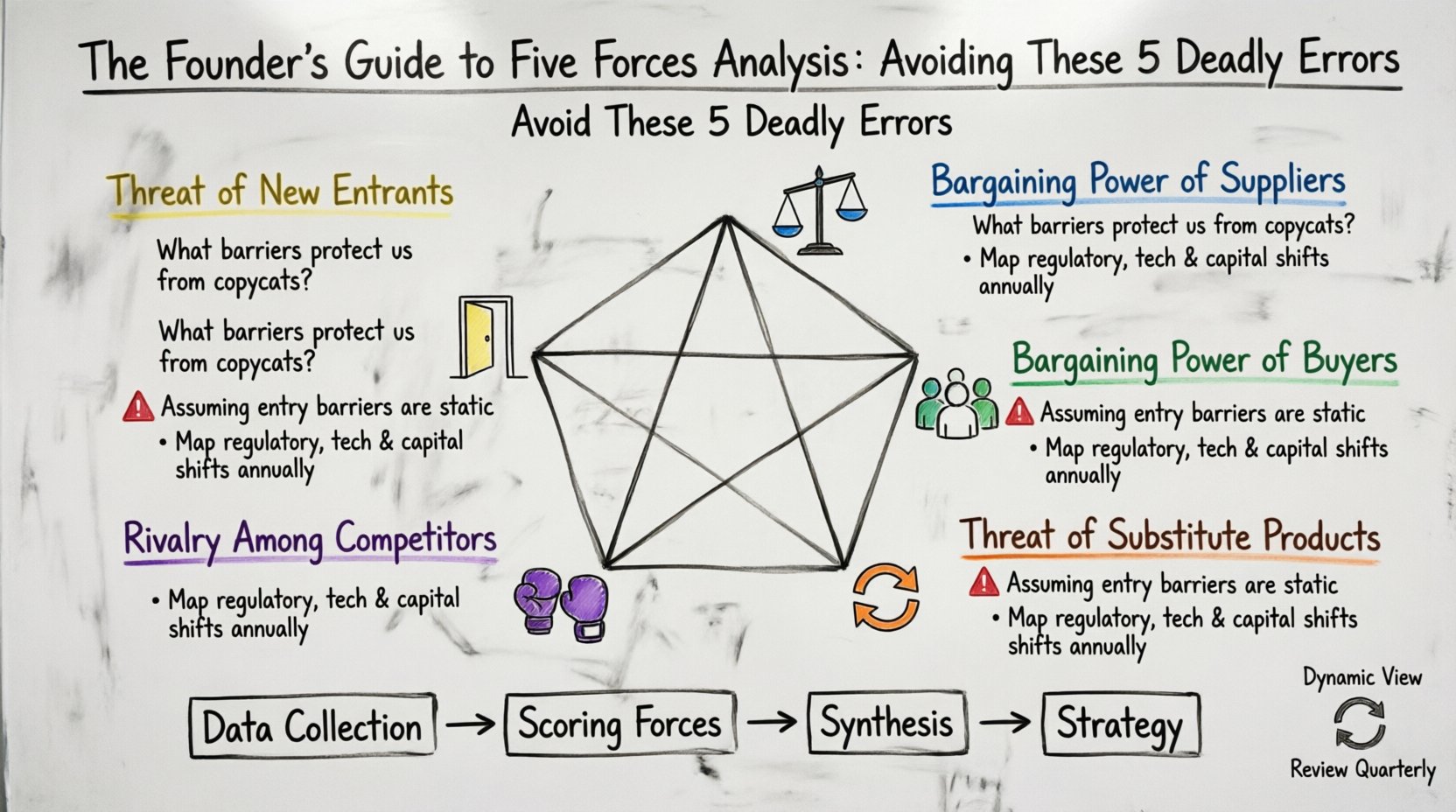
Porter’s Five Forces framework assesses the competitive intensity and attractiveness of a market. It looks beyond direct competitors to include broader industry dynamics. These forces determine the profitability potential of an industry. If the forces are strong, profits tend to be low. If they are weak, profitability can be higher.
The five forces are:
- Threat of New Entrants: How easy is it for new players to enter your space?
- Bargaining Power of Suppliers: How much control do your vendors have over costs?
- Bargaining Power of Buyers: How much leverage do your customers have to drive prices down?
- Threat of Substitute Products: Are there alternative solutions that solve the same problem?
- Rivalry Among Existing Competitors: How fierce is the competition for market share?
Many founders treat this list as static. They fill in the blanks once and file the document away. In reality, these forces shift constantly. Technology changes, regulations evolve, and consumer behaviors adapt. A static analysis yields outdated insights. A dynamic analysis informs decision-making.
Error 1: Ignoring the Threat of Substitutes 🔄
The most dangerous oversight often involves substitutes. Founders frequently define their competition too narrowly. They look at direct rivals who sell similar products. They fail to see the indirect solutions that customers might use instead.
Why This Happens
Cognitive bias plays a major role here. It is easier to analyze a known competitor than a hypothetical alternative. You see the logo of the rival company every day. You do not see the spreadsheet or the manual process your product is replacing. This tunnel vision leads to an underestimation of risk.
The Impact
When substitutes are strong, price caps are imposed on your business. If your product costs $100, but a DIY solution costs $20, your pricing power is limited. You cannot raise prices without losing customers to the substitute. This limits your margin and growth potential.
How to Avoid It
- Define the Job-to-be-Done: Ask what problem the customer is trying to solve. List every way that problem can be solved, not just your competitors.
- Analyze Switching Costs: How difficult is it for a user to switch to a substitute? If it is easy, the threat is high.
- Monitor Adjacent Markets: Look at industries that are not your direct competitors but serve similar needs.
For example, a coffee shop does not just compete with other coffee shops. It competes with energy drinks, tea, or even making coffee at home. If the home-brewing experience improves, the coffee shop faces a substitute threat. Acknowledging this allows for better differentiation strategies.
Error 2: Underestimating Supplier Power ⚖️
Founders often focus on the customer and forget the supply chain. They assume vendors will always be available and affordable. When a key supplier raises prices or restricts access, the business model can collapse.
Why This Happens
Early-stage ventures are often small buyers. Suppliers may not see you as a threat. This leads to complacency. Founders assume the supply chain is stable. They do not negotiate contracts aggressively enough. They do not diversify their vendor base.
The Impact
High supplier power squeezes margins. It can also create bottlenecks in production or delivery. If you rely on a single source for a critical component, you are vulnerable. A disruption in their operations becomes a disruption in yours.
How to Avoid It
- Diversify Your Vendor Base: Never rely on a single supplier for critical inputs.
- Vertical Integration: Consider bringing parts of the supply chain in-house if margins allow.
- Long-term Contracts: Lock in pricing and capacity where possible to reduce volatility.
Technology companies often overlook this by focusing on software. However, hardware startups face this acutely. Chip shortages have halted production for many firms. A robust supplier analysis would have highlighted this risk earlier. Building relationships and securing capacity is as important as securing customers.
Error 3: Overlooking Buyer Power 👥
Customers hold significant leverage in many industries. Founders sometimes assume demand is inelastic. They believe customers will pay regardless of price or service quality. This assumption is rarely true in mature markets.
Why This Happens
There is a tendency to romanticize the product. Founders fall in love with their solution. They assume the value proposition is obvious. They fail to recognize that buyers have alternatives. They also fail to recognize that buyers are rational actors seeking the best value.
The Impact
High buyer power leads to price wars. It forces companies to lower margins to retain market share. It also demands higher levels of service and support, increasing operational costs. If buyers can easily compare prices, they will choose the lowest option.
How to Avoid It
- Calculate Switching Costs: Make it difficult for customers to leave. Integrate deeply into their workflows.
- Focus on Value, Not Price: Demonstrate ROI clearly so price becomes a secondary concern.
- Segment Your Customers: Identify which customers are price-sensitive and which value convenience.
In B2B markets, enterprise clients often have massive buying power. They can demand custom features or lower pricing. In B2C, marketplaces give buyers immense power through comparison tools. Understanding who holds the power helps you design your go-to-market strategy.
Error 4: Misjudging Industry Rivalry 🥊
Competition is often the most visible force. Founders spend the most time looking at their rivals. However, they often misinterpret the nature of the rivalry. They focus on market share battles rather than profitability.
Why This Happens
It is easy to track competitor marketing and product launches. It is harder to analyze their unit economics. Founders assume rivalry is defined by advertising spend. They do not see that rivalry can also be defined by innovation speed or customer service.
The Impact
Intense rivalry drives down prices and increases acquisition costs. It leads to a “red ocean” where everyone fights for the same scraps. Profitability vanishes. Companies burn cash trying to outspend the competition.
How to Avoid It
- Analyze Exit Barriers: Are competitors locked in? If they cannot leave easily, they will fight harder.
- Identify Strategic Groups: Group competitors by strategy. Do not compare yourself to everyone.
- Seek Blue Oceans: Look for segments of the market that are underserved.
Not all competition is bad. Some competition validates the market. The error lies in engaging in a race to the bottom. Instead of fighting for the same customer, find a niche where your specific strengths create an advantage. Differentiation is the antidote to intense rivalry.
Error 5: Neglecting the Threat of New Entrants 🚪
Barriers to entry are rarely permanent. Founders often build a “moat” based on current conditions. They assume their brand or technology will protect them forever. This assumption ignores the pace of technological change.
Why This Happens
Success breeds complacency. When a business grows, the focus shifts to operations. The external environment gets less attention. Founders assume their current advantages are sustainable. They forget that capital and technology can lower entry barriers quickly.
The Impact
New entrants disrupt established players. They bring new business models or lower cost structures. They can capture market share before the incumbent reacts. If barriers are low, the industry becomes fragmented and less profitable.
How to Avoid It
- Monitor Emerging Technologies: What new tech could make your current setup obsolete?
- Strengthen Network Effects: Build ecosystems where value increases with more users.
- Build Brand Loyalty: Emotional connection is harder to copy than price.
Regulations can also change. A barrier that exists today might vanish tomorrow. Keep an eye on policy shifts. Furthermore, large companies can enter your niche if they have excess capital. They can undercut prices or acquire your team. Continuous innovation is the only true defense.
Structured Analysis Framework 📊
To ensure you avoid these errors, a structured approach is necessary. Do not rely on memory or gut feeling. Use a systematic method to gather and evaluate data. The following table summarizes the forces and the specific checks you should perform.
| Force | Key Question | Common Mistake | Mitigation Strategy |
|---|---|---|---|
| Threat of Substitutes | What else solves this problem? | Ignoring indirect alternatives | Map all job-to-be-done solutions |
| Supplier Power | How many vendors exist? | Assuming supply is stable | Diversify vendors and negotiate terms |
| Buyer Power | Can customers switch easily? | Overestimating product stickiness | Increase switching costs and value |
| Rivalry | How many competitors are there? | Focusing only on price wars | Differentiate and find niche segments |
| New Entrants | How easy is it to start? | Assuming barriers are permanent | Build moats and monitor tech trends |
Executing the Analysis Without Tools 🛠️
Conducting this analysis does not require expensive software. It requires disciplined thinking and data organization. Here is a practical workflow to follow.
Step 1: Data Collection
Gather information from public records, industry reports, and direct conversations. Talk to suppliers. Talk to customers. Talk to former employees of competitors. Do not rely solely on secondary research. Primary insights often reveal nuances that reports miss.
Step 2: Scoring the Forces
Assign a level of intensity to each force. Use a scale of Low, Medium, or High. Be objective. If a force is High, it means it exerts significant pressure on profitability. If it is Low, it offers an opportunity.
Step 3: Synthesis
Combine the findings to determine the overall attractiveness of the industry. An industry with four High forces is likely unattractive. An industry with mostly Low forces is attractive. However, look for where you can influence these forces. Can you reduce supplier power? Can you increase switching costs?
Step 4: Strategy Formulation
Use the insights to shape your business model. If rivalry is high, focus on differentiation. If supplier power is high, focus on vertical integration. If buyer power is high, focus on volume or loyalty programs. The analysis must drive action.
Maintaining a Dynamic View 🔄
Strategy is not a one-time event. The market changes. A five-forces analysis from six months ago may no longer be valid. Technology evolves. Consumer preferences shift. Regulatory environments alter. To stay ahead, you must revisit this framework regularly.
Set a quarterly review cycle. Update your data. Reassess the intensity of each force. Ask if the strategy needs to pivot. This continuous loop ensures that your planning remains relevant. It prevents the document from becoming a relic in a drawer.
Founders who succeed are those who respect the complexity of the market. They do not assume they know everything. They use frameworks to structure their thinking. They use these tools to identify risks before they become crises. By avoiding the five deadly errors outlined above, you build a stronger foundation.
Remember, the goal is not to predict the future perfectly. The goal is to be prepared for multiple futures. When you understand the forces at play, you can navigate uncertainty with greater confidence. This preparation is what separates sustainable ventures from fleeting experiments.