
Strategic planning often feels like navigating a foggy map. Founders constantly ask: how do we assess our position? Who are our real rivals? What internal capabilities drive our growth? Two of the most established frameworks dominate the conversation: Five Forces Analysis and SWOT Analysis. While both offer value, applying the wrong tool can lead to misaligned resources and missed opportunities.
This guide provides a clear comparison to help you decide which framework fits your startup’s current stage and competitive landscape. We will examine the mechanics of each model, highlight their distinct strengths, and outline practical steps for implementation without relying on external software or hype.
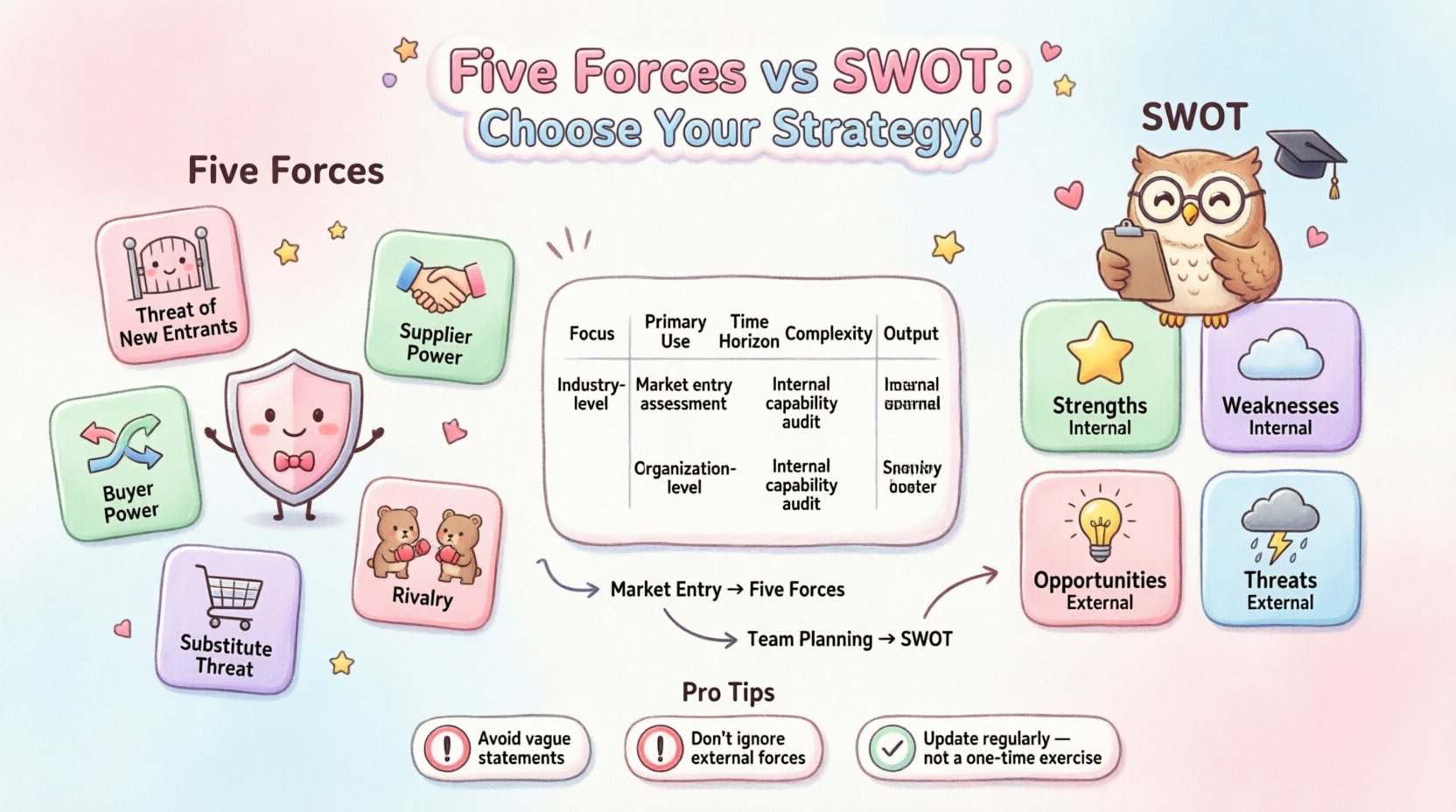
Understanding Porter’s Five Forces Analysis 🛡️
Developed by Michael Porter in 1979, the Five Forces Analysis is designed to evaluate the competitive intensity and attractiveness of a market. It moves beyond simple competitor identification to assess the underlying economic forces that determine profitability.
For a startup, understanding these forces is critical before entering a market. It helps determine if the industry structure allows for sustainable margins or if the environment is too hostile.
The Five Forces Defined
To conduct a robust analysis, you must examine each of the following elements:
- Threat of New Entrants: How easy is it for competitors to enter the market? High barriers (capital, regulation, technology) reduce this threat. Low barriers mean you must be ready for rapid imitation.
- Bargaining Power of Suppliers: Do suppliers have leverage to raise prices or reduce quality? If you rely on a single vendor for a critical component, your risk increases significantly.
- Bargaining Power of Buyers: Can customers easily switch to alternatives? If your customers are large corporations or there are many substitutes, they hold the power to demand lower prices.
- Threat of Substitute Products or Services: Are there different products that solve the same problem? For example, a video conferencing app faces a substitute threat from in-person meetings.
- Rivalry Among Existing Competitors: How fierce is the competition? High rivalry leads to price wars and increased marketing spend, which can erode startup margins quickly.
Why This Matters for Startups
Startups often focus heavily on their product. However, a great product in a terrible industry structure will struggle. This framework forces founders to look outward at the ecosystem rather than inward at the solution.
Consider a SaaS company entering the crowded project management space. The rivalry is high, and switching costs for buyers are low. This analysis signals that differentiation must be extreme, or the market is not viable.
The Basics of SWOT Analysis 📊
SWOT stands for Strengths, Weaknesses, Opportunities, and Threats. Unlike Five Forces, which is almost exclusively external and industry-focused, SWOT blends internal capabilities with external conditions.
It is a versatile tool used for broad strategic planning, marketing campaigns, and operational reviews.
The Four Quadrants Explained
- Strengths (Internal): What does your team do better than anyone else? This could be proprietary technology, a strong brand, or low overhead costs.
- Weaknesses (Internal): Where are you lacking? Common examples include limited cash reserves, lack of industry experience, or technical debt.
- Opportunities (External): Market trends that you can exploit. This includes regulatory changes, emerging technologies, or gaps left by competitors.
- Threats (External): External challenges that could cause trouble. This includes economic downturns, new regulations, or aggressive competitor moves.
Why This Matters for Startups
SWOT is excellent for the early stages of a startup when you need to align your team around what you have and what you need. It creates a shared understanding of the company’s current reality.
It is particularly useful when pivoting. If a market trend shifts (Opportunity), does your internal tech stack (Strength) allow you to capitalize, or does it create a blocker (Weakness)?
Core Differences at a Glance 🔄
Choosing the right framework depends on the depth of market insight you require versus the need for internal self-reflection.
| Feature | Five Forces Analysis | SWOT Analysis |
|---|---|---|
| Focus | External industry structure | Internal capabilities + External environment |
| Primary Use | Market entry decisions | Strategic alignment and planning |
| Time Horizon | Medium to Long-term | Short to Medium-term |
| Complexity | High (requires industry data) | Low (requires honest self-assessment) |
| Output | Profitability potential | Strategic options |
When to Deploy Five Forces for Startups 🎯
There are specific scenarios where the granularity of Five Forces is necessary. You should prioritize this framework when making decisions about market entry or expansion.
1. Evaluating Market Viability
Before building a product, validate if the industry supports profit. If the bargaining power of suppliers is too high, your margins will be squeezed regardless of how good your product is.
- Use this when assessing hardware startups dependent on chip availability.
- Use this when entering highly regulated sectors like fintech or healthtech.
2. Assessing Competitive Moats
Five Forces helps identify where a competitive advantage can be built. If the threat of new entrants is low due to high capital requirements, your existing capital becomes a defensive moat.
3. Pricing Strategy Formulation
Understanding buyer power is essential for pricing. If customers have many alternatives, a premium pricing strategy will fail. If they have few alternatives, value-based pricing becomes possible.
When SWOT Takes the Lead 🧭
SWOT is the go-to tool for operational strategy and team alignment. It is less about the market structure and more about your specific position within it.
1. Quarterly Planning Sessions
For regular reviews, SWOT provides a quick snapshot of where the company stands. It helps prioritize tasks based on current internal capacity.
- Review strengths to decide what to double down on.
- Review weaknesses to identify hiring needs or training gaps.
2. Resource Allocation
When cash is tight, you must focus on what you have. SWOT forces you to look at your weaknesses. If you lack engineering capacity, you cannot pursue a complex feature roadmap, regardless of the opportunity.
3. Team Alignment
Onboarding new team members often involves a SWOT review. It helps them understand where the company excels and where it struggles, setting realistic expectations.
Combining Frameworks for Robust Strategy 🔗
Using these frameworks in isolation can lead to blind spots. The most effective strategic approach integrates both.
The Integrated Workflow
- Start with Five Forces: Determine if the industry is attractive. If the rivalry is too high and margins are thin, pause expansion plans.
- Apply SWOT: If the market is viable, assess if your startup has the Strengths to capture value against the Threats identified.
- Identify Opportunities: Look for gaps in the Five Forces structure that your internal Strengths can exploit.
This combined approach ensures you are not just strong internally, but operating in a space where strength matters.
Implementation Steps for Founders 🛠️
Executing these frameworks requires time and discipline. Here is a practical guide to conducting the analysis without external tools.
Step 1: Gather Data
Do not rely on assumptions. Collect data on competitors, pricing, supplier contracts, and customer feedback. For Five Forces, look at annual reports of public competitors. For SWOT, interview your team.
Step 2: Conduct the Workshop
Bring key stakeholders together. Dedicate a full day to the Five Forces and half a day to SWOT. Ensure everyone contributes. Different perspectives reveal blind spots.
- For Five Forces: Ask “Who controls the supply chain?” and “Why do customers stay?”
- For SWOT: Ask “What are we bad at?” and “What is our unfair advantage?”
Step 3: Prioritize Findings
A list of ten points is useless. Rank the forces and factors by impact. Focus on the top three threats and top three strengths.
Step 4: Translate to Action
Turn insights into tasks. If Supplier Power is high, the action item is to diversify vendors. If a Strength is technical speed, the action item is to market speed to customers.
Common Pitfalls to Sidestep ⚠️
Even with the right framework, execution errors can occur. Avoid these common mistakes to ensure your analysis remains actionable.
1. Vague Statements
“We are good at service” is not a strength. “We have a 99.9% uptime guarantee and 2-hour response time” is. Specificity allows for better decision-making.
2. Ignoring the External
SWOT often becomes an internal brag session. Do not ignore the Threats. If the market is shrinking, your internal efficiency means nothing.
3. Static Analysis
These are not one-time exercises. Market conditions change. Revisit Five Forces annually and SWOT quarterly. A new competitor entering the space changes the Rivalry force overnight.
4. Confusing Weaknesses with Opportunities
A weakness is internal. An opportunity is external. Do not list “We need to hire” as a weakness and “We need to hire” as an opportunity. One is a lack of capacity; the other is a chance to expand into a new market.
Real-World Application Scenarios 🌍
To clarify the distinction, consider two hypothetical startup scenarios.
Scenario A: A Food Delivery App
This startup faces high rivalry from established giants. Five Forces analysis reveals high buyer power (switching is easy) and high threat of substitutes (cooking at home). The conclusion might be to niche down to a specific cuisine to reduce rivalry.
Scenario B: A B2B Security Firm
This startup has unique proprietary encryption. SWOT analysis highlights a Strength in technology but a Weakness in sales channels. The strategy focuses on partnering with larger firms to leverage their channels while protecting the tech.
Final Thoughts on Strategic Clarity 🧠
Choosing between Five Forces and SWOT is not about picking a winner. It is about matching the tool to the question.
Ask yourself: Do I need to understand the industry structure? Use Five Forces. Do I need to understand our company’s readiness? Use SWOT.
Strategic clarity comes from consistent application. Avoid the urge to rush. Take the time to gather data, engage your team, and review the findings regularly. By grounding your decisions in these frameworks, you build a startup capable of weathering market shifts and capitalizing on genuine opportunities.
Start with the industry, then assess the team. This dual approach creates a foundation for sustainable growth.