
Strategic planning requires more than intuition; it demands a structured understanding of the competitive landscape. Two of the most enduring frameworks in business strategy come from Michael Porter. While often discussed together, they serve distinct purposes. One examines the attractiveness of an industry, while the other dictates how a firm positions itself within that industry.
This guide provides a detailed comparison between the Five Forces Analysis and Porter’s Generic Strategies. We will explore when to apply each framework, how they complement one another, and the specific nuances that determine their effectiveness in modern business environments. 📊
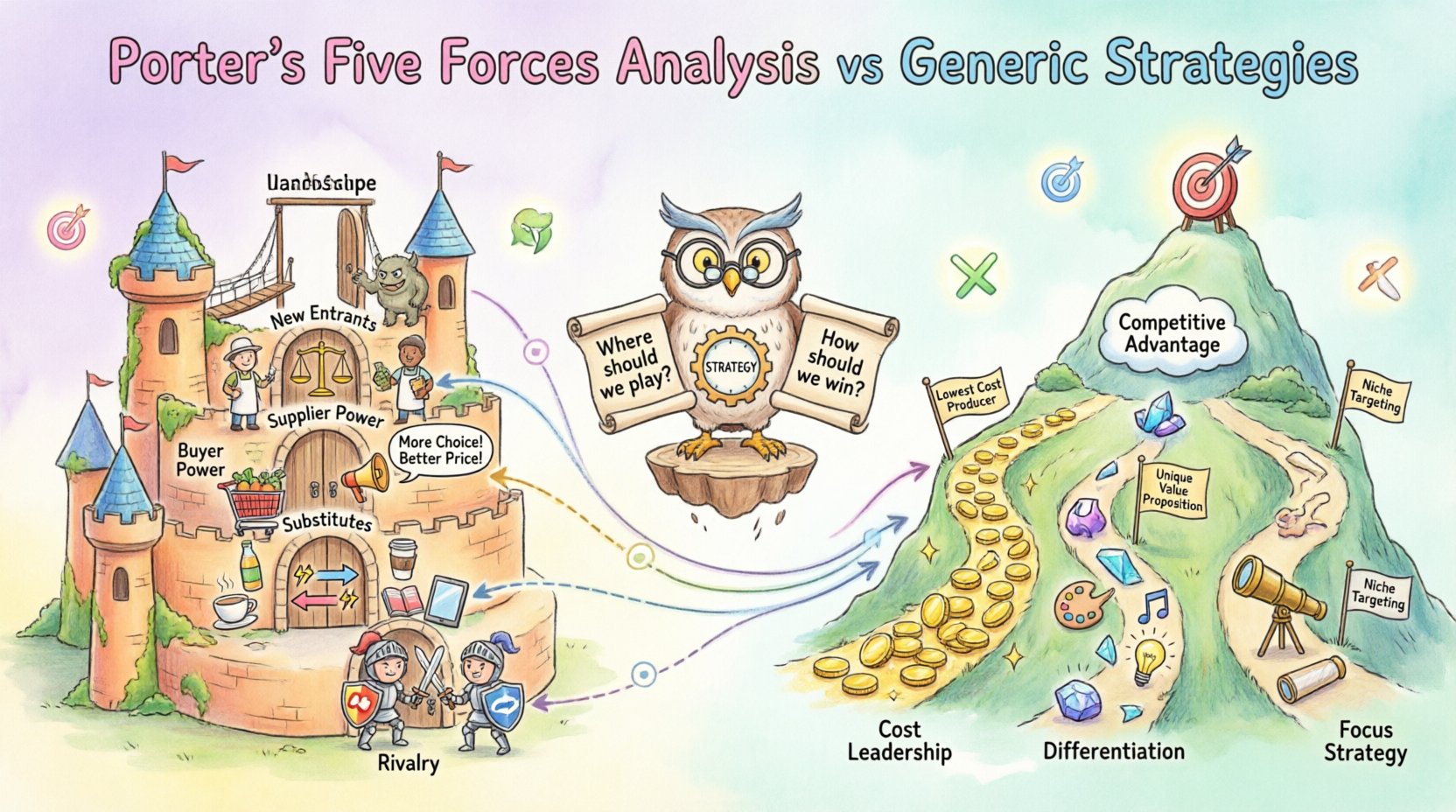
🔍 Understanding the Five Forces Analysis
Porter’s Five Forces is a framework for analyzing the competitive intensity and attractiveness of a market. It helps organizations understand the profit potential of an industry. If the forces are strong, profitability is likely to be low. If they are weak, profitability is higher.
The framework identifies five specific forces that shape every market:
1. Threat of New Entrants 🚪
This force measures how easy it is for new competitors to enter your market. High barriers to entry protect existing companies. Low barriers invite a flood of competition.
- Capital Requirements: Does the industry require massive investment to start?
- Regulatory Hurdles: Are there government licenses or patents required?
- Brand Loyalty: Do customers stick to existing brands, or can they easily switch?
- Access to Distribution: Can new players get their products to shelves or platforms?
2. Bargaining Power of Suppliers 📦
Suppliers can drive up prices if they hold significant leverage. This force analyzes the relationship between the buying company and its input providers.
- Supplier Concentration: Are there few suppliers or many?
- Uniqueness of Product: Is the supplier’s product specialized or commoditized?
- Switching Costs: How expensive is it to change suppliers?
- Threat of Forward Integration: Can the supplier start making the final product themselves?
3. Bargaining Power of Buyers 🛒
Buyers exert pressure by demanding lower prices or higher quality. High buyer power squeezes margins.
- Concentration of Buyers: Are there a few large buyers or many small ones?
- Price Sensitivity: How responsive are customers to price changes?
- Availability of Information: Do customers know exactly what competitors charge?
- Threat of Backward Integration: Can the buyer make the product themselves?
4. Threat of Substitute Products 🔄
Substitutes are products from outside the industry that solve the same problem. They place a ceiling on prices.
- Performance vs. Price: Is the substitute better or cheaper?
- Switching Costs: Is it difficult for customers to change to the substitute?
- Product Differentiation: How unique is the current offering compared to alternatives?
5. Rivalry Among Existing Competitors ⚔️
This is the most visible force. It looks at how fiercely companies fight for market share.
- Number of Competitors: Is the market crowded or consolidated?
- Industry Growth: Are companies fighting for a shrinking pie or a growing one?
- Exit Barriers: How hard is it to leave the industry (e.g., specialized assets)?
- Fixed Costs: Do high fixed costs force price wars to utilize capacity?
🎯 Deep Dive: Porter’s Generic Strategies
Once the industry landscape is mapped using the Five Forces, a company must decide how to compete. Porter’s Generic Strategies outlines three paths to achieving a competitive advantage. A firm must choose one to avoid being “stuck in the middle.”
1. Cost Leadership 💰
The goal is to become the lowest-cost producer in the industry. This allows for lower prices or higher margins.
- Operational Efficiency: Streamlining processes to reduce waste.
- Economies of Scale: Spreading costs over a larger volume of production.
- Access to Raw Materials: Securing cheaper inputs than rivals.
- Technological Advantage: Using proprietary methods to lower labor costs.
Best For: Price-sensitive customers, standardized products, industries where brand loyalty is low.
2. Differentiation 🎨
The goal is to offer something unique that customers value and are willing to pay a premium for. Uniqueness can be in design, technology, customer service, or brand image.
- Innovation: Continuous product development.
- Brand Reputation: Building a strong emotional connection.
- Customer Service: Providing superior support experiences.
- Quality: Ensuring reliability exceeds industry standards.
Best For: Niche markets, customers prioritizing value over price, industries with high R&D potential.
3. Focus Strategy 🔍
This strategy targets a specific niche market segment rather than the whole industry. It can be a Focus Cost or Focus Differentiation approach.
- Geographic Focus: Serving a specific region or country.
- Demographic Focus: Targeting a specific age group or income level.
- Product Focus: Specializing in a specific product line.
- Channel Focus: Selling only through specific retailers or online platforms.
Best For: Small to medium enterprises, specialized industries, high barriers to serving the mass market.
📊 Comparison: When to Use Which Framework
Confusion often arises because both frameworks are strategic tools. The key distinction lies in the scope of the question they answer. Five Forces asks, “Is this industry worth entering?” Generic Strategies asks, “How do we win within this industry?”
| Feature | Five Forces Analysis | Porter’s Generic Strategies |
|---|---|---|
| Primary Focus | Industry Attractiveness | Competitive Positioning |
| Scope | Macro (External Environment) | Meso (Firm Level) |
| Goal | Assess Profit Potential | Define Competitive Advantage |
| Key Question | “Where should we play?” | “How should we win?” |
| Time Horizon | Long-term Industry Trends | Medium-term Operational Tactics |
| Output | Strategic Entry or Exit Decision | Value Proposition Statement |
🔄 Integrating Both Frameworks
Using these frameworks in isolation limits strategic insight. The most robust plans layer them together. Here is how to integrate them effectively.
Step 1: Industry Assessment via Five Forces
Before defining your strategy, validate the environment. If the Five Forces indicate a highly unattractive industry (e.g., high supplier power, low barriers to entry), no Generic Strategy may save the business. You might need to pivot to a different sector entirely.
Step 2: Select the Generic Strategy
Once an attractive industry is identified, choose a positioning. If the industry is commodity-heavy (low differentiation), Cost Leadership is often the only viable path. If the industry relies on innovation, Differentiation is required.
Step 3: Align Internal Capabilities
Ensure your operations support the chosen strategy. A Cost Leader cannot afford expensive R&D for Differentiation without eroding margins. A Differentiator cannot cut costs so aggressively that quality suffers.
Step 4: Monitor the Forces
Strategies are not static. Five Forces change over time. For example, technology can lower barriers to entry, threatening a Cost Leader. Regularly re-evaluate the industry landscape to ensure your Generic Strategy remains valid.
⚠️ Limitations and Modern Context
While these frameworks are foundational, they are not perfect. Understanding their limitations prevents strategic blind spots.
1. Static Nature
Porter’s models are snapshots. They analyze the status quo. In fast-moving sectors, by the time an analysis is complete, the market conditions may have shifted. Continuous monitoring is essential.
2. Industry Definition Boundaries
Defining the “industry” can be difficult. Is a streaming service in the same industry as a cable company? Is a ride-share app in the same industry as a taxi? Ambiguous boundaries lead to inaccurate Force assessments.
3. The “Stuck in the Middle” Myth
While Porter warns against being stuck in the middle, modern businesses sometimes succeed by combining strategies (e.g., offering customization at a moderate price). Rigid adherence to one path can limit innovation.
4. Ignores Internal Resources
Five Forces looks outward. Generic Strategies look outwardly at positioning but must be grounded in internal resources. A company cannot pursue Differentiation if it lacks the talent or technology to deliver it.
5. Digital Disruption
In the digital economy, network effects and platform dynamics often outweigh traditional forces. A company with high switching costs might be rendered obsolete by a free, network-based alternative that Five Forces might not initially flag as a strong substitute threat.
🛠️ Implementation Steps (Manual Approach)
You do not need expensive software to apply these frameworks. A disciplined, manual process yields high value.
Phase 1: Data Collection
- Identify Competitors: List direct and indirect rivals.
- Gather Financial Data: Review public reports, earnings calls, and industry publications.
- Customer Feedback: Collect reviews and surveys to understand buyer power and satisfaction.
- Supplier Contracts: Analyze pricing trends and contract terms.
Phase 2: Scoring the Forces
- Rate Each Force: Assign a High, Medium, or Low rating to each of the five forces.
- Document Evidence: Write down the specific data points that support each rating.
- Visualize: Create a chart or diagram to see the aggregate pressure on the industry.
Phase 3: Strategy Formulation
- Brainstorm Options: Based on the Force analysis, list possible Generic Strategies.
- Stress Test: Ask, “If a competitor copies this strategy, can we defend our position?”
- Resource Check: Do we have the capital, people, and time to execute this?
Phase 4: Execution and Review
- Set KPIs: Define metrics to track progress (e.g., market share, margin, customer retention).
- Quarterly Reviews: Re-assess the Five Forces annually to catch shifts early.
- Adapt: Be willing to pivot if the industry landscape changes fundamentally.
❓ Frequently Asked Questions
Can I use these frameworks for non-profit organizations?
Yes. While originally designed for business, the logic applies to non-profits. “Buyers” become donors or beneficiaries. “Suppliers” become grant providers or partners. “Rivalry” becomes competition for funding or attention.
What is the difference between SWOT and Five Forces?
SWOT is a broader, more general tool that includes internal Strengths and Weaknesses. Five Forces is exclusively external and focuses specifically on industry structure. Use Five Forces to understand the market, and SWOT to assess your specific position within it.
How often should I re-run a Five Forces Analysis?
For stable industries, once every 1 to 2 years is sufficient. For volatile sectors like technology or media, quarterly reviews may be necessary to stay ahead of shifts.
Is it possible to have a Hybrid Strategy?
Traditionally, Porter argued against this. However, modern success often requires flexibility. A company might use Cost Leadership for entry-level products and Differentiation for premium tiers. The key is ensuring the core operational model supports the primary value proposition.
What if the Five Forces suggest an unattractive industry?
This is a critical signal. It suggests that profitability will be low regardless of performance. You might consider exiting the market, acquiring a competitor to consolidate power, or diversifying into a more attractive sector.
🏁 Final Thoughts on Strategic Alignment
Strategic management is about making choices. The Five Forces Analysis helps you choose the right battlefield. Porter’s Generic Strategies help you choose the right weapon. Neither is effective without the other.
By rigorously applying these frameworks, organizations can move beyond guesswork. They gain clarity on where the value lies and how to capture it. The goal is not just survival, but sustained competitive advantage in a changing world. 🚀