
Strategic governance requires a clear understanding of the competitive landscape. As markets shift and disruption accelerates, board members must move beyond internal metrics to assess external pressures. The Porter’s Five Forces framework offers a structured approach to evaluate industry attractiveness and competitive intensity. This tutorial provides a practical exercise designed to facilitate a rigorous discussion during your upcoming strategic planning session.
This guide walks through the mechanics of the analysis, how to gather necessary data without external tools, and how to present findings effectively to stakeholders. By the end of this exercise, the committee will have a calibrated view of the micro-environment risks and opportunities.
Understanding the Framework 🧩
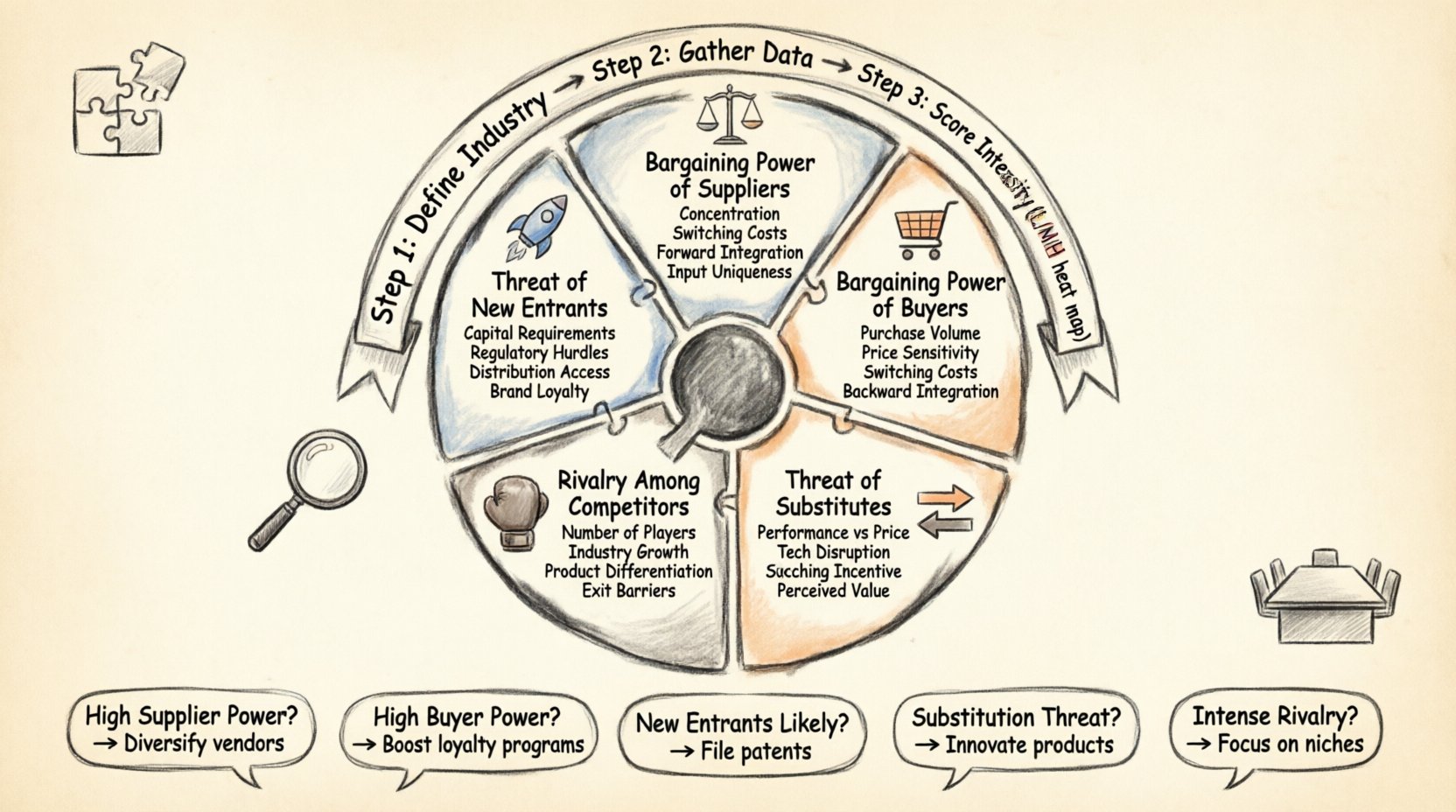
Developed by Michael Porter in 1979, this model identifies five key forces that determine the profit potential and intensity of competition within an industry. It moves the conversation from simple revenue growth to structural viability. The framework is not merely a checklist; it is a diagnostic tool for long-term sustainability.
When applied correctly, the analysis reveals where value is being captured and where it is being eroded. It helps answer critical questions regarding margin protection, pricing power, and market entry barriers.
The Five Forces Defined 🔍
Each force represents a specific type of pressure. To conduct a robust analysis, you must evaluate each force independently before synthesizing the findings.
- Threat of New Entrants: How easy is it for competitors to enter your market? High barriers protect margins; low barriers invite price wars.
- Bargaining Power of Suppliers: Can suppliers raise prices or reduce quality? Concentrated supply chains create vulnerability.
- Bargaining Power of Buyers: Can customers force prices down? High power leads to margin compression.
- Threat of Substitute Products: Are there alternative solutions outside the industry? Substitutes cap pricing potential.
- Rivalry Among Existing Competitors: How intense is the current competition? High rivalry often leads to reduced profitability.
Conducting the Practical Exercise 📝
Executing this analysis requires preparation and collaboration. It is not a solitary task for the strategy team but a collective exercise for the leadership group. Follow this step-by-step protocol to ensure data-driven outcomes.
Step 1: Define the Industry Boundary
Clarity on scope is essential. The analysis will vary significantly depending on whether the industry is defined by geography, product category, or customer segment. A broad definition may dilute insights, while a narrow one may miss cross-industry threats.
- Identify the core value proposition of the organization.
- List all direct competitors offering the same core function.
- Identify indirect competitors solving the same problem differently.
Step 2: Gather Qualitative and Quantitative Data
Data collection should precede the meeting. Rely on internal knowledge, public filings, industry reports, and customer feedback. Avoid relying on anecdotal evidence alone.
- Supplier Data: Review procurement logs for concentration ratios.
- Customer Data: Analyze churn rates and price sensitivity surveys.
- Competitor Intelligence: Review public announcements, patent filings, and hiring trends.
Step 3: Assess Intensity Levels
Score each force on a scale of Low, Medium, or High. This scoring should be done during a facilitated session to encourage debate and diverse perspectives.
| Force | Key Indicator | Score (L/M/H) | Rationale |
|---|---|---|---|
| Threat of New Entrants | Capital Requirements | … | |
| Bargaining Power of Suppliers | Number of Available Suppliers | … | |
| Bargaining Power of Buyers | Switching Costs | … | |
| Threat of Substitutes | Price-Performance Ratio | … | |
| Rivalry Among Competitors | Industry Growth Rate | … |
Detailed Analysis of Each Force 📊
Understanding the nuance behind each force allows for more accurate strategic planning. Below is a deep dive into what to look for during the assessment.
1. Threat of New Entrants 🚀
This force examines the likelihood of new competitors entering the market. High barriers protect existing players, while low barriers invite disruption.
- Capital Requirements: High initial investment deters entry. Low investment allows rapid scaling by agile startups.
- Regulatory Hurdles: Licenses, patents, and compliance standards can block access.
- Access to Distribution: If channels are controlled by incumbents, new players struggle to reach customers.
- Brand Loyalty: Established trust reduces the incentive for customers to try new brands.
2. Bargaining Power of Suppliers ⚖️
Suppliers exert power when they can dictate price or terms. This force is critical for supply chain resilience.
- Concentration: A single supplier or oligopoly increases risk.
- Switching Costs: If changing vendors requires retooling or retraining, the supplier holds leverage.
- Threat of Forward Integration: Can the supplier enter your market directly?
- Input Uniqueness: Are there proprietary materials or specialized skills required?
3. Bargaining Power of Buyers 🛒
Buyers exert power when they can demand lower prices or higher quality. This often dictates pricing strategy.
- Volume of Purchases: Large buyers command better terms due to their volume.
- Price Sensitivity: If the product is a commodity, buyers will choose the lowest price.
- Switching Costs: If customers can easily move to a competitor, pricing power is low.
- Threat of Backward Integration: Can the customer produce the product themselves?
4. Threat of Substitute Products 🔀
Substitutes are products from outside the industry that solve the same problem. They set the ceiling on prices.
- Performance vs. Price: If a substitute offers better performance at a similar price, demand shifts.
- Technological Disruption: New technologies often render old solutions obsolete.
- Switching Incentive: How much effort does the customer need to make to switch?
- Perceived Value: Does the customer view the substitute as a viable alternative?
5. Rivalry Among Existing Competitors 🥊
This force measures the intensity of competition among current players. It is often the most visible force.
- Number of Competitors: Many small players lead to fragmentation; few large players lead to oligopoly.
- Industry Growth: Slow growth forces companies to fight for market share.
- Product Differentiation: Commodity products lead to price wars; differentiated products allow premium pricing.
- Exit Barriers: High fixed costs make it difficult to leave the industry, leading to overcapacity.
Presenting Findings to the Board 🏛️
Once the analysis is complete, the data must be translated into actionable insights for the board. The goal is not to present a chart, but to drive a decision.
Visualizing the Competitive Landscape
Avoid cluttered dashboards. Use clear, high-contrast visuals to highlight risk areas. Focus on the forces that have shifted significantly since the last review.
- Use heat maps to indicate intensity levels.
- Highlight trends over time rather than static snapshots.
- Connect external forces to internal financial projections.
Strategic Implications
Every force assessment should lead to a strategic recommendation. The board needs to know what to do with the information.
- If Supplier Power is High: Consider vertical integration or diversifying the vendor base.
- If Buyer Power is High: Invest in customer loyalty programs or increase switching costs.
- If New Entrants are Likely: Accelerate patent filings or increase brand investment.
- If Substitution is Threatening: Innovate the product offering or expand into adjacent markets.
- If Rivalry is Intense: Focus on operational efficiency or niche segmentation.
Common Pitfalls to Avoid ⚠️
Even experienced strategists can misapply this framework. Awareness of common errors ensures the analysis remains accurate.
- Ignoring Substitutes: Often, the biggest threat comes from outside the industry, not direct competitors.
- Static Analysis: The landscape changes rapidly. This exercise must be repeated regularly.
- Over-reliance on History: Past performance does not guarantee future stability in dynamic markets.
- Ignoring Macro Factors: While this is a micro-environment model, macro trends influence the forces.
- Subjective Bias: Ensure the scoring is based on evidence, not optimism or pessimism.
Integrating with Other Strategic Tools 🧠
Porter’s Five Forces works best when combined with other frameworks. This creates a holistic view of the organization’s position.
SWOT Analysis
Use the Five Forces to populate the “Threats” and “Opportunities” sections of a SWOT analysis. This grounds external analysis in internal capabilities.
PESTLE Analysis
PESTLE covers macro factors (Political, Economic, Social, Technological, Legal, Environmental). These factors often drive the intensity of the Five Forces. For example, a new regulation (Legal) might increase barriers to entry.
Scenario Planning
Use the analysis to build scenarios. If a specific force intensifies (e.g., supplier power doubles), how does that impact the financial model? This stress-testing strengthens resilience.
Establishing a Review Cycle 🔄
A one-time analysis is insufficient for modern governance. Market dynamics evolve, and the competitive landscape shifts. Establish a cadence for review.
- Quarterly Check-ins: Monitor high-risk forces for early warning signs.
- Annual Deep Dive: Conduct a full re-evaluation of all five forces.
- Trigger Events: Re-evaluate immediately following major market disruptions, mergers, or regulatory changes.
Data Sources and Intelligence 📡
Reliable data is the foundation of this exercise. You do not need expensive software to gather intelligence. Focus on credible sources.
- Public Filings: 10-K and 10-Q reports from competitors reveal strategic priorities and financial health.
- Industry Associations: Reports often contain aggregated market data and trends.
- Customer Interviews: Direct feedback reveals switching costs and satisfaction levels.
- Patent Databases: Tracking R&D investments indicates future competitive threats.
- Job Postings: Hiring trends can signal expansion into new markets or technologies.
Final Considerations 🌟
Implementing this analysis requires discipline and objectivity. The board must remain willing to confront uncomfortable truths about the competitive environment. Success is not defined by the complexity of the model, but by the clarity of the strategic decisions it informs.
By regularly engaging with the Five Forces, leadership teams maintain a vigilant stance against market erosion. This proactive approach ensures that the organization adapts to change rather than reacting to it. The exercise transforms raw data into strategic foresight, enabling sustainable growth and value creation.
Prepare your team for the next board meeting with this structured approach. Ensure that every participant understands the methodology and the criteria for evaluation. When the analysis is rigorous, the resulting strategy is robust.