
Building a company from the ground up requires more than just a great idea. It requires a rigorous understanding of the market landscape. For co-founders, aligning on strategy is as critical as the product itself. One of the most reliable frameworks for assessing market viability is Porter’s Five Forces Analysis. This tool provides a structured way to evaluate the competitive environment, helping teams identify risks before they become fatal flaws.
This guide walks through the mechanics of the analysis, specifically tailored for the unique dynamics of a founding team. We will explore each force in depth, discuss how to gather the necessary data, and outline how to use these insights to shape your business model. There are no shortcuts here, only clear-eyed assessment.
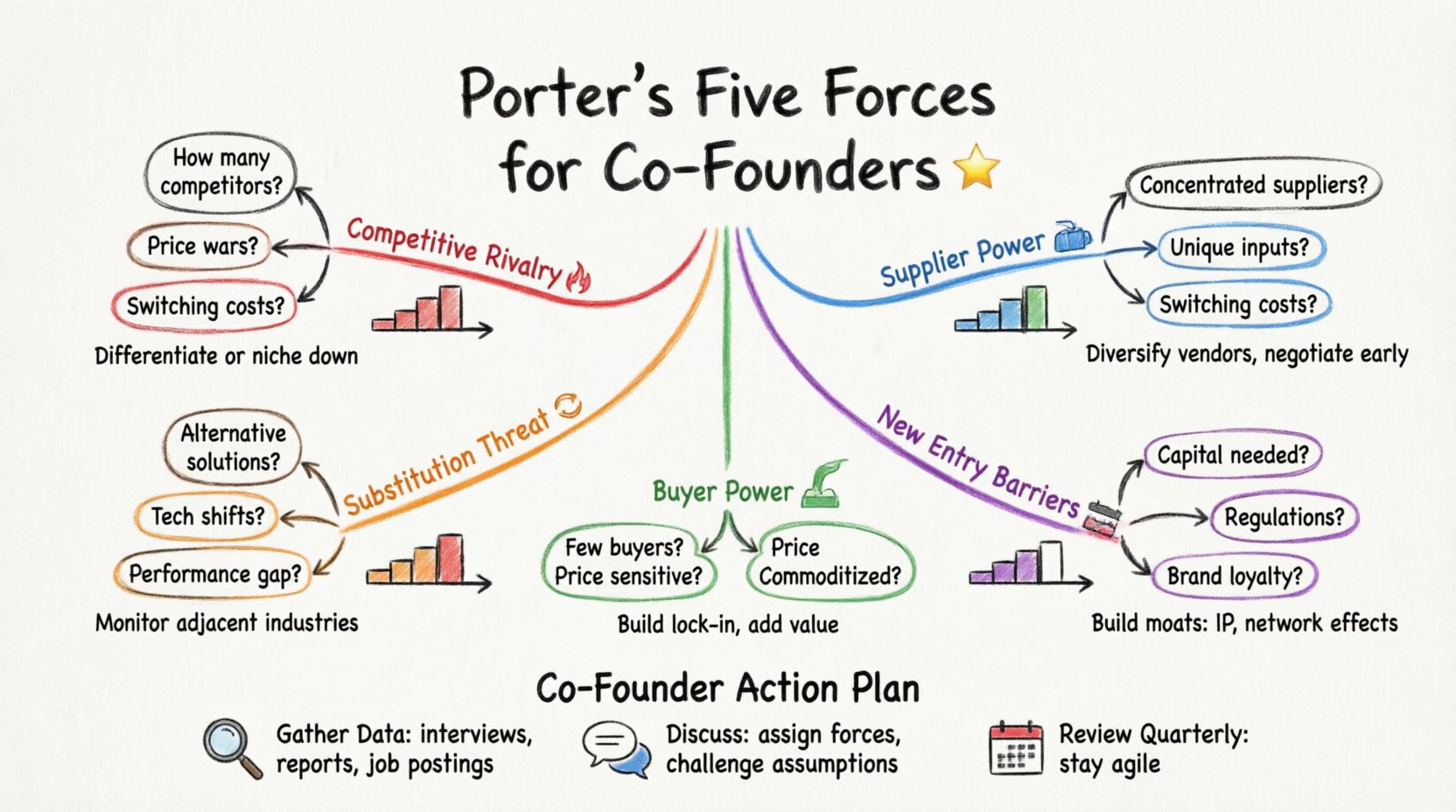
Understanding the Framework 📊
Porter’s Five Forces was introduced by Michael Porter in 1979. It focuses on the intensity of competition and the profit potential of an industry. Unlike market sizing, which looks at total revenue, this framework looks at the structural forces that determine profitability.
For co-founders, this analysis serves two main purposes:
Validation: Does the market structure support a sustainable business?
Risk Mitigation: Where are the pressure points that could erode margins?
The framework consists of five distinct forces. Each represents a different source of pressure on your business model. Understanding them allows you to position your company to withstand these pressures or capitalize on gaps in the market.
Force 1: Competitive Rivalry 🔥
This force examines the intensity of competition among existing players. In a crowded market, rivalry drives down prices and increases marketing costs. For a startup, high rivalry often means a longer path to profitability.
Key Questions to Ask
How many direct competitors are currently active?
What is the rate of growth in this specific market segment?
Are competitors price-aggressive or focused on differentiation?
How high are the switching costs for customers?
Implications for Co-Founders
When rivalry is high, co-founders must agree on a clear differentiation strategy. If you both believe the market is saturated, you might pivot to a niche segment. If you believe the market is fragmented, you might focus on consolidation.
Strategic Considerations:
Brand Positioning: Can you own a specific category in the minds of customers?
Cost Structure: Can you operate more efficiently than incumbents?
Innovation: Is the product superior enough to justify a premium?
If your analysis shows intense rivalry with low barriers to entry, you may face a race to the bottom. Co-founders need to discuss whether the potential return justifies the effort required to defend market share.
Force 2: Supplier Power 🏭
Supplier power refers to the ability of providers to raise prices or reduce the quality of goods and services. In early-stage ventures, supplier power can be a silent killer of margins.
Key Questions to Ask
How concentrated is the supplier base?
Are there unique inputs that are difficult to replicate?
What are the costs of switching to a different supplier?
Can suppliers integrate forward into the business?
Implications for Co-Founders
Different founders often have different risk tolerances regarding supply chains. One might prefer vertical integration, while another prefers outsourcing. This analysis clarifies where control is necessary.
Strategic Considerations:
Diversification: Relying on a single vendor is a critical single point of failure.
Contract Terms: Negotiate long-term agreements early to lock in rates.
Alternative Sourcing: Invest time in identifying backup options before you need them.
If suppliers hold significant power, your margins are at their mercy. Co-founders must decide how much operational control is worth the cost of building internal capabilities versus paying a premium for flexibility.
Force 3: Buyer Power 💰
Buyer power is the influence customers have on the price and terms of the product. If buyers are powerful, they can demand lower prices or higher quality, squeezing your profitability.
Key Questions to Ask
How many buyers exist relative to sellers?
How large are the individual orders?
How sensitive are customers to price changes?
Is the product commoditized or unique?
Implications for Co-Founders
High buyer power often leads to price wars. Co-founders need to align on whether the business model relies on volume or high margins. If customers can easily compare prices, you must build value beyond the transaction.
Strategic Considerations:
Customer Lock-in: Create ecosystems where leaving is difficult or costly.
Value Addition: Offer services or support that competitors do not.
Segmentation: Target customers who are less price-sensitive.
Understanding buyer power helps determine pricing strategy. If buyers are weak, you have more room to experiment with pricing models. If they are strong, you must focus on efficiency and cost leadership.
Force 4: Substitution Threat 🔄
Substitute products are not direct competitors but fulfill the same need in a different way. A classic example is video conferencing replacing business travel. This force is often overlooked by founders focused on direct competitors.
Key Questions to Ask
Are there alternative ways to solve the customer problem?
How much more expensive are the substitutes?
How much more difficult are the substitutes to use?
Is the performance gap closing over time?
Implications for Co-Founders
This force requires a broad view of the market. Co-founders might get tunnel vision focusing on direct rivals while missing a technological shift that renders the entire category obsolete.
Strategic Considerations:
Continuous Monitoring: Keep an eye on adjacent industries for disruptive technologies.
Adaptability: Build the team to pivot if the primary solution becomes obsolete.
Education: Teach customers why your solution is superior to the alternative.
Ignoring substitutes is a common cause of failure. The analysis forces you to look outward, ensuring your solution remains relevant even if the technology landscape shifts.
Force 5: New Entry Barriers 🚧
This force assesses how easy it is for new competitors to enter the market. High barriers protect existing players. Low barriers invite a flood of competition, which drives down profits.
Key Questions to Ask
What is the capital requirement to start?
Are there regulatory hurdles or licenses needed?
Is there significant brand loyalty to overcome?
Are there economies of scale in place?
Implications for Co-Founders
If barriers are low, you must build your own moat quickly. This could mean building a network effect, securing exclusive partnerships, or accumulating proprietary data. Co-founders must agree on where to invest capital to create these barriers.
Strategic Considerations:
Speed to Market: Be the first to establish a foothold.
Intellectual Property: Protect core innovations where possible.
Relationship Building: Secure key partners before others can.
High barriers to entry are a blessing for incumbents but a challenge for startups. If you are the entrant, you must find a way to lower your own costs or increase your perceived value to justify the risk.
Summary of Forces 📋
Force | Primary Question | Impact on Margin |
|---|---|---|
Competitive Rivalry | How aggressive are existing players? | High if saturation is high |
Supplier Power | Can vendors dictate terms? | High if inputs are scarce |
Buyer Power | Can customers force price cuts? | High if switching costs are low |
Substitution Threat | Are there better alternatives? | High if technology shifts |
New Entry Barriers | How easy is it for others to join? | High if entry is cheap |
Applying the Analysis as Co-Founders 🤝
Conducting this analysis is not a solitary task. It is a collaborative exercise that tests the alignment of the founding team. Disagreements on the assessment of these forces often reveal deeper differences in vision.
Data Gathering Without Tools
You do not need expensive software to perform this analysis. Reliance on manual research ensures a deeper understanding of the nuances.
Public Records: Review annual reports of public competitors to understand their cost structures.
Customer Interviews: Speak directly to potential buyers about their pain points and alternatives.
Supplier Conversations: Talk to vendors to understand their pricing models and constraints.
Industry Reports: Read white papers and trade publications for market trends.
Job Postings: Analyze competitor hiring to understand their strategic priorities.
Facilitating the Discussion
When reviewing the findings together, use a structured approach to avoid conflict.
Define the Scope: Agree on what market and segment you are analyzing.
Assign Responsibility: Each founder takes ownership of researching specific forces.
Share Findings: Present the data objectively without bias.
Challenge Assumptions: Ask “Why” until you reach the root cause of a conclusion.
Document Decisions: Record the agreed-upon strategy to prevent future drift.
Common Pitfalls to Avoid ⚠️
Even with a solid framework, errors in execution can lead to flawed conclusions. Be aware of these common mistakes.
Confirmation Bias: Only looking for data that supports your initial idea.
Narrow Scope: Ignoring adjacent markets that could disrupt you.
Static Analysis: Treating the market as frozen in time rather than dynamic.
Ignoring Micro-Forces: Focusing on the big picture while missing local nuances.
Overconfidence: Assuming your team is the exception to the market rules.
Integrating Findings into Strategy 🗺️
The output of this analysis should directly inform your business plan and operational roadmap.
Product Development
If substitution threat is high, focus on features that are hard to replicate. If buyer power is high, invest in customer success to increase retention.
Go-to-Market
If rivalry is intense, consider a niche marketing approach rather than broad awareness campaigns. If barriers are low, prioritize speed of execution.
Financial Planning
Use the supplier and buyer analysis to model your unit economics accurately. Do not assume you can negotiate better terms than the industry average without proof.
Maintaining Strategic Agility 🔄
A Five Forces Analysis is not a one-time event. Market conditions change, new technologies emerge, and competitor strategies evolve. You must treat this as a living document.
Quarterly Reviews: Revisit the analysis every three months to check for shifts.
Trigger Events: Update immediately if a major competitor launches a product or if regulations change.
Feedback Loops: Use customer feedback to validate your assumptions about buyer power.
Final Thoughts on Strategic Clarity 🌟
The goal of this exercise is not to predict the future with certainty. It is to reduce uncertainty and prepare your team for various scenarios. By understanding the structural forces at play, co-founders can make decisions based on reality rather than hope.
When both founders agree on the market reality, execution becomes smoother. Resources are allocated efficiently, and risks are managed proactively. This shared understanding is a foundation for long-term partnership and business success.
Start the analysis today. Gather the data, have the difficult conversations, and build a strategy that withstands the pressure of the market. Your venture will be stronger for the preparation.