
Strategic planning is not a one-time event; it is a continuous discipline. For early-stage founders and scaling executives, understanding the competitive landscape is critical for survival and growth. The Porter’s Five Forces framework remains a cornerstone of industry analysis, yet many organizations apply it incorrectly. Successful founders treat this model not as a static report, but as a living diagnostic tool. This guide explores how to leverage these forces effectively without falling into common analytical traps.
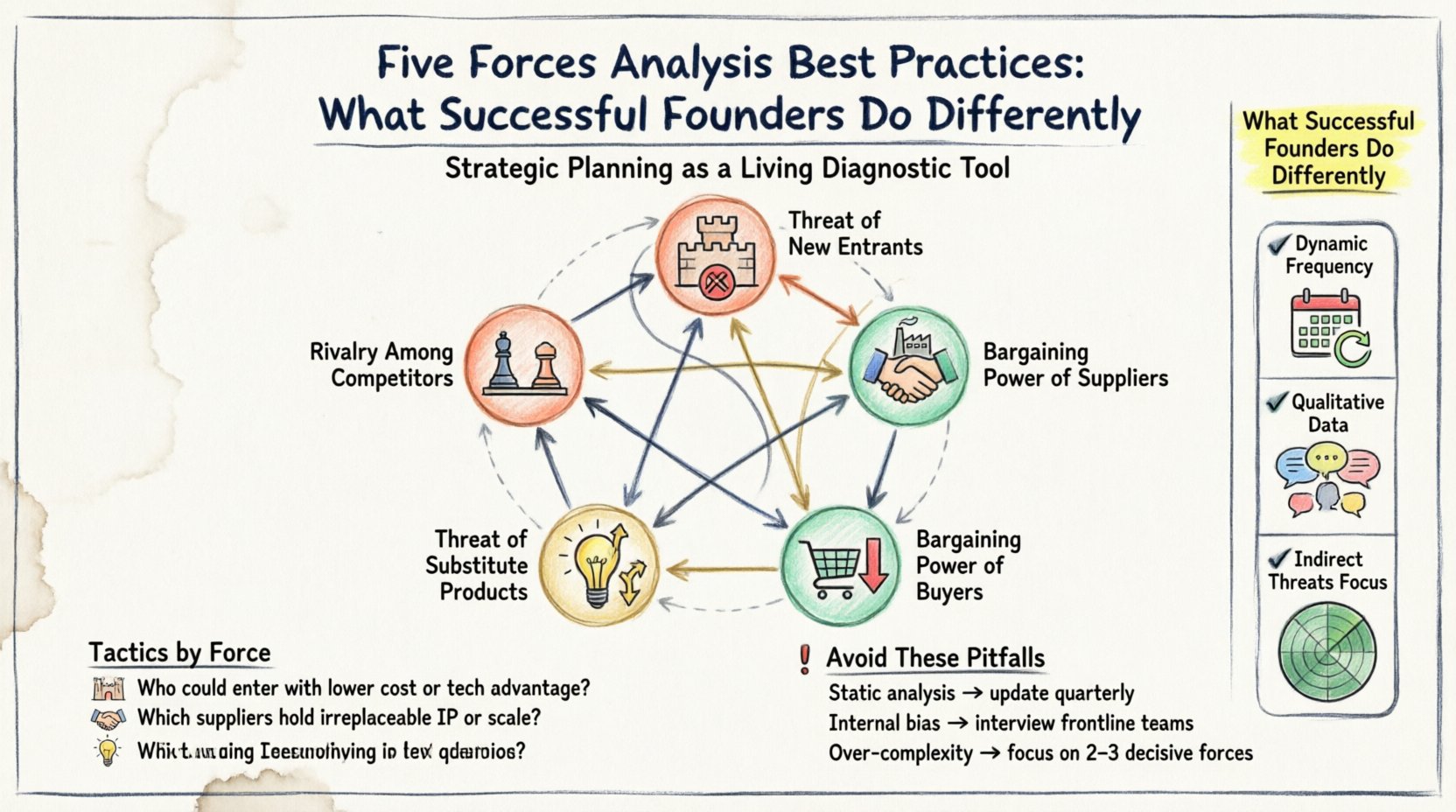
🔍 The Core Framework Revisited
Before diving into advanced tactics, it is essential to ground the analysis in the five fundamental components. These forces determine the profitability and attractiveness of an industry. They dictate where power lies within a market and how value is distributed.
- Threat of New Entrants: How easy is it for competitors to enter the market?
- Bargaining Power of Suppliers: Can suppliers dictate terms and prices?
- Bargaining Power of Buyers: Can customers drive prices down?
- Threat of Substitute Products: Are there alternative solutions outside your direct category?
- Rivalry Among Existing Competitors: How intense is the competition for market share?
Most standard analyses treat these forces as isolated silos. A superior approach recognizes the interconnectivity between them. For instance, high supplier power often exacerbates rivalry among existing competitors as everyone fights for the same raw materials. Founders who understand these dynamics can anticipate shifts before they impact the bottom line.
🏆 What Successful Founders Do Differently
There is a distinct gap between a textbook application of the Five Forces and a practical, founder-led strategy. The difference lies in execution, frequency, and the depth of data interrogation. Here are the specific behaviors that separate high-performing teams from the rest.
1. Dynamic Frequency Over Annual Reviews
Traditional business planning often schedules comprehensive market analysis once a year. In a rapidly evolving startup environment, this is insufficient. Market conditions shift quarterly, sometimes monthly. Successful founders update their Five Forces assessment continuously.
- Monitor Regulatory Changes: New laws can instantly alter the threat of new entrants.
- Track Technology Shifts: A new technology can make existing barriers obsolete overnight.
- Review Customer Sentiment: Buyer power changes with economic cycles and sentiment.
By keeping a pulse on these variables, teams can pivot their strategy before a crisis occurs rather than reacting after damage is done.
2. Qualitative Data Over Generic Reports
Publicly available industry reports often lag behind reality. They provide historical data, not current sentiment. Founders prioritize direct engagement with the market ecosystem.
- Customer Interviews: Ask buyers directly what alternatives they considered.
- Supplier Conversations: Understand their capacity constraints and pricing models.
- Competitor Listening: Analyze job postings to understand competitor priorities and resource allocation.
This first-party intelligence offers a level of granularity that third-party data simply cannot match. It allows for the identification of subtle power shifts that precede major market moves.
3. Focus on Indirect Threats
Many analyses focus heavily on direct competitors. However, the greatest threat often comes from substitutes. Successful founders cast a wider net to identify non-obvious competitors.
- Alternative Solutions: If you sell a productivity tool, is the substitute Excel or a new AI workflow?
- Changing Behaviors: Are customers shifting how they solve the problem entirely?
- Innovation Creep: Is a tech giant slowly encroaching on your core value proposition?
Ignoring indirect threats leads to a false sense of security. A founder who acknowledges that their product competes with a customer’s time or a different category of tool is better prepared for disruption.
🛠️ Deep Dive: Tactics for Each Force
To apply this framework effectively, one must move beyond definitions into specific tactical actions. Below is a breakdown of how to analyze each force with precision.
Threat of New Entrants
Barriers to entry are the primary defense against new competitors. Founders must assess the height of these walls.
- Capital Requirements: Does the business require significant upfront investment to start?
- Regulatory Hurdles: Are there licenses or certifications required that slow down entrants?
- Network Effects: Does the product become more valuable as more people use it?
- Switching Costs: How difficult is it for a customer to move to a new provider?
A founder should actively work to increase these barriers through brand building, proprietary technology, or exclusive partnerships. However, one must also remain aware of how technology can lower these barriers over time.
Bargaining Power of Suppliers
Supplier power threatens margins. If you rely on a single source for a critical component, your leverage is low.
- Supplier Concentration: How many vendors can provide this input?
- Unique Inputs: Is the supply specialized or commoditized?
- Forward Integration: Could the supplier decide to compete with you?
Mitigation strategies include diversifying the supply chain, negotiating long-term contracts, or developing in-house capabilities to reduce dependency. The goal is to maintain flexibility in negotiations.
Bargaining Power of Buyers
Buyer power determines pricing flexibility. When buyers have many options, they drive prices down.
- Price Sensitivity: Is the product a commodity or a differentiated solution?
- Volume: Do buyers purchase in large quantities relative to the market?
- Information Access: Do buyers know the market price better than you do?
Founders can reduce buyer power by increasing switching costs, enhancing brand loyalty, or creating unique value propositions that are hard to replicate. Differentiation is the key antidote to price wars.
Threat of Substitute Products
Substitutes address the same need but through a different means. This force is often underestimated.
- Performance vs. Price: Do substitutes offer a better price-to-performance ratio?
- Convenience: Are substitutes easier or faster to use?
- Adoption Rates: How quickly are customers moving to the alternative?
Monitoring substitute trends requires looking outside your industry. If you are in transportation, your substitute might be remote work software. If you are in food, it might be meal kits or convenience stores.
Rivalry Among Existing Competitors
This force measures the intensity of competition within the industry.
- Number of Competitors: Is the market fragmented or consolidated?
- Growth Rate: Is the market growing slowly, forcing a fight for share?
- Exit Barriers: Is it expensive or difficult to leave the market?
High rivalry leads to price wars and increased marketing spend. Founders should aim for niches where rivalry is lower or where they can differentiate sufficiently to escape the price battle.
📊 Structuring Your Findings
To make this analysis actionable, it must be structured clearly. The following table provides a template for organizing your insights and corresponding strategic actions.
| Force | Key Diagnostic Question | Data Point to Track | Strategic Action |
|---|---|---|---|
| New Entrants | What barriers exist today? | Time to market for competitors | Build IP or exclusive partnerships |
| Supplier Power | How many sources exist? | Supplier concentration ratio | Diversify vendors or integrate vertically |
| Buyer Power | How easy is it to switch? | Customer churn rate | Increase switching costs or loyalty |
| Substitutes | What solves this need differently? | Adoption of alternative tools | Monitor tech trends and innovate |
| Rivalry | How aggressive is pricing? | Competitor marketing spend | Focus on differentiation, not price |
⚠️ Common Pitfalls to Avoid
Even with the best intentions, analysis can go wrong. Recognizing these traps helps maintain the integrity of your strategy.
- Static Analysis: Treating the market as a snapshot in time rather than a moving target. Markets evolve, and so must the analysis.
- Internal Bias: Relying too heavily on internal data while ignoring external signals. This leads to an echo chamber effect.
- Over-Complexity: Trying to measure every variable. Focus on the high-impact drivers of profitability.
- Ignoring Macro Trends: Failing to account for economic cycles, demographic shifts, or geopolitical events that influence industry forces.
- Disconnect from Execution: Conducting the analysis but failing to translate insights into product or operational changes.
🔄 Integrating Analysis into Strategy
The value of the Five Forces lies in its application. Once the assessment is complete, the findings must inform decision-making across the organization.
Product Roadmap Alignment
Use the analysis to prioritize features. If buyer power is high, focus on features that increase stickiness. If substitution is high, focus on innovation speed. If supplier power is high, invest in automation to reduce dependency.
Fundraising Narratives
Investors want to see that you understand your competitive landscape. A Five Forces analysis provides the structure to articulate barriers to entry and sustainability. It demonstrates that you are not just reacting to the market, but navigating it with intent.
Mergers and Acquisitions
When evaluating acquisition targets, the forces help assess the long-term viability of the asset. A target with high buyer power and low barriers to entry might not be a safe investment, regardless of current revenue.
🧠 The Founder Mindset
Ultimately, the framework is a tool, not a strategy. The mindset required to use it effectively involves humility and curiosity. Founders must admit when their assumptions about the market are wrong. They must be willing to pivot based on evidence gathered from the forces.
- Stay Curious: Continuously ask why the market is changing.
- Be Agnostic: Do not defend your current position if the data suggests it is under threat.
- Collaborate: Involve teams from sales, product, and engineering in the analysis. Diverse perspectives reveal blind spots.
By treating the Five Forces as a living system of checks and balances, founders can build businesses that are resilient to external shocks. The goal is not to predict the future with certainty, but to prepare for multiple scenarios.
📈 Final Thoughts on Execution
Strategic clarity comes from disciplined analysis. The Five Forces model offers a structured way to understand the economics of your business. However, the difference between success and failure often lies in the rigor of the execution.
- Update the analysis regularly to reflect current conditions.
- Focus on qualitative insights that quantitative data misses.
- Translate findings into concrete operational changes.
- Remain vigilant against indirect threats and substitutes.
When applied with depth and frequency, this framework becomes a powerful asset. It helps founders navigate uncertainty with a clearer view of the landscape. Success in business is not about avoiding competition, but understanding the forces that shape it and positioning the company where it can thrive.